
I actually wanted to expand that position further.
But from time to time, I just didn't like it anymore.
What do you think of the industry?

Messaggi
10$ (-1,2%)TYL (-1,2%)
$GE (+0,44%)
$GD (+2,17%)
$CHRW (-3,2%)
$ROL (-1,46%)
$TW (+1,19%)
$CSGP (+0,81%)
$RKT (+2,28%)
$CLX (+1,19%)
$ROST (+1,15%)
$FAST (+2,02%)
$CSCO (-2,13%)
$YUMC (+0,75%)
$KOF (+2,67%)
$ORLY (+1,24%)
$KO (+2,07%)
$RY (+0,41%)
$MDLZ (+1,66%)
$IMBBY (+3%)
$A (-1,54%)
$IDXX (+2,25%)
$SONY (+0%)
$MSCI (-1,21%)
$SYY (-0,18%)
$VLTO WI (-0,09%)
$DPZ (+1,48%)
$IDEX (+2%)
$VRSN (-0,74%)
$COST (+0,73%)
$ITT (-1,45%)
$SHW (-0,68%)
$EPD
$SIE (-1,31%)
$CP (+0,09%)
$CTAS (+0,14%)
$ROG (-0,62%)
$BK (+0,79%)
$CNR (+0,72%)
$PM (+1,8%)
$TSM (-2,13%)
$ITW (+0,23%)
$APD (+0,87%)
$PG (+1,17%)
$AAPL (+0,25%)
$BAC (-0,89%)
$CPB (-0,4%)
$VRSK (+0,59%)
$HSY (+1,1%)
$GWRE (-4,09%)
$HII (+0,88%)
$GSK (+0,71%)
$SBUX (+0,65%)
$ALLE (+0,34%)
$INTU (-1,46%)
$MSI (+0,86%)
$GWW (-0,21%)
$UNP (+0,12%)
$WCN (+1,28%)
$WM (+1,54%)
$NOC (+4,37%)
$CAT (-0,94%)
$PAYX (-0,22%)
$ADP (+0,97%)
$MCO (-0,12%)
$SPGI (+0,53%)
$NDSN (-2,12%)
$WMT (+0,55%)
$OTIS (+1,7%)
$CL (+1,41%)
Best Companies to Own: Methodology
The companies on this list are covered by Morningstar Research Services’ equity analysts and have shares available to US investors. This means that Morningstar equity analysts have calculated fair value estimates for the shares of the companies that trade on US exchanges. As a result, most of the companies on this list are based in the US.
Within that coverage list, the best companies meet the following criteria:
What Gives a Company an Economic Moat?
Companies with moats have one or more of the following characteristics:
To maintain analysts’ independence, Morningstar Research Services does not publicly rate its parent company Morningstar Inc. Therefore, Morningstar, Inc. is not on the list of the best companies available to US investors.
https://www.morningstar.com/stocks/best-companies-own-2026-edition
These are the success factors
These factors are leading to steady growth, which is likely to continue in the future.
Since its IPO in 2020, Otis has increased its turnover from USD 12.76 billion to USD 14.17 billion.
However, what initially appears to be restrained growth momentum has been achieved without a noticeable increase in staffing levels, which has improved the operating margin from just under 13% to over 14%.
At the same time, the number of outstanding Aktien was reduced from 433 million to 402 million.
Boosted by this, earnings have since increased from USD 2.52 to USD 3.83 per share.
Otis is therefore one of the few cases in which "the bride" was not prettied up for the IPO and in which the IPO did not serve to collect vast sums of capital in order to then squander it - quite the opposite.
Immediately after the IPO the IPO, Otis switched to distributing Dividendendistributing capital to shareholders.
Current challenges
The last Quartalszahlen - or rather the outlook - have nevertheless caused the share price to plummet.
At USD 1.05 per share, Q2 earnings were well above analysts' estimates of USD 1.02. With sales of USD 3.60 billion, expectations were met.
For the year as a whole, this corresponds to virtually unchanged sales and earnings.
It is clear to see that the current conditions for new orders are challenging. The economic and geopolitical upheavals of recent months have led to a reluctance to invest in construction projects.
Incoming orders for new elevators and escalators fell by 1% over the year as a whole, mainly due to an 11% slump in China. In the media, the real estate crisis in China has long since ceased to be an issue - in reality, however, the building seems to be on fire.
However, this is where the advantages of the service business become apparent again. In the second quarter, the segment recorded a 6% increase in sales and a 20 basis point rise in the operating margin.
Outlook and valuation
There is also an enormous need for modernization. Orders in this area have risen by 22 % and the order backlog by 19 %.
These modernizations will in turn lead to new service orders.
My concerns are therefore limited when I look at the lowered forecast. The current financial year is just a snapshot and nothing more.
Otis has lowered its sales forecast for the current financial year from USD 14.6-14.8 billion to USD 14.5-14.6 billion and its free cash flow forecast from USD 1.6 billion to USD 1.4-1.5 billion.
However, the earnings forecast was confirmed at USD 4.00-4.10 per share.
Free cash flow should therefore increase slightly and earnings should rise by around 6%. This would be the second weakest financial year since the IPO.
On the other hand, Otis currently has a comparatively low valuation. The forward P/E is 22, which is reasonable in view of all the information available.
Since the IPO, the P/E has averaged 25.6
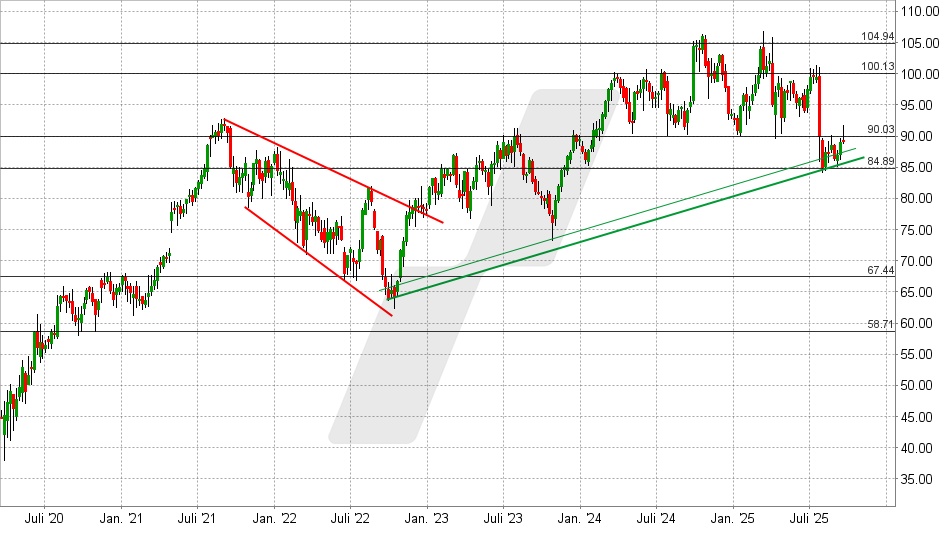
Otis share: Chart from 22.09.2025, price: USD 89.16 - ticker symbol: OTIS | Source: TWS
If Otis now manages to break out above USD 90, a procyclical uptrend will ensue Kaufsignal with possible price targets at USD 95 and USD 100.
If, on the other hand, the share falls below USD 85, the bulls will have lost their chance for the time being.
Source:

I will dissolve my $VICI (+0,12%) position and reinvest in $OTIS (+1,7%) reinvest.
The primary reason for this is that I do not want to be so strongly influenced by the development of interest rates in the future. In other words, I no longer believe that REIts will yield a premium that would justify exposure to these risks.
The second reason is that I want to weed out companies that I bought primarily as "safe" dividend payers. Especially the companies that can offer less shareholder value. I now have a separate portfolio for my high yield stocks.
The last reason is that mMn. OTIS has one of the strongest MOATs of all. In the long term, more and more has to be built and before I replace the elevator or escalator, I have them repaired. They also have to be repaired to maintain safety standards.
How do you see REITs?

My personal year-end closing 2023
Reading time: approx. 5min
The end of the year is approaching and it's time to review the past year. That's why I'd like to share my personal portfolio review for 2023 with you today. I tracked and calculated all the figures with the help of Getquin. Most of the figures have already been provided to me by Getquin (Dashboard --> Performance), some are based on my own calculations. The figures can of course still change by the end of the year and are as of 11.12.2023.
Performance
First of all, of course, what is probably of greatest interest to many: the performance of my portfolio. For those who are not yet familiar with my investment strategy, I focus primarily on dividend stocks that offer high future dividend growth. dividend growth growth in the future. I also include stocks that do not currently pay dividends, but where it seems likely that they will pay dividends in the future.
TTWROR*: +27.7%
Price gains: +16.3%
Dividends: +2.0%
Interest rates: +0.1%
Realized gains: +4.1%
Trading costs: -0.01%
*: TTWOR = True Time-Weighted Rate Of Return
My strongest month was November with +6.9% followed by January with +5.8%. My only two months with a loss were August with just under -2% and September with -0.3%.
Portfolio movements
New purchases:
My focus this year was clearly on improving the quality in the portfolio. The biggest new addition to my portfolio this year was Chipotle $CMG (-2,66%) which at the same time meant the sale of my positions in Starbucks $SBUX (+0,65%) and McDonalds $MCD (+0,02%) at the same time. At the same time, I took larger positions in DEFAMA $DEF (-1,2%) and Philipp Morris $PM (+1,8%) at the same time. Another new addition worth mentioning is Adyen $ADYEN (+0,08%)which I was able to buy at a low of around €700 per share in October and is currently trading at around €1200 per share again. I am also currently building up a FTSE India ETF position via a savings plan. $FLXI (-0,8%) via a savings plan. This explains the current small share in the portfolio.
(Security | Ticker | Amount invested relative to the portfolio)
Chipotle $CMG (-2,66%) 11.6%
Philipp Morris $PM (+1,8%) 7.7%
DEFAMA $DEF (-1,2%) 5.8%
Visa $V (+0,58%) 4%
Adyen $ADYEN (+0,08%) 3.2%
KLA Tencor Corp $KLAC (-3,72%) 2.9%
Rio Tinto $RIO (-0,74%) 2.2%
FTSE India ETF $FLXI (-0,8%) 0.2%
Complete sales:
As mentioned under new purchases, my aim was to further increase the quality of my portfolio. In addition, I bundled my "quick service restaurant" investment in Chipotle, which resulted in the sale of Starbucks and McDonalds. I also divested from the REITs Realty Income $O (+0,65%) and American Tower $AMT (+2%) and reduced my real estate investments to VICI $VICI (+0,12%) and DEFAMA $DEF (-1,2%) and DEFAMA.
(security | ticker | profit/loss incl. dividends)
Otis $OTIS (+1,7%) -4.2%
Greencoat UKW 💔 $UKW (+0%) -1.4%
Alliance $ALV (-0,21%) +1.1%
Air Products $APD (+0,87%) +20.9%
Realty Income $O (+0,65%) -8.4%
American Tower $AMT (+2%) -12.7%
Starbucks $SBUX (+0,65%) +34.3%
McDonalds $MCD (+0,02%) +14.1%
Altira $MO (+1,55%) -7.5%
Partial sales:
I decided to reduce my Apple position here a few days ago. At a price of around €180, I already see a lot priced in for the future. Apple is still my third-largest position and I could also imagine buying more if the share price falls. In the meantime, I am pleased with the realized gains of around 370%.
(security | ticker | % sold | profit/loss)
Apple $AAPL (+0,25%) 35.7% +372.3%
United Health $UNH (-1,66%) 13.4% +12.2%
Coca Cola $KO (+2,07%) 88.1% -0.8%
Portfolio composition
The largest 5 positions in my portfolio make up 54.3% of my portfolio. If I add my cash position and the next 2 companies, I already have over 75% of my portfolio are already covered. My portfolio can therefore be described as a high-conviction portfolio portfolio. I deliberately focus on stocks in which I personally have come to the conclusion that they will outperform the broad equity market in the long term. Of course, this is at the expense of diversification. This can work out well, but of course it doesn't have to.
(Portfolio share | security | ticker | YTD performance incl. dividends in the portfolio*)
13.6% Chiptole $CMG (-2,66%) +17.1%
10.5% Costco $COST (+0,73%) +23.3%
10.5% Apple $AAPL (+0,25%) +52.9%
9.9% VICI $VICI (+0,12%) -3.1%
9.8% UnitedHealth Group $UNH (-1,66%) +20.2%
9.6% Cash
7.6% Philipp Morris $PM (+1,8%) -0.2%
6.4% DEFAMA $DEF (-1,2%) +13.2%
5.4% Adyen $ADYEN (+0,08%) +67%
4.9% Microsoft $MSFT (-1,82%) +46.1%
4.6% Visa $V (+0,58%) +13.9%
4.3% KLA $KLAC (-3,72%) +50.3%
2.5% Rio Tinto $RIO (-0,74%) +13.8%
0.4% Coca Cola $KO (+2,07%) -5.4%
0.2% FTSE India ETF $FLXI (-0,8%) +0.2%
*: Performance since purchase, may differ from YTD performance of the share.
Conclusion
Personally, I currently feel very comfortable with my portfolio. I currently see no reason to make any major changes and am leaving everything as it is. I am very satisfied with the performance and am already looking forward to the dividend increases in 2024.


hui, big news from $CARR (-0,08%) today. Since the split of United Technologies into $RTX (+3,61%)
$OTIS (+1,7%) and Carrier, I have all three in my portfolio.
Time for a re-buy at$CARR (-0,08%) ? Does anyone still have them in their portfolio ? Opinion on the possible upcoming deal ?
https://www.reuters.com/markets/deals/carrier-nears-more-than-10-bln-deal-viessmann-wsj-2023-04-24/


