

I'm currently working on a fund with several billion in assets under management, so I need to clean up my small holdings.

Nutrien
Stock
Stock
ISIN: CA67077M1086
Ticker: NTR
CA67077M1086
NTR
Price
Debate sobre NTR
Puestos
12

6Lun·
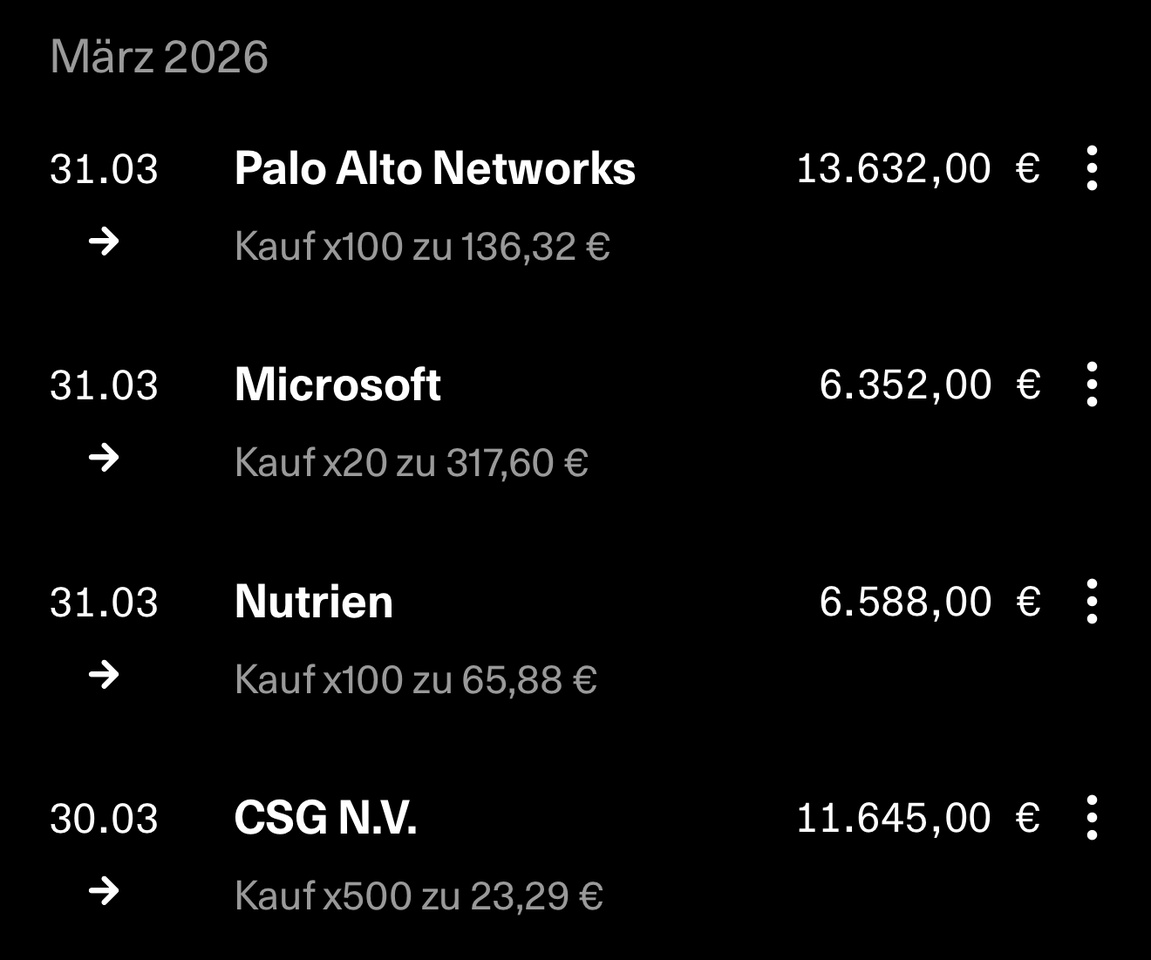
4 purchases in March - €38k deployed in four positions.
$PANW (+4,97 %) Palo Alto Networks (100x @ 136,32€ new purchase)
My conviction pick of the month.
PANW is -31% from the high, near the 52-week low and the CEO bought $10m of his own shares on 3/27. First open-market purchase since 2019, which is no coincidence.
My thesis: In a world with an active US-Iran cyber war, escalating nation-state attacks and exploding AI agent attack surface, cybersecurity is critical infrastructure.
PANW is the leading platform with $11.3B revenue guidance (+22%), 38-39% FCF margin and $18.7B Remaining Performance Obligations. The CyberArk integration ($25B) is squeezing margins in the short term, which is exactly what creates the entry point.
$MSFT (+2,41 %) Microsoft (20x @ 317,60€ buy)
MSFT trades at ~23x forward P/E, the cheapest level since early 2023.
Azure is growing 39% at $75B+ run-rate, $625B Commercial RPO (+110% YoY), and 53 of 53 analysts rate Buy. The selloff after the January earnings (-31% from ATH) was an overreaction to the capex jump. Today's AI infrastructure spending is tomorrow's revenue and that is already contracted.
MSFT remains my A-tier big tech pick and the enterprise cloud backbone of a world where data sovereignty matters.
$NTR (-3,34 %) (100x @ €65.88 re-buy)
Nutrien is the world's largest potash producer from Canada, my A-tier country. Potash has no substitute, it's as essential as oil.
FY2025: $2.3B net profit (+200%), record potash sales of 14.25Mt, EBITDA +13%. And the share price is close to a multi-year low with ~4.5% dividend yield. The Hormuz closure threatens fertilizer supply chains from the Middle East. Nutrien operates completely isolated from it. Zeihan calls food security one of the three pillars of national resilience.
$CSG (-0,8 %) CSG N.V. (500x @ €23.29 buy)
Conviction buy into my core European defense position.
With the current order pipeline and European defense budgets serious for the first time since the Cold War, CSG remains one of the most undervalued European defense plays for me.
JPM takes a similar view.
Rating: Overweight, target price €40 (Dec. 2027).
What did you treat your portfolio to in March? 😬👍
2929
5 Comentarios
6Lun
nice, that's why the market is going so high today 😁
•
77
•
10Lun·
Energy 4.0 - The foundation of a new industry Part 1.2
Good morning, dear getquin community.
I've been looking closely at the CSP hybrid ecosystem from China recently and heard an interesting contribution from futurologist Lars Thomsen. Today I would like to tell you why I think this system is one of the most exciting energy projects of the coming years. I don't want to withhold the results of this research from you.
Before we get into the topic, a quick word about the last post.
Thank you for your strong interaction, support, likes and participation. It was good to see that so many of you sent a clear signal to getquin to finally get things moving. It was just as nice to see that it @Tenbagger2024 motivated you to carry on and give new impetus. It's moments like this that keep the community together.
Speaking of momentum.
Today I'm giving you a new one. Because what is currently being built in China is more than just an energy project. It is a blueprint for an infrastructure that, in my eyes, puts coal and nuclear power plants in the shade.
Before we start, a quick note. I already wrote a first post on this topic. I'm now building on this, but in a much more comprehensive, clearly structured way and with more details so that the connections are easier for you to grasp.
I also @SAUgut777 had already addressed the topic back then, so I would like to mention him here as well. I'm including the link to my earlier article, China is reshaping the sun and Energy 4.0 Part 1. https://getqu.in/OIMCfh/
https://getqu.in/G4f1Tk/
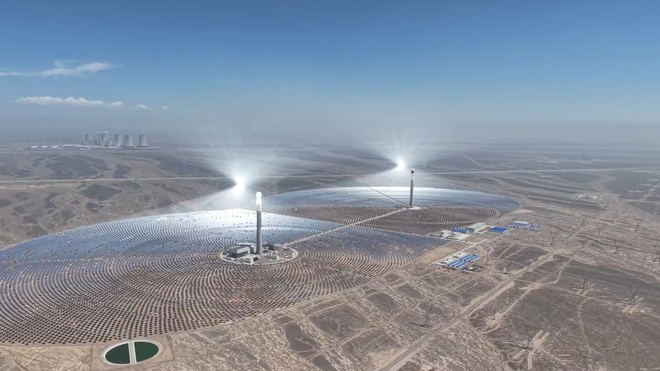
The global energy transition will not be won by individual technologies but by integrative systems that have to fulfill two decisive factors: Scalability and base load capability . What we are currently seeing in China is the construction of the most modern energy infrastructure that radically solves the decades-old problem of solar and wind volatility. Not with wind turbines and solar panels alone, but with a system that supplies base load, integrates storage and enables scaling. The centerpiece is the CSP Hybrid Ecosystemin which solar thermal energy, photovoltaics and gigantic battery storage units are combined to create a continuous 24/7 power source power source.
Technically explained: The new paradigm is the CSP hybrid ecosystem. It combines the rapidly erected photovoltaic (PV) fields with the thermal storage of Concentrated Solar Power (CSP) plants and complements both with massive Battery Energy Storage System (BESS). This intelligent coupling provides stable electricity 24 hours a day, 7 days a week and makes the system a direct and superior competitor to coal and nuclear power.
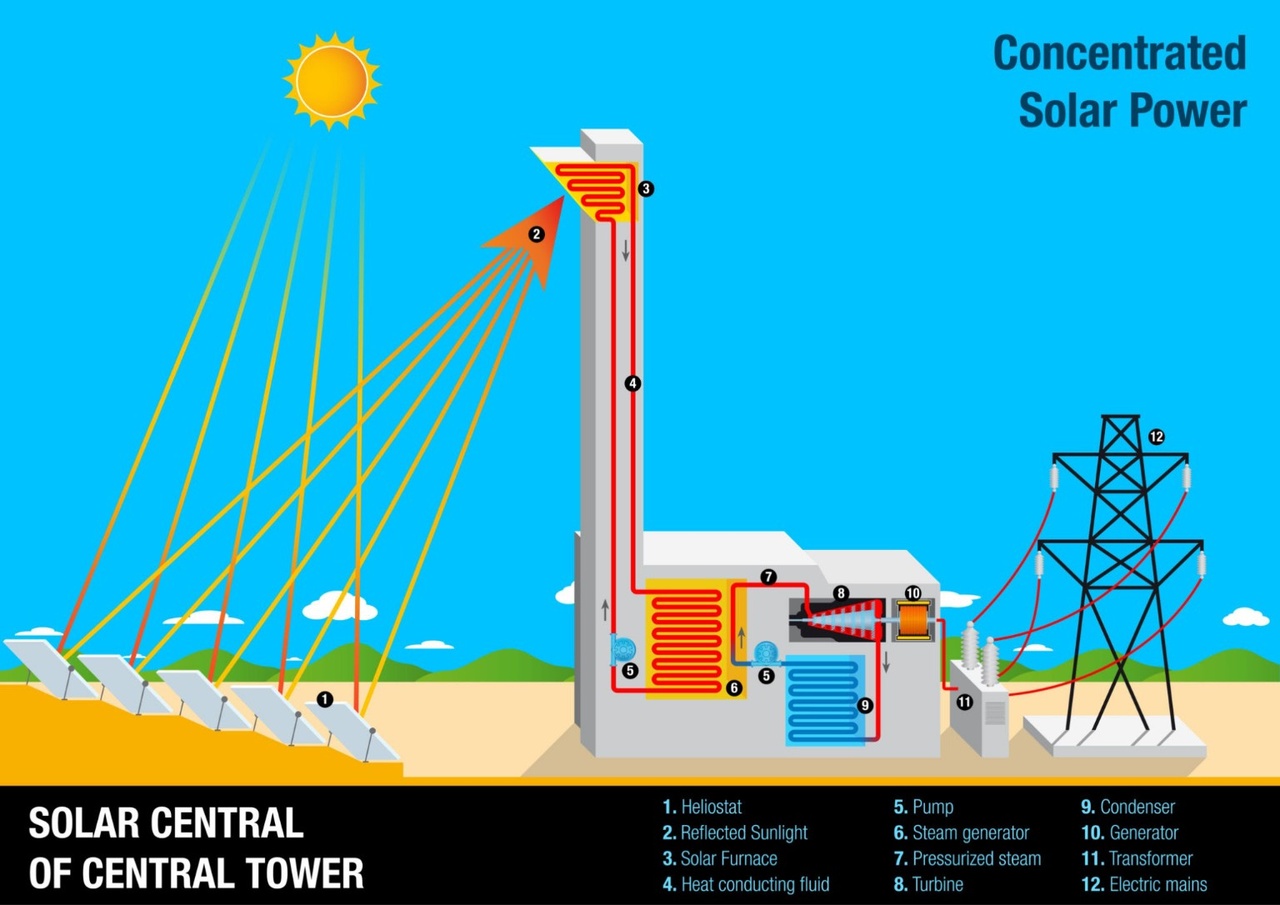
How the system works
1. mirrors collect sunlight
The surface at the bottom left consists of many movable mirrors (heliostats, point 1).
They are constantly aligned with the sun and focus the light onto the top of the tower (reflected sunlight, point 2).
2. the tower heats a heat medium
The solar oven (3) is located at the top of the tower.
There, the concentrated light hits a system of pipes through which a heat-conducting fluid runs (typically molten salts or oil).
This fluid becomes extremely hot, often several hundred degrees (4).
3. heat is converted into vapor
At the bottom of the building, the hot fluid transfers its energy to water in the steam generator (6), turning it into steam under high pressure (7). Pumps (5) keep the cycle going: hot fluid → cooled fluid → back up into the tower.
4. turbine and generator produce electricity
The pressurized steam drives a turbine (8). The turbine is connected to a generator (10), which converts the mechanical energy into electricity.
5. steam is liquefied again
The steam then enters the condenser (9), cools down and becomes water again. Then it goes back into the steam generator.
6. feed into the power grid
The electricity is brought to a higher voltage via a transformer (11) and fed into the grid via the high-voltage lines (12).
The gigawatt comparison and the true added value. A modern nuclear power plant constantly supplies around 1 GW to 1.6 GW of power. This output is continuous but extremely expensive, inflexible and ties up capital for over a decade. A CSP hybrid park in the Chinese desert can achieve a peak output of 5 GW. However, the real added value is the guaranteed base load capacity of 1 GW to 3 GW that can be called up 24/7 thanks to integrated thermal storage and batteries. This intelligent coupling provides stable electricity and makes the plant a direct and superior competitor to coal and nuclear power. This is the disruptive difference: the new generation delivers the same necessary base load but with much higher capital efficiency and 10 years shorter construction time. This makes nuclear power plants an outdated investment model.
The economic key lies in China Speed. It takes ten to 15 years for a nuclear power plant to produce any electricity at all. The Chinese mega bases reach base load capability in 18 to 24 months. This rapid time to market reduces capital costs and raises profitability to a level that is unattainable for traditional power generation.
🌍 Globalization of the Sun Belt: 8 investment pillars
China is exporting the hybrid model to the entire global sunbelt. MENA, North Africa, South America, Australia and Central Asia are among the new core markets. The pipeline is growing every year. The investment opportunities lie in the 8 fundamental pillars that make this infrastructure possible:
1. optics and mirror technology - These companies provide the optical basis for every CSP park
Big players
$SGO (+0,09 %) Saint-Gobain (EPA: SGO) - France - World leader in specialty glass and high-tech materials. Supplies glass solutions and coatings for heliostats and CSP mirror systems.
Schott AG - Germany, private - Specialty glass and receiver tubes for many of the existing CSP plants. Key role in collector efficiency and lifetime.
Hidden champions
Rioglass Solar - Spain, private - Market leader for curved mirrors and receiver components especially for CSP parks. Strong in projects in Spain, MENA and Latin America.
Flabeg FE - Germany, private - High-precision mirrors for solar thermal energy. Supplies optics that directly determine the efficiency of power plants.
$000012 CSG Holding - China, Shenzhen - Large Chinese glass manufacturer with a growing focus on solar and CSP glass products.
2. storage chemistry and thermal media - They supply the chemical storage media for molten salt storage and heat transfer
Big player
$NTR (-3,34 %) Nutrien (NYSE: NTR / TSX: NTR) - Canada - One of the largest fertilizer and nitrate suppliers in the world. Supplies nitrates for thermal storage and molten salt mixtures.
$YAR (-0,94 %) Yara International (OSE: YAR) - Norway - Global fertilizer company. Produces nitrates and nitrogen chemicals that can be used in molten salt storage facilities.
$OCI (-0,91 %) OCI N.V. (AMS: OCI) - Netherlands - Produces hydrogen and natural gas-based products, including nitrogen chemicals for thermal storage solutions.
Hidden Champions
$SQM (-1,04 %) Sociedad Química y Minera (NYSE: SQM) - Chile - Lithium and specialty chemicals producer. Supplies lithium and nitrate salts for battery and thermal storage.
$MIN (+0,83 %) Mineral Resources (ASX: MIN) - Australia - Combines lithium mining and processing. Important for lithium-based storage chains.
$SOLB (+0,64 %) Solvay (EBR: SOLB) - Belgium - Specialty chemicals and heat transfer fluids, relevant for CSP and storage applications.
3. battery and energy storage systems (BESS) - The combination of BESS and thermal storage is the real 24/7 engine of CSP parks
Big player
$3750 (+0,88 %) CATL - China - World market leader for EV batteries and large-scale storage. Supplies complete BESS systems for grids and CSP hybrid parks.
$1211 (+3,41 %) BYD Co Ltd - China - Integrated battery and system provider. Provides energy storage systems for industrial and utility-scale applications.
$373220 LG Energy Solution (KRX: 373220) - South Korea - Global cell supplier with a strong focus on high-performance cells for e-mobility and stationary storage.
$SMSN (+1,19 %) Samsung SDI (KRX: 006400) - South Korea - Premium cells and modular storage solutions for grid and industrial applications.
Hidden Champions
$FLNC (-0,3 %) Fluence Energy (NASDAQ: FLNC) - USA - Joint venture between Siemens Energy and AES. Market leader in turnkey large-scale storage projects and operating software.
Powin Energy - USA, private - System integrator for utility-scale storage with a strong presence in North America and Asia.
$300274 Sungrow Power Supply (SZSE: 300274) - China - Well-known for inverters, growing strongly in the area of integrated BESS solutions for large-scale projects.
4. HVDC, cables and power transmission - HVDC turns desert power into exportable base load power
Big player
$HTHIY (+3,82 %) Hitachi Energy - Switzerland / Japan, part of the Hitachi Group $HTHIY - World leader in HVDC converters, substations and grid control.
$PRY (+1,49 %) Prysmian (BIT: PRY) - Italy - Largest manufacturer of high-voltage cables and submarine cables, central role in European HVDC projects.
$NEX (+1,29 %) Nexans (EPA: NEX) - France - Specialized in power and submarine cables, important for long-distance transmission of desert electricity to Europe.
$ABBN (+1,32 %) ABB (SWX: ABBN) - Switzerland - HVDC converters, switchgear and grid automation for large-scale projects.
Hidden Champions
$NKT (-0,22 %) NKT A/S (CPH: NKT) - Denmark - Cable specialist with a focus on high-voltage and offshore wind connections.
Taihan - South Korea, private - Major Asian manufacturer of high-voltage cables with a growing export share.
$ANA (+0,52 %) Acciona (BME: ANA) - Spain - Not only EPC, but also active in grid connections and infrastructure for large-scale renewable projects.
5. hydrogen and Power-to-X - Surplus electricity from hybrid parks is processed into green hydrogen
Big player
$LIN (+0,42 %) Linde plc (NASDAQ: LIN) - Ireland / global - The world's largest industrial gases group. Plans, builds and operates large-scale electrolysis and liquefaction plants for green hydrogen.
$NCH2 (+0,56 %) thyssenkrupp nucera (XETRA: NCH2) - Germany - Specialist for multi-gigawatt scale alkaline electrolyzers, key supplier for industrial H2 projects.
$NEL (-0,91 %) Nel ASA (OSE: NEL) - Norway - Pure hydrogen player with focus on electrolyzers and H2 tank infrastructure.
Hidden Champions
$PLUG (-1,95 %) Plug Power (NASDAQ: PLUG) - USA - PEM electrolysis, fuel cells and H2 infrastructure, increasingly involved in large-scale projects.
$BE (-2,56 %) Bloom Energy (NYSE: BE) - USA - Develops higher efficiency solid oxide electrolyzers for industrial H2 generation.
$ITM (+2,34 %) ITM Power (LSE: ITM) - United Kingdom - Focused on utility-scale PEM electrolysis, strong in European project business.
$HPUR (+17,65 %) Hexagon Purus (OSL: HPUR) - Norway - Specialist in high-pressure tanks and transportation solutions for compressed hydrogen.
6. EPC, engineering and construction - These companies enable construction in less than two years
Big players
$601669 Power Construction Corporation of China (SSE: 601669) - China - One of the largest engineering and construction groups in the world. Builds dams, large-scale PV and CSP plants, including grid connection.
$601727 Shanghai Electric Group (SSE: 601727) - China - Full-service provider for CSP, turbines, storage integration and EPC services.
$ANA (+0,52 %) Acciona (BME: ANA) - Spain - Global EPC player for solar, wind and CSP, strong in MENA and Latin America.
Hidden champions
SEPCO III - China, private - Highly specialized EPC for large power plants and CSP projects, often partner in Saudi Arabia and North Africa.
$WOR (+1,29 %) Worley Limited (ASX: WOR) - Australia - Engineering and project services provider for energy infrastructure, including hybrid and storage projects.
$3996 (+0,42 %) China Energy Engineering Corp (HKEX: 3996) - China - Large state-owned EPC group, active in the development of solar and grid projects in Asia, Africa and MENA.
7. turbines and power plant technology - CSP Hybrid is ultimately based on modern thermal power technology, only climate neutral
Big player
$ENR (+3,09 %) Siemens Energy (XETRA: ENR) - Germany - Turbines, generators, switchgear and grid solutions. Core supplier for the thermal side of CSP hybrids.
$GE (+0,93 %) General Electric (NYSE: GE) - USA - Steam turbines and power plant technology used directly in hybrid farms and thermal storage systems.
Hidden champions
$1072 (-1,15 %) Dongfang Electric (HKEX: 1072) - China - Major turbine and power plant equipment supplier, strong in domestic market and MENA project.
$1133 (-1,99 %) Harbin Electric (HKEX: 1133) - China - Manufacturer of turbines, generators and power plant components, active in large-scale conventional and renewable power plants.
8. blade manufacturers and construction materials for CSP hybrid parks
8.1 Construction and mining equipment
Big Player
$CAT (+0,65 %) Caterpillar (USA, NYSE: CAT) - World's largest manufacturer of construction and mining equipment, dozers, excavators, dump trucks, generators. Provides heavy equipment for earthmoving, foundation construction and park infrastructure.
$6301 (+1,96 %) Komatsu (Japan, TSE: 6301) - Number two worldwide in construction and mining equipment. Excavators, wheel loaders, large dump trucks and special machines used in desert projects and large construction sites.
$SAND (+3,63 %) Sandvik (Sweden, OMX: SAND) - Drilling technology, rock processing, wear parts. Important for foundation construction, cable routes and the raw materials side of the value chain.
$EPI A (+2,31 %) Epiroc (Sweden, OMX: EPI A) - Drilling rigs and underground equipment, wherever CSP infrastructure is built on difficult terrain.
Hidden champions
$6305 (+0 %) Hitachi Construction Machinery (Japan, TSE: 6305) - Strong presence in Asia and MENA, large excavators and wheel loaders for deserts and large construction sites.
$DE (-4,69 %) Wirtgen Group / John Deere $DE (USA) - Road construction, milling, compaction. Benefit from the expansion of access roads, platforms and logistics around CSP parks.
8.2 Steel, tubes and sections
Big player
$MT (+4,49 %) ArcelorMittal (Luxembourg, NYSE: MT) - Global steel group with flat and long products. Supplies beams, sections and structural steel for tower structures, racks and infrastructure.
$5401 (+0,31 %) Nippon Steel (Japan, TSE: 5401) - High-quality steel for energy and infrastructure applications, including heat-resistant steels.
$TEN (+1,55 %) Tenaris (Luxembourg/Argentina, NYSE: TS) - Leading manufacturer of seamless steel tubes for energy, pipelines and high-pressure systems. Relevant for heat exchanger circuits, media pipelines and infrastructure in the CSP environment.
$VK (+1,72 %) Vallourec (France, EPA: VK) - Specialty tubes and high-performance steels for energy projects, including high-temperature pipelines.
Hidden Champions
$5411 (+1,07 %) JFE Holdings (Japan, TSE: 5411) - steels and tubes for large-scale projects, with a focus on Asia.
$TUB (-1,37 %) Tubacex (Spain, BME: TUB) - Seamless stainless steel tubes for high temperature and corrosive environments, directly relevant for CSP heat and process piping.
$NXT Nextpower (USA) - Steel-intensive tracker systems for PV fields. Important in hybrid parks where PV and CSP are combined.
$ARRY (-2,1 %) Array Technologies (USA) - Similar to Nextracker, focus on utility-scale tracking systems.
8.3 Cement, concrete and construction chemicals
Big player
$HOLN (+1,05 %) Holcim (Switzerland, SIX: HOLN) - The world's leading supplier of cement and concrete. Supplies foundation concrete, specialty mortars and infrastructure construction materials for major projects, including desert locations.
$HEI (+1,33 %) Heidelberg Materials (Germany, Xetra: HEI) - Strong player in Europe, North Africa and Asia. Cement, concrete and aggregates for foundations, turbine houses, storage blocks.
$CX (+0 %) Cemex (Mexico, NYSE: CX) - Globally active in cement and concrete, supplier for infrastructure in MENA and the Americas.
$CRH (-0,59 %) CRH plc (Ireland, NYSE: CRH) - Building materials group with a focus on infrastructure, road construction and precast concrete products.
Hidden Champions
$ULTRACEMCO UltraTech Cement (India, NSE) - Largest cement manufacturer in India, relevant for CSP projects in the subcontinent and neighboring regions.
Votorantim Cimentos (Brazil, private / regionally listed) - Strong supplier in Latin America with a direct link to infrastructure and energy projects.
8.4 Industrial components, heat exchangers and process equipment
Big player
$ALFA (+2,86 %) Alfa Laval (Sweden, OMX: ALFA) - Heat exchangers, pumps and separators. Key components for thermal storage, steam generation and process heat in CSP plants.
$FLS (+4,29 %) Flowserve (USA, NYSE: FLS) - Pumps, valves and sealing systems for high-temperature and high-pressure circuits in energy plants.
$SPX (+2,98 %) Spirax Group (UK, LSE: SPX) - Steam and condensate technology, control valves and heat exchange systems, important for the fine control of thermal circuits.
Hidden champions
$IMI (+1,93 %) IMI plc (UK, LSE: IMI) - Specialty valves and control technology for the energy and process industries, especially for demanding media.
$KSB (+1,71 %) KSB SE (Germany, Xetra) - Pumps and valves for the energy, water and process industries. Suitable for cooling water, heat transfer media and storage systems in CSP parks.
🎯 Conclusion and outlook
The CSP hybrid ecosystem eliminates the weaknesses of renewable energies and uses China Speed as an economic lever. This combination creates a capital efficiency that will overtake traditional energy generation in the long term. The investment opportunities range from the Asian battery giants to the European HVDC specialists.
The fundamental question is whether European regulators can adjust the speed of permitting procedures to allow the continent to keep up with the pace of the Sahara projects and the European EPC companies operating there, or whether the continent will be left behind in terms of energy self-sufficiency.
Takeaway
The real investment case lies in the efficiency superiority of the CSP hybrid system. The ability to provide gigawatts of base load within two years, coupled with thermal storage and BESS, makes this infrastructure one of the strongest energy models of the future. This benefits optics, chemistry, BESS, HVDC, hydrogen, EPC and turbine manufacturers.
Sources: own research + IEA, IRENA, NREL, Fraunhofer ISE, SolarPACES, World Bank, Ember Climate, company reports & technical documentation of the companies mentioned.
Image: https://videos.winfuture.de/27754.mp4
Getty Images, Illustrative image - JLStock / Shutterstock.com

6666
32 Comentarios

10Lun
Incidentally, solar thermal systems have been around in Europe (southern Spain) for over 15 years: Gemasolar, PS20 or Andasol.
•
66
•1Año·
China is reshaping the sun
Good morning dear Getquin Community, energy is one of the biggest levers for the transformation of our economy and independence from fossil fuels. Today I would like to introduce you to the exciting solar thermal power (CSP) project from China.
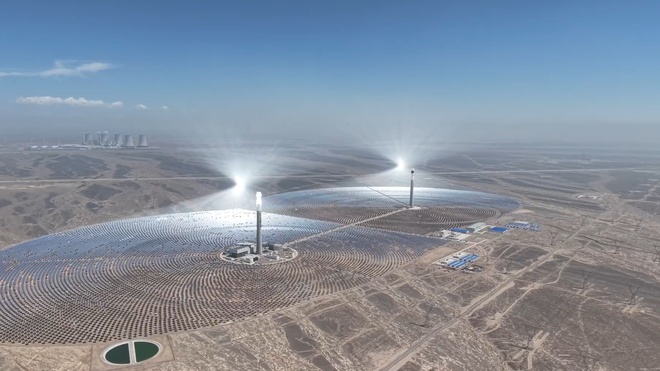
https://videos.winfuture.de/27754.mp4
In the desert, two huge solar towers use thousands of mirrors to concentrate the sun's rays, store the heat in molten salt and use it to reliably generate electricity. The special feature: By storing heat, energy is also provided at night or when it is cloudy. This is a step towards a more stable renewable power supply beyond traditional photovoltaics and wind.
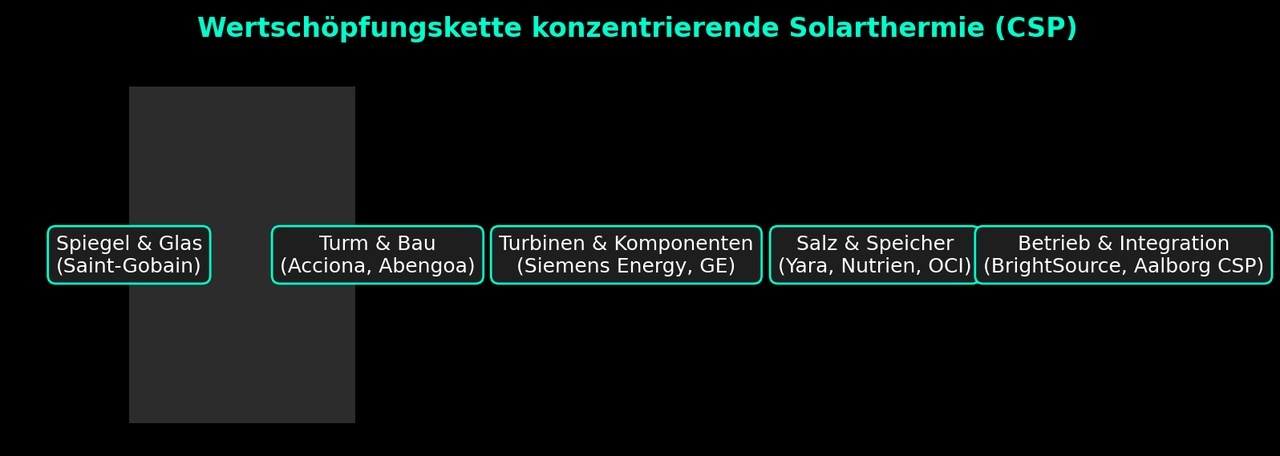
The CSP value chain is broad. The project and turbine side is dominated by $ENR (+3,09 %) Siemens Energy (ENR), $ANA (+0,52 %) Acciona (ANA) and $GE (+0,93 %) General Electric (GE). They supply turbines, engineering and EPC services for the majority of plants worldwide. On the materials and storage side $SGO (+0,09 %) Saint-Gobain (SGO) for glass and mirrors and $YAR (-0,94 %) Yara (YAR), $NTR (-3,34 %) Nutrien (NTR) and $OCI (-0,91 %) OCI (OCI) for the provision of salts. These components are essential for thermal storage and therefore for the competitiveness of CSP. In addition, there are developers such as Abengoa Solar, BrightSource and Aalborg CSP, which realize special projects.
Takeaway: While photovoltaics has long since arrived in the mainstream, CSP is opening up new niches through the combination of electricity production and storage. The companies that supply mirrors, turbines, chemicals and engineering - the industry's blade manufacturers - are particularly exciting for investors.
The crucial question is whether CSP will manage to establish itself with these players as a serious pillar in the future energy mix alongside PV and wind.
Source: https://winfuture.de/news,152708.html and own creation
1414
8 ComentariosCan anyone here explain the dividend phenomenon of $OCI?! Why are they paying out over 300%?
•
11
•1Año·
Discounted cash flow valuations of selected shares
With my KI-gestützten DCF-Prompt I have analyzed several stocks from my portfolio that are currently trading well below their all-time highs.
The results are not binding buy or sell signals, but merely an additional building block in the decision-making process. All information is of course provided without guarantee.
🤖 All analyses were carried out with Gemini 2.5 Pro Deep Research created.
On average, each analysis researched 223 websites.
As the full reports are very extensive, the appendix contains only
- the fair values for bull, base and bear cases
- a compact summary of the most important findings
📍Lockheed Martin $LMT (+0,74 %)
Current share price August 4, 2025: $421
Fair value
Bull: $570.80
Base: $495.50
Bear: $425.20
Lockheed Martin is at a critical juncture. The share price reflects deep concerns over repeated multi-billion dollar write-downs on risky fixed-price development programs, which peaked in the second quarter of 2025. Our analysis yields a fair value of USD 495.50, well above the current price, and a range of USD 425 to USD 571 in our scenarios.
The key value drivers are the record high order backlog of over USD 166bn, the strong demand for tactical missiles (MFC) and the stability of the space business (Space), which form a solid base.
The greatest leverage lies in management's ability to stabilize operational execution in the Aeronautics segment and normalize margins.
The main risks remain further unforeseen losses on classified programs, the high focus on the F-35 program and the volatility of US defense budgets. The current valuation provides a significant margin of safety for investors who believe in a stabilization of operational performance and the long-term strategic importance of the company.
📍Chevron $CVX (+0,37 %)
Current price August 4, 2025: $151
Fair value
Bull: $203.80
Base: $178.50
Bear: $155.20
The comprehensive DCF analysis results in a fair value of USD 178.50 per share for Chevron, which implies a significant undervaluation compared to the current share price. The valuation range from the scenarios (USD 155.20 - 203.80) and the Monte Carlo simulation supports this assessment and shows a limited downside risk even in the bear scenario.
The key value drivers are the transformative Hess acquisition, which heralds a new era of high-margin growth, and the impressive capital and cost discipline, which manifests itself in rising free cash flow. These factors position Chevron robustly to benefit disproportionately from a stable or rising energy price environment.
The main risks remain the exogenous volatility of the commodity markets and the operational execution of the integration of Hess and the ramp-up of major projects. Overall, the opportunities resulting from the strategic realignment and the attractive valuation clearly outweigh the inherent risks in the sector.
📍Occidental $OXY (+0,2 %)
Current share price August 4, 2025: $43
Fair value
Bull: $79.8
Base: $64.1
Bear: $51.5
The comprehensive DCF analysis results in a fair value of $64.1 per share for Occidental Petroleum, which corresponds to a considerable upside potential compared to the current price of $43.41. The valuation range resulting from the scenarios and simulations is between $51.5 and $79.8.
The key drivers for this value are the robust free cash flow from the scaled and highly efficient Permian Basin business and the disciplined capital allocation, which prioritizes debt reduction and thus increases shareholder value. The main risks remain the inherent volatility of commodity prices and the significant execution and political risks associated with the ambitious but as yet unproven low carbon ventures strategy.
Based on the significant discrepancy between the calculated fair value and the current market price, a buy recommendation is issued for Occidental Petroleum shares. Investors should closely monitor the development of commodity prices, the progress in deleveraging and the operational and commercial milestones of the LCV division, in particular the STRATOS project.
📍Intel $INTC (-2,46 %)
Current share price August 4, 2025: $19
Fair value
Bull: $36.10
Base: $25.20
Bear: $15.50
Based on a detailed discounted cash flow (DCF) analysis using the sum-of-the-parts method (SOTP), Intel Corporation has a fair value of $25.20 per share in the base scenario. This implies an upside potential of 27.3% compared to the reference price of $19.80. The valuation range derived from the bull and bear scenarios ranges from $15.50 to $36.10 per share. The Monte Carlo simulation, which takes a probabilistic view of the uncertainties of the central assumptions, yields a median value of $24.50 and indicates that the share is trading below its fair value with a probability of around 68%.
The investment thesis for Intel is a high-risk turnaround bet that is inextricably linked to the success of the "IDM 2.0" strategy and in particular the development of the Intel Foundry (IF) business. The primary value drivers are management's ability to win one or more "significant" external foundry customers, the stabilization of market share in the core Client Computing (CCG) and Data Center & AI (DCAI) businesses and the realization of the announced cost reductions.
The main risks lie in the enormous challenge of mastering the turnaround in the established segments and at the same time building up a world-class foundry business from a position of being behind. Persistent operating losses and cash outflows from the foundry business, further loss of market share to agile competitors such as AMD and Nvidia and the failure to regain technological leadership in process technologies by 2025 represent existential risks that could turn the massive capital investments into value-destroying stranded assets.
📍Nutria $NTR (-3,34 %)
Current share price August 4, 2025: $58
Fair value
Bull: $90
Base: $68.2
Bear: $45
This analysis provides a detailed fundamental valuation of Nutrien Ltd (Nutrien) based on a discounted cash flow (DCF) model. The base case scenario yields a fair value of USD 68.2 per share (equivalent to CAD 93.8). The valuation range determined by scenario analyses and a Monte Carlo simulation indicates a balanced risk-return profile.
The central investment argument is based on Nutrien's position as an integrated global market leader in an industry with positive long-term fundamentals. The valuation suggests that the stock is currently fairly valued but offers potential from an expected recovery in fertilizer prices and margins from their cyclical lows.
Key value drivers include operational efficiency reinforced by the integrated business model (production and retail), disciplined capital allocation with a focus on shareholder returns and the underlying strength of global agricultural markets supported by low grain inventories.
The main risks lie in the inherent volatility of commodity prices, exposure to the cost of key inputs such as natural gas in the nitrogen segment and geopolitical uncertainties that may impact global supply chains. A key uncertainty factor for the short-term forecast is the strong dependence on a significant increase in earnings in the second half of 2025 in order to achieve the company's forecast after a weak first quarter.
1414

1Año·
Tariffs: Canada counters, German automotive sector in focus
After I wrote in the first post about the consequences of the announced and effective tariffs of the USA... there are now some concrete answers from the affected countries, especially from Canada.
It's hard to keep up with all the news 👀
In this post, I go into more detail about the possible consequences for the EU, especially for the automotive sector.
"1st post from this morning" can be read again here: https://getqu.in/oj1JRH/
Trump's new tariffs: Recap
Since February 1, 2025, the US government and Donald Trump have imposed new import tariffs on Mexico, Canada and China:
- 25% on imports from Mexico and Canada
- 10% on imports from China
- Trump's decrees also contain a passage stating that the tariffs could be increased or extended if the countries respond with retaliatory measures [1].
Canada: A tough counterattack
- Canada has already reported on countermeasures in the form of three levels of escalation [2]:
- 1️⃣ Targeted punitive tariffs on US products coming from Republican states (e.g. orange juice, whiskey, ketchup, peanut butter and motorcycles).
- 2️⃣ Tariffs on steel products and machine parts from the USA.
- 3️⃣ Escalation: Stop exports of oil, gas and electricity to the USA
However, this last step in particular would be a double-edged sword, as Canada is heavily dependent on energy cooperation with the USA.
Now it's getting concrete:
Canada's Prime Minister Justin Trudeau announced at a press conference in the evening Canadian time that tariffs of 25 percent will also be introduced on US goods from Tuesday next week 🔄 [2].
The tariffs planned by Canada are intended for US goods with a total value of 155 billion dollars.
The Canadian government is also considering measures in other areas, such as trade in critical minerals.
Further effects on companies:
- Canadian exports to the USA will become more expensive and therefore less competitive.
Particularly affected: (automotive, energy, raw materials, agriculture)
German car manufacturers used Canada as a production and export location
- Volkswagen $VOW3 (+1,76 %) , BMW $BMW (+1,81 %) , Mercedes Benz $MBG (+0,91 %)
- e.g. VW is planning a battery factory in Canada to supply its US plants, Trudeau's government has lured the billion-euro project with high subsidies [2]. Trump's tariffs could make this billion-euro project unprofitable 🤡
Canadian oil and gas producers sell large quantities to the US, higher tariffs could make exports less attractive and squeeze profits.
- affected e.g. Canadian Natural Resources $CNQ (+1,3 %) Suncor Energy $SU (+2,04 %)
Fertilizer producers are heavily dependent on US exports, higher costs and a competitive disadvantage compared to US competitors represent a potential risk.
- affected e.g. Nutrien $NTR (-3,34 %)
Mexico: The USA punishes its most important trading partner
Counter-tariffs possible: President Claudia Sheinbaum has announced corresponding measures and instructed her Secretary of Commerce to implement a plan that considers counter-tariffs [2]. - We can be curious.
Mexico's dependence on the USA:
- According to economists, the tariff policy is likely to harm both economies through higher inflation and job losses.
- 80% of Mexican exports go to the USA, no other country exports more to the US.
- Millions of jobs and thousands of companies depend on the US market 💀
Trump uses tariffs as political leverage:
- He wants to force Mexico to take a tougher stance against illegal migration and drug cartels.
- He also accuses China of circumventing tariffs by allowing Chinese companies to export from Mexico to the USA.
Impact on European companies: (again the car manufacturers 👀)
- Almost all manufacturers and many suppliers use Mexico as a cheap production location and serve the US market from there
- VW, Audi and BMW have their own factories in the country, while Mercedes Benz produces in a joint plant with Nissan.
- With an additional surcharge, it hardly makes sense to send cars from Mexico to the USA.
- In response, manufacturers are expected to relocate at least part of their production from Mexico to the USA (at high cost, of course), where VW, BMW and Mercedes also have plants.
China: a further burden for an ailing economy
- China strongly criticized the punitive tariffs [2].
- Complaint to the World Trade Organization (WTO): China sees the tariffs as unfair and wants to take legal action against them.
Consequences for China:
- US tariffs make Chinese products more expensive in the USA.
- The already weakening economy will be further burdened.
Indirect effects on Europe:
Chinese manufacturers such as BYD $1211 (+3,41 %) could be forced to develop alternative markets and push even harder into Europe.
- The result: more competition for German car manufacturers and possible price wars.
- VW & Co. are already struggling with overcapacity in Germany.
Furthermore:
- Foxconn $2354 an important Apple supplier with production in China and Mexico
- Punitive tariffs could make it necessary to relocate production.
Is the EU facing the same fate?
Trump has already indicated that the EU must also fear tariffs.
- His main argument: the EU has treated the USA unfairly in trade.
Possible measures:
- Tariffs on... who would have thought... the automotive industry and also other exports from the EU.
- Car exports to the USA could become increasingly unprofitable -> relocating production to the USA could ultimately be the only solution.
- A new edition of the trade conflict from Trump's first term in office (2017-2021).
Possible reaction of the EU:
- If Trump escalates again, the EU could also take retaliatory measures so far I haven't heard anything concrete 😴
Conclusion: Trade war 2.0?
Trump is once again focusing on confrontation and using tariffs as economic and political leverage. The countries affected are fighting back, which increases the risk of a global trade war.
The consequences are far-reaching:
USA: Higher prices for consumers, relocation of production to the domestic market possible.
China: Further economic pressure, stronger focus on Europe as a sales market.
Mexico & Canada: Massive burden on the economy & industry, relocation of production conceivable.
Europe: German car manufacturers under pressure, possible US tariffs on European products.
I'm in the mood... Thanks for reading, I've had enough now! 🤝
__________
Main sources:
[1] https://www.tagesschau.de/ausland/amerika/usa-trump-strafzoelle-100.html
[2] https://de.finance.yahoo.com/nachrichten/roundup-kanada-mexiko-china-kontern-083517258.html
2121
14 Comentarios
1Año
As long as the rest of the world is fragmented and everyone acts on their own, T can use the economic power of the USA as leverage. If the major democracies in South America, Canada, the UK, the EU and India join forces - according to the motto: if you attack one of us, we will all react - then things will look different. The EU could respond to the tariffs against Mexico and Canada with counter-tariffs. But it doesn't. Stares like a rabbit at a snake. This would be THE opportunity to work more closely with Mexico and Canada. Doesn't take it.
Why?
Unfortunately, there is no vision for Europe right now. Everyone is only thinking about their dry sheep. 😢
Why?
Unfortunately, there is no vision for Europe right now. Everyone is only thinking about their dry sheep. 😢
•
1111
•
1Año·
Hello :)
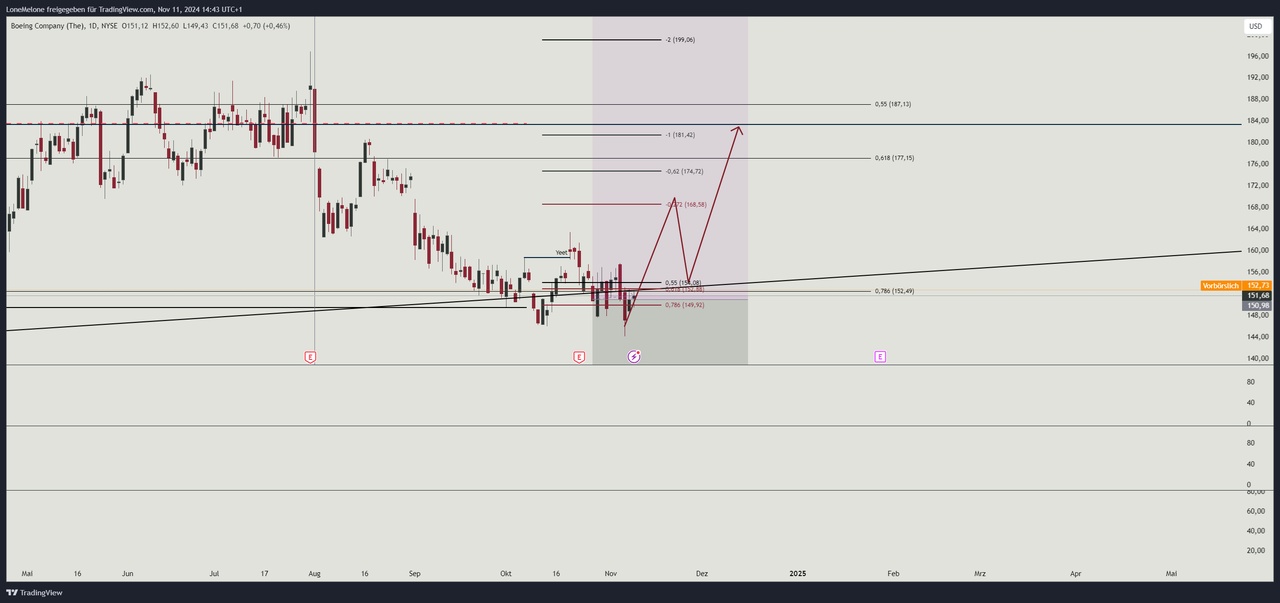
I can't say yet if there will be a comeback here - but now I have some time to briefly introduce a trade I'm in or in which I'm increasingly going into should I get more bullish signals.
Currently I am still holding a $TSLA (+2,03 %) long from May $INTC (-2,46 %) from September (even if we are still a bit away from my entry here). $NTR (-3,34 %) Long from July (it should move!) and since October a $BA (+1,01 %) long - which I am now presenting!
Why is that $BA (+1,01 %) ? Well, a colleague at work has told me several times how bad the company is doing and that (to exaggerate) he expects it to go bankrupt next year. So I thought I'd take a look at the chart and lo and behold I found it quite attractive for a long ;).
As you know, I don't pay much attention to fundamental news, so I'm not interested in the bad news. With a few exceptions, everything is priced in before we hear about it and then I can see it in the chart anyway.
Briefly on the basic situation:
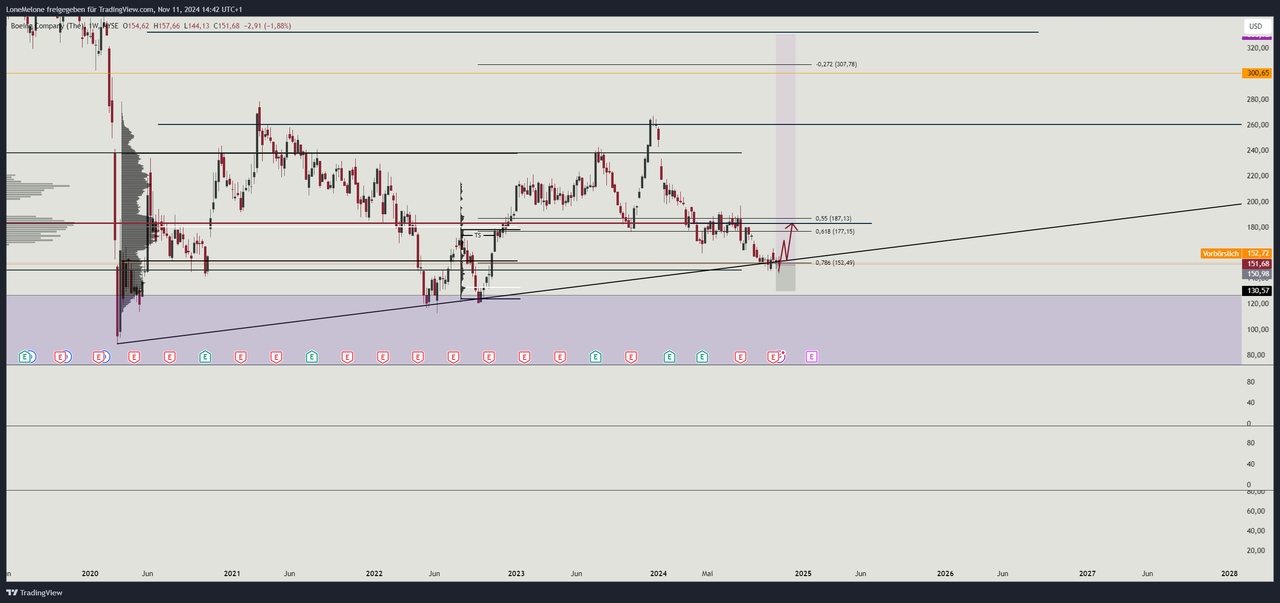
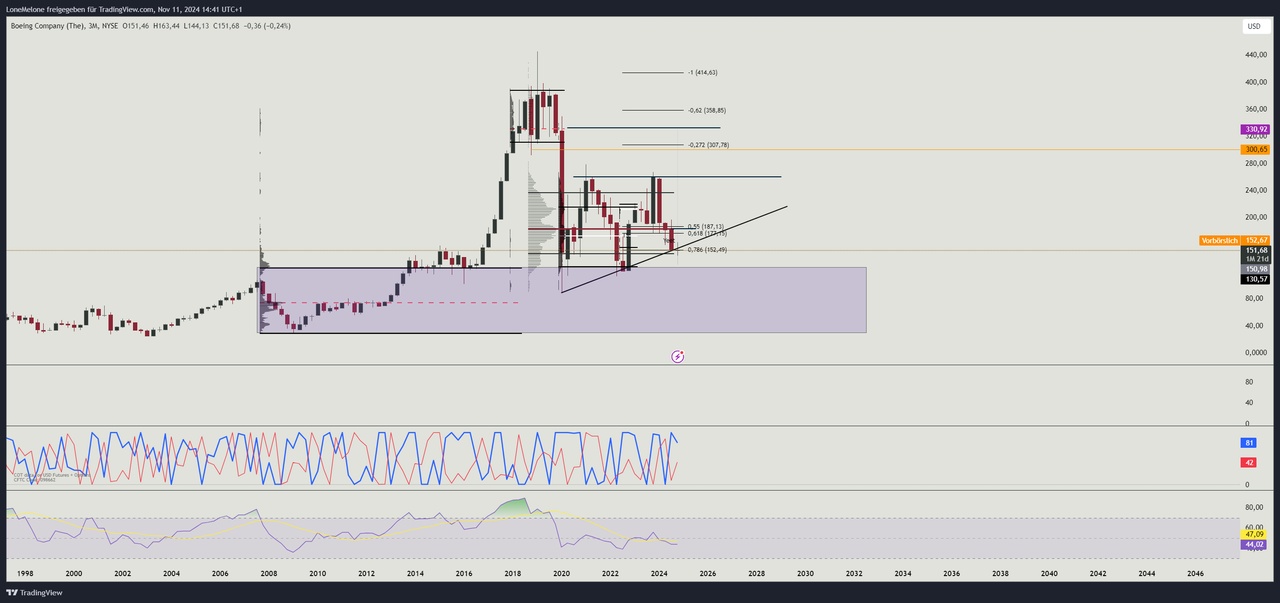
Corona crashed to 88$ then a nice rebound to 280$. That would give us our range for the last 3-4 years. Even due to Corona and the latest NASA news etc., we have never broken our breakout zone from the all-time high. We never broke our breakout zone from the all-time high. This means that we have always remained bullish in the monthly structure and higher.
What is my basic target for this trade? Breakout zone from Pre Corona. So 300-400$.
Why now ?
We are basically at the lower end of the range. That means basically in the discount zone. - Anyone who knows me knows that I only take trades from a discount zone - in other words, I always trade anti-cyclically and on trend changes after a clear confirmation. In other words, I don't buy into a bearish candle at random, but after we have already seen a structural change in the order flow.
In addition, we have reached a POC, i.e. a point of control (point of highest volume in a range). We still have a nice POC a little further down at around 133$ but that would break the order flow which would be so bearish that the trade is irrelevant for me anyway. (There is no perfect setup anyway).
We are currently accumulating nicely at the trendline and have obtained a bullish structure on the daily chart. At the beginning I said that I am not yet completely convinced - this is because we are currently still at the breakdown point - so we could expand downwards at any time with a strong downward impulse. However, if we now break the 160 mark again impulsively, this is a clear signal for me that the share wants more and I would then buy even more into my position on a correction.
The first and most difficult target is the 180$ mark. Here we have the point of control of the downward movement that came about after the last test of the range highs at 260$. Above 200 at the latest is practically no man's land and price discovery up to 260$.
So I set my stop loss at 180$ to +-0 (breakeven). If we break and close the range highs at 260$ impulsively with a weekly candle, the path to the target at 300$+ is clear.
Why do I think the trade is good at the moment and I am already in it without having broken the 165$ .... well, I just think the chart is good and wanted to open halfway. A lot comes with time simply by feeling and I have the chance here to set a tight stop loss and thus get a comparatively high R/R with high leverage. So I have a tight invalidation level. Earnings are now over and the news is therefore limited.
It is important to mention that my entry is a RISK ENTRY and a confirmation for me is actually only given from the break of 160$. Before that, anything can happen and it is normally just a watchlist position for me. (So exception)
Enclosed you will find my monthly, weekly and daily charts. Questions as always in the comments. I have probably written complete gibberish again.
PS. $DIS (+0,96 %) is currently on my watchlist.
If you have any great stocks on your watchlist - check them out. Due to $TSLA (+2,03 %) has freed up some liquidity, so I can enter into a few new swing trades.
Greetings Melon!

3Año·
How does the community actually feel about the agricultural sector? In the last few years, it has been possible to work with $DE (-4,69 %) , $ADM (-2,11 %) or also $NTR (-3,34 %) good returns. How will the sector perform in the future and what would be your favorite? Are there any other interesting companies that I don't have on my radar? 🤷🏼♂️
My favorite is $ADM (-2,11 %) . Dividend increase for 48 years. Increase in the last 10 years on average just under 9%. The company also goes through crises quite well. Cocoa, corn, wheat, etc. must always be processed. Now it is just under 25% correction from ATH. Good entry opportunity?

