$BTC (+0,58%)
$ETH (+0,66%)
$XRP (+0,01%)
$SOL (+0,89%)
$TRX (+0,06%)
$BTC (+0,58%)
$ETH (+0,66%)
$XRP (+0,01%)
$SOL (+0,89%)
$TRX (+0,06%)
Investable via:
$BITC (+0,06%)
$CETH (+0,42%)
$XRRL (+1,16%)
$SLNC (+2,41%)
$CTEN (+1,78%)

Postos
57Investment products for digital assets register inflows of USD 1.2 billion, the fourth positive week in a row. This presumably reflects increasing institutional demand, against the backdrop that $BTC (+0,58%) trading at its highest level since the beginning of February. The market is now looking ahead to the FOMC decision on April 28-29, which is likely to contribute to some caution. Total assets under management (AuM) rise to USD 155 billion, the highest level since February 1, but still well below the peak of USD 263 billion in October 2025.
You can invest in Bitcoin via the following vehicle: $BITC (+0,06%)
$BTC (+0,58%) continues to hold its own as a surprisingly robust crisis winner. Since the escalation in Iran at the end of February, the cryptocurrency has risen by around 23%, while stock markets fell and $GOLD and trended significantly weaker. Bitcoin gained a further 4.5% this week alone.
Institutional investors also remain committed: Products for digital assets recently attracted around one billion US dollars in fresh capital. Blockchain shares are also in particularly high demand, with record inflows this month.
Additional tailwinds could come from the USA. The focus there is on the Clarity Act, which is intended to provide clear rules for the crypto market. If passed, it would make it easier for banks and large investors in particular to enter the market. (Author James Butterfill, CoinShares' Head of Research)
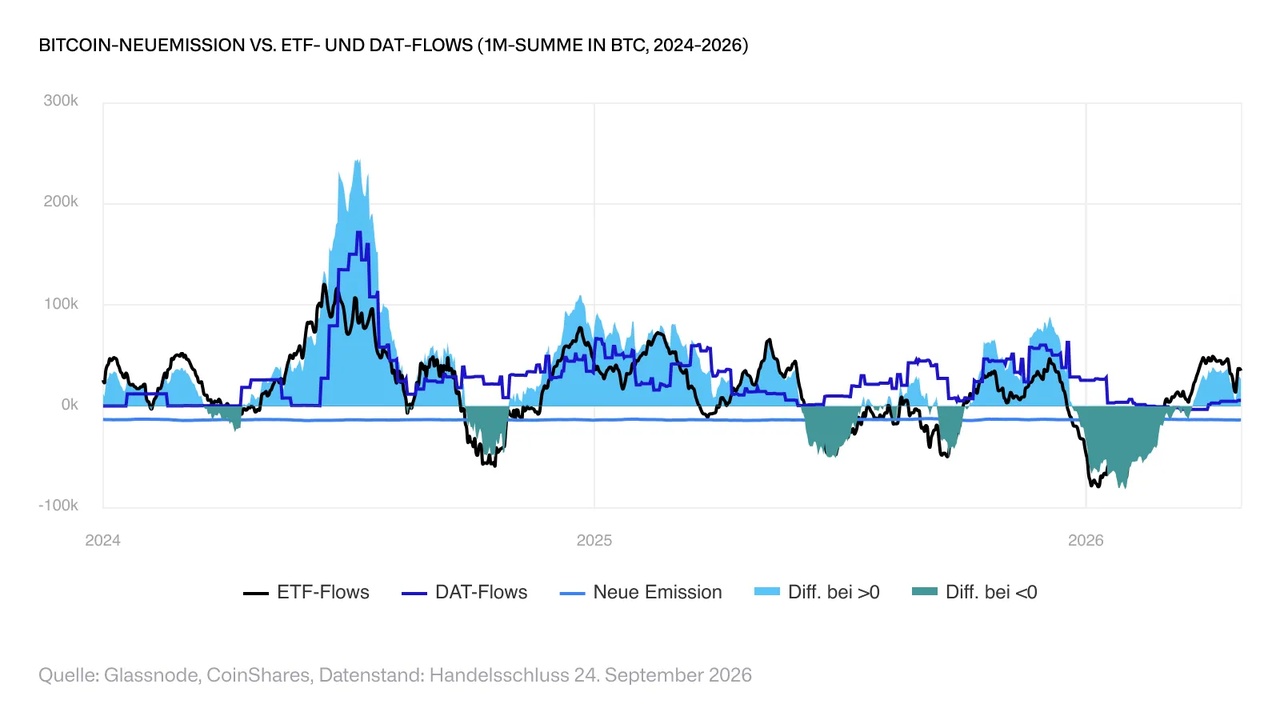
Today, institutional capital inflows are primarily focused on two channels: Inflows into US spot ETFs and purchases through digital asset treasuries (DATs). The latter - such as Strategy - pursue the goal of accumulating as many $BTC (+0,58%) possible without the intention of selling. As long as they are not forced to sell positions, these holdings are effectively considered to be withdrawn from the market.
With ETFs, inflows and outflows are basically possible in both directions. In the current environment of increasing adoption, however, the buy side clearly dominates. More and more financial advisors are only now beginning to offer their clients corresponding products. At the same time, large financial institutions continue to launch new #bitcoin-ETFs to the market, most recently Morgan Stanley.
The development shows: If you add up the demand from ETFs and DATs, it already significantly exceeds the amount of new $BTC (+0,58%)that come onto the market every day through mining. In addition, every four years or so, halving halves the number of new $BTC (+0,58%).
ETFs and DATs together currently only account for around eleven percent of the total $BTC (+0,58%)-supply. If this trend continues, an increasing imbalance between supply and demand seems likely - with the corresponding potential for prices to rise significantly.
You can invest in Bitcoin via the following vehicle: $BITC (+0,06%)
Digital asset investment products saw inflows of USD 1.4 billion, the highest weekly figure since January and the third consecutive week of positive inflows. This reflects a continued recovery in risk appetite, buoyed by talks to extend the ceasefire between the United States and Iran and boosted by the mid-week rise of $BTC (+0,58%) over USD 76,000 in the middle of the week - the highest level since the price slump in February. Inflation data for March (consumer price index, CPI) stands at 3.3% year-on-year and is largely ignored by the market. Core inflation remains moderate at 2.6% and points to a supply-driven rather than a broad-based inflationary impulse.
You can invest in Bitcoin via the following vehicle: $BITC (+0,06%)
$BTC (+0,58%) is currently showing remarkable strength. Since the start of the Iran crisis, the cryptocurrency has gained around 18.8%, while many stock markets have fallen and gold has lost around 7.4%. This means that #bitcoin is performing significantly better than many traditional asset classes in a geopolitically tense environment.
The market picture is also brightening internally. Large investors, so-called whales, are buying bitcoin on a net basis again for the first time since the fall. Institutional investors are also increasingly buying again: digital investment products recently recorded inflows for the third week in a row. If this momentum continues, Bitcoin could be on the verge of another dynamic upward movement. (A market update from CoinShares' Head of Research, James Butterfill)
A proposal, $BTC (+0,58%) for toll payments in the Strait of Hormuz is less a practical payment innovation than a geopolitical signal that shows how sanctioned states could $BTC (+0,58%) could test as a censorship-resistant settlement layer and alternative infrastructure outside the dollar system.
At its core, this is not about #bitcoin as a day-to-day payment system, but about increasing monetary fragmentation: while this may increase the relevance of $BTC (+0,58%) in sanctioned or fragmented systems, it also reinforces regulatory concerns about potential circumvention use.
In the long term, the idea of a "$BTC (+0,58%)-economy" remains limited; it is more likely to be $BTC (+0,58%) as a reserve-based or intermediary settlement layer in a parallel financial system - not as a direct unit of account for critical trade flows.
Our latest analysis (as at the end of 2024) shows clear trends in $BTC (+0,58%)-usage: around 65% of all $BTC (+0,58%)-owners come from emerging markets - that equates to around 300 million people. The penetration rate is particularly high in India (approx. 160 million), followed by Indonesia, Brazil and Nigeria.
In terms of population, however, another country is in the lead: in the United Arab Emirates, around 19% of people own a car. #bitcoinin Vietnam and 12% in Turkey. A clear pattern is becoming apparent: where currencies are weak and monetary policy enjoys little confidence, the importance of $BTC (+0,58%) gains in importance.
Overall, the number of $BTC (+0,58%)-users rose sharply between 2022 and 2024 - to around 467 million worldwide. Usage also increased significantly in the US (from 21 million to 35 million), bringing additional capital into the market, for example via ETFs.
The demand for $BTC (+0,58%) continues to grow worldwide. However, it remains to be seen whether this will be reflected in the price in the long term.
In our latest adoption study (as at the end of 2024), around 65% of all $BTC (+0,58%)-owners worldwide were in emerging markets, which corresponds to around 300 million people. India leads with around 160 million users, followed by Indonesia, Brazil and Nigeria. In percentage terms, the UAE is in the lead with 19%, followed by Vietnam with 14% and Turkey with 12%. The pattern is both interesting and consistent: where local currencies are weak and monetary policy is considered unreliable, this gap is filling. #bitcoin fills this gap.
The number of $BTC (+0,58%)-users nearly doubled between 2022 and 2024, reaching 467 million - well above the 20% that our adoption model had assumed based on global internet growth in the second decade. In the US, the number of users increased from 21 million to 35 million, driving increased capital flows from high-income countries into the market and triggering significant ETF inflows. Adoption is accelerating in absolute terms and also remains at a high level in percentage terms. Whether this is reflected in the price is another question - but the fundamentals on the demand side remain strong.
Between February and April $GOLDwhile $BTC (+0,58%) rose - contrary to typical crisis patterns. $BTC (+0,58%) The euro benefited from reduced speculative surpluses, institutional inflows and its growing role as a hedge outside traditional financial systems.
#gold suffered from rising real interest rates and inflation expectations.
The short-term ceasefire in the Middle East provided relief #bitcoinHowever, should the crisis flare up again, volatility remains likely - but $BTC (+0,58%) could nevertheless prove more robust than traditional risk assets.
Principais criadores desta semana