My dear friends,
I’ve often read here that some people strongly criticize the use of AI.
For my new approach today, however, I decided to give Mr. Prompt’s girlfriend a try @Raketentoni as a helper.
At the end of the day, what really matters is that we
“Succeed Together.”
And it also made my work a little easier.
But now let’s get to the exciting part.
As my friends—whose advice I greatly value—have already noticed, I’ve been looking into raw materials over the last few days, particularly tungsten.
I’ve already reported on titanium.
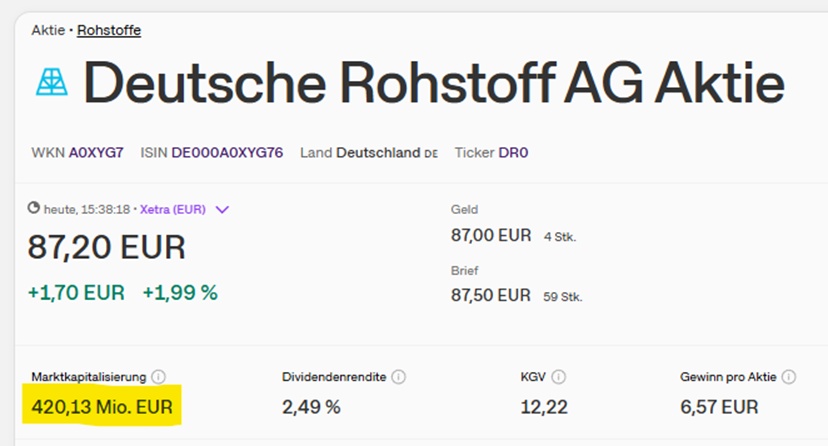
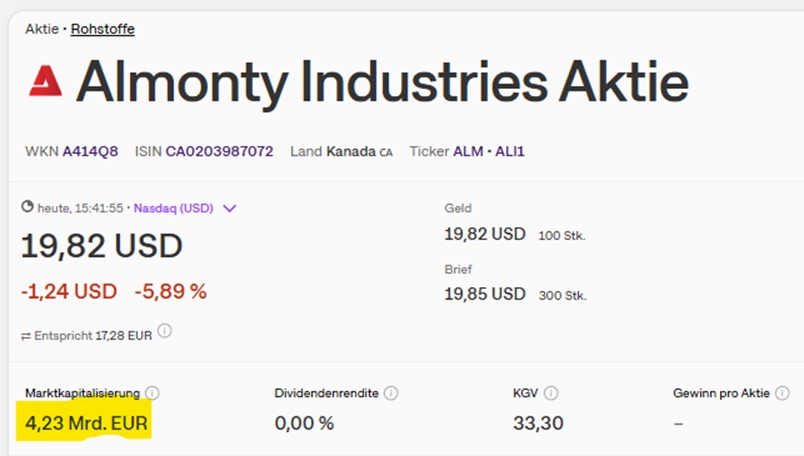
When it comes to tungsten, the biggest player outside of China is Almonthy $AII (-3.33%) ; it would also be interesting to note the involvement of $DR0 (+0.84%) Deutsch. Rohstoff’s stake in Almonty.
It’s probably well known that the Western world wants—and needs—to become independent of China. That’s why I won’t write much more on this topic.
But it does explain the huge RUN on Almonty stock.
Performance:
1 year +831.34%
3 years + 2,468.17%
Since demand for tungsten remains high and continues to rise despite the disruption from China, I still see $AII (-3.33%) .
But the stock is already a hot commodity.
Feel free to share your thoughts on this in the comments.
Anyway, I decided to look into tungsten a bit today.
🔥 Key Properties of Tungsten
🧱 Physical Properties
- Highest melting point of any metal: 3,422 °C → ideal for rocket engines, hypersonic missiles, and heat shields.
- Very high density: similar to gold → perfect for armor-piercing ammunition and radiation shielding.
- Extreme hardness → used in tools, drill bits, armor, and industrial equipment.
- High tensile strength at high temperatures → remains stable where other metals have long since failed.
⚡ Electrical & thermal properties
- Very good thermal conductivity → important for electronics, semiconductors, lasers, and high-performance lighting.
- Good electrical conductivity → Used in electrodes, contacts, and specialty components.
🛡️ Chemical Properties
- Corrosion-resistant
- Low thermal expansion → Ideal for precision components in extreme environments.
🚀 Why Tungsten Is Considered a “Supermaterial”
The article explains that rockets, hypersonic weapons, and spaceflight require increasing amounts of tungsten because it withstands extreme temperatures and atomic oxygen in space. This makes it a strategic raw material for:
- SpaceX rockets
- Hypersonic weapons
- Satellites
- Defense systems (e.g., Rheinmetall)
- High-temperature engines
While researching tungsten, I came across a new supermaterial .
So I dove even deeper into the engine room for you and looked for alternatives to tungsten—as well as raw materials with properties similar to tungsten.
And I looked into what other raw materials are used in the defense and aerospace industries.
🧪 Which materials are realistic options?
Heat resistance, lightweight and use in hypersonic and spaceflight projects point to a very small group of materials:
Most likely candidates
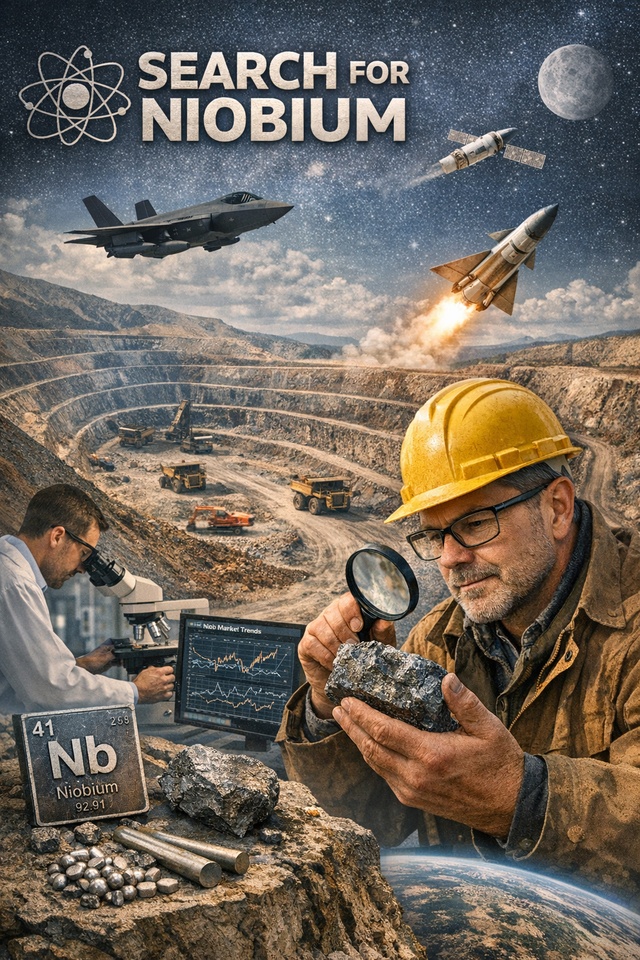
Niobium
- Highly heat-resistant
- Lightweight
- Used in rocket engines, turbines, and superalloys
Tantalum
- Extremely temperature-resistant
- Corrosion-resistant
- Used in aerospace and defense
Molybdenum
- High melting points
- Component of many superalloys
High-performance ceramic matrix composites (CMC)
- Ultra-light
- Heat-resistant up to > 2,000 °C
- Increasingly used in hypersonic missiles and spaceflight
Less likely, but possible
- Titanium aluminides (lightweight + heat-resistant)
- Rhenium alloys (extremely heat-resistant, but very expensive)
🎯 Most likely material (synthesis)
The description best fits best to niobium:
- Combination of lightness + temperature resistance
- Used in hypersonic superalloys
- Used in rockets, turbines, aerospace
- Defense demand (Rheinmetall reference applies)
- Material share in jets (NGAD reference applies to niobium alloys)
👉 My best guess: The supermaterial is niobium.
My friends, who among you has ever heard of niobium or is familiar with this material?
🚀
My friends, after extensive research, I’ve found an alternative to tungsten that’s already being used in industry.
But for us as investors, here comes the more interesting part.
Who are the producers of the supermaterial niobium?
📈 Which stocks are realistic candidates?
🔥 A) Niobium producers
CBMM (Companhia Brasileira de Metalurgia e Mineração)
- Global market leader (70–80% market share)
- Not publicly traded
NioCorp Developments (U.S./Canada)
- Elk Creek Niobium Project
- Publicly traded (small-cap)
- Classic “insider tip” character
Magris Resources (Niobec Mine)
👉 NioCorp is the only publicly traded pure-play niobium company.
That’s a perfectly with NioCorp Developments:
- The only publicly traded niobium pure play
- Has been in development for years, hence “undervalued”
- Often cited as a strategic metal project for defense and space
- Could benefit significantly if demand for niobium rises
👉 Most likely stock: NioCorp Developments (NB / NIOBF) $NB (-4.14%)
After further research, I’ve also found
Dear readers, you might also find this interesting.
Which companies use NIOB, and is it strategically important?
Companies that use niobium primarily come from three sectors: Aerospace, Hypersonic/Defense , and High-Tech Industry. Niobium’s technical properties—extreme heat resistance, high strength, and good workability—make it indispensable in these fields. The following sections will show you who uses niobium, and for what purposes and why it is strategically important.
🚀 Aerospace
Niobium is used in engines, rockets, and hypersonic vehicles because it can withstand temperatures exceeding 2,400 °C while remaining relatively lightweight. Sources indicate that niobium has been used since the Gemini and Apollo programs .
Typical users:
- NASA – historical and modern rocket programs
- SpaceX – heat shields, engine components
- Blue Origin – High-temperature components
- Aerojet Rocketdyne – Rocket engines
- GE Aerospace – Superalloys for turbines
- Safran – High-temperature components for aircraft engines
🛡️ Defense & Hypersonic
Niobium is essential for hypersonic weapons and modern defense systems because it can withstand extreme thermal stresses. Sources indicate that niobium is used in critical defense applications and that the U.S. government is actively investing in niobium productionto secure the supply.
Typical users:
- U.S. Department of Defense (DoD) – hypersonic programs, materials research
- Lockheed Martin – Hypersonic missiles, NGAD program
- Raytheon/RTX – Hypersonic and missile components
- Northrop Grumman – Space and defense systems
- Rheinmetall – High-temperature and armor applications (indirectly via suppliers)
- Elmet Technologies – Supplies defense companies with niobium products
🧪 High-Tech Industry & Energy
In addition to defense and aerospace, niobium is also used in electronics, energy storage, and specialty alloys.
Typical users:
- Intel, Samsung, TSMC – Niobium in thin-film and semiconductor processes
- Siemens Energy, GE Power – Turbine materials
- Additive manufacturing companies – Niobium powder for 3D printing (e.g., GAM, which manufactures niobium powder)
- Automotive industry – Niobium-alloyed steels for lighter, stronger car bodies
🏭 Who produces niobium?
Important for understanding the value chain:
- CBMM (Brazil) – Global market leader (privately held)
- China Molybdenum (CMOC) – Major producer of niobium and molybdenum
- NioCorp Developments – The only publicly traded pure niobium project
- Global Advanced Metals (GAM) – niobium oxides and powders, DoD partner
🔍 Why Niobium Is Becoming Strategic Right Now
The U.S. government is actively investing in the restoring domestic niobium productionto reduce dependence on imports. To this end, the DoD has $26.4 million to establish high-purity niobium production in the U.S.
This shows that: Niobium is a strategic metal for hypersonic technology, defense, and aerospace—and demand is rising.
My friends,
in closing, I’d be very interested to hear your thoughts.
What do you think of my approach?
Should I give you a detailed overview of the two niobium players I found?
@Get_Rich_or_Die_Tryin
@Multibagger
@Klein-Anleger And all the rest of you, my dear friends.