

$WBA has just been sold automatically in the securities account (ING). Does anyone have any idea whether this is automatically included in the loss account if you bought through it (like me)? Do I still have to do something or has the delisting issue been resolved?

Walgreens Boots
Ação
Ação
Ticker: WBA
WBA
Price
Discussão sobre WBA
Postos
54
1Ano·
Walgreens agrees to $350 million opioid settlement | Google faces antitrust challenge in the U.S.
Walgreens agrees to $350 million opioid settlement
Walgreens $WBA has agreed to pay up to $350 million with the U.S. Department of Justice after the company was accused of illegally filling millions of prescriptions for opioids and other controlled substances over a period of more than a decade. The well-known drugstore must pay at least $300 million to the government and could owe another $50 million if a sale, merger or transfer occurs before 2032. The lawsuit, filed in January in the U.S. District Court for the Northern District of Illinois, accuses Walgreens of knowingly filling millions of illegal prescriptions between August 2012 and March 2023. Despite these allegations, Walgreens denied the allegations and emphasized that the agreement allows it to settle all opioid-related litigation with authorities and focus on restructuring. The company thus faces the challenge of not only resolving legal issues, but also realigning its business to be more stable in the market going forward.
Google faces antitrust challenge in the USA
In the USA, Google is facing $GOOGL (-0,92%) faces an existential threat as the US government has set itself the goal of breaking up the company due to its monopoly-like behavior in the search engine sector. Hearings began in a Washington court on Monday and it is now being determined how the company should be punished. Federal authorities asked in their opening arguments that the court take drastic action to prevent Google from continuing to enter into monopoly-like contracts with companies like Apple that protect its search engine from competition. Google's lawyer countered that the proposed measures would not promote competition, but could unfairly favor smaller competitors. This lawsuit is the result of a lawsuit filed four and a half years ago accusing Google of using its power on the Internet to hinder competition and innovation. A federal judge has already found that Google has entered into anti-competitive contracts to establish its search engine as the preferred source of information on various devices. The upcoming negotiations will be decisive in determining how the competitive situation in the online sector will be shaped.
Sources:
https://finance.yahoo.com/news/walgreens-pay-350-million-u-024811733.html
https://finance.yahoo.com/news/google-face-off-us-government-002008266.html
22

1Ano·
Walgreens agrees on settlement
The US pharmacy chain/drugstore Walgreens $WBA has agreed a settlement of 300 million US dollars with the US government. The settlement relates to allegations that the company supplied large quantities of illegal prescriptions for powerful painkillers such as opioids without adequately verifying their validity. The lawsuit was brought as part of the US judiciary's extensive efforts to deal with the opioid crisis. Walgreens said it wanted to take responsibility with the settlement without admitting guilt. The company emphasizes that it has now introduced stricter internal control mechanisms to prevent such incidents in the future.
The news is based on what I personally consider to be reputable sources. No investment advice. Follow me for more updates!
finance.yahoo.comWalgreens to pay $300 million in US opioid settlement
22

1Ano·
Walgreens Boots Alliance Q2'25 Earnings Highlights
🔹 Adj. EPS: $0.63 (Est. $0.52) 🟢
🔹 Revenue: $38.6B (Est. $38.03B) 🟢; +4.1% YoY
🔹 US Healthcare Sales: $2.15B (Est. $2.27B) 🔴
🔸 Withdrew FY25 Guidance due to pending acquisition by Sycamore Partners
🔹 Merger expected to close in Q4 CY25; WBA will go private
🔸 No FY25 call or webcast held
Segment Performance (Q2 FY25)
U.S. Retail Pharmacy:
🔹 Sales: $30.4B (+5.3% YoY)
🔹 Comparable Rx Sales: +12.2%
🔹 Retail Sales: -5.5%; Comp Retail Sales: -2.8%
🔹 Adj. Op. Income: $487M (↓35% YoY)
International:
🔹 Sales: $6.06B (+0.6% YoY; +4.1% CC)
🔹 Boots UK Comp Pharmacy Sales: +5% CC
🔹 Boots UK Comp Retail Sales: +5.1% CC
🔹 Adj. Op. Income: $234M (↓4.7% YoY)
U.S. Healthcare:
🔹 Sales: $2.15B (↓1% YoY)
🔹 VillageMD Sales: -6.2%
🔹 Shields Sales: +29.7%
🔹 Adj. Op. Income: $117M (vs. loss of $34M YoY)
🔹 Adj. EBITDA: $158M (↑$140M YoY)
Profitability and Cash Flow
🔹 GAAP EPS: $(3.30) (includes $4.2B in impairment charges)
🔹 Adj. Net Income: $543M (↓47.6% YoY)
🔹 Adj. Op. Income: $785M (↓12.8% YoY)
🔹 Operating Cash Flow: $(199)M (improved YoY despite $969M in legal settlements)
🔹 Free Cash Flow: $(418)M (↑$192M YoY)
Management Commentary
“We remain in the early stages of our turnaround... cost discipline and U.S. Healthcare gains were offset by front-end softness and legal settlements.”
— Tim Wentworth, CEO
33
1Ano·
The S&P 500 inclusions are being announced Friday:
Potential candidates to be added:
$TTD (-0,3%) The Trade Desk
$HOOD (-1,11%) Robinhood
$COIN (-2,34%) Coinbase
$APP (-0,8%) Applovin
Potential candidates to be removed:
$WBA Walgreens
$INTC (+2,73%) Intel

1Ano·
Walgreens is going private in $10 billion deal
$WBA WALGREENS BOOTS ALLIANCE TO BE ACQUIRED BY SYCAMORE PARTNERS IN A DEAL WORTH UP TO USD 23.7 BILLION; SHAREHOLDERS TO RECEIVE USD 11.45 PER SHARE IN CASH $WBA


1Ano·
I didn't sell it, so I didn't lose it ... did I? (Loss P0rn)
Everyone only ever shows their winners, but let's be honest - that's boring.
I'm going to turn the tables and present you with my own personal financial disasters. Because who diamond hands need a thick skin.
My investment strategy?
- Hold for at least Hold for 5-10 years (i.e. enough time to ride out a complete market crisis).
- A maximum of 1% of the portfolio in speculative stocks (haha, if only that were the case).
- No stop loss, because I prefer to look straight into the abyss.
Here are my highlights from the "Let's burn down the portfolio!"-category:
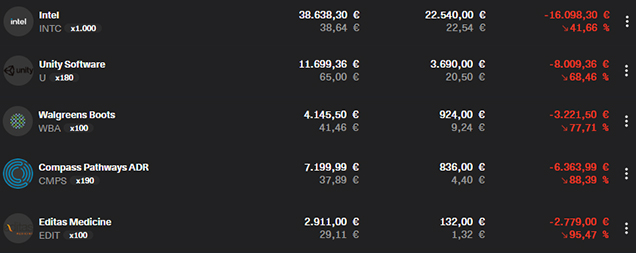
Intel (-41%) $INTC (+2,73%)
I thought I was buying a solid chip giant. Turns out: I bought a museum walk through the glory days of 1995. While Nvidia is flying to the moon, Intel is barely keeping its head above water like an old Windows 98 computer.
Unity Software (-68%) $U (+2,12%)
"Gaming is the future! Unity is THE platform for developers!" - At least that's what I thought. In reality, Unity has bugged itself so badly that not even a game patch would help. At least I have the consolation that my shares are more lag than a mobile game with too much advertising.
Walgreens Boots Alliance (-77%) $WBA
Pharmacies? Safe bet! People always get sick! It's just stupid when a company is managed in such a way that even a pharmaceutical giant looks like it has overdosed itself.
Compass Pathways (-88%) $5Y6A
Psychedelic therapy is the future! Or so I thought. But my investment journey was more like a wild drug trip that ended directly in the financial hole. Instead of astral travel, it was just capital destruction.
Edita's Medicine (-95%) $EDIT (-3,6%)
Genetic engineering and CRISPR? Technology of the future! It's just a shame that my investment was deleted faster than faulty DNA. Editas has actually managed to edit itself out - and my capital along with it.
And you?
Do you also have a "Loss P0rn" story you want to share?
Or are you smarter than me and use stop losses? 😂
117117
60 Comentários
1Ano
Thanks for the glimpse into the future of many GQ portfolio satellites! 😁
The only difference: you talk about it publicly. 💪
Honestly, I used to have times when my portfolio looked like this. It was a while ago. But those times prompted me to look for strategies that would save me from looking like that. It can't happen to me like that anymore. 😬
The only difference: you talk about it publicly. 💪
Honestly, I used to have times when my portfolio looked like this. It was a while ago. But those times prompted me to look for strategies that would save me from looking like that. It can't happen to me like that anymore. 😬
•
2828
•
1Ano·
Trump's new tariffs, rising inflation and a trade war on the horizon?
In this post, I’d like to highlight the new U.S. tariffs and their potential economic consequences. I’ll discuss the background and the possible effects on inflation and businesses, as well as the winners and losers on the stock market.
Again, please note that the stocks mentioned here do not constitute investment advice; they are merely examples of potential beneficiaries or losers as trade restrictions intensify. Past performance is no guarantee of future returns.
__________
In this post:
- Impact on Inflation
- New Tariffs Take Effect
- Countries’ Reactions
- Consequences for the Global Economy
- Winners & Losers
- Investment Opportunities
__________
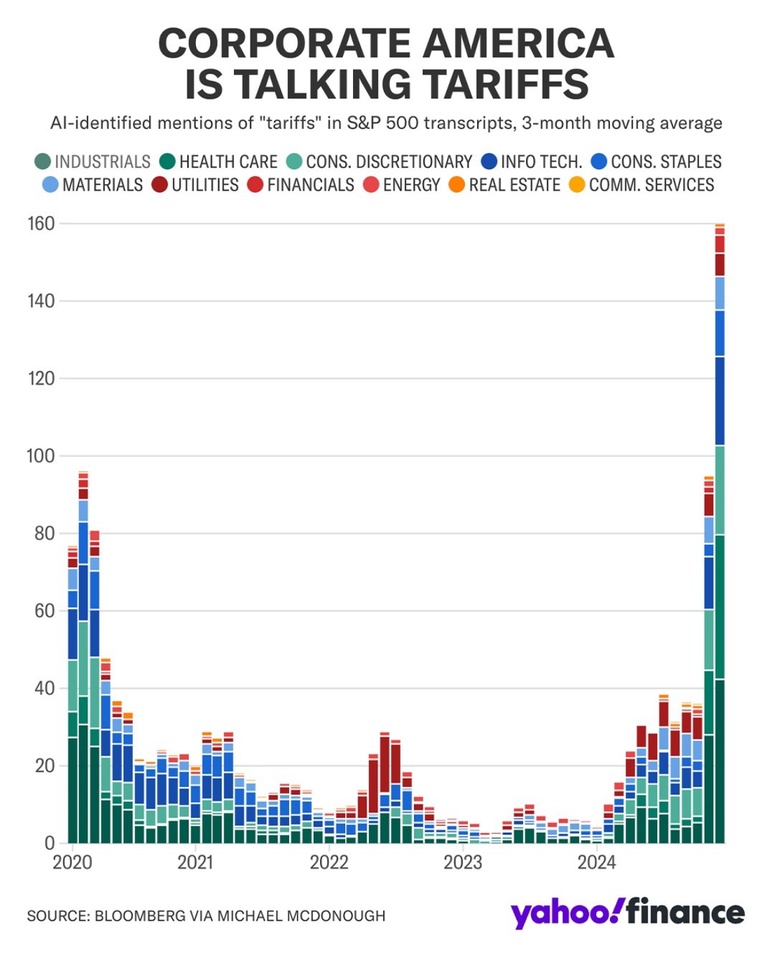
The topic of “tariffs” is currently not only very prominent in the media, but also in recent earnings calls by S&P 500 companies, where the term “tariffs” was already discussed in the context of a sharp increase, as shown in the following chart [1].
The chart shows that the discussion about tariffs has intensified over the past few months and is having an increasingly significant impact on the outlook in companies’ earnings reports.
The data is presented as a three-month average and broken down into various sectors, including, for example, industrials, healthcare, consumer goods, information technology, etc.
I’m curious to see how the stock markets will perform in the coming week. In addition to the ongoing earnings season, the topic of “tariffs” will certainly dominate.
Since the announced heavy tariffs were not immediately enforced after Trump took office—leading to a “slight” sigh of relief—there could now be a new reaction in the markets, as was already seen on Friday evening was on Friday evening when the markets turned around toward the end of the day.
A looming trade conflict could not only affect individual companies but also further fuel inflation in the U.S.:
💰 Impact on inflation
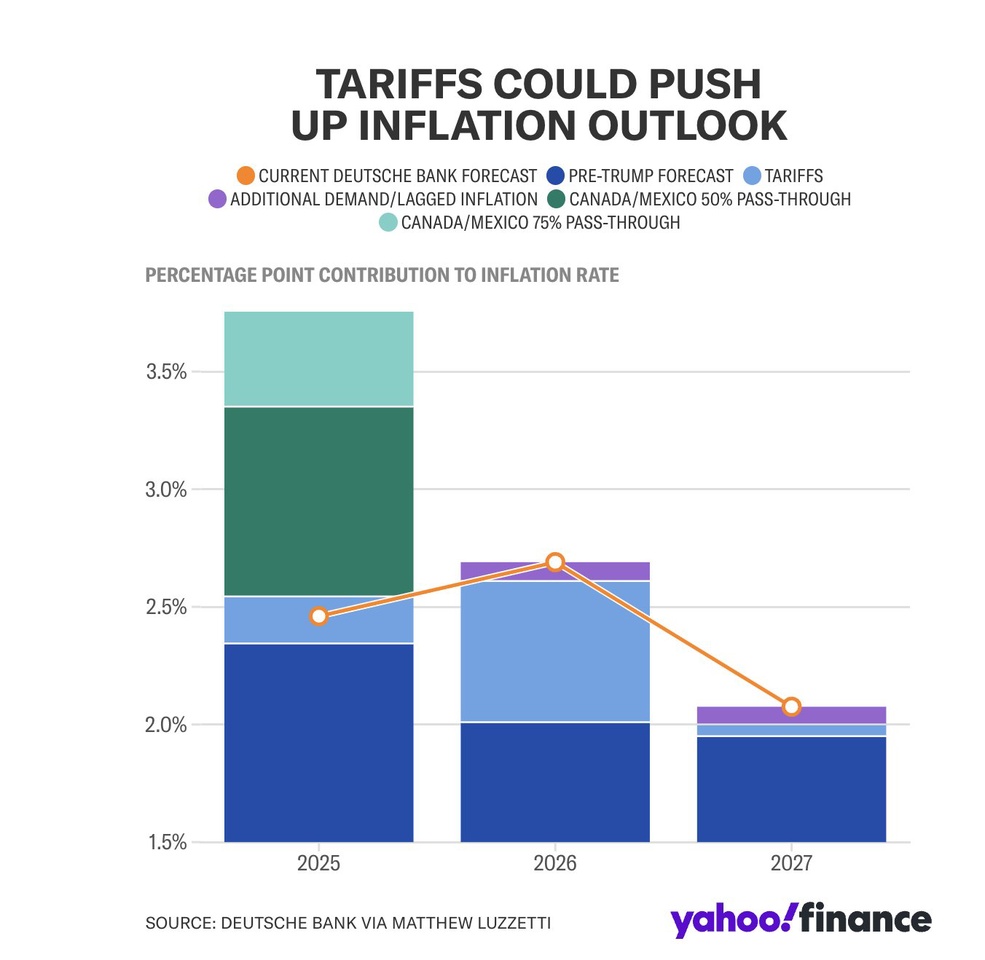
On January 31, Deutsche Bank already issued a forecast on the potential impact of tariffs on the inflation rate [2]:
The chart compares the current forecast with the forecast from before the “Trump” era and takes into account various scenarios for the pass-through of tariffs by Canada and Mexico.
Two scenarios are considered: one with a 50% pass-through of tariffs (additional increase shown in dark green) and one with a 75% pass-through (light green). It becomes clear that, according to this, the inflation rate could rise sharply again this year and then decline again by 2027.
🛃 New Tariffs in Effect & Further Measures Planned
As of today, February 1, 2025, the U.S. government—specifically Donald Trump—has imposed new import tariffs on Mexico, Canada, and China:
- 25% on imports from Mexico and Canada
- 10% on imports from China
According to the White House spokesperson, these measures are, among other things, a response to these countries’ failure to stop the influx of fentanyl and illegal immigrants into the U.S. [3]
But that’s just the beginning:
Starting in mid-February, the U.S. will also impose tariffs on strategic goods [4], including:
- Computer chips
- Pharmaceuticals
- Steel, aluminum, and copper
- Oil and gas imports (though not until February 18, with reduced 10% tariffs to avoid immediately driving up U.S. gas prices).
🚨 Trump Bets on Escalation—Canada Announces Retaliation
Yesterday, Canadian government officials, including Foreign Minister Mélanie Joly, tried in vain to prevent the tariffs in Washington.
Before departing for Mar-a-Lago, Trump made it clear [5]:
“We have a $200 billion trade deficit with Canada. Why should we subsidize Canada?”
The EU could also soon be targeted, as Trump hinted:
“Absolutely! The European Union has treated us so terribly!”
🔄 Canada’s response:
Prime Minister Justin Trudeau announced that Canada will not back down and will respond with “swift and robust countermeasures.”
The government is planning a three-stage retaliation strategy [5]:
- 1️⃣ Targeted punitive tariffs on U.S. products originating from Republican states (e.g., orange juice, whiskey, ketchup, peanut butter, and motorcycles).
- 2️⃣ Tariffs on steel products and machine parts from the U.S.
- 3️⃣ Escalation: Halting exports of oil, gas, and electricity to the U.S.
This last step, in particular, would be a double-edged sword, however, as Canada is heavily dependent on energy cooperation with the U.S.
Economic experts in the U.S. are already warning of the consequences of a trade war [5]:
- The new tariffs could increase the cost of living for an average U.S. household by $800 per year.
- The oil and gas tariffs could raise the price of gasoline in the U.S. by up to 20 cents per liter.
But Trump remains firm:
“There may be disruptions in the short term, but in the long term, the tariffs will make us very rich and very strong.”
🌎 Possible consequences for the global economy
(a) Rising prices in the U.S.
- Technology & Electronics: Higher chip prices are affecting companies such as Apple $AAPL (-0,05%) , Dell $DELL and HP $HPQ (-0,35%) , as many of their components come from China.
- Healthcare Costs: Pharmaceutical companies such as CVS Health $CVS (-0,7%) and Walgreens Boots Alliance $WBA are expected to face higher procurement costs.
- Construction & Infrastructure: Higher steel prices are weighing on companies such as Lennar $LEN (+0,81%) , D.R. Horton $DHI (+0,02%) and Caterpillar $CAT (-2,11%) .
(b) Retaliatory measures & new trade wars?
- China could impose tariffs on U.S. products, which could affect, for example, Archer Daniels Midland $ADM (+0,49%) , Boeing $BA (+0,48%) and Qualcomm $QCOM (+2,25%) .
- The EU could raise the cost of U.S. imports, which would affect companies such as Tesla $TSLA (-0,23%) , Ford $F (-2,73%) and General Motors $GM (-1,09%) .
(c) Impact on the Stock Market
- Volatility is increasing due to uncertainties about the consequences for various industries.
- Particularly affected: technology and automotive stocks with global supply chains.
🏆 Winners & Losers—Which companies will benefit, and which will suffer?
Potential beneficiaries of the tariffs
U.S. manufacturers of steel, aluminum, and copper
- Nucor $NUE (+0,15%) , U.S. Steel $X and Freeport-McMoRan $FCX (+0,88%) could benefit, as foreign competitors will become more expensive due to the tariffs.
Domestic pharmaceutical and biotech companies
- Pfizer $PFE (-0,63%) , Moderna $MRNA (+0,7%) and Eli Lilly $LLY (-2,35%) could gain market share.
Energy companies with U.S. production
- ExxonMobil $XOM (+2,77%) , Chevron$CVX (+2,97%) and Expand Energy $CHK (+0,42%) could benefit from rising prices for U.S. oil and gas.
Semiconductor manufacturers with U.S. production
- Intel $INTC (+2,73%) and Texas Instruments$TXN (+2,44%) have US factories and could gain market share.
😥 Companies that could suffer from the tariffs
Chip manufacturers with global supply chains
- Apple $AAPL (-0,05%) , NVIDIA $NVDA (-0,41%) , AMD $AMD (+2,31%) are dependent on imports from Asia and could face higher production costs.
Automakers with global suppliers
- Tesla $TSLA (-0,23%) , Ford $F (-2,73%) , General Motors $GM (-1,09%) are under pressure because components from Mexico and Canada could become more expensive.
Companies with strong export businesses
- Boeing $BA (+0,48%) and Caterpillar $CAT (-2,11%) are suffering from potential retaliatory tariffs.
U.S. retailers with a high proportion of imports
- Walmart $WMT (-0,64%) , Target $TGT (-3,19%) and Nike $NKE (-1,45%) may have to pass on rising prices to customers.
🧠 Possible investment strategies
Favor defensive sectors:
- Utilities (e.g., NextEra Energy $NEE (+0,32%) , Duke Energy $DUK (-0,2%) ) and healthcare companies (e.g., UnitedHealth $UNH (-1,51%) , Johnson & Johnson $JNJ (-1,38%) ) remain more stable.
Capitalize on long-term opportunities in “reshoring”:
- Intel $INTC (+2,73%) , Eli Lilly $LLY (-2,35%) , Nucor $NUE (+0,15%) could benefit in the long term.
Conclusion: Will the trade conflict continue to escalate?
With the new tariffs, Trump is taking a confrontational stance, and Canada, Mexico, and China are preparing retaliatory measures. If further tariffs on European goods follow, the situation could escalate even further.
❓What do you think—which stocks might be most affected? Which companies do you see benefiting?
Thanks for reading! 🤝
__________
Sources:
[4]
[5] https://www.tagesschau.de/ausland/amerika/usa-trump-strafzoelle-100.html
6464
31 Comentários

Great contribution. Not even 20 minutes to read this time 😁
•
55
•Títulos em alta
Principais criadores desta semana
Dados tempo real da LSX · Dados financeiros e EOD da FactSet