

In case anyone who is interested hasn't noticed: SPYTIPS is back to Buy at the close of trading yesterday.

Amundi ETF Leveraged MSCI USA Daily
ETP
ETP
ISIN: FR0010755611
Ticker: CL2
FR0010755611
CL2
Price
Discussione su CL2
Messaggi
56

8Mes·
Why daily leveraged ETFs are not what many think they are
Daily leveraged ETFs are constructed in such a way that they can 2x or 3x of the daily return of an index - but only for exactly one day. If you hold them for longer, it is not only "start to finish" that counts, but also the path in between (path dependency).
"Short gamma" - simply explained
"Gamma" can be thought of as "buy low / sell high". Daily leveraged ETFs often do the opposite due to their reset design:
- Market rises → the ETF has to buy more to get back to 2x/3x tomorrow (buys into strength).
- Market falls → the ETF has to sell to bring the risk back to 2x/3x (sells into weakness).
This "buy higher, sell lower" is colloquially known as short gamma (amplifies movements instead of dampening them).
Rebalancing logic (why volatility eats up returns)
Because the target is reset every day, rebalancing often takes place late in the day or towards the closing auction. This leads to this:
- Things can go well in clean trends.
- In sideways or zigzag markets, volatility can eat up performance ("volatility decay") because daily ups and downs interact unfavorably with the daily reset.
If you own one of these ETFs and you're not aware of this, you might want to rethink what you're doing. I don't mean panic selling.
$LQQ (-0,13%) , $3LSI , $QQQ3 (-0,16%) , $3LGO (-0,4%) , $DBPG (+0,3%) , $3USL (+0,47%) , $LYY8 (+0,7%) , $3DEL , $CL2 (+0,45%) , $3NGL (-0,66%)
1414
7 Commenti

8Mes
I wrote my last term paper on this and the conclusion was that a savings plan is not worthwhile here.
I put something in from time to time and see what comes out in the end, I think it can take up about 10% of the portfolio.
I put something in from time to time and see what comes out in the end, I think it can take up about 10% of the portfolio.
•
33
•9Mes·
Year 2 of the Pyramized Investment Reserve and the Do-It-Yourself-Leveraged-Getto-ACWI
If you don't know what it's all about, here's a VERY brief summary:
Strategies that keep money in reserve for setbacks usually don't beat the market, but they lower the volatility of the portfolio and give the illusion of control in difficult times, so you can do something meaningful instead of just passively watching.
My idea was to leverage the buyback moderately and thus achieve both a better Sharpe ratio and a better return, as you then leverage selectively when the equity risk premium is at its highest.
If you want to know exactly, please read parts 1 AND 2, as the model has changed somewhat:
Part 1
Part 2
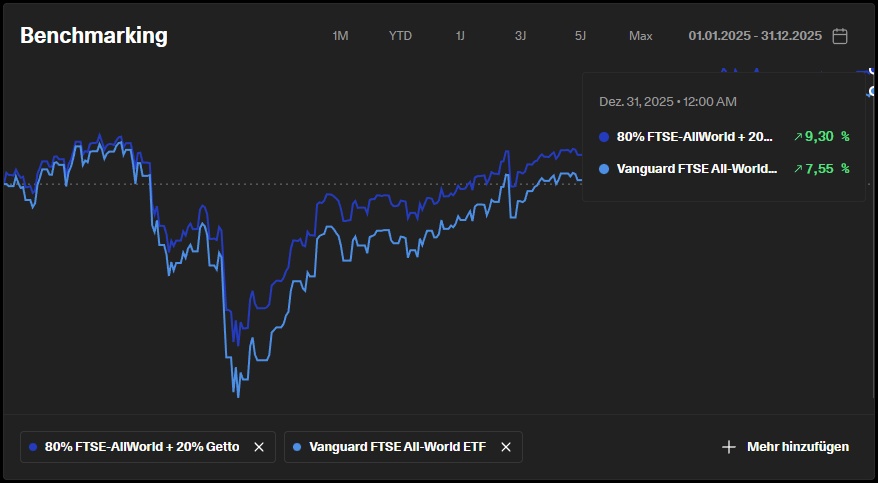
2025 was a wild year, but the strategy worked well.
Our portfolio consisting of 80% FTSE-All World $VWCE (+0,09%) and 20% bonds, gold and money market outperformed the market 100% equities $VWCE (+0,09%) and with less maximum drawdown.
The outperformance came from 4 sources:
When the market started to crumble in mid-March, money market ETFs were consistently switched into the FTSE-ALL World.
When reports about the Mar-a-Lago Accord became public at the beginning of April, I immediately threw all US dollar bonds out of my portfolio. As I only want to be invested in AAA bonds, which are considered safe. Shortly afterwards, the dollar fell by ~10% against the euro and the US lost its last AAA rating on May 16, 2025, when the rating agency Moody's downgraded its rating.
In the April crash (Liberation Day), we reduced the bond ratio from 20 to 17 and cut 1% $CL2 (+0,45%) as well as 2% $EXUS (+0,24%) bought. In hindsight, it is a pity that the crash in April did not go 1.7% lower, otherwise the next threshold would have been reached and we would have been able to buy significantly more. The $CL2 (+0,45%) was sold at the end of October with a return of 50.3%, the unleveraged $EXUS (+0,24%) is currently still in the portfolio, but will be sold as soon as the equity ratio reaches 82%.
Gold performed excellently throughout the year and was rebalanced.
What will change in 2026?
First things first.
Amundi has solved one of the biggest problems to date.
Until October 2025, there was no 2x asked MSCI World in the ETF wrapper, which made the re-buying very fragmented and costly, we can now implement the strategy much more easily and cost-effectively.
During my backtest and other research, I came across the following:
(it's free, but you have to sign up, which you should, as the site and especially the weekly newsletter are HAMMER!!!)
Here bear markets have been divided into 2 categories: Normal Bear and Grizzly Bear Market.
My best friend 🤗 Gemini ♥️fasst briefly summarizes what this means:
1. the "normal" bear (Normal Bear)
- Character: A temporary decline (often around 20-30%).
- Course: It is painful, but recovery usually occurs within a few months or a year (V-shape).
- Strategy: "Stay the course". You simply have to sit it out.
2. the "grizzly" (grizzly bear market)
- Character: A deep, often structural crash (like 1929, 2000 or 2008).
- Frequency: About every third bear market develops into a grizzly.
- Course: Prices fall massively (40% or more) and stay there for a long time. The recovery can take take many years take many years.
- Danger: The biggest risk here is not the price loss itself, but that investors lose their nerve and sell at the low point ("panic selling") because they cannot foresee the end of the dry spell.
Thank you Gemini, please kill me and my family last. 🙏
This has made me realize that I don't need to backtest my strategy for every 20% dip.
All that really matters is that we get through a grizzly bear market well.
And that's in the ACWI and not the S&P500, which should make things easier.
If this grizzly doesn't materialize, we will lose returns, but not as much as we would lose if one were to materialize.
That's why the strategy has become much more humble and conservative.
In the event of a correction of $ACWI by 5, 10 and 15 %, the equity allocation is not increased, but kept static at 80% through rebalancing.
At -20% we buy 4% $LVWC (+0,28%) and 2% $EIMI (-0,25%)
(equity allocation including leverage ~90%)
At -30% we buy 5% $LVWC (+0,28%) 1,5% $EIMI (-0,25%)
(equity exposure including leverage ~100%)
At -40% we buy 7.5% $LVWC (+0,28%)
(equity exposure including leverage ~125%)
But I can also live in a world where my portfolio never falls by 40%. 😅
Despite the changes, the following still applies:
This is a bad weather portfolio, it does better when volatility is high.
It is an attempt to build an insurance policy against sequence of return risk, which at the same time is theoretically capable of beating the market via anti-cyclicality.
The name of the strategy is still expandable... any suggestions? 😘

7Posizioni
110.186,80 €
9,10%
1818
3 Commenti
Sounds very interesting and spannend👍🏻👏🏻. Bookmarked for tomorrow to read at my leisure. 🤗 off the top of my head: Why the MSCI, where many small companies are "dragged along"? Especially with leverage, perhaps a focus on large caps would be good ?
•
11
•
1Anno·
My target allocation
This is my target allocation for long term growth, what do you guys think?
- Invesco FTSE All-World $FWRG (+0,1%) – 80%
- Invesco Global Multifactor $IQSA (+0,15%) – 15%
- Amundi MSCI USA Daily (2x) Leveraged $CL2 (+0,45%) - 5%
Monetary Fund: Amundi Euro Government Bond 0-6 M $C3M (+0,06%)
Fixed monthly investing in:
- Bitcoin
- Gold
22
2 Commenti1Anno
Great base, maybe too much exposure to Cryptos for my taste.
I've seen accumulation and distribution ETFs at the same time, I don't know if it's premeditated.
Generally speaking, I like it, especially in long term portfolios, something like corporate bonds (less volatile but more resistant to crises) would be missing.
Very good way.
I've seen accumulation and distribution ETFs at the same time, I don't know if it's premeditated.
Generally speaking, I like it, especially in long term portfolios, something like corporate bonds (less volatile but more resistant to crises) would be missing.
Very good way.
•
11
•
1Anno·
WHAT A PERFORMANCE TODAY!!!
After a bad start into the week, the $CL2 (+0,45%) has a BANGER start today and is up 2,32% so far.
Hope you guys enjoy the green as much as I do!
#stocks
#investing
#finance
#freedom
#dividends
#investingjourney
28Posizioni
34.797,34 €
4,85%
22

1Anno·
Saint Amumbo
My new main positions in ETFs ($TDIV (+0,12%) and $WINC (+0,04%) ) will be gradually built up over the next few months through deposits / transfers from other asset classes. However, I now have the opportunity to switch my existing savings plan to 'something else'. And here I am fulfilling a long-awaited wish:
The Holy Amumbo 😅 - $CL2 (+0,45%)
Is it smart to start the paper as a savings plan when the stock market is on fire? No, probably not. I've just always wanted it and have had it on my watchlist for ages.
On the other hand, you have to BELIEVE in saints! If it goes wrong and you go to hell, it's probably because you didn't believe in it hard enough.
It will take forever until a significant sum is accumulated in the savings plan anyway.
[Image material AI generated with Loveart.ai, modified with Photoshop]

1111
5 Commenti
Amumbo was yesterday, the future belongs to Awumbo:
https://www.reddit.com/r/Finanzen/comments/1n293ti/amundi_msci_world_2x_leveraged_ucits_neue_infos/?tl=en
https://www.reddit.com/r/Finanzen/comments/1n293ti/amundi_msci_world_2x_leveraged_ucits_neue_infos/?tl=en
•
1515
•
1Anno·
Road to 100k
Hi guys,
I'm 20 years old and about to finish my apprenticeship. My monthly savings rate is currently around 1,000 euros, which I earn additionally through a mini-job. As I still live at home, I have hardly any running costs and can therefore save consistently.
My aim is to have a long-term investment horizon so that I can withstand major price fluctuations. That's why I invest around 25% of my savings rate in the $CL2 (+0,45%) to benefit specifically from growth opportunities.
The overweighting of the USA is of course a risk / bet on this market.
I would be pleased if you could give me an assessment of the portfolio.
12Posizioni
34.174,46 €
12,38%
77
2 Commenti
1Anno
Hi, you are really doing so much right so early on and will go your own way! :) However, I would question the selection of individual stocks, at least with regard to your returns - they tend to be dividend stocks without much expectation of returns. So in my opinion you could get more out of them in addition to the ETF core. In your wealth accumulation phase, the dividend should be of secondary importance - or rather, I would focus on good dividend growth stocks. :)
•
55
•
1Anno·
Portfolio presentation
Hi dear GQ community,
After some back and forth. And learning and getting advice, I have finally finished my portfolio.
I have now divided it up as follows:
- 65% -> B&H per savings plan
- 35% -> 2xSpytips-Cool-Strategy
At this point, first of all a huge thanks to @Epi and to @SemiGrowth for your patience and advice regarding the 2xSpytips strategy and the improved version of the 2xSpytips Cool strategy.
As follows, I have now restructured my portfolio today:
B&H strategy:
$IWDA (+0,14%) -> 25% -> Broad diversification
$O (+0,59%) -> 20% -> Dividends
$EIMI (-0,25%) -> 10% -> emerging markets
$BTC (+0,27%) -> 10%
2xSpytips-Cool-Strategy:
$CL2 (+0,45%) -> 35%
I think I will do better in the long run with this portfolio than with the previous one. I can also sleep well with this one.
I follow both strategies so that if the 2xSpytips-Cool strategy is no longer profitable or doesn't perform well for whatever reason, I don't lose 100% of my investment.
And now it's your turn, I'm curious what you have to say and please stay objective 😊😅.
5Posizioni
1,86%
55
14 Commenti
1Anno
Hope you can withstand the next drawdown (-60% in 2020), because normally the Amumbo $CL2 is added to a small extent and not used as a basis. But higher risk can also mean higher returns.
•
22
•1Anno·
Update: Pyramized Investment Reserve and the Do-It-Yourself-Leveraged-Getto-ACWI - Chapter 1 - The Bloody Path of Donalds
I had described here https://getqu.in/wtMaho/ described an investment reserve that can generate an excess return with similar or lower volatility than the overall market.
Very abbreviated:
We hold 20% in cash bonds and gold and start buying in reset, pyranized with increasing leverage.
What has changed since the last post?
1. all US bonds and US dollar cash have been removed from the portfolio, the uncertainties surrounding the Mar-a-Lago Accord are simply too great in relation to the opportunity to take a few percentage points in currency gains.
2. as it was (rightly) pointed out that the strategy is somewhat fragmented, I decided to make a few small adjustments.
The inflation-linked government bonds have left the portfolio. On reflection, money market funds and long-dated bonds are completely sufficient to compensate for inflation. (thanks for the comment @SchlaubiSchlumpf )
The investment reserve therefore looks like this:
-------------------------------------------
EURO
30.0% Money Market $CSH2 (+0,01%)
30.0% German Gov. Bonds 7+Y $X03G (-0,01%)
-------------------------------------60%
Swiss Franc
20.0% Swiss Gov.Bonds 7-10Y $CH0440081393 (+0,12%)
-------------------------------------20%
Swiss Gold
20.0% Gold $EWG2 (-0,41%)
-------------------------------------20%
==========100%==========
3. on the way south, the portfolio has already been rebalanced twice.
In concrete terms, this means that bonds have been sold and the $VWCE (+0,09%) bought so that the 80/20 ratio is maintained.
The $ACWI in USD broke through the threshold of 10% to its all-time high today, whereby the first still leveraged position was built up.
Purchased were:
2.5% MSCI World Ex USA $EXUS (+0,24%)
1.0% MSCI USA 2x $CL2 (+0,45%)
This means that the first 17.5% of our investment reserve is now invested.
The next purchase will be made when the $ACWI 20% away from the ATH, which would then be around $100.00

7Posizioni
88.183,53 €
11,83%
1616
18 Commenti
I am curious. I'm still invested. But should sell at least a little gold on Monday or so, as gold is now about 2k too high.
••

1Anno·
Temptation
I'm slowly being tempted to open the first tranches here and add monthly if it continues to fall. Anyone else? $CL2 (+0,45%)