$ASML (+0,17%) to the moon
ASML Holding ADR Representing
Azione
Azione
Ticker: ASML
ASML
Price
Discussione su ASML
Messaggi
40
10Mes·
Nov 19 / ASML — Taking a Win, Not Losing Conviction
Opportunity cost over comfort, especially in the current market environment
I sold my ASML position recently at just above $1,000 per share, locking in a solid 40% profit. But this isn’t a bearish take in any way. In fact, it’s not even a mild concern. ASML is still one of the best companies in the world, an untouchable monopoly, and the definition of a “buy and forget” stock. I didn’t sell because something broke, quite honestly I’d be surprised if this was the last time I own the stock. The only reason I sold is because the rally has run far hotter and faster than I anticipated.
ASML was trading at multi-year, if not historical, valuation lows when I bought. Now the stock sits closer to its long-term average again, and that changes the risk/reward, especially considering the abruptness of this re-rating. I simply don’t think this is the moment where ASML doubles from here anytime soon, nor do I think it’s going to collapse. Most likely the stock goes sideways for a bit and that’s fine. But with this kind of volatility in the market, going sideways isn’t a luxury, but opportunity cost.
And that’s exactly where my decision came from. Not fear, not profit protection, not lack of conviction, just pure portfolio math. I don’t mind holding a stock that fluctuates. However, I don’t see much point in holding a stock at the 1–2-year price target I had envisioned when I bought it. The market hands out better alternatives almost daily.
That’s why I rotated the 10k from the sell straight into Visa. A company that is no worse than ASML in terms of dominance, moat, or predictability, just in an entirely different sector. Visa trades at a forward P/E of around 25, the same level it reached during the 2022 lows. Net income and free cash flow are growing in the mid-teens as always, revenue around 11%, and FCF margins are an absurd 56%. So why am I even talking about it? Everyone knows that Visa is an incredible business with a balance sheet straight from Buffett’s dreams. Visa prints cash, Visa grows, Visa compounds. There isn’t much more to add.
Again, ASML is a great company with potential for the future, but short-term I don’t see much more wiggle room. I just think Visa’s current setup offers a better balance of growth, valuation, and risk, and that’s what counts in my opinion. ASML remains a world-class compounder, and I’ll almost certainly own it again.
44
1Anno·
Sep 24 / ASML – The Quiet Giant Wakes Up
The Market Finally Gets It? What a Re-Rating
ASML has been in both my portfolios since the very beginning, and I even published a comprehensive deep dive on the company earlier this year. For months, nothing happened – the stock was flat through the first half of 2024, and to many it probably looked boring.
Some even dared to question ASML’s market position amid the tariff crisis and comparatively “weak” earnings. But then things took a turn, and suddenly the market decided to pay attention. Shares are up almost 40% since the start of August. That’s not a small move for a company of this size. People love talking about Google’s resurgence, but many forget that ASML outperformed the giant in this period.
The obvious question to ask is: “what changed?” Did ASML suddenly reinvent semis? No. The story is exactly the same as before. The company holds a de facto monopoly in EUV lithography, the most important foundational technology for advanced semiconductors. If you want to build cutting-edge chips, you need ASML – no exceptions. That hasn’t changed in years, and won’t change anytime soon. As pointed out in my analysis, competitors, if any, are light-years behind. You can barely imagine a healthier position to be in. “The AI revolution hinges on Nvidia.” Yes, but don’t forget about ASML. Without them and their technology, all these advanced fantasies are nothing more than that: dreams. ASML is the backbone of this mega trend, and the market, apparently, has made this realization.
Maybe the real shift is in perception. For a long time, investors treated ASML like just another cyclical chip equipment play, ignoring the power of its monopoly. With a forward P/E around 30–35, the stock is actually still cheap historically and compared to other tech monopolies. Microsoft, Nvidia, even Salesforce – all command far higher multiples despite not holding quite the same chokehold on their industry.
So the question is whether the market has finally woken up to what ASML really is: not just another semiconductor stock, but the single most important supplier in the global chip arms race. The recent run looks like the market re-rating ASML closer to where it belongs. Something I am betting on with quite a lot of my holdings: whether it’s Salesforce, Adobe, or Fiserv, I believe markets misjudge the power of these leaders. Now one of them is finally getting close to a fair price.
For me, nothing changes. I continue to hold, as I always have. This is one of those rare “set and forget” positions, where the only real risk is if China has cooked something up in a secret lab – and even then, ASML would still dominate the Western market. You can bet that Trump wouldn’t allow Chinese chips to power “his” AI race. ASML is simply too important to ignore.
$ASML (+0,25%)
$ASML (+0,17%)
$NVDA (-0,89%)
$MSFT (+0,4%)
$CRM (+1,63%)
88
1 Commento
Hendan@Hendan
1Anno
•
33
•1Anno·
📈 August 2025 Portfolio Recap – First Month in Review
Introduction
It has now been a little bit over a month since I published my first portfolio review. I started this portfolio on July 23 and will continue to share monthly recaps from now to, hopefully, a very long time. My goal with these updates is simple: transparency. They are to document performance regularly, explain my investment process, and create a track record of decisions that I can learn from and reflect on over time. I will focus on what worked and what did not, while keeping the macro picture and long-term perspective over short-term volatility in mind. As I pointed out in my last review, I strive to become a hedge fund manager, and while there is still a long way to go, and many lessons to be learned, this portfolio will be my primary credential for the future.
Unlike a traditional investor letter, this recap is designed to be professional yet approachable, so it can serve as a portfolio log and as a resource or inspiration for anyone interested in equity investing. Yes, I am doing this primarily because I love investing and diving into company reports and stock market news, but I also want to share my journey and hopefully be able to use my passion in a professional setting. Every month, I will share performance vs. benchmark indices, most suitable to asset allocation, highlights of the strongest and weakest performance, and any changes I have made to my portfolio. This is not about sugarcoating results. Since I genuinely want to improve, there is no point in trying to sweet talk mistakes and slip-ups. Over time, this series should build a narrative of my investing journey, through wins, theses, and most importantly long-term performance and improvement. My daily commentary usually serves as an opinion piece on companies on my watchlist or the most recent macro news, while these monthly recaps are intended to provide a comprehensive guide on my investing principles and execution.
Portfolio Performance
For the month of August, my portfolio delivered a strong +5.25% total return. Not a bad start for month one, but it is always important to remember that short-term gains are not the most meaningful metric. Consistency is key. Nevertheless, to put this month’s return in perspective, here are important benchmarks:
- S&P 500: +3.33%
- Nasdaq 100: +2.42%
- MSCI ACWI: +3.84%
This means the portfolio outperformed both global and U.S. benchmarks in its first full month, which is encouraging.
However, the performance was not linear. The first few days were negative, but as the month progressed, companies reported earnings and news surfaced, several key holdings – particularly those in healthcare and fintech – drove strong upward momentum. This led to an intersection between my portfolio performance and benchmarks around the middle of the month. Since then, the portfolio has outpaced the market’s broader rally.
The outperformance cannot be attributed to one single stock, but rather a combination of multiple holdings reacting strongly. This is exactly how I want my portfolio to behave: diversified enough to avoid cluster risk, but concentrated enough to benefit meaningfully from each of my highest-conviction ideas. It is crucial to strike the balance between diversification and conviction, without sacrificing returns or risk management.
Allocation Snapshot
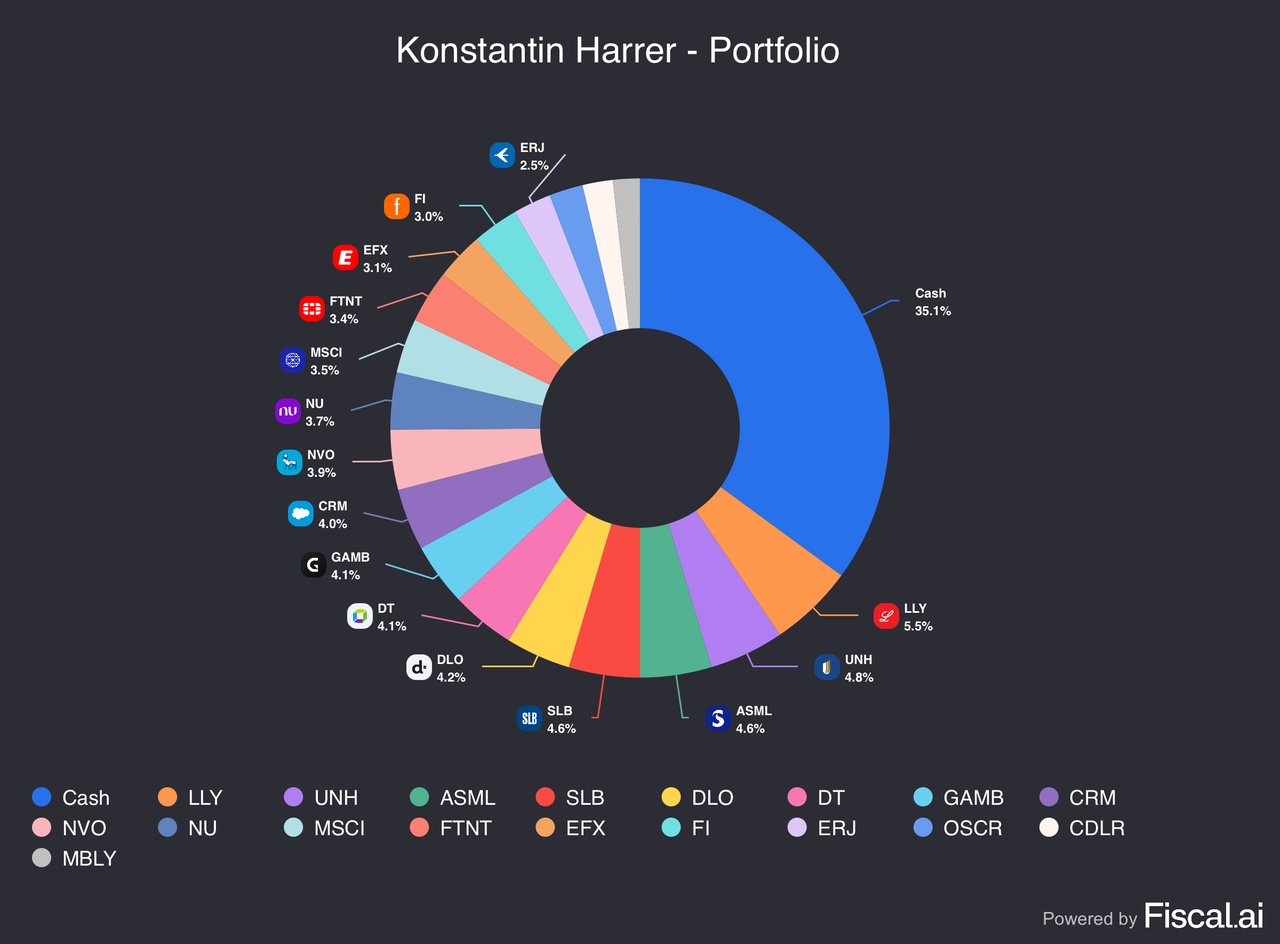
The portfolio currently consists of 18 equity holdings plus cash, with cash representing the single largest allocation at 35.1%.
This is a short breakdown of my portfolio:
- Cash: 35.1%
- Largest equity holding: Eli Lilly (LLY) at 5.5%
- Other top allocations include: UNH (4.8%), ASML (4.6%), SLB (4.6%), DLocal (4.2%), Dynatrace (4.1%), Gambling.com (4.1%), Salesforce (4.0%), Novo Nordisk (3.9%), and Nu (3.7%).
The high cash balance is intentional. As this is the first month of the portfolio, it is important not to rush into not-well-enough researched positions only to reduce the cash quota. Even for my highest-conviction positions, like LLY or ASML, I want to remain disciplined with entry prices and only buy on pullbacks, after I initiate my first tranche. As I emphasized in my last report, I aim to invest opportunistically in great companies at discounts, and reduce my cash balance to below 10% by the end of the year. In fact, over the course of August I already reduced my cash position from 56% to 35%, by adding to and opening new positions, especially during the first half of the month.
However, I am not in a rush to close my cash holding right now, since I am convinced that this rally off the April lows is highly unsustainable, considering the economic tensions and tariff regime in place. AI hype is driving this rally, and if the enthusiasm cools down, some interesting opportunities could present.
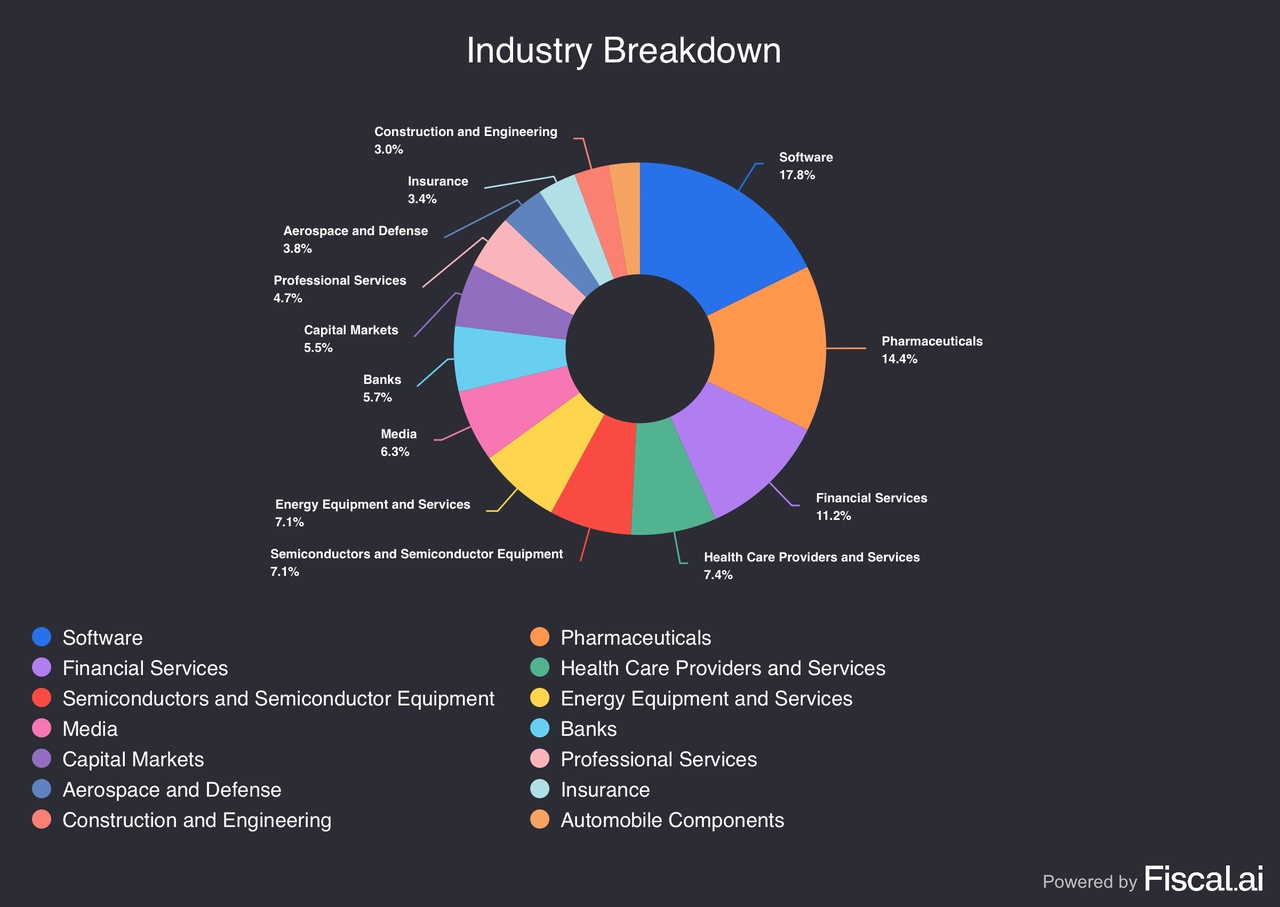
Since I aim for high returns with acceptable risk management, the exposure to fast-growing industries like fintech and software comes naturally. However, I also own more defensive players in the energy and healthcare spaces that, in my opinion, offer a healthy risk/reward ratio not recognized enough by the market. Indeed, some of the companies I hold fall on the more expensive spectrum, but they also boast immense growth and potential for the future. My focus does not lie on momentum or trends, but rather fundamentals and underlying prospects.
Strongest & Weakest Performers
Strongest performers:
- DLocal posted strong earnings in a volatile market environment, which led to a jump in the stock of more than 40% the day after. I remain extremely bullish on the company, with a forward P/E ratio of 23, reflecting a more than fair valuation even after the recent rally. The fintech disruptor is revolutionizing payment solutions across emerging markets, with still a massive TAM left.
- UnitedHealth recovered more than 30% from the lows hit at the beginning of the month, due to improving sentiment and the news of several super-investors, most notably Buffett’s Berkshire Hathaway, opening a position in the healthcare giant. The company has a very healthy balance sheet and a strong moat as the largest health insurer worldwide, and that is not even taking into account all its other ventures.
- Nubank outperformed on strong user growth (over 127 million customers across Latin America) and rising profitability. As the leading neobank in Latin America, Nu delivers >25% annual growth and holds a stellar position. The TAM is hard to overlook, as the neobank operates in one of the most underbanked regions worldwide.
Weakest performers:
- Salesforce slightly recovered from recently hit lows, while still underperforming the broader tech sector due to a perceived lack of AI implementation. However, Salesforce is the largest provider of CRM services worldwide and in a very good position for a recovery if any good news hits. The company has not taken part in the recent rally and could be in for a rebound.
- Gambling.com sold off after solid earnings due to a cautious outlook. Online betting is inherently cyclical, and the current economic situation does not look great. However, Gambling.com is already trading at an extremely cheap valuation. Somehow, the market still finds a way to send the stock further down.
In both cases, I view the weakness as sentiment-driven rather than structural. Investors’ confidence is shattered at the moment. However, my theses on these companies have not changed. I think both of them are misunderstood and victims of short-term focus, rather than the broader picture.
Portfolio Activity
Because this was the first month, most activity was centered around building initial positions. I deliberately capped position sizes at ~3–5% each, which allows me to add more over time if conviction grows or valuations improve.
- New Buys: SLB, FTNT, DT, CDLR
- Adds: CRM, GAMB, LLY, UNH
- Sells: M12
- Cash: Meaningfully reduced from >55% to ~35%
My portfolio is still “under construction.” While I reduced my cash position and invested aggressively, especially after earnings hit, I still hold a significant chunk of my portfolio in cash, which I plan to reduce by the end of the year. When I decide to buy into a company, I always do it in tranches and build a position over time, rather than buying all at once. Take Lilly for example: I opened an initial position in July and then bought multiple times this month after the earnings-related dip, and now I am almost 10% in the green with the position.
Market & Macro Context
Markets in August were shaped mainly by speculation around interest rate cuts and the earnings season, both of which contributed positively to my return. Several of my holdings jumped after stellar earnings, while others fell and therefore created opportunities to add, increasing long-term upside. Economic data was two-edged: while unemployment continued to increase, so did GDP, and tariff impacts were largely absorbed by corporations. My portfolio specifically profited from improving sentiment around some beaten-up healthcare names and increasing momentum for fintech and Latin American stocks. August has also been a good month for many tech investors due to continued growth and AI momentum.
Outlook
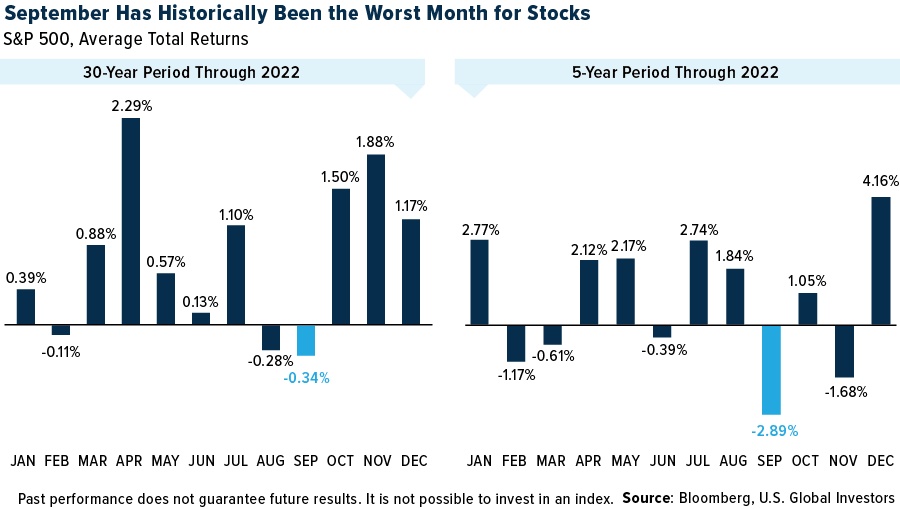
September historically is a very difficult month for markets. These are the key catalysts I will be looking at over the next month:
Jerome Powell has hinted at a possible rate cut at the next meeting, which the market has now priced in. It seems likely, at this point, that interest rates will be falling. However, if the Fed has a sudden change of heart, it could mean a cold awakening for stocks across the board.
On the other hand, if the most likely scenario – a rate cut – comes in, the already started shift from tech stocks to more cyclical industries profiting from lower interest rates could get a boost in September.
Apart from that, I still wholeheartedly believe that the current recovery rally from April lows is highly unsustainable and will eventually cool down, which could create buying opportunities. Whether that will be in September or a later month, I cannot determine. However, it seems strange to have such bullish sentiment ruling the markets, considering the tariff-inflicted strain on the economy. If signs of a cooling cycle thicken, markets could tumble very quickly.
Nevertheless, I am not worried about a broader pullback, since conviction is unwavering for the holdings in my portfolio. If anything, selloffs create possibilities to add to existing holdings or initiate new positions at attractive entry prices.
Closing Thoughts
This first month has been a promising start, with outperformance vs. benchmarks, and multiple adds to my highest-conviction positions. My strategy of investing opportunistically has proven correct so far. However, it has only been one month and I understand that markets fluctuate, which means that patience is key. While it is tempting to deploy cash all at once in order to ride the rally, that is not how I play the game.
In my daily comments I talked about many companies on my watchlist, some of which I will probably never own, because they do not reach my entry prices. That is not important. I have my eyes on countless stocks and continue to research new companies every day. There are always opportunities in the market, and often they are the ones most under fire.
Furthermore, I look forward to continuing this series monthly. Transparency, accountability, and consistency are the main goals. I strive to be the best investor I can possibly be, and this is my log. The target is as clear as ever: beating the market consistently and transforming that experience into the real world.
$ACWU (+0,11%)
$LYPS (+0%)
$CSNDX (-0,32%)
$LLY (+0,41%)
$UNH (+0,77%)
$ASML (+0,25%)
$ASML (+0,17%)
$SLB (+0,9%)
$DT (+0,88%)
$DLO (-0,56%)
$CRM (+1,63%)
$GAMB (+1,45%)
$NOVO B (-0,43%)
$NVO (-0,11%)
$NU (-0,7%)
$NU
$MSCI (+0,16%)
$FTNT (-0,38%)
$EFX (-0,33%)
$FI (+0,3%)
$ERJ (-0,16%)
$OSCR (+0,37%)
$CDLR (+2,62%)
$CADLR (+2,38%)
$MBLY
+ 5
19Posizioni
155.179,63 USD
4,21%
1Anno·
Aug 11 / Chips, Chips, Chips
A Creative Deal
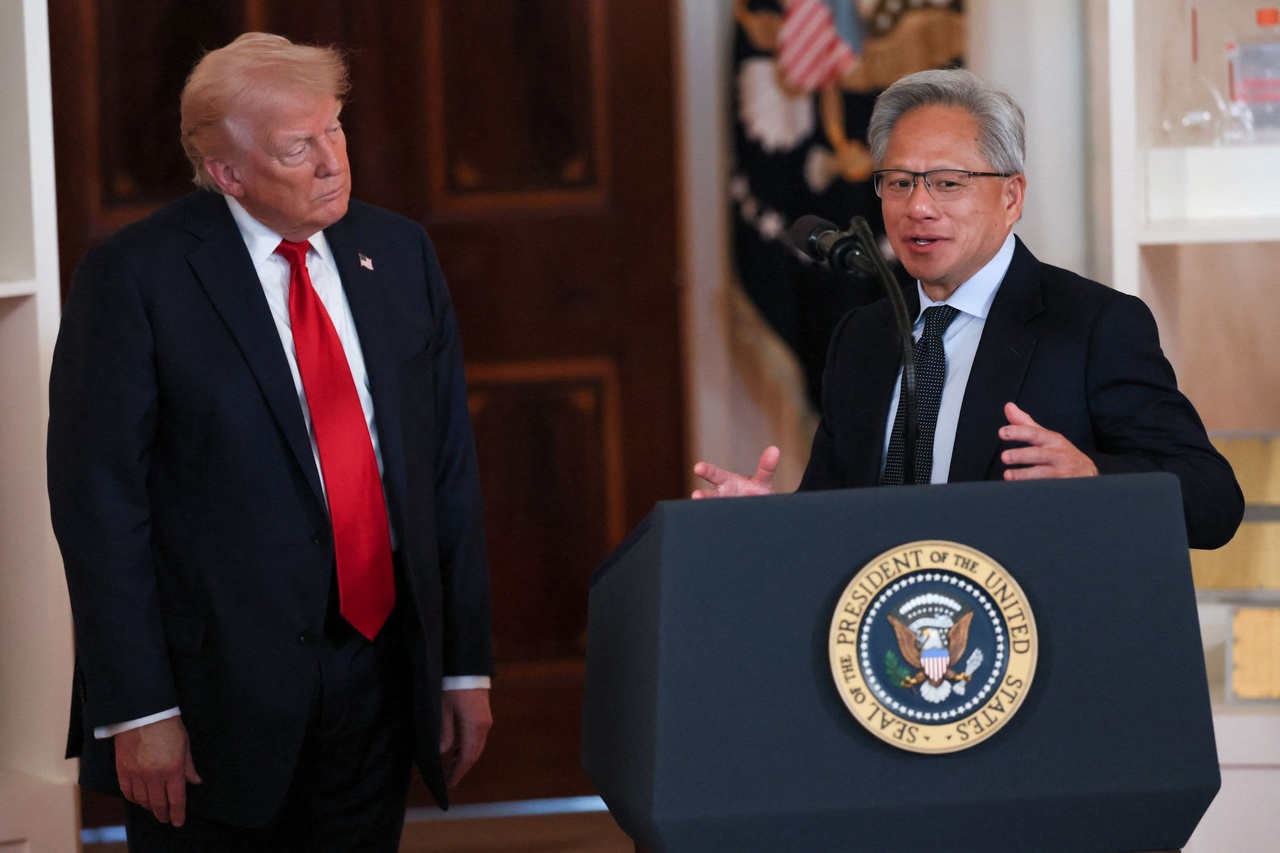
The semiconductor giants Nvidia and AMD have agreed to pay the Trump Administration 15% of sales made in China. Yes, you heard correctly. The U.S. President is lifting trade restrictions for advanced chip exports to China, after a rather peculiar deal was struck.
Interestingly enough, this completely contradicts Trump’s stated goal of isolating China globally and slowing down its progress in the AI race. “What for?”, is an appropriate question. That’s pocket change for the treasury, though potentially a massive boost for China’s innovation. Surely, it wasn’t Jensen Huang’s charm that moved the president.
I have been critical of some of Trump’s steps in the past, and while many these moves were double-edged, this one I truly don’t understand. He is giving away, or at least sharing, a technological edge, after having alienated the whole world already. So, you can’t argue that it’s a gesture of goodwill. You don’t run into a bar, shoot five people, and then offer them a beer for their troubles. That’s likely how China will take it as well – a desperate gesture from an out-of-control administration.
For AMD and Nvidia, however, it’s a major win, though it should be pointed out that 15% of all China sales is a strange metric, since it doesn’t consider costs and efforts for making or selling the products. But we are already used to oversimplified calculation methods, since April 2.
Nevertheless, I am sure that Jensen Huang is partying with a great feeling that $20 billion of his company’s revenue is safe – at least for now.
ASML – Short Summary of My Latest Analysis
Yesterday I published a full breakdown of ASML, an exceptional company, undervalued and misunderstood by the market. I’ll briefly outline my key points for an investment case here; if you are interested, check out the complete report on my profile:
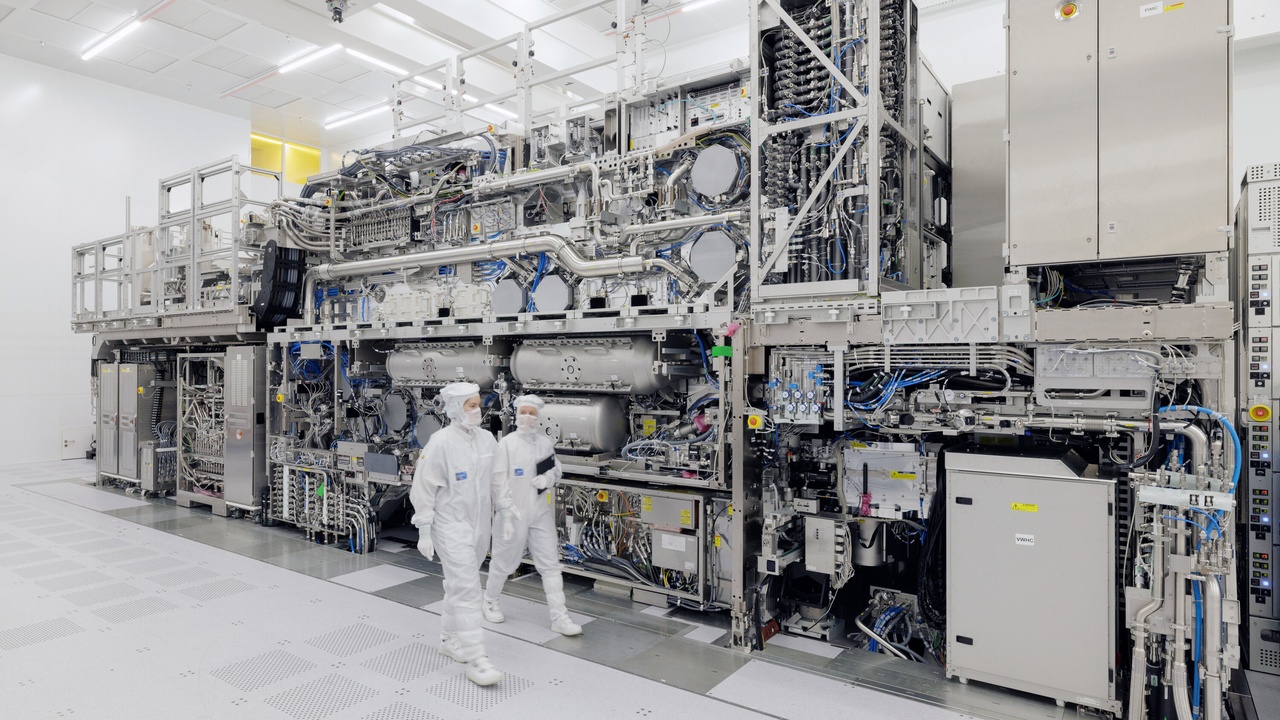
ASML is a monopoly. The company is the ONLY supplier of EUV litography machines. These machines lay the foundation for the production of the most advanced chips worldwide. Every major foundry is dependent on ASML’s technology. If they stopped servicing their machines or slowed innovation, the global chip industry would go back to the Stone Age.
People love to talk about Nvidia and AMD, but the truth is that you can forget the AI revolution without ASML. This gives the company enormous pricing power, which it further strengthens by striking exclusive partnerships with suppliers or simply buying them outright.
So, what do you get that for? A 40 P/E? 50, maybe? No, ASML’s stock is trading near multi-year lows at a 25 forward P/E ratio, representing as close to a no-brainer buy for the next five years as you can get.
$NVDA (-0,89%)
$AMD (-1,64%)
$ASML (+0,25%)
$ASML (+0,17%)
$2330
$TSM (-0,6%)
$INTC (-1,83%)
$005930
66
17 Commenti
Now he's already imposing 15% tariffs on his own chips.
What can you say except:
https://www.youtube.com/watch?v=r5sTTlph2Vk
What can you say except:
https://www.youtube.com/watch?v=r5sTTlph2Vk
•
22
•1Anno·
ASML – A Monopoly for a Bargain
1) Executive Summary
ASML is the world’s only supplier of extreme ultraviolet lithography (EUVL) systems. This technology is essential for the production of the most advanced chips worldwide.
The company’s monopolistic position in the semiconductor industry provides considerable pricing power and a large moat, forcing customers to buy from a single source: ASML.
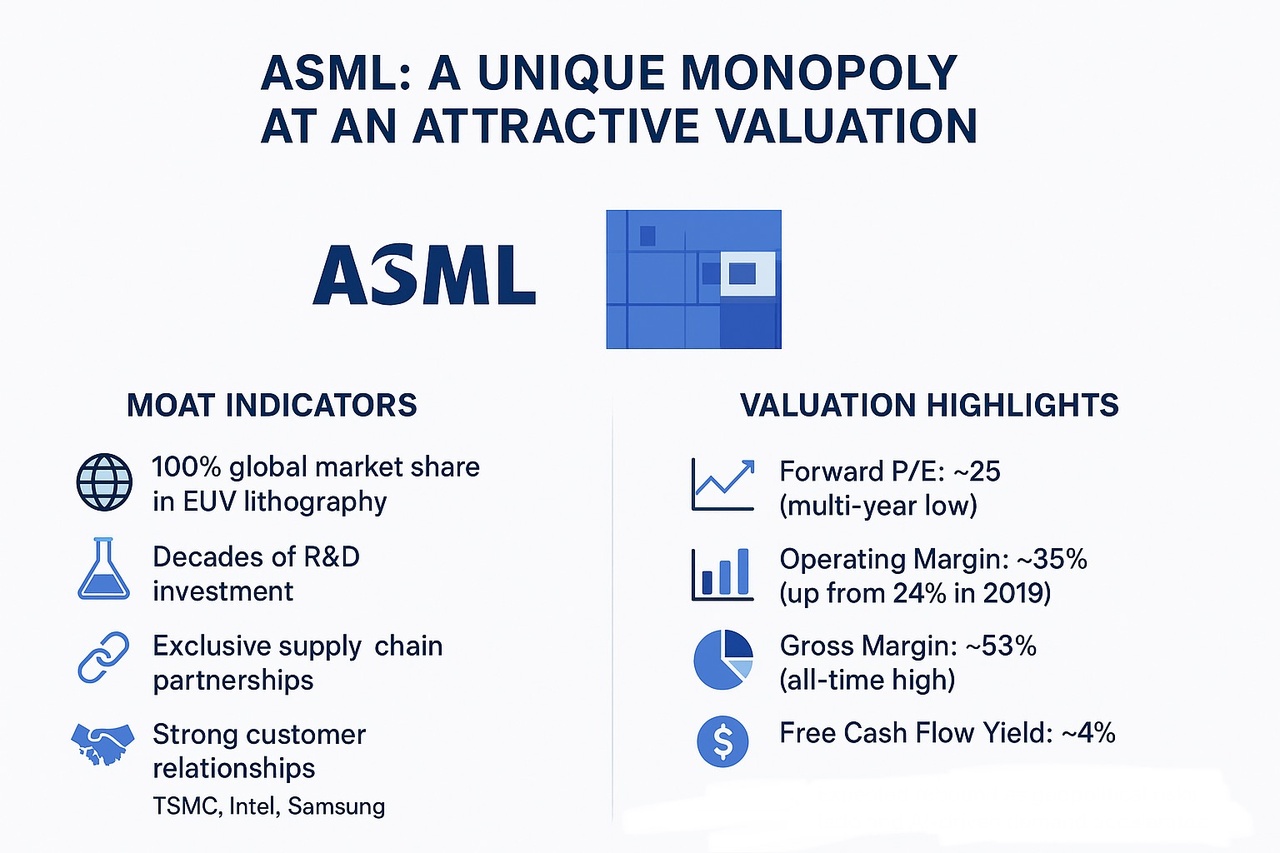
Its moat also does not show any sign of fading and is underpinned by decades of R&D, control over the supply chain, and global dependence.
Despite being at the forefront of the AI boom, ASML trades at a forward P/E ratio of ~25-26, well below its average, offering a rare opportunity to own a dominant, critical infrastructure provider, without a massive price tag.
2) Investment Thesis
ASML operates as a monopoly, plain and simple. The company is the exclusive supplier of EUVL machines essential for powering the AI revolution. ASML controls 100% of the global market for these machines – not a single known competitor. Additionally, ASML owns almost the entire value chain for these machines – it acquired multiple suppliers to fortify its position.
Furthermore, the company is not just reliant on selling EUVL machines, as service revenue is responsible for roughly 27% of all revenue. ASML is more than a simple manufacturer of some advanced lithography tools, it is a fully integrated high-tech company, laying the foundation for an AI-dominated future.
Subsequently, as these machines advance, chip foundries like TSMC and Intel have no other choice than purchasing newer models, in order to maintain their position. ASML is in a unique spot to set the pace of innovation for global foundries, which is powering the AI boom and data center expansion.
Finally, ASML illustrates a classic case of market mispricing. Investors undervalue the monopolistic position of the company and rather tend to focus on short-term trade headwinds. It would also be wise to consider that the force creating the tariff concerns, would never allow the U.S. to fall behind in the AI race, and there is no company more crucial to facilitating innovation in that regard than ASML.
This represents a (near) perfect opportunity to add a monopoly in the arguably fastest-growing industry worldwide, to your portfolio at a forward P/E ratio around 25, a multiple-year-low valuation.
3) Growth Drivers
While the AI race is fully underway now, underappreciated innovators like ASML drive this immense growth. Global demand for WFE (Wafer Fab Equipment) is rising rapidly, which is reflected by ASML’s healthy growth (Revenue CAGR ~15%, 2021-2025).
The scaling of AI models moves demand for WFE to more advanced machines and is likely to lead to a rise in total sold products (at a higher price point), as well as increased service revenue.
On top of the secular growth prospects, cyclical rebuild cycles, as happening for DRAM and NAND memory chip suppliers, play a major role in ASML’s global expansion. Companies like Micron need to level up their machines regularly to meet rising cloud demand.
Similarly, major chip foundries are constantly innovating, which can only be facilitated through advanced systems, delivered by ASML. In order to keep a competitive edge over competitors, global players like TSMC, will always buy the hottest and newest lithography machines, which benefits the only player in this market: ASML.
With rising CapEx, the company is in a prime spot to capitalise, which makes future growth estimates seem conservative.
4) Competitive Position
ASML’s technology is deeply embedded in the operations of the largest chip makers worldwide. Leading global foundries like Samsung, TSMC and Intel account for the lion’s share of ASML’s EUVL sales, which makes them heavily reliant on ASML’s maintenance services as well, boosting recurring, high-margin revenue generation.
To understand why ASML is in such a monopolistic position and has widened its moat over time, it is important to consider a few factors that prevent competitors from entering the market successfully.
A first technological barrier for other companies is the R&D intensity of the business: ASML has invested billions in EUVL for decades, apart from the millions of hours of development that were spent before the first commercial shipment.
Another substantial advantage for ASML is its control of the supply chain: the company has exclusive partnerships with Zeiss (optics) and Cyber (light sources), for instance, through partial ownership or full integration, ensuring value chain quality and safety.
Also noteworthy is the relationship ASML has built with customers over years of successful integration of its machines into global chip production facilities. Competitors would have to outshine ASML’s reputation or seriously undercut prices to lure foundries away.
5) Recent Financials
Highlights of the most recent Q2 2025 report:
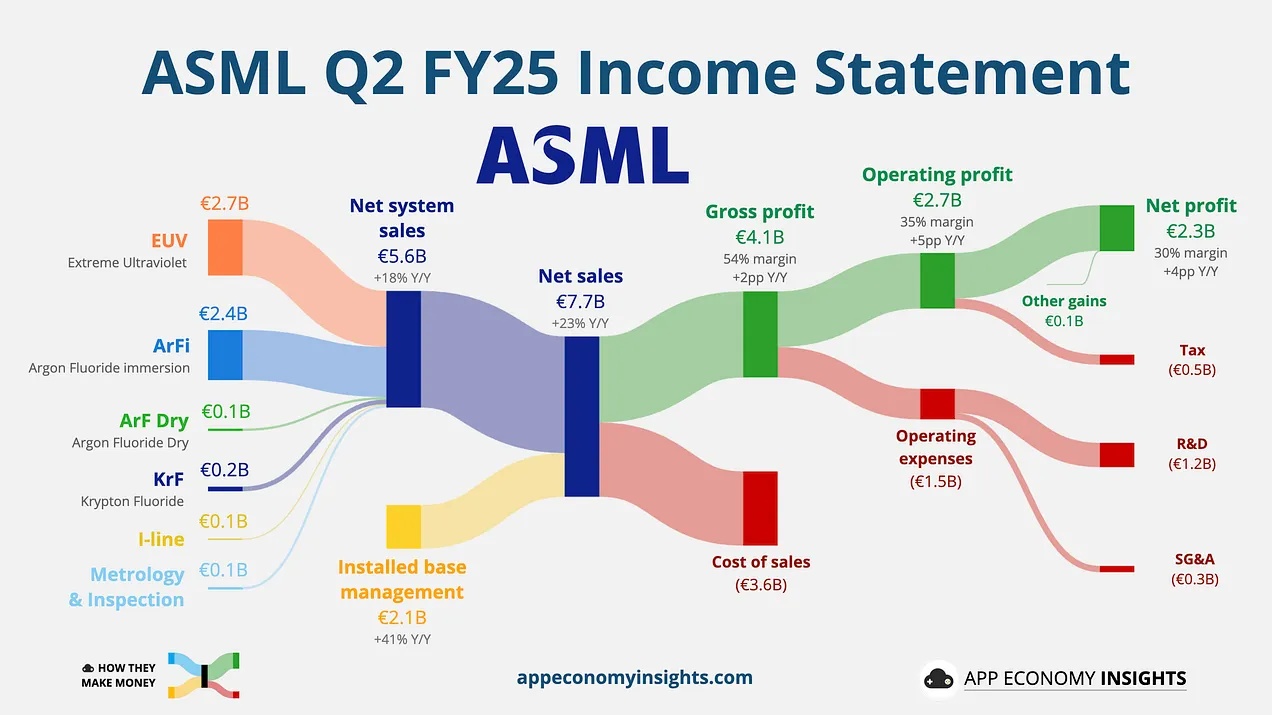
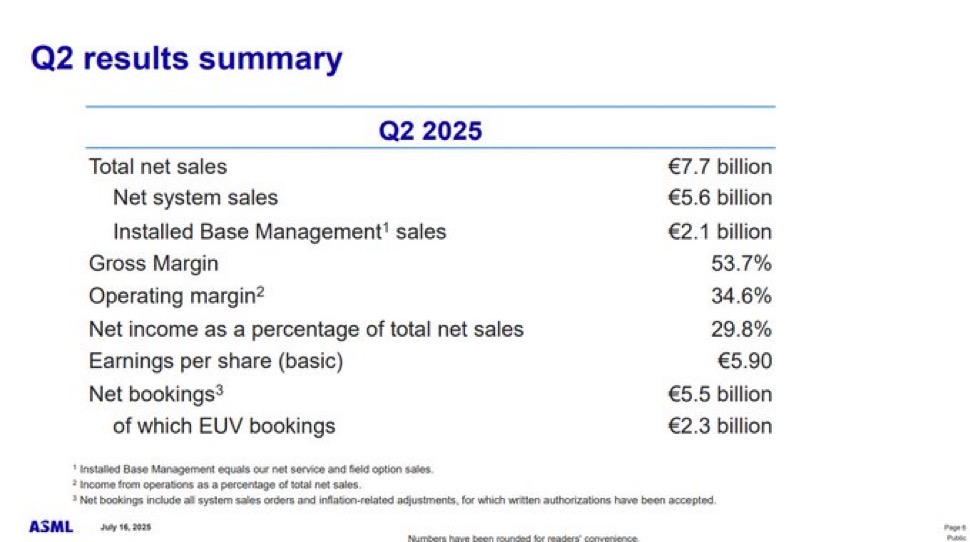
· Total net sales: €7.7 billion (upper bound of guidance)
· System sales: €5.6 billion, with Installed Base Management hitting €2.1 billion (strong recurring revenue)
· ~54% gross margin and 35% operating margin (beating guidance)
· Net bookings: €5.54 billion, with ~€2.3 billion from EUV systems
· Announced dividend of €1.60/share and major buybacks of €1.4 billion
While there are many positive takeaways, from the results and the call, like strong execution (sales and margins beat expectations), high bookings in EUV signalling continued demand, recurring revenue strength and a healthy buyback program, not everything was great.
Most notably, the refusal of management to confirm growth for 2026, due to macroeconomic and geopolitical uncertainties and a disappointing sales guidance for Q3.
However, the positives seem to outshine the negatives on these results and geopolitical uncertainties tend to resolve fairly quickly in this day and age, considering the high deal flow announced by the White House, which makes me optimistic for a brighter guidance in the next earnings report.
6) Valuation
As mentioned above multiple times, ASML is cheap at current levels, considering its position. Here are some key metrics to underpin that assumption:
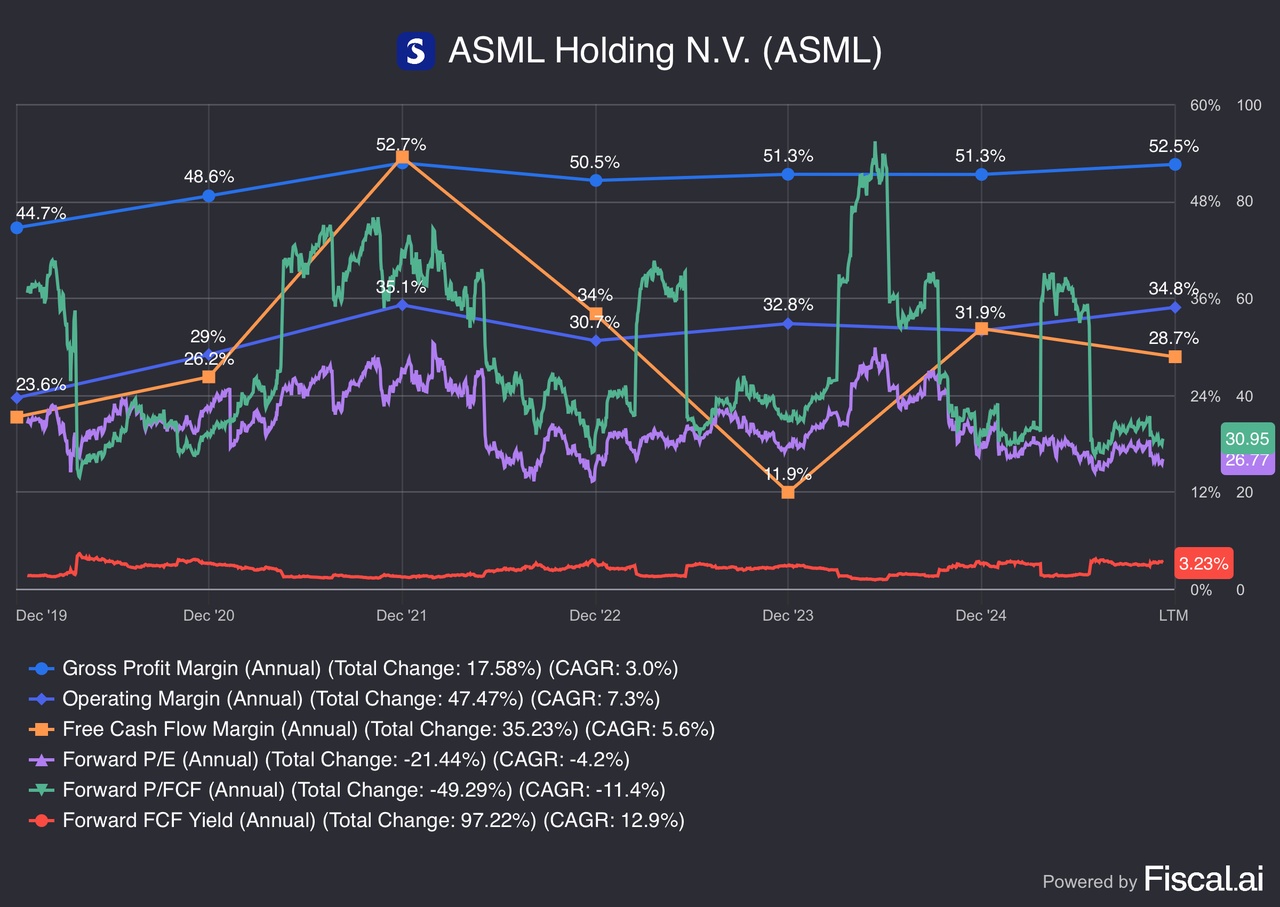
· Forward P/E: ~25/26 (avg. of ~34 in the last 5 years)
o Considerations: EPS consensus seems rather conservative, due to highlighted geopolitical tension during the last call
· Forward P/FCF: ~30 (falling rapidly YoY due to strong growth, expected to continue)
· Gross Margin: ~53% (at ATHs, up from 45% in 2019)
· Operating Margin: ~35% (up from 24% in 2019)
· FCF Yield: ~4% (avg. ~3.3% in the last 5 years)
Multiple factors including the company’s moat, and future potential, a multi-year low valuation combined with expanding margins and free cash flow yield, make the stock a compelling buy right now.
7) Risks
Trade restrictions form one of the key problems ASML faces, though it might not be as bad as it looks. Much of the uncertainty around possible tariffs has already vanished, especially after the U.S.–EU trade deal and President Trump’s confirmation that companies investing in America will be exempt from the immense tariff rates (>100% and rising) imposed on the semiconductor industry.
Another possibly considerable risk is innovations of Chinese competitors happening under the radar. Nobody can estimate how far China has already advanced and how soon they could launch alternative solutions to ASML’s products.
However, there is a geopolitical lifeline, even in the unlikely case that Chinese newcomers could overtake ASML: The U.S., especially under the current administration, and in part Europe aim to be as independent from China as possible, reducing the risk of U.S. foundries rotating their sales to a possible Chinese competitor. And even if no restrictions were imposed from the Western side, there is no incentive for China, an autocratic regime, to allow its tech to aid the U.S.’ advances in the AI race.
There is no company that does not face any risks, though ASML is in a relatively strong position to alleviate core uncertainties, especially those within their control, through innovation and strong management execution.
8) Catalysts & Timeline
In the near future it is possible that geopolitical pressures can keep the stock down, but it is critical to emphasize that these issues are temporary. The AI boom is fully underway and the chip market is booming, further solidifying ASML’s importance globally.
Mid to long-term the outlook is incredibly bright – the stock market usually does not misprice excellent companies forever and while Nvidia and AMD are getting most of the spotlight, ASML is compounding in the background. Macro headwinds are likely to fade over the next quarters and the stock is poised for a rebound.
9) Conclusion
ASML sits at the intersection of demand (AI, advanced logic, memory) and impresses with a near-insurmountable technological moat as the sole EUVL supplier. The Q2 2025 report demonstrates robust demand and healthy, expanding margins, and while management’s cautious tone might signal uncertainty, it is more likely they try to set low expectations, in order to beat later. This should not unsettle long-term investors, who believe in the AI revolution, resulting CapEx, and strong fundamentals.
Personally, I think the downsides are limited and, to a great extent, already priced in. It is vital to emphasize again that a Forward P/E ratio of 25 is certainly not expensive for a sole contender in their respective field, especially one so crucial for the future.
$ASML (+0,25%)
$ASML (+0,17%)
$TSM (-0,6%)
$2330
$INTC (-1,83%)
$005930
$NVDA (-0,89%)
$AMD (-1,64%)
+ 5


1Anno·
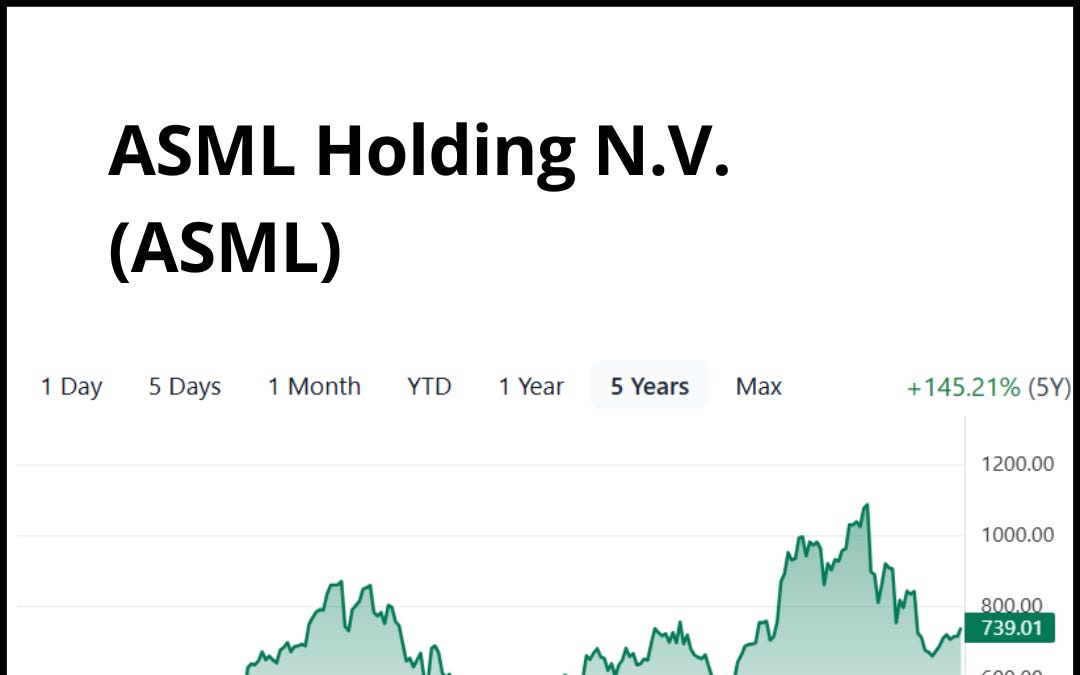
"ASML: The world's most expensive (and indispensable) printer" - ASML Holding: Full Review
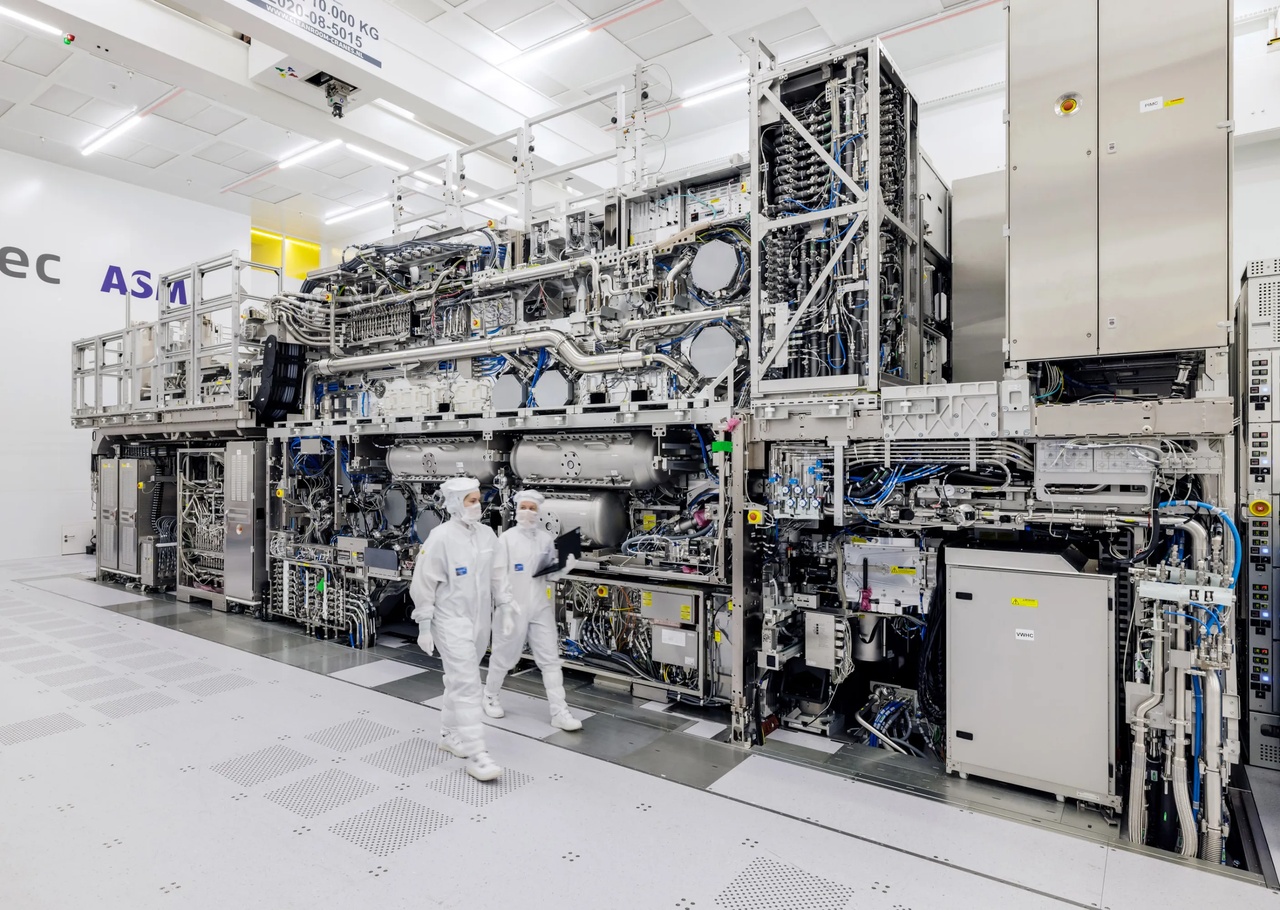
ASML is much more than a manufacturer of semiconductor equipment. It is a company with a monopoly position in EUV lithography, operating at the heart of global technological innovation.
I would like to highlight a few of the company's key points:
- The only global supplier of EUV lithography, an essential technology for 2 nm chips and below, with high barriers to entry;
- Solid financial track record, with robust revenue and profit growth, consistent cash generation and solid capital structure; 📊
- Highly profitable business model, with gross margins above 50% and return on capital (ROCE) above 24%; 📈
- Attractive shareholder remuneration, through stable dividends and regular share buyback programs; 💼
- Attractive valuation with the share trading at historically low multiples, with potential appreciation from the current price of over 18% per year over the next 5 years. 🚀
With its strong positioning, critical technology and proven ability to execute, I see ASML as a differentiated investment opportunity in the European technology sector.
🔎 If you want to know more about this investment opportunity, visit the full analysis at: https://dalemcapital.substack.com/p/asml-holding-analise-completa
#asml
#investing
#semiconductor
#tech
#stocks
#ações
#moat
#longterm
#equityresearch
#getquin
$ASML (+0,25%)
$ASML (+0,17%)
$ASMLF
dalemcapital.substack.comASML Holding: Análise Completa
1010

1Anno·
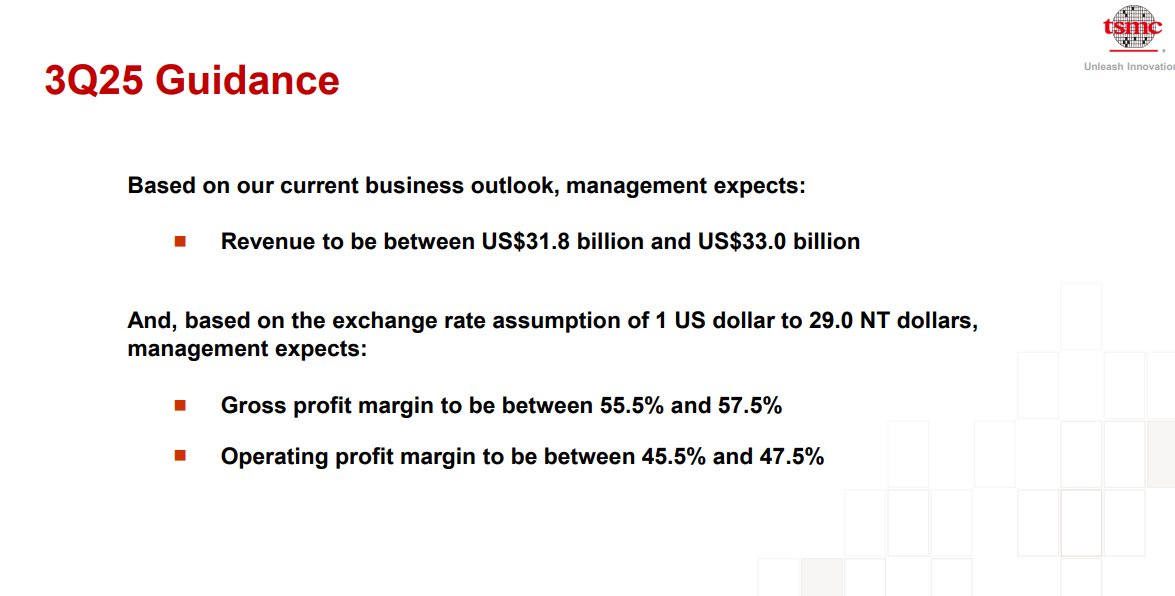
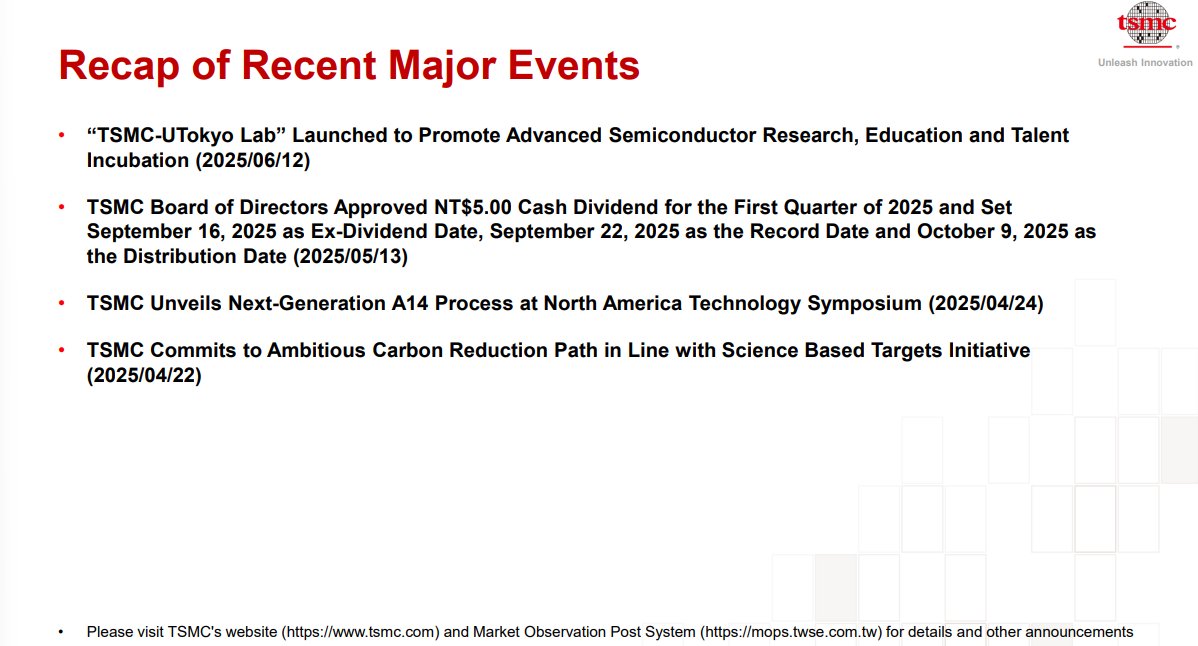
Management Kommentare:
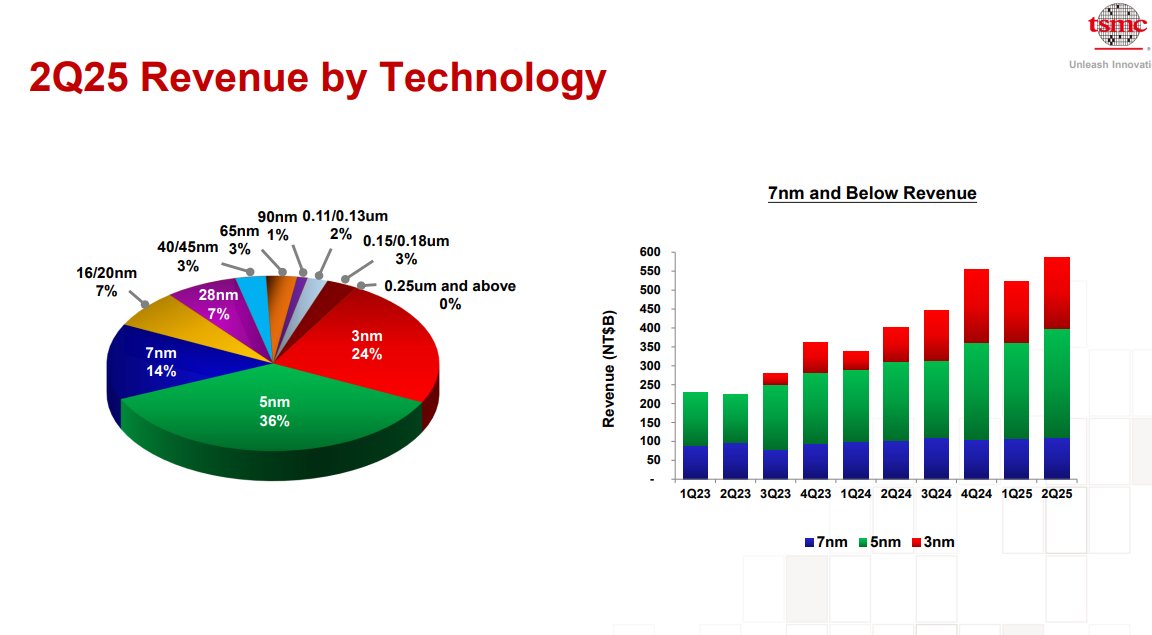
- Strong Q2 revenue supported by industry-leading 3nm and 5nm technologies, partially offset by FX headwinds.”
- “Gross margin pressure from FX and overseas fab dilution was partly balanced by higher utilization and cost improvements.”
- “Receivable and inventory days improved on higher N3/N5 wafer shipments.”
- Management flagged tariff uncertainty & FX volatility as 2H margin risks; long-term GM ≥53% goal reiterated.
- U.S./EU fab build-out (~$165B multi-year) aimed at capacity diversification & customer security; overseas fabs carry structural margin dilution.
- N3 capacity remains tight; narrowing supply-demand gap at premium nodes while ramping N2 (HVM 2H25) and advanced packaging (CoWoS/SoIC).
$2330
$NVDA (-0,89%)
$AMD (-1,64%)
$AVGO (-0,83%)
$ASML (+0,25%)
$ASML (+0,17%)
1Anno·
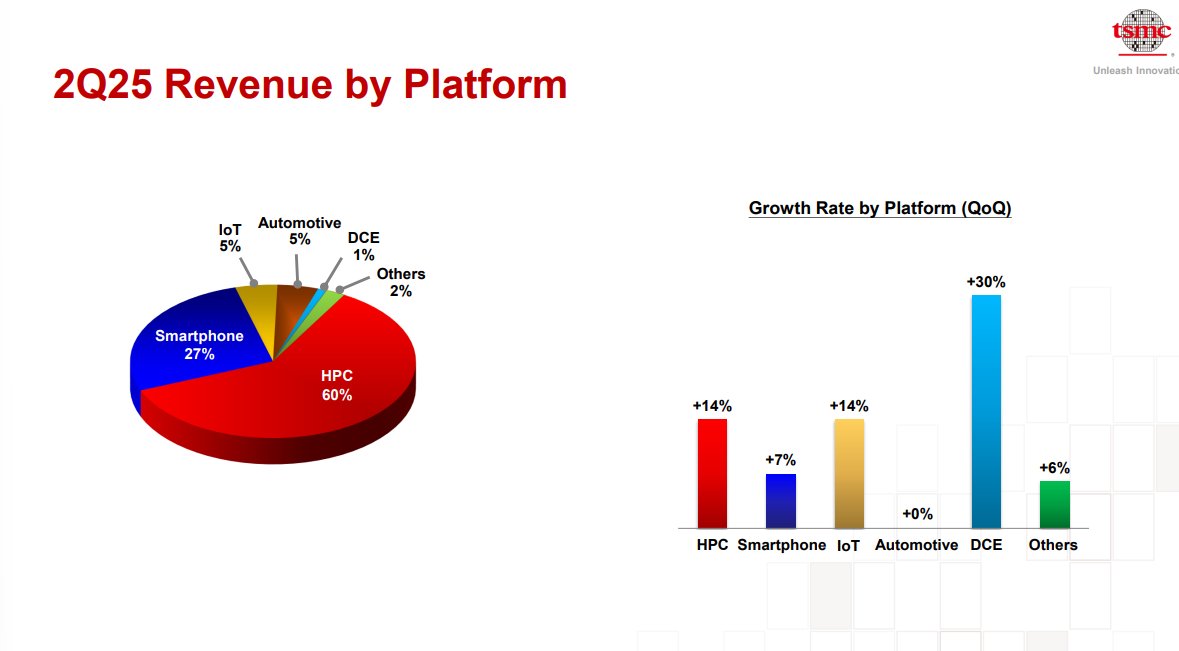
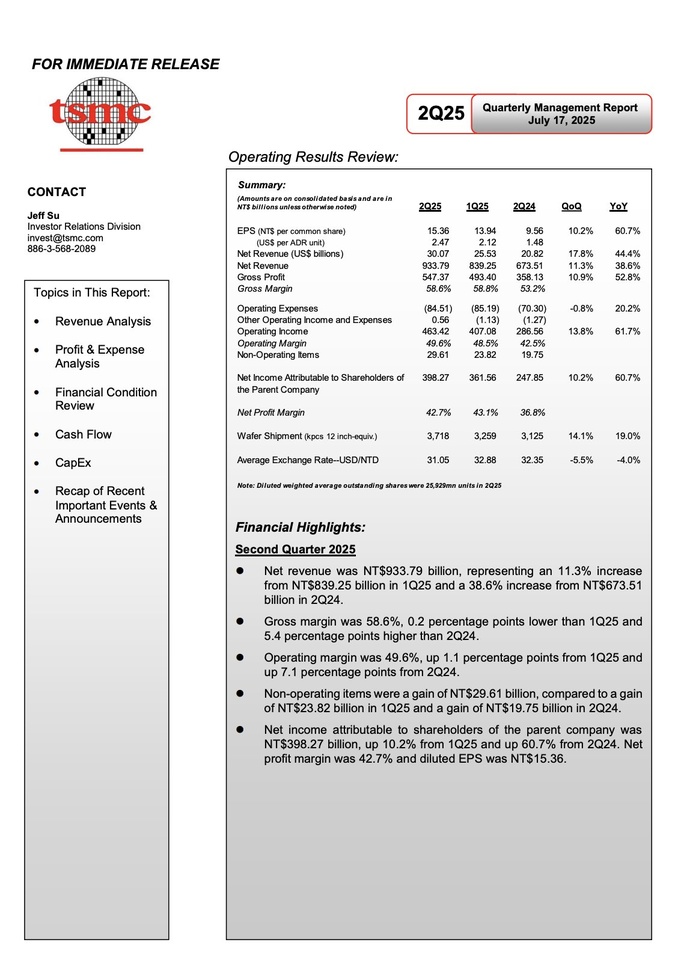
TSMC Q2 2025 results [NTD, YoY]: (NTD = Neuen Taiwan-Dollar)
- Net revenue: +38.6% to 933.8B
- Operating income: +61.7% to 463.4B
- Operating margin: +7.1pp to 49.6%
- Net profit: +60.7% to 398.3B
- Net profit margin: +5.9pp to 42.7%
- EPS: +60.7% to NTD 15.36
$NVDA (-0,89%)
$ASML (+0,25%)
$ASML (+0,17%)
$ASML
$AMD (-1,64%)
$AVGO (-0,83%)
$QCOM (-1,02%)
$INTC (-1,83%)
$TXN (-0,89%)
66
1Anno·
TSMC Q2 2025 results [NTD, YoY]: (NTD = Neuen Taiwan-Dollar)
- Net revenue: +38.6% to 933.8B
- Operating income: +61.7% to 463.4B
- Operating margin: +7.1pp to 49.6%
- Net profit: +60.7% to 398.3B
- Net profit margin: +5.9pp to 42.7%
- EPS: +60.7% to NTD 15.36
$NVDA (-0,89%)
$ASML (+0,25%)
$ASML (+0,17%)
$ASML
$AMD (-1,64%)
$AVGO (-0,83%)
$QCOM (-1,02%)
$INTC (-1,83%)
$TXN (-0,89%)

1Anno·
ASML Q2'25 Earnings Highlights
$ASML (+0,25%)
$ASML (+0,17%)
$ASMLF
- Revenue: €7.69B (Est. €7.51B) ✅; +23% YoY
- EPS: €5.90 (Est. €5.22) ✅;+47% YoY
- Gross Margin: 53.7% (Est. 51.9%) ✅; +220bps YoY
- Net Bookings: €5.54B (Est. €4.80B) ✅; -0.5% YoY
Guidance
- FY25 Revenue Growth: ~15% YoY (Prior: €30-35B)
- FY25 Gross Margin: ~52% (Prior: 51%-53%)
- Q3 Revenue: €7.4B-€7.9B (Est. €8.21B)
- Q3 Gross Margin: 50%-52% (Est. 51.4%)
Comment from the CEO:
- "Tariffs were slightly less negative than we expected."
- "We are preparing for growth in 2026, but cannot confirm this due to the increasing uncertainty."
- "Gross margin was above forecast due to higher upgrade business and one-off promotions."
- "The introduction of EUV and High NA is progressing as planned; the first EXE:5200B system has been delivered."
✌️
3030
27 Commenti
1Anno
Nice that ASML did well yesterday, so we are only back to where we were the day before yesterday 😂 always look on the bright side
•
1414
•