23H·

Neocloud Crash: My Assessment

Last week's Neocloud crash has $CRWV (-3,34%), $NBIS (-0,21%) and $IREN (+2,78%) sent it into a tailspin. What’s behind this, and what has actually changed for the future?


It all starts with the price of oil

Since the attacks on Iran, the price of oil has risen from ~$80 in August to over $106 per barrel. This is having a major impact on U.S. inflation:

  • Consumer Price Index (CPI): 3.7% in September, compared to an expected 3.6%. That’s nearly double the Fed’s 2% target
  • Core inflation: 2.6%, also above expectations
  • Producer prices (PPI): 6.3% year-over-year, more than three times the Fed’s target. Month-over-month: +1.3%, nearly double the expected increase and the sharpest rise since March 2022


The Fed raised interest rates on September 16 for the first time since 2023 raised interest ratesto 3.75–4.00%. The yield on 10-year U.S. Treasury bonds stood at over 5.2% at the end of September, the highest it has been since 2007. Added to this is a U.S. government that is sinking deeper and deeper into debt and must continually issue new bonds.


This is precisely where the problem with Neoclouds lies: The expansion of AI is largely financed by debt and competes for the same investors as the U.S. government. If a government bond yields over 5% with almost no risk, lenders will demand significantly more from a company that is still operating at a loss.


The trigger for the crash: CoreWeave’s bonds

On October 14, a chart went viral showing a CoreWeave bond worth $1.25 billion with a yield of just under 15% . It was issued in June at 9.625%. The credit default swap (CDS) is at a record high of 1,194.5 basis points; on October 6, it was still at 368.


According to standard calculations, this corresponds to a probability of default of over 60% within five years.


On the same day, Gartner added: By 2030, over 80% of Neocloud providers are expected to lose their independence. By then, AI data centers would generate at most $3.6 trillion in revenue, whereas $8.5 trillion would be needed.


Is this fear justified?

In CoreWeave’s case, partly yes. The higher market yield doesn’t affect the interest rate on existing bonds, but each new round of financing becomes more expensive, and CoreWeave’s growth depends on new loans. However, the 60% figure is a market price from a week of panic and not a forecast.


IREN and Nebius are in a different position

IREN has financed the Microsoft project $MSFT (+1,24%) at ~6% with $3.6 billion. Microsoft accepted Horizon 1 in August, and revenue has been generated since then. Horizon 2 through 4 are scheduled to follow in the fourth quarter; contractually, there is a buffer until early Q2 2027.

Information is currently circulating on X that Microsoft $IREN (+2,78%) is said to have provided incorrect network requirements, forcing the current Childress data centers to be have to be . Horizon 2 is reportedly delayed by ~45 days as a result; Horizon 1 will continue to operate and will continue to be paid for by Microsoft during the retrofit. Horizon 3 & 4 are not expected to be affected, as they will be completed directly with the correct network specifications. Thus, all four buildings are expected to generate revenue by the end of the year as planned. None of this has been officially confirmed.


In July, Nebius switched to a more capital-efficient model in which partners finance the data centers. In addition, advance payments from customers already amount to ~40–55% of the contract total, which alleviates a large portion of Neocloud’s financing risk. Added to this is the possibility of asset-backed financing, whereby the data centers themselves can be used as collateral for loans, thereby reducing interest rates. Nevertheless, the market treats the three companies—with their differing financing risks—as a single entity.


Demand points in the opposite direction

The GPU rental prices are rising: As of October 1, Nebius raised the price for B300 GPUs by 21% to $9.50 per hour—the second increase in three months.


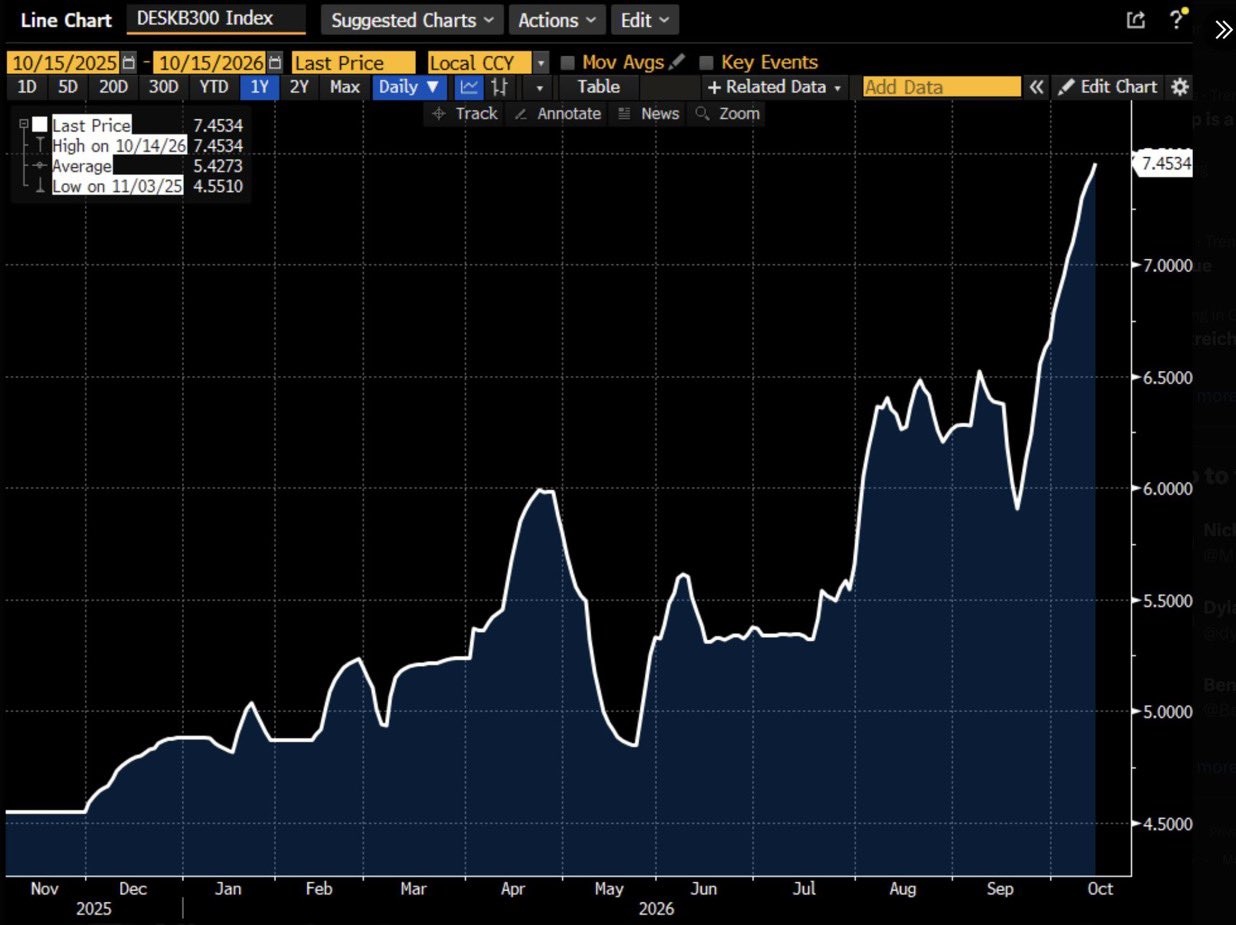
The DESKB300 Rental Index, based on actual rental transactions at U.S. neoclouds, reached a record high in mid-October, driven in part by inference using open-source models. This does not bode well for concerns that GPUs are depreciating too quickly.
attachment

GPU rental prices could also be influenced by rising financing costs and thus increase—so overall, this is more of a neutral process.


Jensen Huang told Bloomberg in Berlin on October 16: “All of this is going to pass.” AI will transform every industry, he said, and we’re only at the beginning. According to Huang, CoreWeave’s cost of capital is actually falling. The bond market saw things differently this week.


Time is the real bottleneck

A data center isn’t built in a single quarter. Securing land and a power connection often takes years, and the construction itself is complex. Neocloud stocks are bets on where these companies will be in three to five years, but they’re traded as if they had to deliver every week.


Even with growing demand, not all of them will make it. Some will repeatedly dilute their shareholders, some will be acquired, and some will fail.

What matters is how management finances the expansion and whether it delivers on its promises.


Sharp sell-offs, months of stagnation, and rallies after which everyone suddenly turns bullish again are all part of this sector and should be clear to every investor. A five-year thesis is difficult to gauge based on year-to-date performance.


Overall, the market is pricing in a financing problem—one that is particularly acute for CoreWeave—and applying it to the entire sector. At the same time, demand for computing power shows no signs of weakness—quite the opposite.


High long-term interest rates are the main risk for all players

If government bond yields remain above 5% for the long term, every new round of financing will become more expensive, and that affects all three companies. CoreWeave, Nebius, and IREN are only at the beginning of their expansion and will need to raise many billions more for data centers and GPUs in the coming years. More expensive financing therefore puts direct pressure on future returns. Against this backdrop, the sell-off is understandable, even if demand itself remains intact.


Key events to watch include Nebius’s earnings report, expected on October 22; the Fed meeting in late October; and the acceptance of Horizon 2. Additionally, the course of the conflict (Iran & the U.S.) must be closely monitored, as it will significantly shape future developments.


Not investment advice


Sources:

https://www.cnbc.com/2026/10/15/coreweave-credit-default-swaps-hit-distress-levels-as-investors-sour-on-ai-debt.html

https://www.cnbc.com/2026/10/15/whats-behind-the-sell-off-in-ai-neocloud-stocks-like-coreweave-and-nebius-.html

https://www.gartner.com/en/newsroom/press-releases/2026-10-14-gartner-says-over-us-dollars-three-and-a-half-trillion-of-artificial-intelligence-infrastructure-spending-could-be-exposed-to-impairment-by-the-end-of-2030

https://www.bls.gov/news.release/cpi.nr0.htm

https://www.bls.gov/news.release/ppi.nr0.htm

https://www.sec.gov/Archives/edgar/data/0001878848/000187884826000052/iren-20260630.htm

https://www.bloomberg.com/news/articles/2026-10-16/nvidia-ceo-on-ai-market-turmoil-all-of-this-is-going-to-pass


$ORCL (+1,21%)$APLD (+7,17%)$CIFR (-0,72%)$GOOGL (+1,24%)$MSFT (+1,24%)$AVGO (+1,58%)$AMD (+1,89%)$INTC (+2,89%)$HUT (+0,97%)

26
4 Comentários

imagem de perfil
Basically, it’s also important to note that different interest rates must be applied throughout a project’s lifecycle (though no one really highlights this in their analyses). I work in asset management at a German insurance company and see significant differences in interest rates between the financing period leading up to the data center’s completion and the period after go-live. These are simply different risks that are refinanced at later stages (and may then be refinanced again, if necessary, based on the end customer’s needs).
•
4
•
imagem de perfil
@Michey777 That’s a very important and interesting point! Long-term debt restructuring reduces financing costs; for example, this is the approach taken by $APLD.
Do you work in asset management with AI companies or Neoclouds?
••
imagem de perfil
@Pazzzi Yes, I'm looking into it. Not so much in the area of convertible bonds, but basically, you can't avoid the topic. Data center financing is becoming more and more common and is being actively promoted by banks and companies like BlackRock, etc. Of course, all of this is mostly in the non-investment-grade sector.
•
1
•
imagem de perfil
I generally find your post reasonable. Above all, it’s correct not to simply equate CoreWeave, IREN, and Nebius.
However, I’ve cross-checked the statements against company documents and original sources.
This reveals a few specific errors and counterarguments. (At least from my perspective)

1. The inflation figures are correct—but the comparison with the Fed’s target is not.

The 3.7% consumer price inflation and 6.3% producer price inflation are confirmed. The monthly PPI increase of 1.3% is also correct.
However, the Fed’s 2% inflation target refers to the PCE (Personal Consumption Expenditures) index, not to producer prices. “PPI more than three times above the Fed’s target” therefore compares different metrics. Inflation remains a problem, but there’s no need to further dramatize the numbers. [1]

2. Nebius has misclassified the prepayments.

You mention approximately 40–55% of the contract amount. The official Q2 shareholder letter states something different: 70% of the completed transactions included advance payments that covered 50–60% of the associated investment costs. Contract volume and investment costs are not the same thing. [2]

Furthermore, Nebius has not switched entirely to a capital-light model. The July 15 announcement explicitly describes an additional partner model that complements its own data centers and colocation facilities. [3]

The counterexample to the supposed relief: Nebius continued to invest approximately $5.7 billion in the second quarter. On August 24, $5.75 billion in new convertible bonds were issued: $3.45 billion with a 0.5% coupon maturing in 2030 and $2.3 billion with a 4.5% coupon maturing in 2034. At the same time, $800 million in older convertible bonds were exchanged for approximately 15.8 million new shares. Low coupons are positive, but convertible bonds also carry dilution risks. [2][4]

“Asset-light” is an additional financing option—not a magic spell that makes the need for billions disappear.

3. IREN’s Microsoft financing is favorable, but not representative of the entire expansion.

The approximately $3.6 billion relates to GPUs and associated infrastructure for the Microsoft contract. According to the annual report, this consists of approximately $1.5 billion in loans at SOFR plus 2.25 percentage points and $2.1 billion in bonds with a fixed interest rate of 5.96%. There are also interest rate hedging requirements. [5]

An important counterexample: The financing for Mackenzie agreed upon in August, totaling up to $2.4 billion, carries a fixed interest rate of 9%. IREN therefore by no means automatically receives Microsoft’s terms for every subsequent project. [5]

Confirmed are the acceptance of Horizon 1 in August, the delivery target for Horizon 2–4 in the fourth quarter, and contractual buffers through the beginning of Q2 2027. However, I have not seen official confirmation of the allegedly incorrect network requirements, the 45-day delay, or continued payments during the conversion. It’s good that you yourself label this story as unconfirmed. [5]

4. The DESKB300 index is not a pure transaction price index.

According to the published methodology, it combines completed transactions and published Neocloud list prices. The data is normalized to one-year U.S. lease agreements and reference hardware. The statement “based on actual rental transactions” is therefore incomplete. [6]

Nebius’s B300 price increase from $7.85 to $9.50 per GPU-hour—about 21%—is correct. However, this refers to the published on-demand rate, not necessarily the average price achieved across all customer contracts. [7]

Furthermore, rising B300 rental rates today do not preclude future economic depreciation. New hardware may be in short supply today but could still come under pressure in a few years from more efficient successors. The decisive factors are utilization rates, operating costs, financing, useful life, and residual values—not just the rental price curve.

5. Gartner’s warning is valid, but the $8.5 trillion figure needs context.

Gartner estimates that a cumulative $8.5 trillion in revenue will be needed by 2030 to cover investments, financing costs, and an assumed return on investment of 12%. This contrasts with a projected maximum of $3.6 trillion in attributable AI revenue. [8]

The 8.5 trillion is therefore not merely a threshold for avoiding insolvency. And the projected cessation of independent business operations at over 80% of Neoclouds does not automatically mean an 80% insolvency rate. Acquisitions and consolidation are also part of the picture.

6. CoreWeave’s credit stress is real—the 60% figure remains a model parameter.

Reuters confirms CDS spreads above 1,100 basis points and bond yields reaching up to 16% at times. This should be taken seriously. However, a probability of default derived from this depends on recovery assumptions and risk premiums; it is not an objectively measured bankruptcy rate. Your caveat is therefore correct. Conversely, “panic” is also no proof that the credit market is wrong. [9]

My conclusion: Demand can be strong, yet shareholder returns can still be disappointing. Nebius and IREN have different financing structures than CoreWeave, but they face their own significant risks. Higher credit spreads, dilution, construction delays, and technological obsolescence do not disappear simply because order books are full.

I would therefore be cautious about claiming that the market is primarily projecting CoreWeave’s problems onto the rest of the sector. To make that claim, one would have to calculate the future financing needs and the return on investment for each company. A customer ordering computing power does not, by any means, guarantee a return for shareholders.

Sources:

[1] BLS: Consumer Price Index, September 2026; BLS: Producer Price Index, September 2026; and Federal Reserve: Definition of the 2% inflation target.

[2] Nebius: Q2 2026 Shareholder Letter—Prepayments and Investments.

[3] Nebius: Additional Infrastructure Partner Model, July 15, 2026.

[4] Nebius: $5.75 Billion in Convertible Bonds and Stock Swap, August 24, 2026.

[5] IREN: Annual Report as of June 30, 2026 – Microsoft Contract, GPU Financing, and August Financing.

[6] Compute Desk: Methodology for GPU Rental Price Indices.

[7] Nebius: Official GPU Price List.

[8] Gartner: Original publication on the cost-effectiveness of AI infrastructure expansion, October 14, 2026.

[9] Reuters: Credit Market Stress at CoreWeave, October 15, 2026, and BIS: Default Probabilities and Risk Premiums in the CDS Market.
•
2
•
Participar na conversa