

Good morning, everyone,
Our Japan expert @PikaPika0105 brought a company to my attention last week that is very interesting for the Second Wave .
I look forward to hearing your thoughts in the comments.
PKSHA Technology—an exciting candidate for the second wave of AI?
PKSHA Technology could be a good fit for my investment strategy “Portfolio 2036 – The Second AI Wave” because the company not only develops AI but is increasingly generating revenue by helping businesses integrate AI into their daily workflows.
Originale Unternehmenspräsentation vom 13. August 2026
🚀 Why PKSHA Is Exciting
1. From AI Investments to Monetization
PKSHA offers AI solutions for businesses, such as for customer communication, contact centers, and the automation of work processes. This allows the company to benefit from the next stage of development: Companies no longer just want to test AI—they want to use it to reduce costs and increase their productivity.
2. Recurring Revenue from AI Software
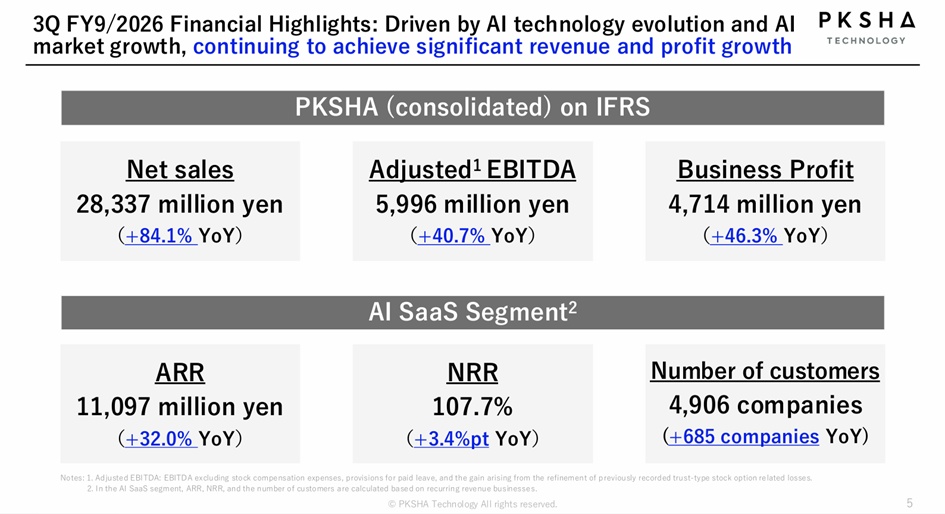
The AI SaaS business is growing steadily. In the third quarter of fiscal year 2026, annual recurring revenue (ARR) reached approximately 11.1 billion yen (+32%). The number of customers rose to approximately 4,900 companies.
3. Proprietary Data Creates Competitive Advantages
According to the presentation, more than 7,000 AI agents are already in use at customer sites. Insights from various industries help further develop the solutions and improve their accuracy. This can create a competitive advantage over new providers and in-house AI solutions.
4. Growth with Increasing Profitability
In the third quarter of 2026, PKSHA reported:
- Revenue: 28.34 billion yen (+84.1%)
- Adjusted EBITDA: 6.00 billion yen (+40.7%)
- Operating profit: 4.71 billion yen (+46.3%)
It should be noted that revenue growth is also influenced by changes in the scope of consolidation.
🎯 My assessment for the 2036 portfolio
PKSHA could benefit from the second wave of AI because the company bridges the gap between AI technology and its practical business applications.
While companies like Nvidia benefit from AI infrastructure, PKSHA focuses on its productive use within businesses.
I find the following particularly interesting:
- AI agents: Automation of tasks and workflows.
- AI monetization: Recurring revenue from software and enterprise solutions.
- Scalability: Existing AI solutions can be deployed for additional customers.
- Japanese AI market: Potential driven by the increasing digitization of businesses.
The key question for us investors: Can PKSHA expand its market position and translate revenue growth into rising profits and cash flows over the long term?
For me, that would be the most important point in further analysis. The stock’s valuation must also align with expected growth.
My conclusion: PKSHA is an interesting candidate for the second wave of AI—not so much as an AI infrastructure stock, but as a provider of AI applications that are expected to be economically viable.
PKSHA Holdings is a Japanese software group and a provider of artificial intelligence-based software with a focus on AI research and solutions as well as AI software-as-a-service. The company, listed on the Tokyo Stock Exchange (3993), positions itself as a specialized Japanese software group with a key market position in AI software through its proprietary AI technology.
Artificial Intelligence Software as a Service is the segment with the highest revenue and encompasses the core Japanese software business, which includes AI software (cloud-based software powered by artificial intelligence, such as for chatbots, the automation of customerservice, and natural language processing—which PKSHA Holdings primarily offers to Japanese companies on a subscription basis, generating recurring revenue and benefiting from the AI trend) for Japanese companies, with its recurring revenue model establishing a key position in the Japanese AI software market. Artificial Intelligence Research & Solution focuses on developing customized AI solutions and AI algorithms on behalf of companies.
Results depend on trends in the Japanese software and AI market (with the adoption of artificial intelligence, corporate digitalization, growth in the subscriber base, and automation serving as key drivers) as well as competition from other software providers.
The company is primarily engaged in the algorithmic licensing business. It operates in two business segments. The Cloud Intelligence segment focuses on the sale of algorithm modules and the algorithm software BEDORE and CELLOR in the field of intelligent processing in the digital space. The Mobility & MaaS segment focuses on the sale of algorithm modules related to image/video analysis and the sale of the Hrus algorithm software in the field of intelligent management of the physical environment for smart cities. The algorithm modules include text comprehension modules, dialogue modules, image/video analysis modules, recommendation modules, prediction modules, anomaly detection modules, and reinforcement learning modules.
Number of employees: 1,001
Solutions by Industry
- Die Zukunft des Einzelhandels und der Logistik
- Die Zukunft der Automobil- und Stadtentwicklung
- Die Zukunft von Kredit und Bankwesen
- Die Zukunft der Versicherung
- Die Zukunft der Bildung
- Die Zukunft des Gesundheitswesens
Solutions by Function
Growth Outlook
The revenue forecast for 2026 is particularly striking. At just under 75% growth, it is exceptionally high. After that, growth is expected to normalize to around 16% annually.
The key point: PKSHA is expected not only to increase revenue but also to further expand its operating profit. This generally points to a growing AI software business. However, it is important to examine to what extent the exceptional growth in 2026 is attributable to organic growth or changes in the scope of consolidation.
My assessment:
- 2025: The negative free cash flow is a warning sign whose causes should be examined more closely.
- 2026: The forecast anticipates a return to positive free cash flow.
- 2027: Expected cash flow will increase significantly. This would be an important step toward better internal financing.
- 2028: Free cash flow is expected to continue growing, though at a slower pace than in the previous year.
For an AI company, free cash flow is particularly important: revenue growth alone is not enough if the additional business activity requires sustained high investments or high liquidity needs.
What do the margins reveal?
This is a key point in the analysis:
Revenue is growing significantly faster than projected profitability.
The EBITDA margin is expected to fall from 25% in 2025 to around 20% in 2028. The EBIT margin, on the other hand, is expected to stabilize at around 15.6–15.8%.
This isn’t necessarily a negative. PKSHA could invest in new business areas, expand its workforce, or grow the business through acquisitions. The key question is whether these measures will generate additional revenue in the future.
It would be positive if the company were to increase its free cash flow over the long term without having to deploy more and more capital to do so.
5. My Conclusion for the 2036 Portfolio
PKSHA Technology is an interesting company in light of the thesis that artificial intelligence is increasingly being integrated into specific software products and automation solutions.
I like three aspects of the forecasts:
Scalable growth: Revenue is expected to rise to more than 51 billion JPY by 2028.
Operating profitability: EBIT is expected to grow from 3.9 billion JPY in 2025 to approximately 8.1 billion JPY in 2028.
Improved cash flow: A significant recovery is expected following the negative free cash flow in 2025.
For me, the two biggest challenges are declining margins and the sustainability of growth following the exceptional forecast year of 2026.
My verdict: PKSHA is an interesting AI software candidate for the Depot 2036 watchlist. Whether the stock is also an attractive investment, however, depends largely on its valuation and the actual development of free cash flow.
Brief Overview
- FC Yield: The forecast improves from −0.85% to 3.72%. This points to an expected improvement in cash flow generation.
- P/E Ratio: Declines to 24.8x by 2028. This means the stock is more attractively valued based on projected earnings.
- P/B ratio: Decreases to 2.64x.
- PEG: According to MarketScreener, it ranges between 1.4x and 1.6x.
- Dividend: According to forecasts, it will rise from 10 to 16 JPY per share, but remains low in terms of yield.
My conclusion: The rising free cash flow yield, coupled with a falling P/E ratio, is particularly interesting. The key question remains whether PKSHA will actually meet its earnings and cash flow forecasts.
Here is an important addition from @PikaPika0105
October 16, 2026, 7:02:50 PM •
Lang & Schwarz (EUR)
20.20 EUR