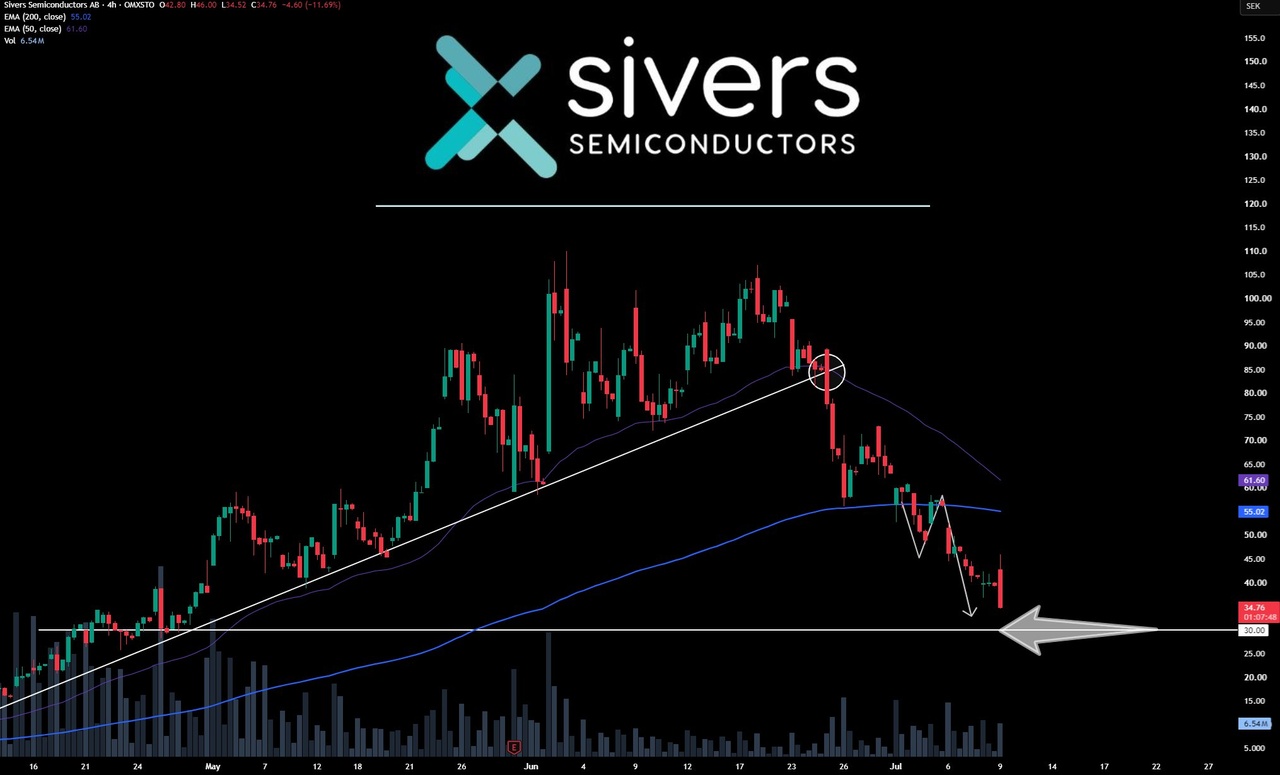
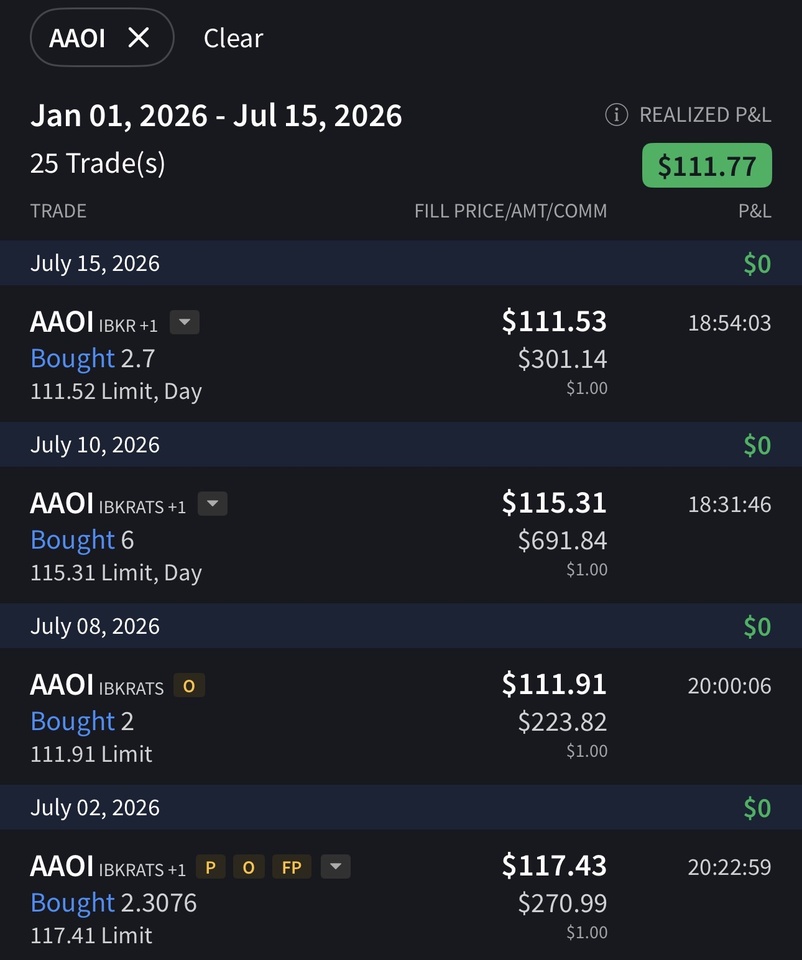
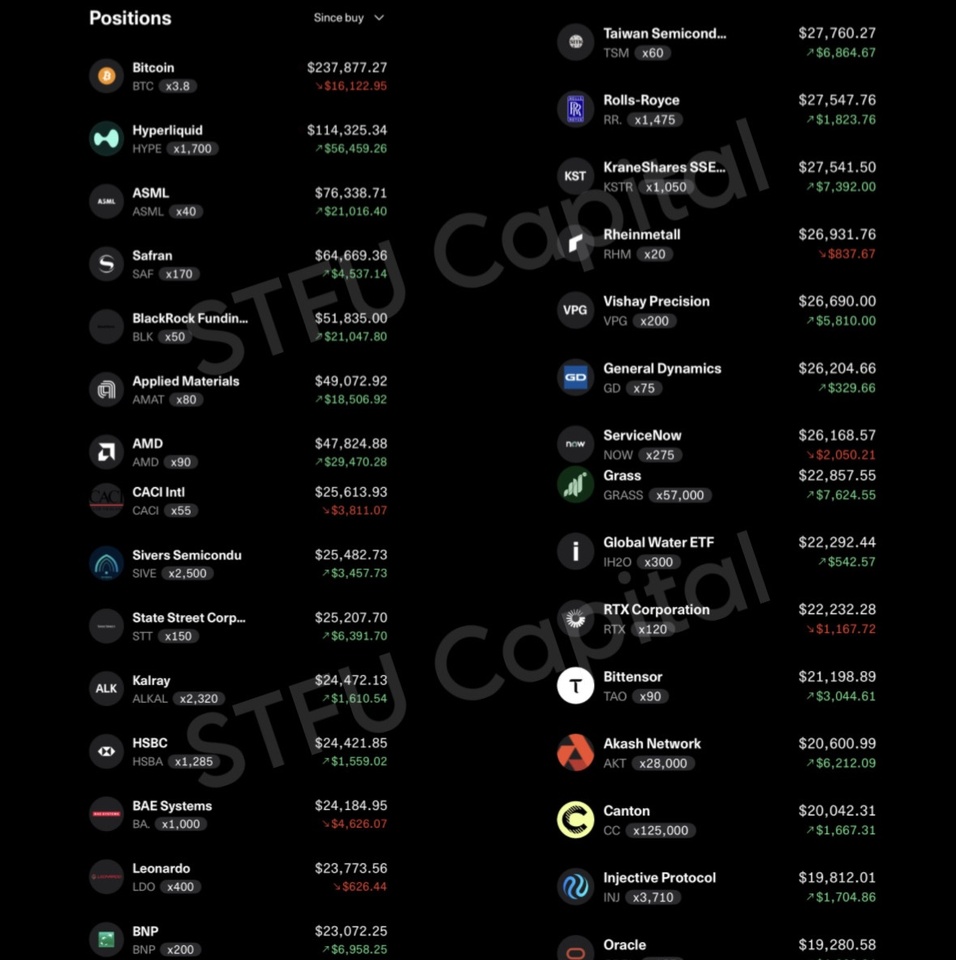
Over $SIVE (+15,5%) the past few days, you can see just how quickly prices can move with such rocket-like gains. I became aware of the company through several posts by our good friend, the Next Limits Wiki operator @ScaleLimits . I find the business model exciting, but after a gain of over 3,000% in just one year (congratulations again to @ScaleLimits for getting in early and, more importantly, for locking in profits), I decided to sit this one out for now. Now, the annual performance has dropped to “just” 1,300% within a few days. If the price reaches €4 or below, it might be worth considering getting back in. We’ll see.

Sivers Semicondu
Price
Discussione su SIVE
Messaggi
12Do we ever make money? 💸
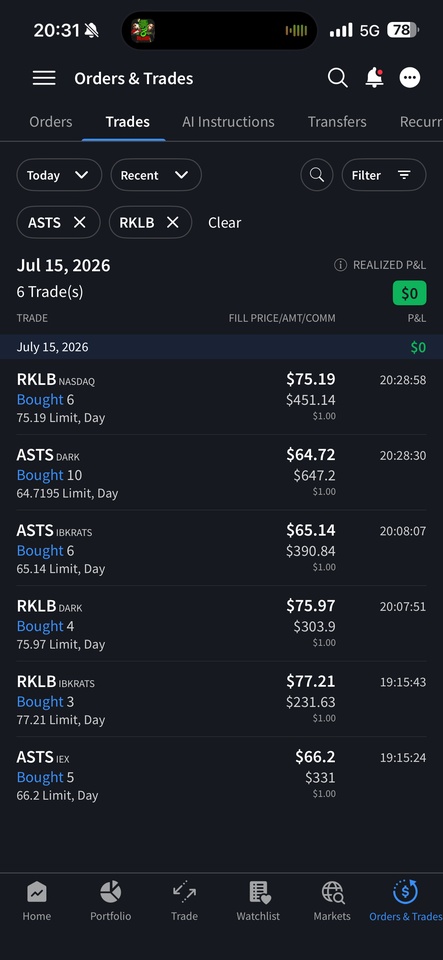
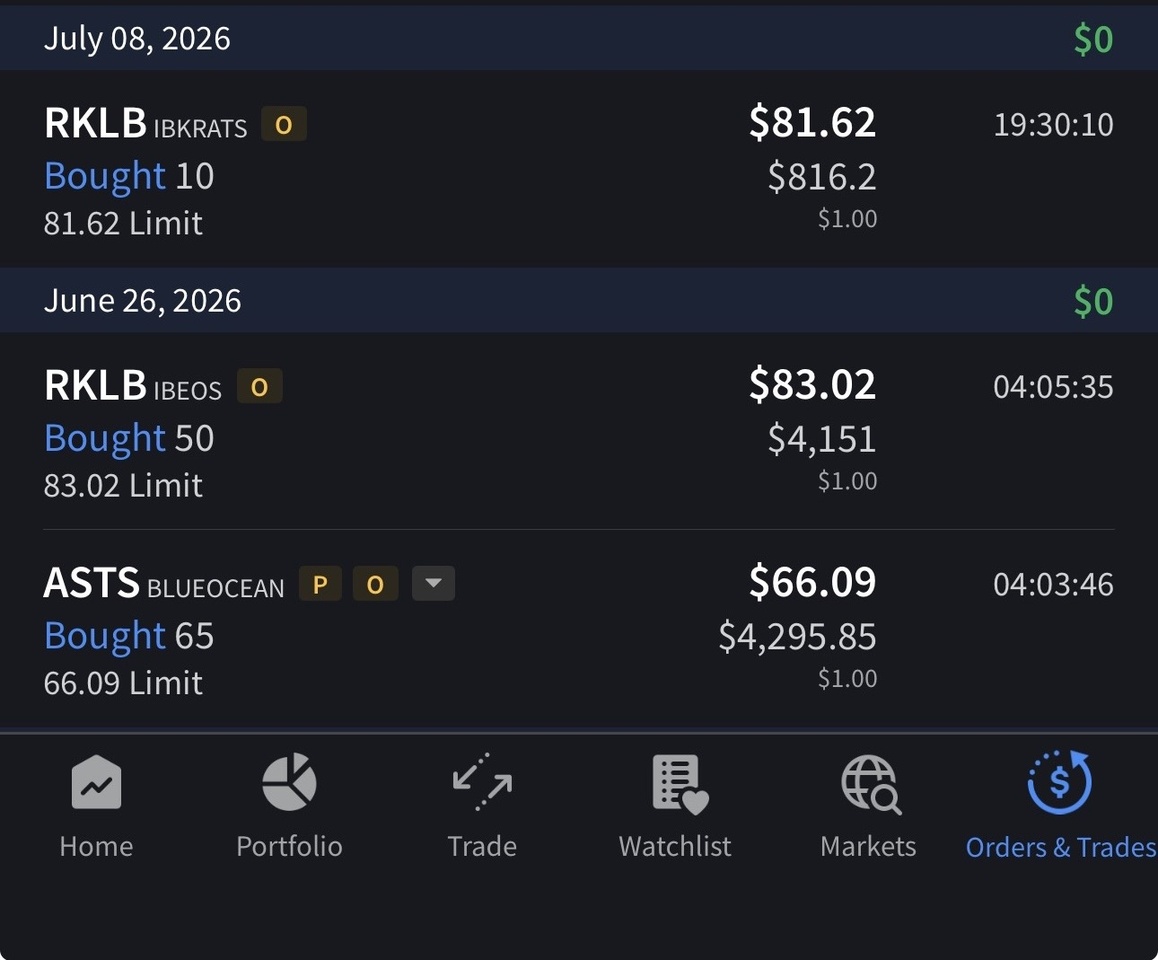
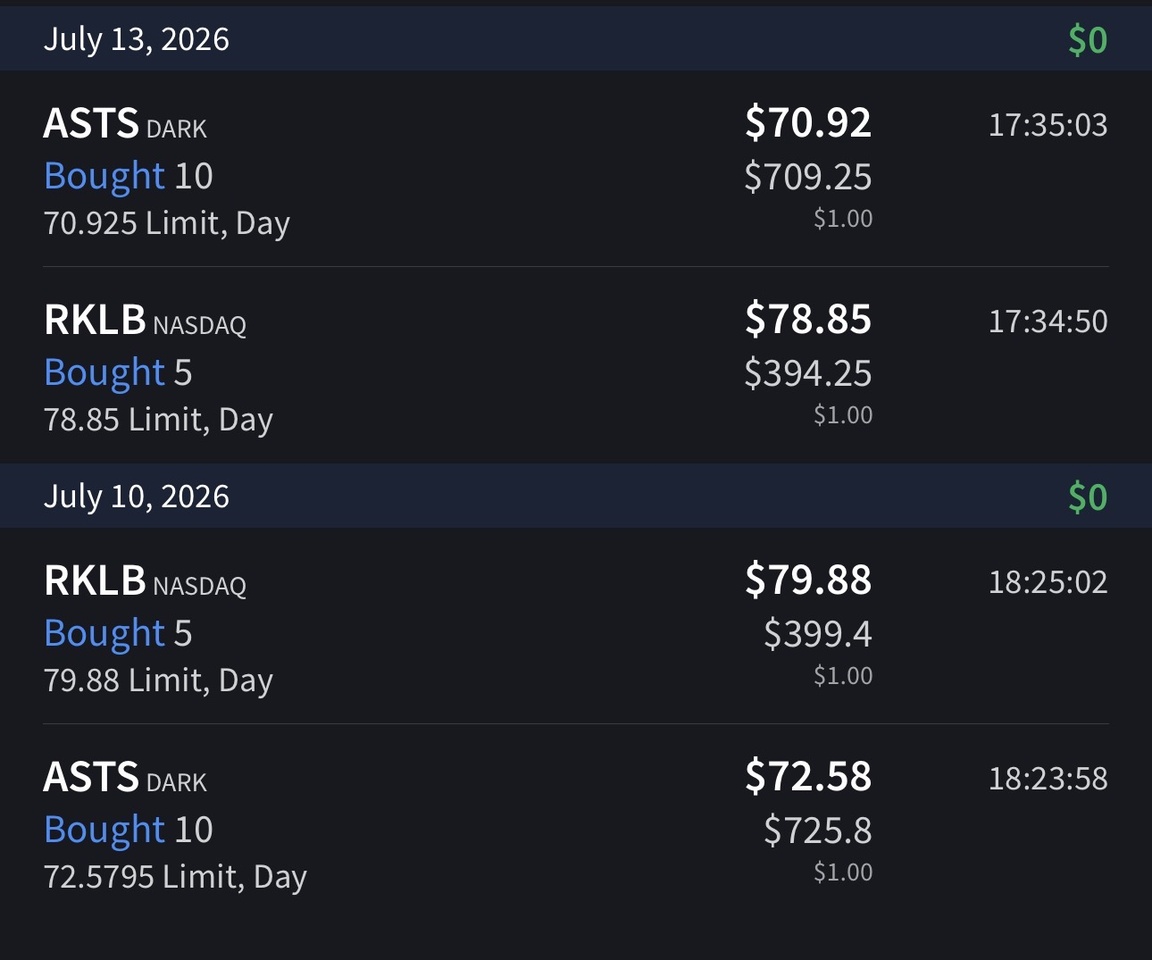
I’ve seen various people wondering if we ever make money considering our, sometimes sudden and repetitive moves, so here’s a screenshot montage of a part of our portfolio from 3 days ago.
These screenshots alone show cumulative profits of ~$214,021 and cumulative losses of ~$29,239.
This is not to flex, brag or anything, this is to provide context. We’re a team, and when there’s a concern that is raised about an asset, or a suggestion, we have to acknowledge it and act accordingly. We have no problem changing parts of the portfolio, readjusting positions and strategies or selling/buying assets in a short period of time. The whole organization is built for this.
Update on my portfolio
Last week, I decided to reduce the size of some positions in my portfolio in order to invest more in the current AI boom.
This involved 35 $BRK.B (-0,05%) and 350 $SHEL (-1,15%) shares were sold from my portfolio.
The following additions were made:
- $SIVE (+15,5%) 1,500
- $AAOI (+6,27%) 50
- $XFAB (+4,35%) 400
- $SHT B (-17,48%) 750
I didn’t quite time the entries perfectly in some cases, but let’s see what happens over the next few months and in 2027/2028. I’m curious to see how it goes.
In addition, the following stocks are on my shortlist for future purchases:
Have a nice evening, everyone!
🇪🇺 Has Europe missed the AI boat?
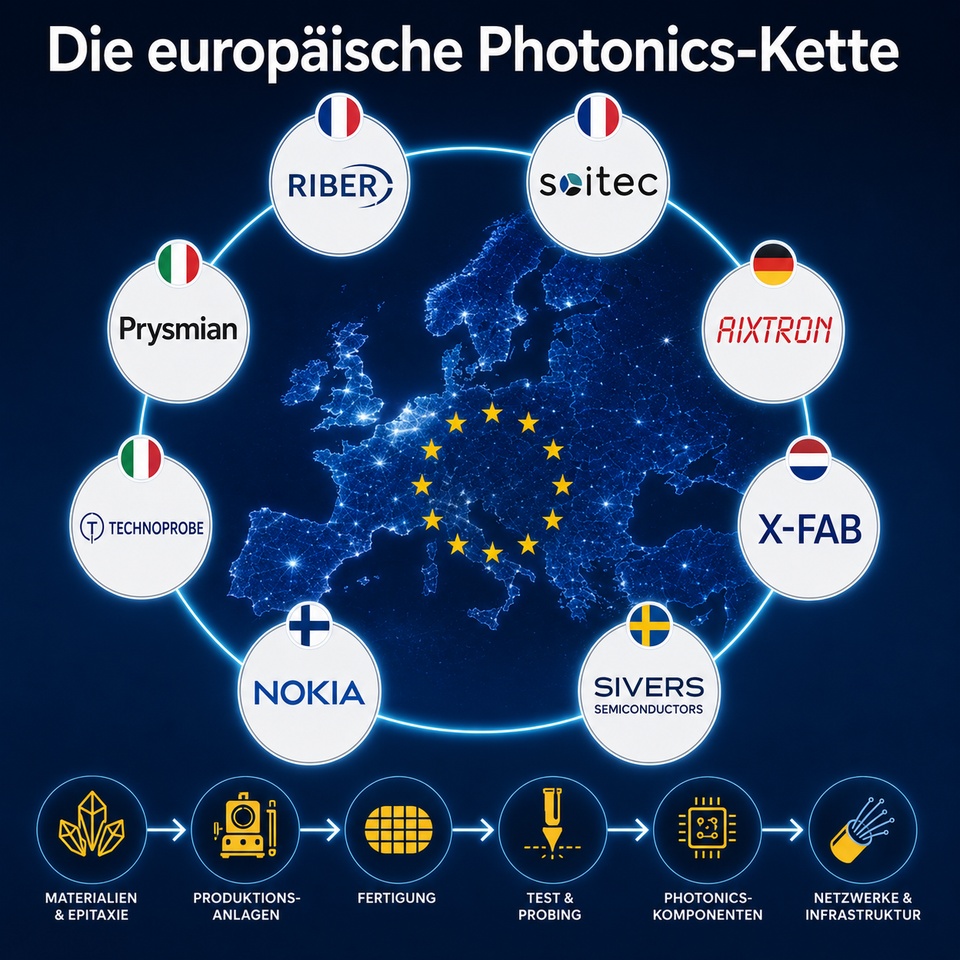
Probably not. Perhaps a European photonics cluster. When people talk about AI, it’s usually about NVIDIA, data centers, or the next language models. At the same time, something exciting has happened in Europe: In the planned Chips Act 2.0 , photonics has been explicitly named for the first time as a strategic field of the future.
This comes as no surprise. After all, modern AI systems need more than just computing power. Above all, they must process ever-larger amounts of data quickly, reliably, and energy-efficiently. This is precisely where a future infrastructure bottleneck could emerge.
What I find exciting is that (with the exception of X-Fab and Nokia) my own portfolio and, to some extent, the bottleneck wikifolios already include several European companies that together almost form a complete photonics value chain :
🇫🇷 Riber
$ALRIB (+8,07%)
MBE systems for the production of highly specialized III-V semiconductors.
🇫🇷 Soitec
$SOI (+5,93%)
Specialty substrates and wafer technologies as the foundation for photonic integration.
🇩🇪 Aixtron
$AIXA (+5,13%)
Production equipment for InP, GaN, and other photonics applications.
🇳🇱 X-Fab
$XFAB (+4,35%)
European foundry expertise for sensor technology and photonic applications.
🇸🇪 Sivers Semiconductors
$SIVE (+15,5%)
Photonics and high-frequency chips for data transmission.
🇮🇹 Technoprobe
$TPRO (+3,34%)
Probe cards and test solutions for increasingly complex semiconductor structures.
🇫🇮 Nokia
$NOKIA (+8,31%)
Optical networking technologies for the next generation of data transmission. The acquisition of Infinera makes Nokia an increasingly relevant European player in the field of optical networking.
🇮🇹 Prysmian
$PRY (+1,94%)
Fiber-optic infrastructure as the physical backbone of digital data transmission.
Taken individually, some of these companies seem rather unremarkable. Taken together, however, they tell a different story. Not that of a continent that has fallen behind. But rather the story of a potential European photonics ecosystem in the making.
Whether this will actually give rise to global champions, no one knows today. But that is exactly where I look for bottlenecks: one level below the obvious winners. Where new technologies are made possible in the first place.
⚠️ Not investment advice.
I also find$NOKIA very interesting… Thanks for your research! I’ll take a look at the other stocks as well. 🙂
wtf
$SIVE (+15,5%) who's holding this?
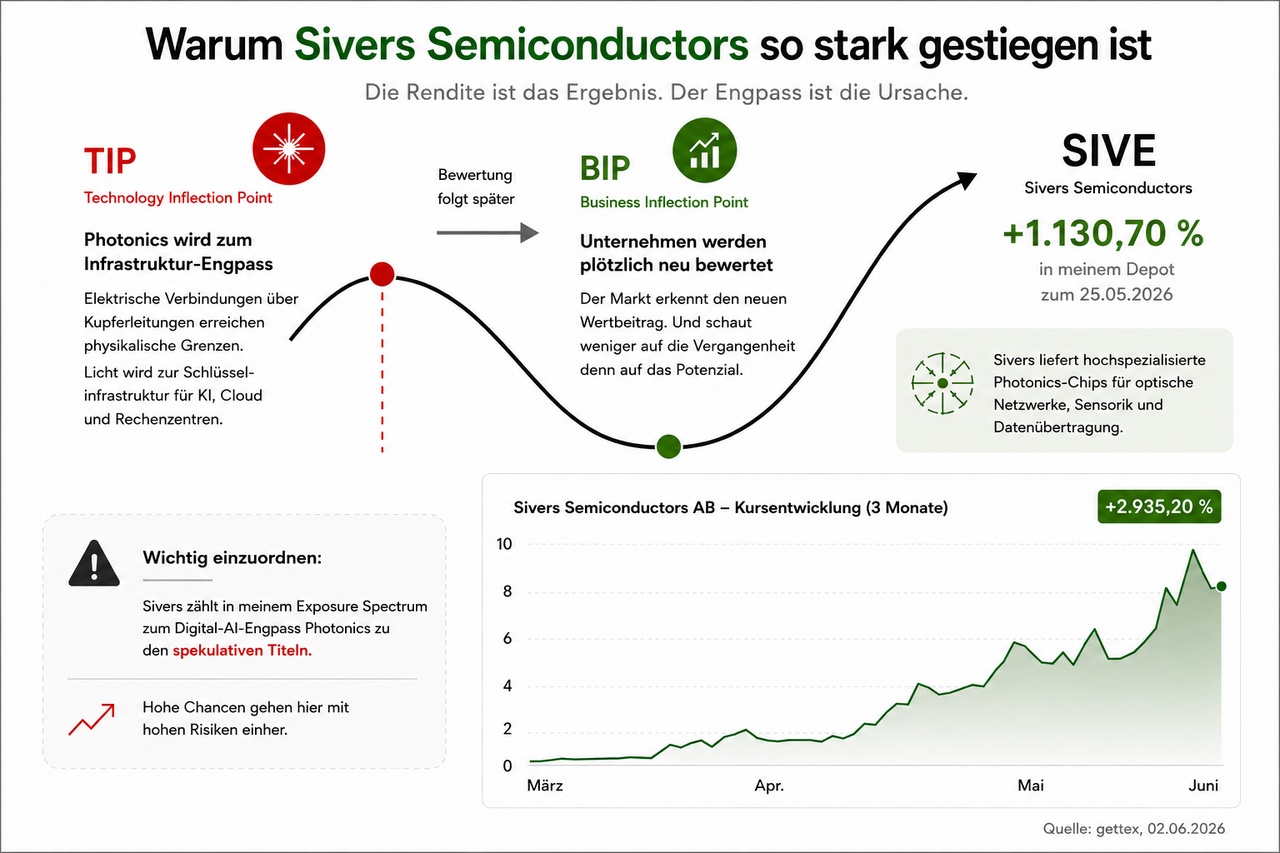
Why Sivers Semiconductors is rising so strongly today 📈
If you only look at the price trend, you will see a classic high flyer. If you dig a little deeper, you will see something else: a potential possible infrastructure bottleneck that is just beginning to become economically relevant.
For me, the development of $SIVE (+15,5%) well explained by two terms:
🔴 TIP = Technology Inflection Point
A technology inflection point occurs when a technology goes from being an interesting niche solution to a potentially indispensable infrastructure.
This could currently be the case with photonics could happen. AI systems are generating ever larger data streams. At the same time, electrical connections via copper are increasingly reaching their physical limits. Energy consumption, heat and signal losses are increasing.
This is why the industry is investing heavily in optical data transmission. Light instead of electricity. Photonics is therefore increasingly developing from a specialist topic into a potential AI infrastructure bottleneck.
🟢 GDP = business inflection point
The business inflection point often comes later. It occurs when companies suddenly benefit economically from this technological change. also benefit economically.
New orders.
New customers.
New sales potential.
New valuations.
A current example is the example is the collaboration between Sivers Semiconductors and GlobalFoundries that was announced today. This is interesting for me because such partnerships can show that a technology is finding its way out of the development phase and towards industrial scaling.
This is precisely the point at which a reassessment by the market. The market then looks less at the past and more at the question: "How big could this market become if the technology catches on?"
Nevertheless, it remains important that Sivers is still one of the speculative stocks in my exposure spectrum. speculative stocks in my exposure spectrum. The company is not an established infrastructure heavyweight like Coherent. It is much earlier in the cycle. The opportunities are therefore greater.
But so are the risks.
For me, Sivers therefore remains above all a bet that the current technology inflection point will eventually become a sustainable business inflection point.
After all, returns are rarely generated when everyone is convinced. They often arise when a new infrastructure bottleneck is just becoming apparent.
Incidentally, Sivers is also my driving force in the NextLimits wikifolio with a current gain of 822%.
LG
Update on NextLimits, the bottleneck wikifolio - after 2 months +107 %
NextLimits is at +107 %. All 20 positions are currently trading in positive territory 🟢 That makes me happy, of course. But what I find more interesting than the pure performance is the question of where it comes from.
Many of the strongest developments stem from topics that I have been observing for months as future technological bottlenecks:
- Photonics
- Advanced Materials
- Space Infrastructure
- sensor technology
- Directed Energy
Companies like Sivers Semiconductors $SIVE (+15,5%) or Everspin Technologies $MRAM (+4,13%) have performed particularly strongly. At the same time, the current development shows that the performance is not only being driven by individual outliers, but has so far been quite broadly distributed across the entire portfolio.
Interim conclusion: The underlying bottleneck theses currently appear to be confirmed. My thinking model here is DIBS (Dynamic Infrastructure Bottleneck Stack).
Nevertheless risk management as the search for opportunities. That is why I have already realized partial gains twice in Sivers Semiconductors and also made a partial sale in Everspin Technologies in order to limit the position sizes in the portfolio.
NextLimits deliberately focuses on topics where the next technological bottlenecks could arise. Not on what is already common knowledge today, but on the infrastructure, material and technology layers below. TechLimits stands for acute bottlenecks, CoreLimits for stability. All three form my ScaleLimits system.
This is still only just under two months. But so far the wikifolio is developing in exactly the direction I had in mind when I launched it.
If not, what does the chart look like without 0.95%pa + 10% for new ath?
Sweden's 🇸🇪 hidden deep-tech bottlenecks
I noticed something some time ago: The deeper I look for technological bottlenecks, the more often I suddenly end up in Sweden. Not with Ericsson or Volvo, but with small and medium-sized deep-tech companies.
A few examples from my portfolio (the first four) or my watchlist:
- Sivers Semiconductors - $SIVE (+15,5%) Radio frequency and photonics components for AI and data networks
- Acconeer - $ACCON (+7,34%) energy-efficient radar sensors for industry and edge applications
- BeammWave - $BEAMMW B digital beamforming technology for future mobile networks
- Obducat - $OBDU B (+28,05%) Nanoimprint lithography for advanced semiconductor and photonic structures
- Hexatronic -
$HTRO (+4,56%) Fiber optic infrastructure for the expansion of digital networks
- Smoltek Nanotech -
$SMOL (+3,78%) Carbon nanostructures for semiconductors, electrolyzers and future packaging solutions
- Smart High Tech -
$SHT B (-17,48%) Special electronics and technical components for demanding industrial applications
What many of these companies have in common: They are not located at the end of the value chain, but often several levels below it. This is where new technologies are made possible in the first place. This is exactly where I look for bottlenecks.
Of course, such stocks are not for every investor. Many are small, less liquid and in some cases still a long way from stable profitability. Individual orders or capital measures can have a massive impact on share prices. Not every technology will prevail and not every company will make it to broad commercialization.
This is precisely why I do not treat them like standard stocks, but as targeted additions within a more broadly diversified technology portfolio. I entered SIVE just over 2 months ago and was already at a price return of 1,150 %, now a little less again and have taken two partial profits 😅.
The deeper you delve into topics such as photonics, sensor technology, wireless technologies or advanced materials, the more frequently Sweden appears.
Sometimes the country seems like a small, listed deep tech incubator in the middle of Europe.
Attention ⚠️ These are very speculative stocks with high volatility! No investment advice!
Future AI bottleneck #2: Photonics 💡
Many AI investors are primarily looking at GPUs, memory or energy supply. I believe that the next big bottleneck is already slowly emerging: Photonics.
The background: modern AI systems have to move ever larger amounts of data. However, classic copper cabling is increasingly reaching its physical physical limits. Energy consumption, heat generation, signal losses and susceptibility to errors are increasing massively. This is why the industry is moving step by step towards light instead of electricity.
- Photonics simply put, means that data is no longer transmitted primarily electrically, but optically via light signals.
- Optoelectronics as a sub-sector combines electronics and lighting technology.
- CPO/Co-Packaged Optics describes the approach of placing optical components directly next to AI chips in order to massively improve speed, energy efficiency and bandwidth.
NVIDIA is now visibly driving this development forward. The company is investing billions in optical infrastructure and partners in the field of AI photonics. (For example, Lumentum and Coherent are currently benefiting from a 2 billion dollar investment each).
For me, this is therefore likely to be the next big upcoming AI bottleneck. What I find particularly interesting is that photonics does not consist of just one area. There are very different levels of risk and maturity within the stack.
Level 1: Established photonics infrastructure
This is where the more stable infrastructure players are located. Companies such as $COHR (+3,24%) (Coherent), $LITE (+11,08%) (Lumentum), $CIEN (+4,61%) (Ciena) or even $FN (+0,75%) (Fabrinet) are already benefiting from the fact that optical systems are increasingly moving into AI data centers.
This is mainly about:
- lasers
- optical components
- Fiber optic infrastructure
- transceivers
- Optical Networking
Level 2: Optical Interconnects & Data Center Connectivity
A field in which there is currently a lot of momentum. AI clusters require ever faster connections between GPUs, storage and switches. I'm thinking of companies like $AAOI (+6,27%) (Applied Optoelectronics), $ANET (+2,05%) (Arista Networks) or in some cases also $5802 (+3,46%) (Sumitomo Electric). Optical interconnects could develop into a central AI bottleneck in the next few years.
Level 3: Materials, substrates & manufacturing bases
This area usually receives much less attention, although it is here that important prerequisites for modern photonics systems are created. Photonics requires highly specialized materials, new substrates and precise manufacturing structures. I find companies such as $AXTI (+4,1%) (AXT), $SOI (+5,93%) (Soitec), $5802 (+3,46%) (Sumitomo Electric) or in some cases also $TSEM (+4,48%) (Tower Semiconductor).
Materials such as indium phosphide (InP), special wafer technologies and optical integration platforms are becoming increasingly important as data rates and integration density rise. And the more complex optical systems become, the more relevant the future bottleneck of "test & metrology" becomes, because these structures have to be controlled and measured with extreme precision (see my last post).
Level 4: Optionality & Next Generation Photonics
The risk increases significantly here. At the same time, however, the potential leverage effect also increases. Companies such as $LWLG (Lightwave Logic), $SIVE (+15,5%) (Sivers Semiconductors), $INFQ (Infleqtion) or even $LASR (nLight) are working on technologies that could make future optical systems even more efficient or powerful. For me, these are not sure winners. But they are often the early technological options for the next wave of infrastructure. Incidentally, Sivers will soon also be listed in parallel on the NASDAQ.
The exciting thing is that the AI bottleneck is shifting further and further away from pure compute and into the physical infrastructure of data movement.
Acute/Active:
HBM + Power & Cooling + Advanced Packaging + Energy/Grid
Future/Emerging:
Test & Metrology + Photonics
AI will not only need more computing power in the future. Above all, AI needs the ability to move gigantic amounts of data efficiently, quickly and stably.
A third AI bottleneck in the "future/emerging" category could already arise: Edge AI. More on this soon.
The Overlooked Laser Supplier and the Hyperscaler Optical Supercycle
$SIVE (+15,5%)
Sivers Semiconductors · $720M MC → $2B+ Journey
The markets have overlooked Sivers ($SIVE), a critical laser supplier for the upcoming hyperscaler optical supercycle. This cycle is driven by fundamental architectural changes—and Sivers is at the very center of this shift.
1. Who are the End Users? The Two-Step Connection to Amazon
If you are wondering where $SIVE’s lasers are going: Sivers Lasers → $MRVL (Marvell) → $AMZN (Amazon). This connection is confirmed in Marvell’s 8-K SEC filings. Amazon has "photonic fabric" purchase agreements for Celestial, which links back to Sivers lasers through a two-step supply chain.
Critical Detail: The share value for Marvell under this agreement was set at $87/share, while Marvell trades at $139+ today. This means Amazon has an incredibly strong incentive to purchase as much volume as possible. Given its scale within the supply chain, $SIVE stands to benefit the most from these volume orders.
2. Everything Changed in Three Days
Recent developments have essentially validated the $SIVE thesis in quick succession:
- Jabil Collaboration: $JBL (Jabil) confirmed it is using $SIVE lasers in its 1.6T optical transceivers.
- Reduced Balance Sheet Risk: Sivers secured $13.5M+ in new financing from long-term institutional investors, including pension funds.
- NASDAQ Listing: $SIVE has taken steps toward a NASDAQ listing. Reuters confirmed the development: "Welcome to America, Sivers."
3. Why the NASDAQ Listing is a Catalyst
Sivers currently trades on the Swedish exchange, and its shareholder base consists primarily of local Swedish investors. With a NASDAQ listing, the landscape changes entirely: Western institutional funds that understand the photonics sector will enter the fray.
The details of the recent capital raise are telling: "The investors in the Directed Share Issue comprise of a limited number of Swedish and international institutional and other qualified investors." This international institutional participation appears aimed at funding the regulatory and audit requirements for the NASDAQ listing. A parabolic upside scenario is well within reach.
4. The Piece That Completes the Ecosystem: Win Semi (3105)
Who are the primary beneficiaries of the next architectural supercycle in mass laser production? Sivers + Win Semi (3105). Together, they form a complementary ecosystem. Therefore, holding a long position in $SIVE alongside Win Semi is a natural extension of this thesis.
5. Valuation: Why $2B+?
We are looking at a company currently trading at a market cap of approximately $560M–$720M. Yet, this company is a critical laser supplier for $MRVL, $JBL, and hyperscaler supply chains.
Consider the comparisons: Companies in similar positions, such as $LITE and $MTSI, are valued in the tens of billions. There are only a handful of companies in the world with this specific positioning. While $LITE is valued at $64B and $MTSI at $20B, $SIVE remains at $720M.
Institutions received full validation today: Sivers is the light source in hyperscaler supply chains and a direct supplier for $JBL optical transceivers. It is only a matter of time before this realization spreads through the institutional investment community.
Conclusion
Can you find another company like $SIVE at a $620M MC that serves as a critical laser supplier for $MRVL, $JBL, and hyperscaler supply chains? No—there are only a few such companies globally. Every other player, from $LITE to $MTSI, is worth tens of billions. $SIVE is on its way to becoming the next $LITE.