Introduction
A young German-British company has taken a remarkable step: For the first time first time a prototype of a hypersonic rocket has been successfully successfully tested for Europe. And after just nine months of construction 😳 This test marks an important milestone in an area that has so far been dominated almost exclusively by major powers such as Russia, the USA and China.
_________________________
⚡️ 1st European hypersonic test flight successful 🚀
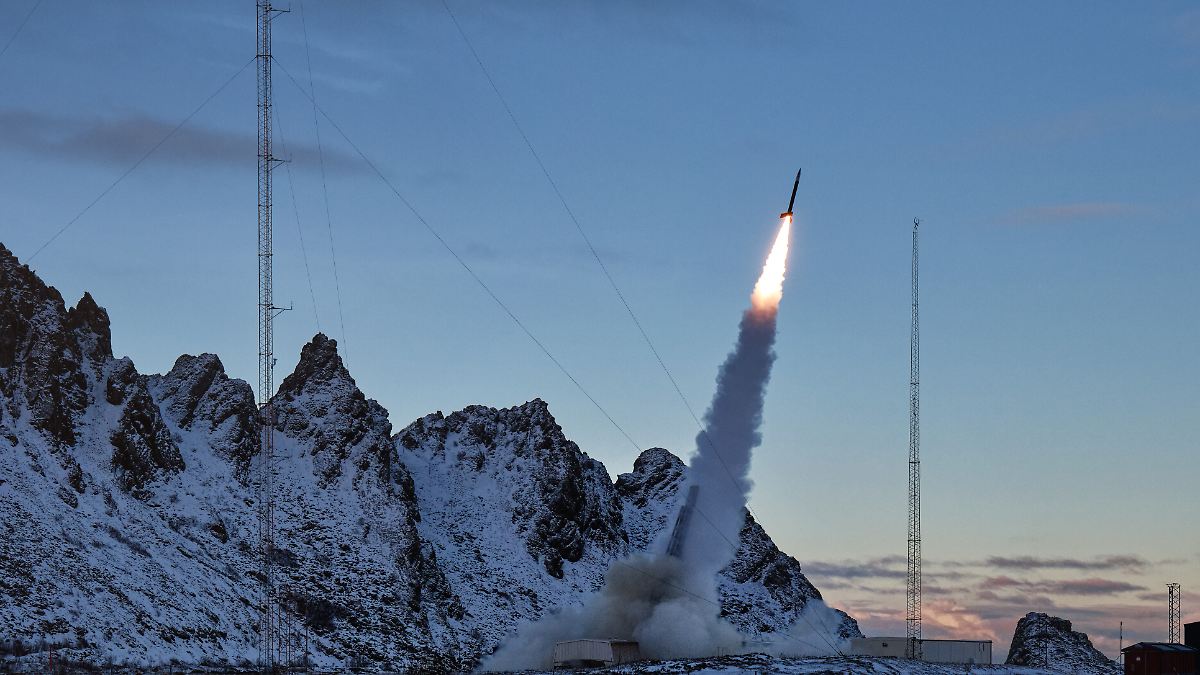
On February 3, 2026, the Munich-based startup Hypersonica launched its HS1 prototype from the Norwegian spaceport Andøya. According to the company:
- The rocket reached hypersonic speeds of over Mach 6 (more than 7,400 km/h).
- It covered a distance of around 300 kilometers.
- The prototype did not carry a warhead - it was purely for flight testing.
- A production-ready version is to be developed by 2029.
Hypersonica has thus achieved an unprecedented success for a privately financed European armaments and aviation project in the hypersonic sector.
_________________________
🧪 2. why hypersonic missiles are relevant
Hypersonic missiles fly extremely fast (faster than Mach 5) and are traditionally difficult to intercept. This gives them:
- ⇨ strategic importance in the field of modern defense systems,
- ⇨ high importance for future military technologies,
- ⇨ Influence on the geopolitical balance of power.
Only a few countries still possess such technology - Russia and the USA have already developed or deployed their own systems. Europe has so far lacked a comparable, sovereign solution.
_________________________
🇪🇺 3. Europe wants to become more technologically independent
The background to the project is not only technical ambition, but also geopolitical strategy:
- Europe is to become more technologically independent from the USA and other major powers.
- Public debates show that security policy and defense technology are seen as part of sovereignty.
- Hypersonica's success could strengthen Europe's role in defense and space technology.
Hypersonica was only founded in 2023, is based in Munich and has a subsidiary in London. The CEO and co-founders emphasize that the technology has long been neglected and that faster development cycles are needed.
_________________________
🧠 4. technical & strategic challenges
Hypersonic missiles are not only fast, but also complex:
- The engine is not the central problem, but
- combining high speed with precise control and stable maneuverability.
- Mach speeds generate enormous thermal loads that require special protection and materials.
Hypersonica wants to address these challenges and carry out further tests and developments in the coming years.
_________________________
👍 5. significance for industry & research
Successful testing is not only a technological step, but can also
- Boost investment in European aerospace
- Boost research networks between universities, start-ups and defense agencies
- Strengthen Europe's presence in a globally strategic technology
Competition and comparison: To date, the USA, Russia and China have also been working on their own hypersonic systems, which have significantly greater ranges. Europe's approach, however, is a fast, private development path, similar to the influence of companies like SpaceX on space development as a whole.
_________________________
$LMT (+3.9%)
$RYTT34
$BA (-0.76%)
$GD (+1.01%)
$LHX (+1.57%)
$KTOS (-2.27%)
$SAF (+0.1%)
$RHM (+2.56%)
$AM (+1.87%)
$SAAB B (+1.42%)