
$BTC (+1.25%) Bitcoin is currently under pressure less due to crypto-specific factors than due to geopolitics, interest rates and liquidity rotation. A total of USD 5.8 billion has recently flowed out of digital asset investment products - a clear drop in sentiment, but no structural damage. The interest rate market is decisive: instead of one or two interest rate cuts, the market is now pricing in around 40 basis points of interest rate hikes. At the same time, AI is withdrawing capital from other segments. Bitcoin now needs two things above all: more clarity in the Iran conflict and a turnaround in the interest rate outlook. (Author: James Butterfill, CoinShares' Head of Research)
- Markets
- ETFs
- CoinShares Bitcoin ETP
- Forum Discussion

CoinShares Bitcoin ETP
ETP
ETP
ISIN: GB00BLD4ZL17
Ticker: BITC
GB00BLD4ZL17
BITC
Price
Discussion about BITC
Posts
64


1Wk·
Stocks up, bonds nervous - Bitcoin listens to the interest rate market
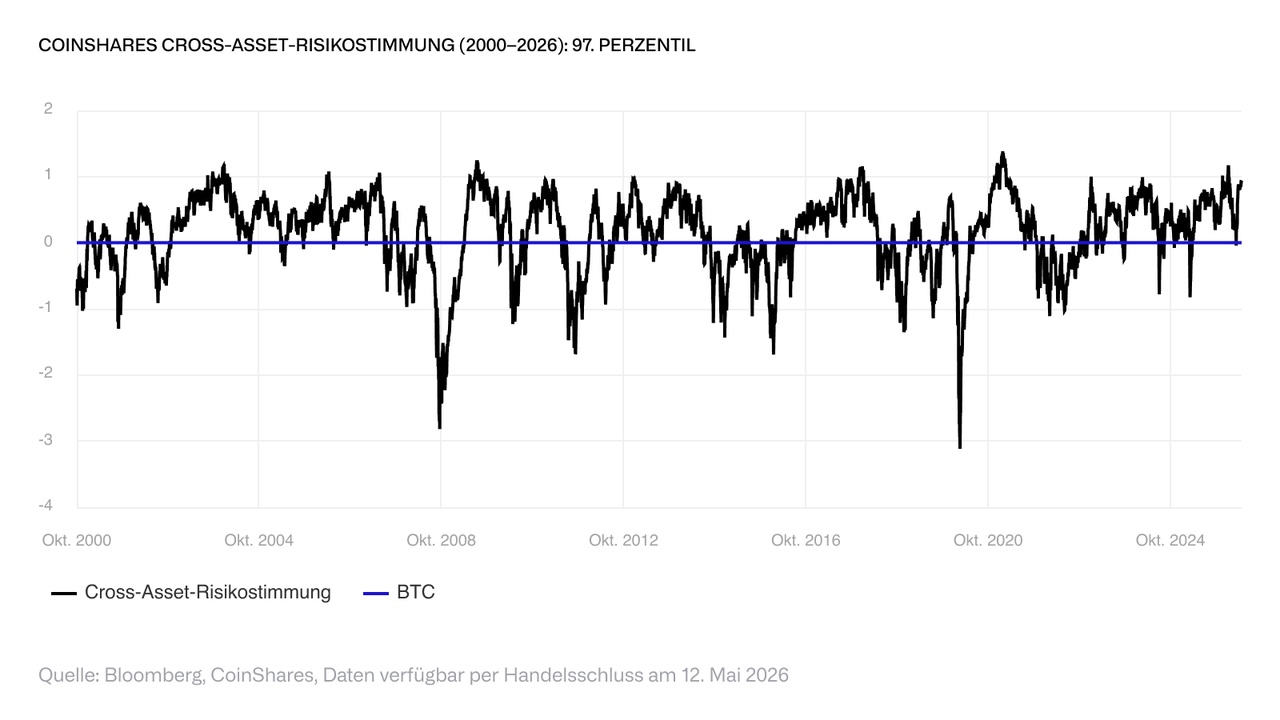
The equity markets remain in a celebratory mood, buoyed by the AI-driven rally. Bond markets, on the other hand, are increasingly focusing on geopolitical tensions and the ongoing blockade of the Strait of Hormuz. The longer the disruption lasts, the more inflationary effects are likely to build up - via rising oil prices and shortages of key commodities such as helium. Market expectations are therefore shifting away from interest rate cuts towards possible renewed interest rate hikes. Against this backdrop, the rolling 30-day correlation between the S&P 500 and the US two-year yield has fallen to extremely low levels. Historically, such divergences rarely last long - and risky assets such as Bitcoin are beginning to price in the fact that the interest rate markets could ultimately be right.
Interestingly, the recent $BTC (+1.25%) -rally appears to have been driven primarily by strong ETF inflows and continued buying of digital asset treasuries, while activity in the derivatives market has remained comparatively subdued. ETF flows have turned negative in recent days, but funding rates for perpetual futures have risen significantly. This indicates that market activity is picking up again after several months of subdued trading conditions.
33
1Wk·
Quantum computers endanger Bitcoin? Three reasons why Thelen's crash scenario is unlikely
Frank Thelen paints a terrifying picture of a sudden crypto-collapse triggered by quantum computers. CoinShares' Bitcoin Research Lead Christopher Bendiksen comes to a different conclusion - for three reasons:
First, the vast majority of $BTC (+1.25%)-addresses today are constructed in such a way that the public key is not visible. Even if quantum computers were able to crack individual keys, there would only be a tiny time window of around ten minutes in which a transaction hangs in the network. Bendiksen believes this is unrealistic, even over decades.
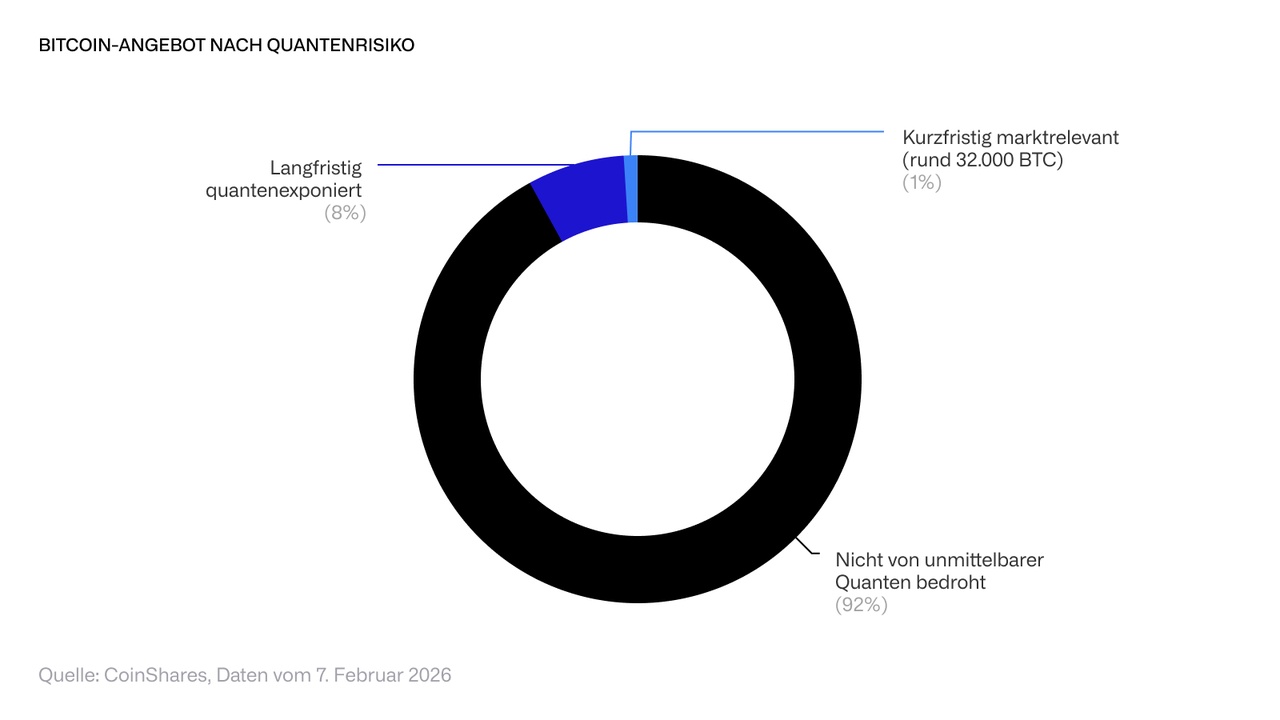
Secondly, only a small, clearly definable part of the supply is actually at risk - especially old pay-to-public key addresses. This affects around eight percent of all coins, of which only a fraction (around ten thousand Bitcoin) would be relevant to the market in the short term. Even with extremely optimistic assumptions about quantum progress, an attacker could only work off the rest over many decades.
Thirdly, Bitcoin is adaptable. A soft fork could introduce quantum-resistant signatures and new address types to which users could gradually migrate. For Bendiksen, Bitcoin is therefore not a victim of quantum technology - but a system facing a long-term engineering problem that can be solved.
44
3 Comments
Thelen is a classic contra-indicator. I think nothing, absolutely nothing of the man who (had) invested in companies like Lilium and complains to the government when it doesn't support a moronic business model with millions in taxes.
I still don't hold BTC. I'm too old for that shit ...
I still don't hold BTC. I'm too old for that shit ...
•
88
•3Wk·
Altcoins defy risk-off sentiment as hopes for CLARITY Act cushion Bitcoin outflows
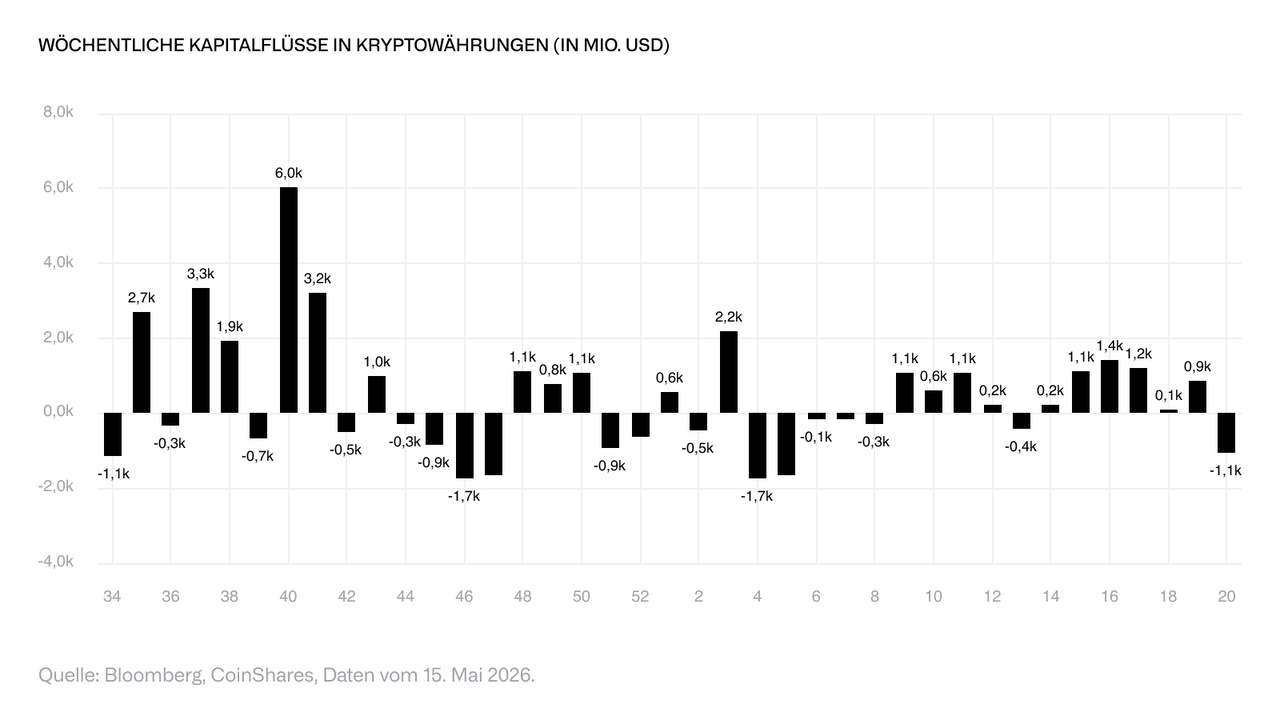
Digital investment products saw outflows of USD 1.07 billion - the first negative week in seven weeks and the third largest weekly outflow of 2026, surpassed only by two weeks at the end of January. This likely reflects renewed geopolitical risk-off sentiment related to developments around Iran, with outflows concentrated mainly in $BTC (+1.25%).
The news surrounding the CLARITY Act appears to have improved sentiment at the margin: Eleven assets continued to see notable inflows, and Thursday was positive with inflows of $174 million. Altcoins held up remarkably well. $XRP (+1.71%) The largest asset class, the cryptocurrency, saw inflows of 67.6 million US dollars, $SOL (+3.37%) The inflow of USD 55.1 million - for both, the momentum accelerated compared to the previous weeks.
22
4Wk·
Decision point for Bitcoin?
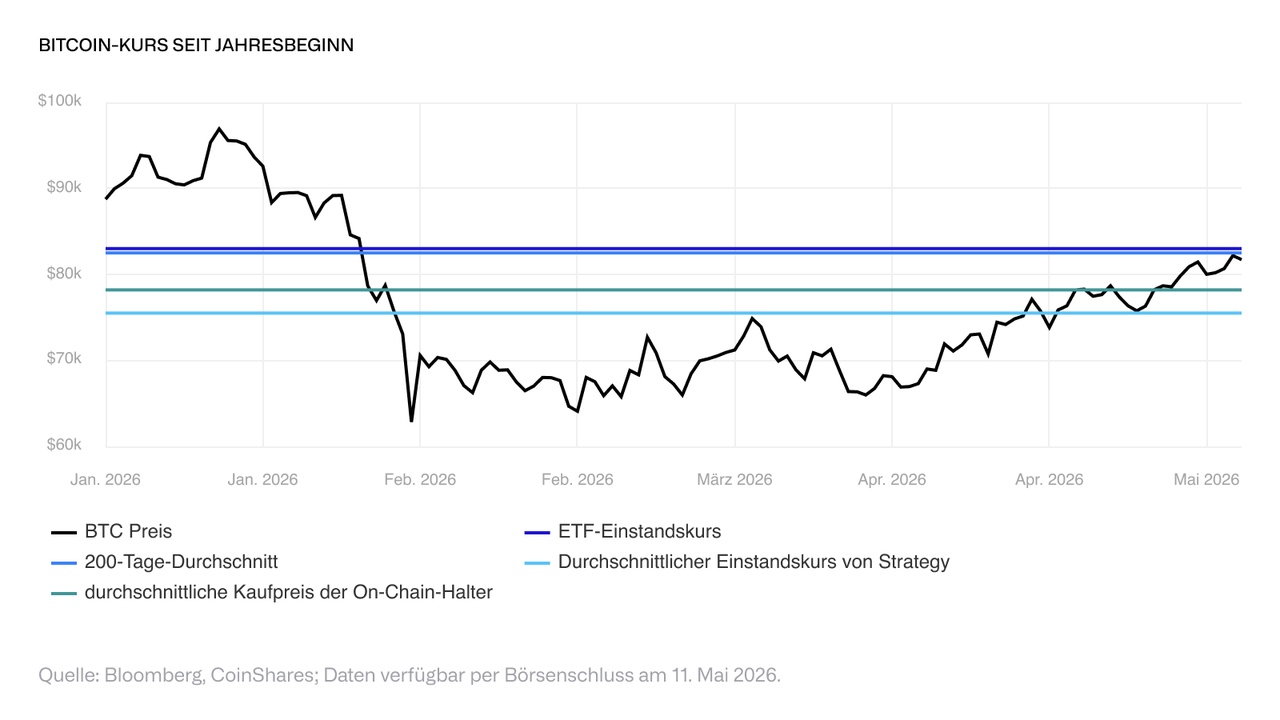
$BTC (+1.25%) moved in a narrow trading range between 80,000 and 82,500 US dollars last week. Four important reference levels are close to the current price and can be clearly divided into resistance and support zones.
Above the current price, two levels act as resistance. The 200-day average is around USD 82,500. The average entry price for investors in US spot$BTC (+1.25%)-ETFs is around USD 83,000, reflecting the strong inflows of the past year. Together, these levels form a zone in which investors waiting for the break-even point tend to sell.
Below the current price, two other levels act as support. The "true market mean", i.e. the average purchase price of on-chain holders, is USD 78,200. Strategy, the world's largest on-chain holder of #bitcoinhas an average purchase price of USD 75,500. A break below one of these levels would put these market participants in the red.
For the bulls, a clear weekly close above USD 83,000 would bring ETF investors back into the profit zone and improve momentum. A clear rejection below USD 78,000, on the other hand, could trigger further selling pressure. Until one side breaks out, the trading range will remain.
88
4Wk·
CLARITY compromise ensures strongest crypto inflows since April
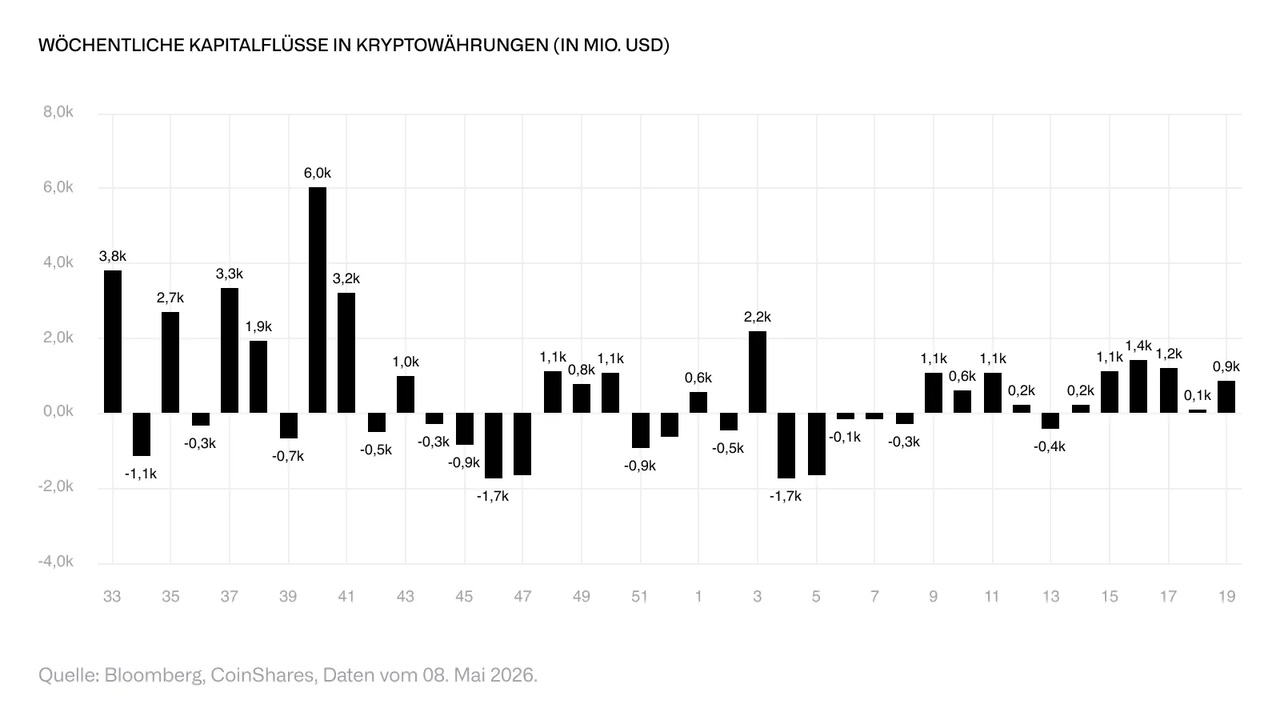
Investment products for digital assets recorded inflows of USD 857.9 million - the sixth consecutive positive week and the highest weekly volume since April 24. This likely reflects the improved sentiment around the CLARITY Act after Senators Tillis and Alsobrooks released the final compromise text on the stablecoin interest rate on May 1 and stood their ground against opposition from the banking industry on May 4. $BTC (+1.25%) The price of the stablecoin rose above the USD 80,000 mark on Monday, reaching its highest level since the correction in February. The Senate Banking Committee is expected to discuss the issue next week. Total assets under management rose to 160 billion US dollars.
11
4Wk·
Bitcoin above 80,000 US dollars: Breakout yes, euphoria no
$BTC (+1.25%) has recaptured the USD 80,000 mark. This is important from a chart perspective, as the market has failed to reach this level several times since the end of January.
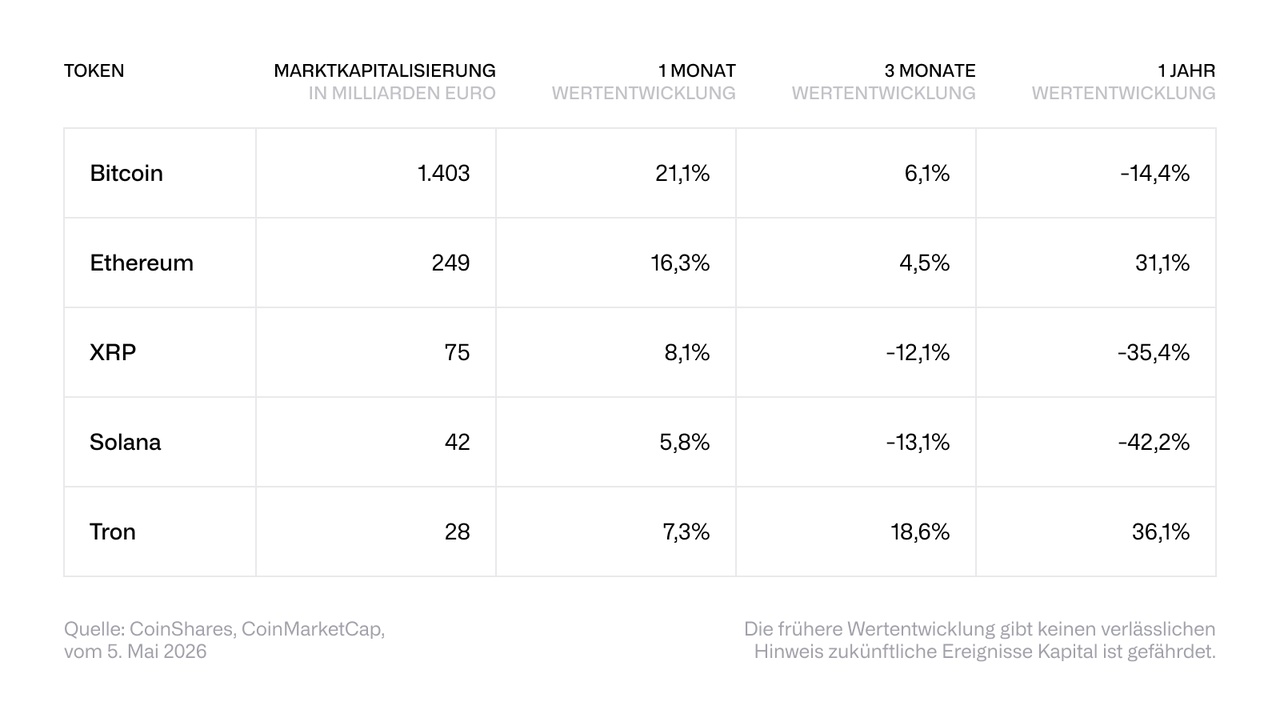
However, the rise does not look like a broad retail euphoria. The movement is being driven primarily by institutional inflows: spot Bitcoin ETFs collected around USD 2.9 billion in April, with a further USD 2 billion added in May.
The tailwind is coming from several directions: lower oil prices, somewhat less geopolitical risks, a weaker dollar, ETF demand and further purchases by large Bitcoin addresses. At the same time, caution remains appropriate. Inflation is stubborn, the US Federal Reserve has little room to cut interest rates, and regulatory progress is more likely to help Ethereum, stablecoins and DeFi than Bitcoin itself.
Conclusion: The medium-term outlook remains constructive. But this market continues to be heavily driven by liquidity, ETF flows and macro data - not a clean new crypto euphoria.

66

1Mon·
Crypto investment products record USD 1.2 bn inflows - institutional demand increases despite FOMC wait-and-see approach
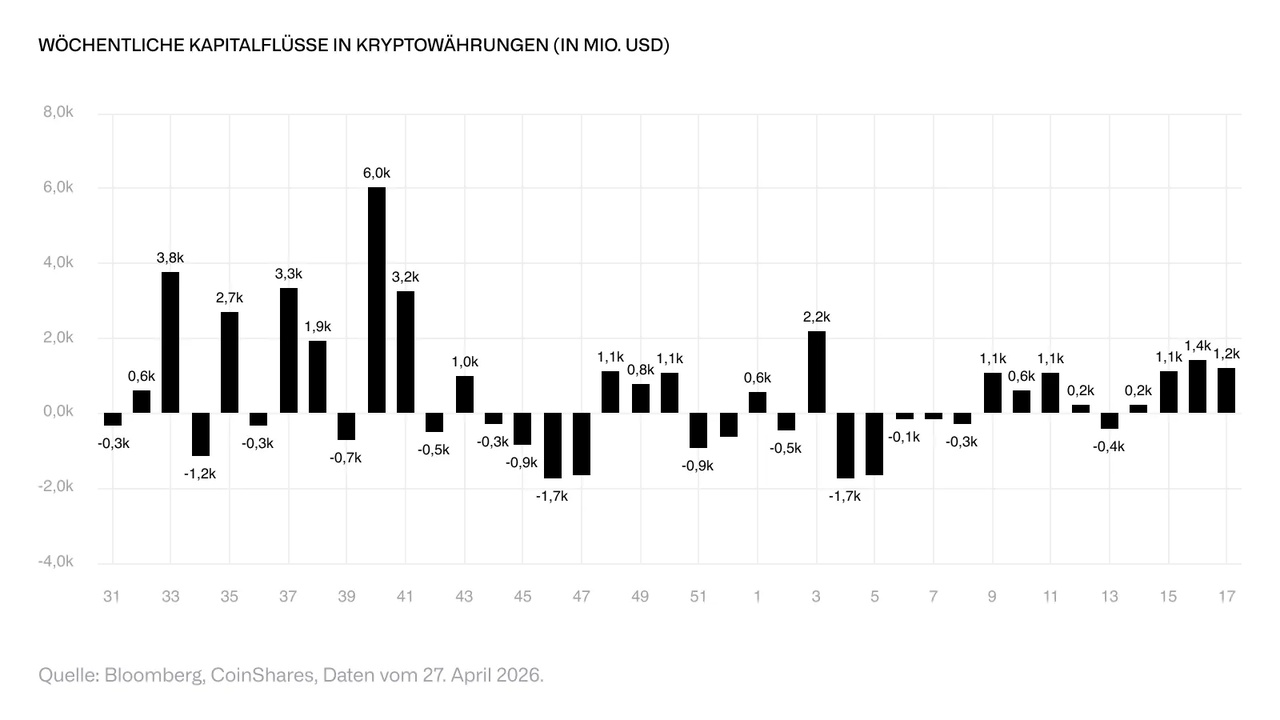
Investment products for digital assets register inflows of USD 1.2 billion, the fourth positive week in a row. This presumably reflects increasing institutional demand, against the backdrop that $BTC (+1.25%) trading at its highest level since the beginning of February. The market is now looking ahead to the FOMC decision on April 28-29, which is likely to contribute to some caution. Total assets under management (AuM) rise to USD 155 billion, the highest level since February 1, but still well below the peak of USD 263 billion in October 2025.
You can invest in Bitcoin via the following vehicle: $BITC (-0.84%)
33
1Mon·
While gold falls: Bitcoin shows new crisis strength
$BTC (+1.25%) continues to hold its own as a surprisingly robust crisis winner. Since the escalation in Iran at the end of February, the cryptocurrency has risen by around 23%, while stock markets fell and $GOLD and trended significantly weaker. Bitcoin gained a further 4.5% this week alone.
Institutional investors also remain committed: Products for digital assets recently attracted around one billion US dollars in fresh capital. Blockchain shares are also in particularly high demand, with record inflows this month.
Additional tailwinds could come from the USA. The focus there is on the Clarity Act, which is intended to provide clear rules for the crypto market. If passed, it would make it easier for banks and large investors in particular to enter the market. (Author James Butterfill, CoinShares' Head of Research)

22
Trending Securities
Top creators this week
Real-time data from LSX · Fundamentals & EOD data from FactSet