

The remaining position is a free roll
Discussion about LINK
Posts
52

4Mon·
Is crypto dead? Or is it the future?
With the prolongation of the fall during this few months, is this topic already dead? Or is it just a matter of time until this assets skyrocket?
Here is what I think of the top 4 that I personally own.
——————————————————————————
Executive Summary
This report provides a detailed utility analysis of four cryptocurrency projects selected for current and emerging use cases. Each project is evaluated on real-world adoption, technological advantages, and risks—excluding price predictions or investment recommendations.
——————————————————————————
Methodology
Each project is assessed across four dimensions:
1. Real Use Cases – Demonstrated, current applications
2. Strengths – Technological or adoption advantages
3. Risks – Technical, regulatory, or design vulnerabilities
4. Reality Check – Gap between promise and execution
——————————————————————————
Project Analysis
Advantages:
1. 3M daily XRPL transactions; proven real volume
2. Clear regulation (SEC settlement 2025 + OCC bank charter approval)
3. 50+ financial institutions adopting (SBI, PNC, American Express)
4. Rakuten: 44M users; live retail integration
5. 3-5 second settlement; specific use cases working
Disadvantages:
1. Competes against established stablecoins (USDT, USDC)
2. Ripple partially controls supply and governance
3. Slow adoption compared to initial blockchain promises
4. Niche market in payments; not a general solution
5. Other tokens compete in institutional payments
Long-Term Outlook ( 7-10 years)
• Base Case (60%): Established niche utility in institutional payments; 5-10% of cross-border payment market captured; ODL corridors normalized globally
• Bull Case (25%): Regulatory clarity spreads; RLUSD becomes settlement standard; 15-20%+ market penetration
• Bear Case (15%): Stablecoins + CBDCs dominate; XRP remains retail/speculative asset
• Regulatory Evolution: Key factor—further legal clarity accelerates or regulatory restriction suppresses
——————————————————————————
Advantages:
1. $3B+ TVL by April 2026; growth from $40M in 2023
2. Market leader in Treasury tokenization (17% market share)
3. Major institutions deploying: WisdomTree, Invesco, Apollo Global
4. Proxy voting for 250+ stocks/ETFs; TradFi experience on-chain
5. $700M in tokenized equities; real use cases live
Disadvantages:
1. ONDO token lacks direct protocol revenue
2. Tokenized securities regulation still evolving
3. Competes with BlackRock BUIDL (greater institutional backing)
4. RWA market saw $14.6M exploits in H1 2025; operational risks
5. Dependent on custodians and traditional finance intermediaries
Long-Term Outlook ( 7-10 years)
• Base Case (55%): RWA tokenization becomes standard for institutional yield and equity products; Ondo maintains 15-25% market share; $500B+ TVL
• Bull Case (30%): Traditional asset custodians adopt blockchain settlement; DTC/DTCC models deployed; Ondo becomes primary RWA infrastructure layer
• Bear Case (15%): Regulatory restrictions; traditional finance rejects on-chain settlement; confined to crypto-native institutions
• Key Factor: Regulatory clarity on tokenized securities and DTC adoption timeline (currently expected 2028+)
——————————————————————————
Advantages:
1. 1000+ integrations; 58.6% market share in oracles
2. $33B TVL in DeFi dependent on Chainlink feeds
3. SWIFT partnership; expansion into institutional finance
4. SVR captures 99% oracle-related MEV ($8.3M in Q1 2026)
5. Staking attracted $500M+; incentive alignment with network
Disadvantages:
1. Competes with Pyth and API3; gradual dominance erosion
2. Centralized model despite decentralization claims
3. Bottleneck: oracles necessary but not a differentiator
4. Systemic risk if validators compromised
5. Profit margin compressible; commoditization possible
Long-Term Outlook ( 7-10 years)
• Base Case (50%): Maintains oracle dominance but with 40-50% market share; CCIP expands institutional use; faces gradual erosion from competitors
• Bull Case (35%): Enterprise adoption accelerates; oracle market consolidation favors Chainlink; $100B+ TVL across DeFi + institutional
• Bear Case (15%): Oracle standardization/consolidation results in commodity pricing; margin compression forces business model evolution
• Key Factor: Execution on CCIP institutional roadmap and competitive response to Pyth/API3
——————————————————————————
Advantages:
1. SEC-registered transfer agent (October 2025); regulatory legitimacy
2. 280K+ RWA holders; largest on-chain RWA user base
3. $645M in managed assets; WisdomTree, Invesco, Apollo real deployments
4. Mainnet June 2025; specialized infrastructure for RWAs (not generic L2)
5. ADGM license + Mastercard Start Path; regulatory + corporate validation
Disadvantages:
1. PLUME token down 95% from ATH (March 2025); token/utility disconnect
2. RWA market still emerging; slow adoption vs potential
3. Competes with generic L2s (Arbitrum, Optimism) + RWA-specific chains
4. Centralization: <5 actors can submit challenges and data availability
5. Total dependence on DTC/DTCC adoption for institutional scale
Long-Term Outlook ( 7-10 years)
• Base Case (50%): Becomes leading RWA settlement infrastructure; $1-2T TVL of tokenized assets; 30-40% market share in RWA layer
• Bull Case (30%): Emerges as primary financial settlement layer; traditional finance custody models shift on-chain; becomes “RWA L1” standard
• Bear Case (20%): Generic L2s commoditize; institutional RWA adoption slower than projected; confined to specific asset classes
• Key Factor: TradFi custodian/settlement adoption (DTC, DTCC, Euroclear partnerships)
What do you guys think of crypto?
33

5Mon·
They want to abolish the tax exemption for Bitcoin and cryptos after a holding period of one year
It may not itch you, as you are not invested anyway. But after that comes gold & silver. Then comes real estate (10 years). Finally come watches, art, vintage cars, spirits, wines and everything else.
In 1999, the speculation period for securities was extended from 6 to 12 months by the SPD and the Greens. In 2009, it was completely abolished by the CDU and SPD and replaced by today's flat-rate withholding tax + solidarity surcharge. More than 14 million small investors and savers are affected by this today. The greedy state is hindering your prosperity and private pension provision.
$BTC (-0%)
$ETH (+0.01%)
$XRP (-0.37%)
$SOL (-0.19%)
$BNB (-0.19%)
$DOGE (+0%)
$HYPE (+0.18%)
$AAVE (-0.21%)
$ZEC (+0.07%)
$WLFI (-0.01%)
$ADA (-1.54%)
$DOT (+0.02%)$TRX (-0.09%)
$XMR (-0.7%)$LINK (-0.14%)
$XLM (-0.46%)
$DAI (-0.01%)
$PAXG (+0.03%)
$LTC (-0.33%)
$AVAX (-0.76%)
$SUI (-0.36%)
$HBAR (+0.22%)
$SHIBA
$TAO (-0.23%)
$CRO (-0.66%)

2323
15 Comments
Ichbinak63@Ichbinak63
5Mon
•
1010
•View all 9 further answers

7Mon·
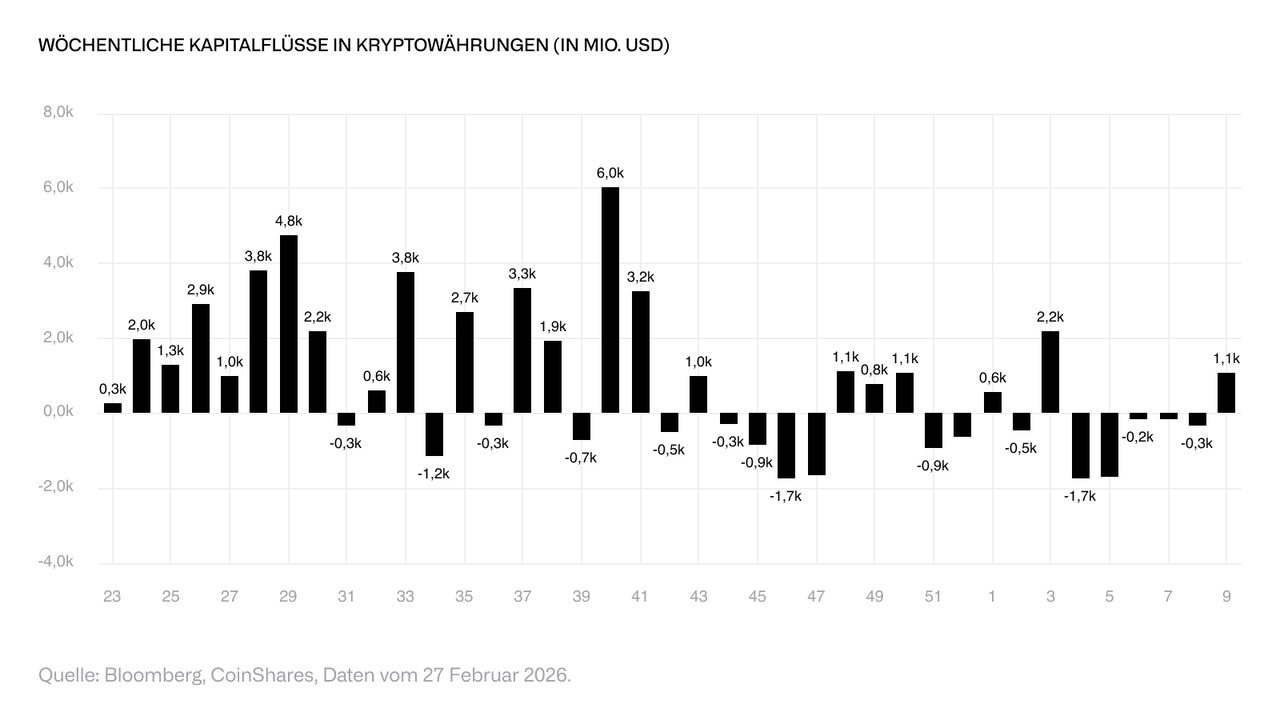
Inflows of one billion US dollars mark shift in sentiment for digital assets
Investment products on digital assets recorded inflows of USD 1 billion last week, ending a five-week period of outflows that totaled USD 4 billion. From a macroeconomic perspective, it is difficult to attribute the change in sentiment to a single trigger. However, the previously weak price performance, the break of important technical support levels and renewed accumulation by large $BTC (-0%)-holders are likely to have contributed to the trend reversal. Anecdotally, it can also be observed that recent client discussions are almost exclusively about attractive entry levels and no longer about reducing the allocation to this asset class.
Bitcoin was the main beneficiary, attracting USD 881 million. At the same time, inflows into short Bitcoin products amounting to USD 3.7 million illustrate that opinions continue to diverge. Ethereum also saw inflows totaling USD 117 million - the highest since mid-January. Both $ETH (+0.01%) and #bitcoin are still net negative since the beginning of the year.
$SOL (-0.19%) In contrast, inflows of USD 53.8 million were recorded last week and total USD 156 million since the start of the year. At $LINK (-0.14%) (Chainlink) saw inflows of a moderate USD 3.4 million, while there were no significant outflows.
You can invest in Bitcoin, Ethereum, Solana and Chainlink via the following vehicles:

7Mon·
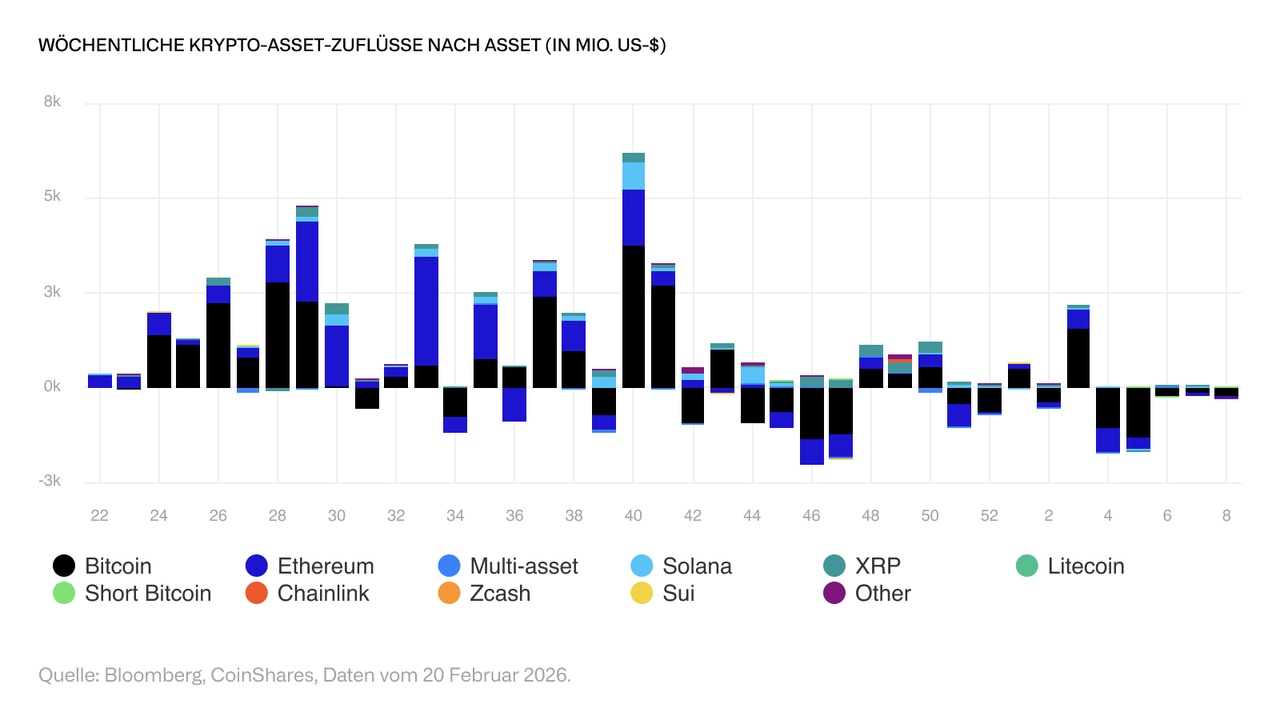
Transatlantic divergence: Germany takes advantage of price weakness, while US capital flows turn negative
Investment products for digital assets recorded outflows of 288 million US dollars last week. This was the fifth consecutive week of net outflows, bringing the total to USD 4.0 billion - still below the USD 6 billion reached in the same period last year. After several weeks of record activity, trading volumes in ETPs slumped significantly to USD 17 billion, the lowest level since July 2025, indicating waning investor interest.
The regional picture is divergent: In the US, outflows totaled USD 347 million, while other regions saw inflows totaling USD 59 million. This was led by Switzerland with USD 19.5 million, Canada with USD 16.8 million and Germany with USD 16.2 million.
$BTC (-0%) The US dollar dominated the negative sentiment with outflows of USD 215 million, while short bitcoin products saw inflows of USD 5.5 million - the highest figure among all asset classes. $ETH (+0.01%) The short bitcoin fund recorded outflows of USD 36.5 million, followed by multi-asset products with USD 32.5 million and $TRX (-0.09%) (Tron) with 18.9 million US dollars. Low inflows were recorded for XRP (USD 3.5 million), $SOL (-0.19%) (3.3 million US dollars) and $LINK (-0.14%) (Chainlink) (USD 1.2 million), but not enough to offset the net outflows from altcoins.
44
7Mon·
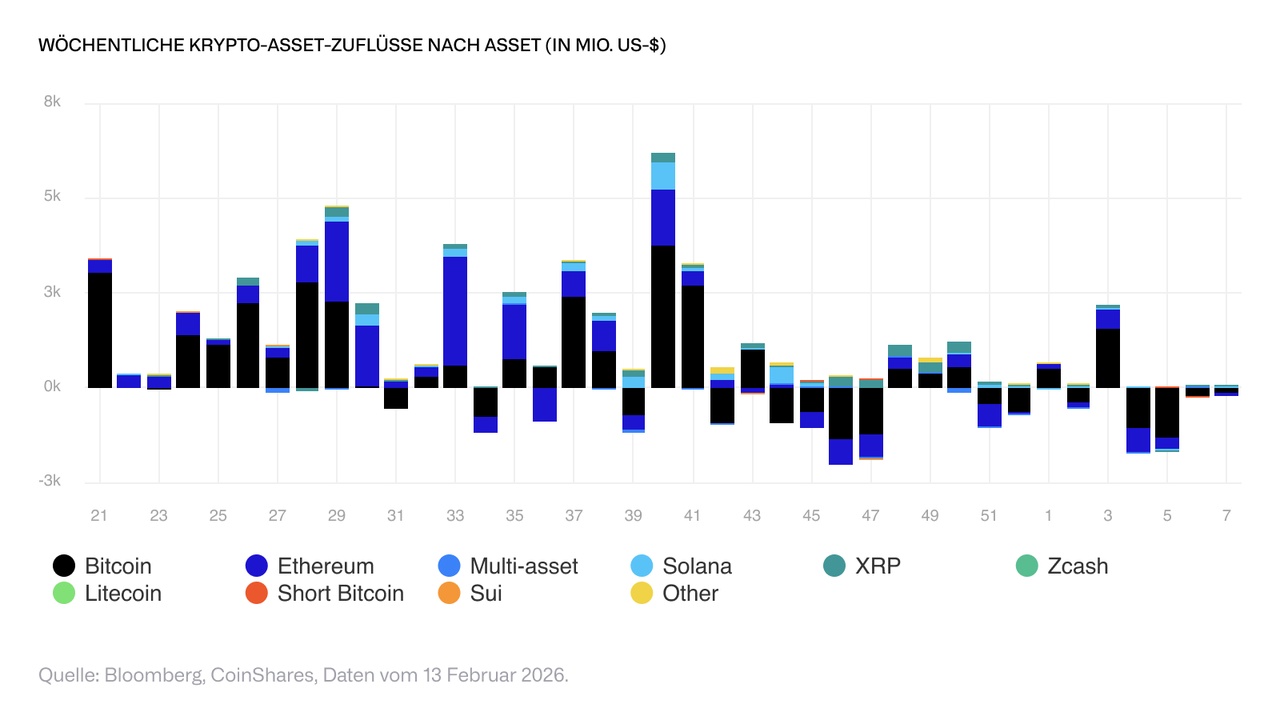
Bitcoin under pressure: outflows dominate, while XRP and Solana see inflows
$BTC (-0%) recorded the weakest investor sentiment last week. A total of USD 133 million flowed out of corresponding investment products. At the same time, there were also outflows from short Bitcoin products, totaling USD 15.4 million over the past two weeks - a pattern that has historically often been observed near local lows.
Also $ETH (+0.01%) was also affected by outflows, with withdrawals totaling USD 85.1 million. $HYPE (+0.18%) The US dollar market also saw outflows, albeit at a much lower level of USD 1 million.
In contrast, sentiment towards $XRP (-0.37%), $SOL (-0.19%) and $LINK (-0.14%) remained constructive. These assets recorded inflows of USD 33.4 million, USD 31 million and USD 1.1 million respectively in the past week.
$XRRL (+0.8%)
$SLNC (-0.98%)
$CTEN (+0.63%)
$GB00BMY36D37 (+0.28%)
55


1Yr·
Portfolio update - crypto focus 🔄
Today I have changed my position in Chainlink (LINK) sold.
📉 Reason: Lower priority in my crypto strategy and focus on projects with higher relevance for my long-term portfolio.
💰 Use of funds: Reinvestment in Ethereum (ETH) to strengthen my core position in the crypto segment.
My goal remains: Less scattered crypto positions, more focus on selected core assets.
66
4 Comments
Chainlink is one of the few projects with strong partnerships and real applications. For me, it is one of the relevant long-term assets. I'm curious to see which cryptos are relevant for you 🤭
•
1313
•1Yr·
Altcoin Chainlink
Hello everyone,
what do you think of $LINK (-0.14%) & the current share price?
22
4 CommentsI would only buy Bitcoin as a standard investment and Solana as a dump and pump coin 🤑
•
33
•
1Yr·
A quick look at my "Krypton successors"
I am glad that I have taken crypto profits and shifted into equities. In line with my strategy, I'm shifting into distributors, which should finance my new accumulation via dividends in the coming bear market so that I don't have to use my net salary. The $HSBA (+1.12%) is one of the major British banks with a focus on Asian business and one of the successors in which my profits and investments from $XRP (-0.37%) , $LINK (-0.14%) , and a tranche $UNI (-0.34%) have flowed into. Of course, crypto in general is only a small part of my assets, hence the amounts invested in the "followers", but HSBC really stands out with a strong +24% performance since December. Wow! I didn't expect that at all. I love such defensive stocks and even more their cash flow. More information will probably be available at the end of next week in my February review.
99

1Yr·
Chainlink and Litecoin
Still have $LINK (-0.14%) and $LTC. Also $ETH (+0.01%) .
What do you do with them? Everything in $BTC (-0%) swap?
Thanks in advance