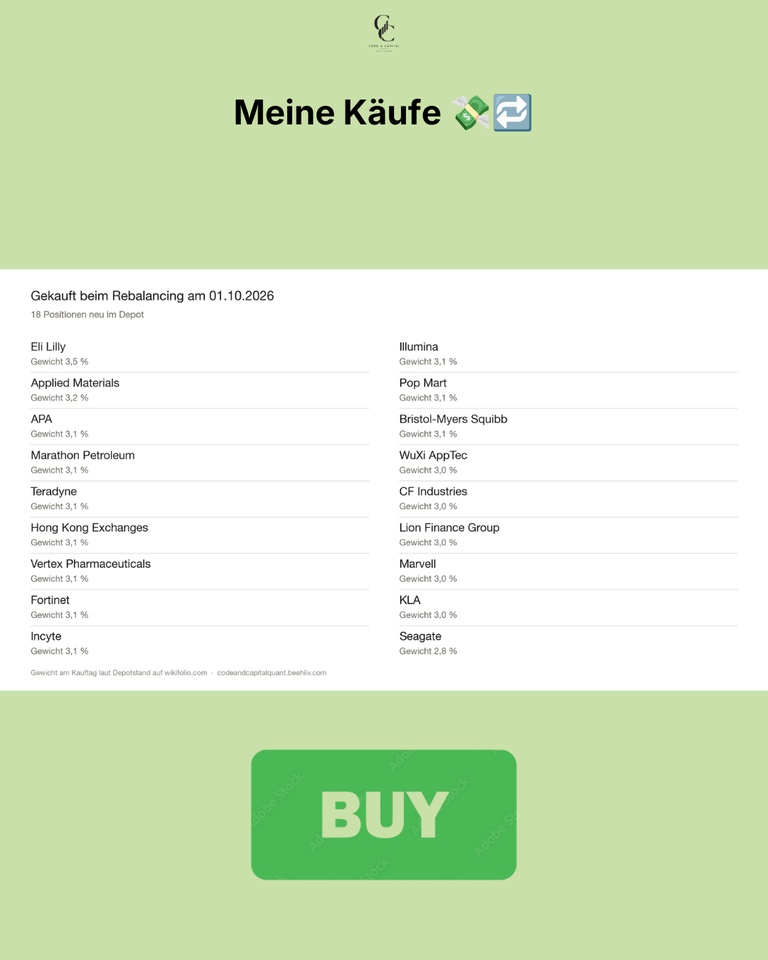
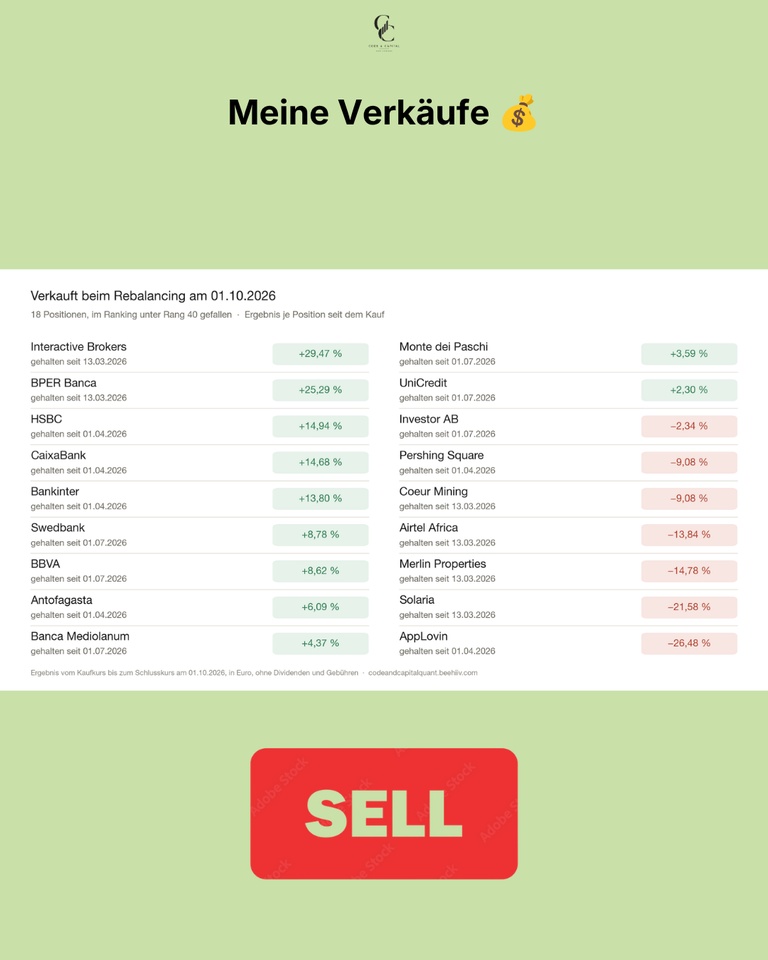
On October 1, the model replaced 18 of its 30 positions. One month later, all six of the month’s top-performing stocks are new additions resulting from that very rebalancing. However, three of the six worst-performing stocks are as well. The Wikifolio ended October down 11.64 percent, its weakest month since its launch in March.
October was not a good month for tech stocks. Concerns about AI spending by the major cloud companies have resurfaced; the SOX semiconductor index lost 15.4 percent over the month, and the Nasdaq fell 5.3 percent. That was its weakest month since March 2025. Quarterly earnings reports came out last week. Seagate and Teradyne beat expectations but still saw their shares fall. On October 30, $INTC (-10,36%) l issued a weak outlook for the fourth quarter and plummeted 28.6 percent in a single day. SanDisk $SNDK (-10,82%) , Marvell $MRVL (-5,75%) and $AMD (-5,15%) also saw double-digit declines. In the meantime, on October 28, the Fed kept interest rates at 3.75 to 4.00 percent; two members would have preferred to raise them already.
For a portfolio that, after rebalancing, is invested nearly half in semiconductors and memory
, this was the worst possible month:
📊 Monthly performance: −11.64%
📊 Price as of October 30: €104.23
📊 Performance since inception (March 13): +4.2%
📊 Largest loss since inception: −18.6% (previously −14.6%)
📊 Next rebalancing: Early January 2027
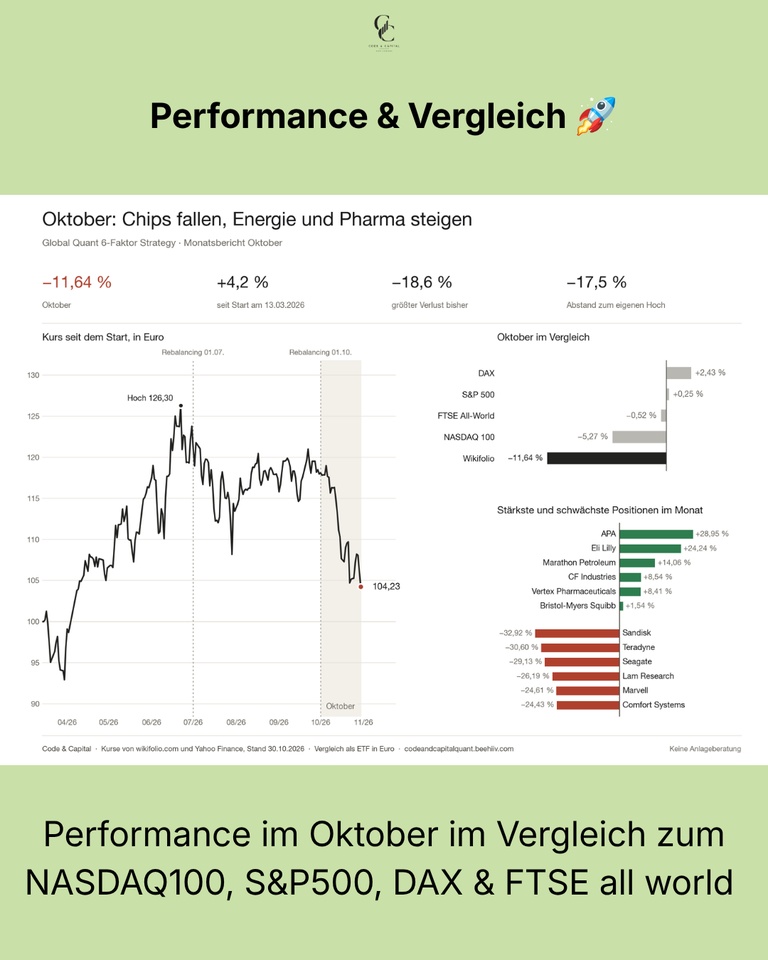
Performance & Comparison 🚀
The Nasdaq fell, the broad indices held steady, and the DAX even gained ground. The model clearly lagged behind this time, falling more than twice as far behind as the Nasdaq.
Performance Comparison (September 30–October 30, 2026, end of day, all as euro-denominated ETFs):
Global Quant 6-Factor: −11.64%
NASDAQ 100: −5.27%
FTSE All-World: −0.52%
S&P 500: +0.25%
DAX: +2.43%
The Wikifolio is now 17.5% below its high of €126.30 on June 22.
Buys & Sales 💶
On October 1, the third rebalancing took place—the largest one yet. 18 stocks out, 18 in, 12 remained.
The model sold all nine banks: Bankinter $BKT (-1,29%) , Swedbank $SWED A (-0,41%) , UniCredit $UCG (-1,37%) , CaixaBank $CABK (+0,52%) , BBVA $BBVA (-3,55%) , BPER $BPE (-1,09%) , Monte dei Paschi $BMPS (-1,19%) , Banca Mediolanum $BMED (-0,95%) and HSBC $HSBA (-2,53%) . Also, Interactive Brokers $IBKR (-4,23%) , Antofagasta $ANTO (-4,64%) , Coeur Mining $CDE (-6%) , AppLovin $APP (-9,25%) , Airtel Africa $AAF (-5,69%) , Merlin Properties $MRL (-1,21%) , Solaria $SLR (-5,11%) , Investor AB $INVE B (+1,93%) and Pershing Square $PS (-6,99%) . All were ranked below 40th place. You can see the returns on each position since the purchase on the slides.
It bought six healthcare stocks (Eli Lilly $LLY (+2,49%) , Bristol-Myers Squibb $BMY (+2%) , Vertex $VRTX (+1,64%) , Incyte $INCY (+3,25%) , Illumina $ILMN (-6,74%) , WuXi AppTec $603259 ) and five semiconductor companies (Seagate $STX (-4,94%) , Marvell $MRVL (-5,75%) , Applied Materials $AMAT (-4,6%) , Teradyne $TER (-4,38%) , KLA $KLAC (-3,2%) ). Also included is Fortinet $FTNT (-0,99%) , CF Industries $CF (+5,18%) , Marathon Petroleum $MPC (+3,03%) , APA $APA (+2,8%) , Pop Mart, the Hong Kong Stock Exchange $HKXCY , and Lion Finance $BGEO (-5,54%) . Applied Materials and KLA had been sold by the model in July; now they’re back in the portfolio.
After the reshuffle, twelve of the thirty positions were semiconductor and memory stocks, accounting for a combined 44.8% of the portfolio.
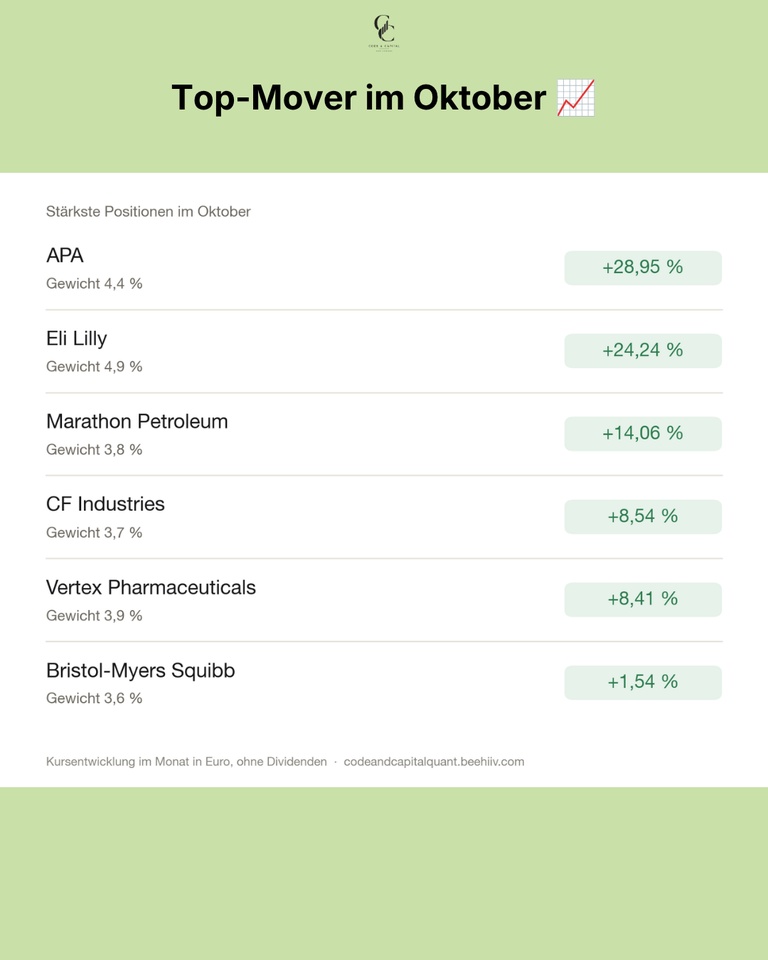
Top Movers in October 🟢
The sectors that gained were those unrelated to AI. APA topped the list with +28.95%. The oil company reported preliminary third-quarter results on October 7 and repurchased 10.5 million of its own shares. Eli Lilly rose +24.24%. Third-quarter revenue rose 39 percent to $24.4 billion, driven by Mounjaro and Zepbound, and Lilly raised its full-year revenue forecast to $91 billion to $92 billion.
Marathon Petroleum gained +14.06%, even though the stock fell 7.4% on October 27 along with other refiners. CF Industries rose by +8.54%, Vertex by +8.41%, and Bristol-Myers Squibb by +1.54%. All six have been in the portfolio since October 1.
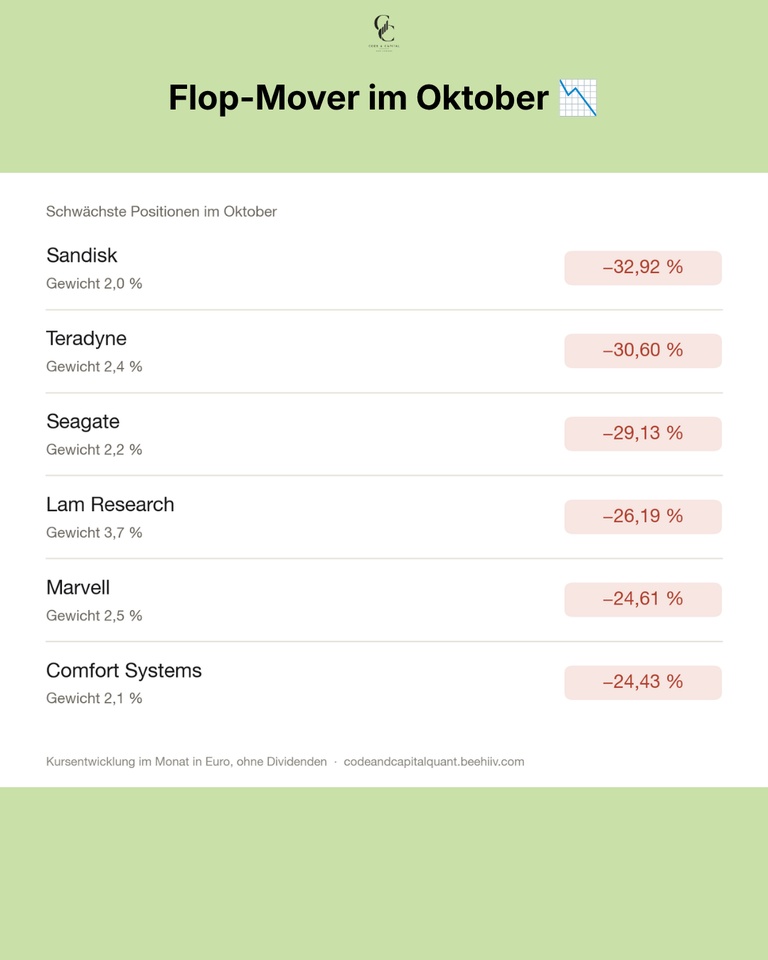
October’s Worst Performers 🔴
This list consists almost entirely of chip stocks. SanDisk saw the biggest loss at −32.92%; on October 30 alone, it fell by 13.5%. Teradyne dropped −30.60%. The earnings report on October 28 beat expectations, as did the outlook, yet the stock still fell. Seagate (−29.13%) saw the same pattern following its earnings report on October 27. Lam Research fell −26.19%, Marvell by −24.61%. Comfort Systems lost −24.43%. It’s not a chip stock, but the company manufactures climate control and electrical systems for data centers and is thus tied to the same sector. On October 23, following the quarterly earnings report—which did not include a 2027 outlook—the stock dropped about 8 percent in a single day.
Teradyne, Seagate, and Marvell were added to the portfolio on October 1. SanDisk, Lam Research, and Comfort Systems $FIX (-2,72%) were already in the portfolio and were still among the gainers in September.
What’s in the portfolio now 🔍
Stock prices have fallen. The companies’ financial results look different so far. Key metrics for the 30 positions, each showing the median value as of October 31:
P/E ratio: 24.6
Revenue growth: +21.2%
Earnings per share growth: +48.8%
Net margin: 39.0%
Return on equity: 39.4%
Debt-to-equity ratio: 0.2
With a P/E ratio of 24.6, this portfolio isn’t exactly cheap. However, revenue is growing by one-fifth per year, and debt plays virtually no role. The next earnings season will show whether these figures hold up.
Conclusion 💡
October showed what a 44.8% gain means in this sector. When the sector turns, the entire portfolio turns with it. The pharmaceutical and oil stocks added during the rebalancing performed well, but they couldn’t keep up with the chip stocks. A few weeks ago, I calculated a sector limit. At 20 percent, it reduced the maximum drawdown by 2.1 points, but I haven’t implemented it yet. I don’t tinker with the rules in the middle of a drawdown.
What I want to look into is the timing. Rebalancing always takes place just before earnings season, and this time the earnings reports came out right in the first few weeks after the purchase. I’ll run the numbers to see if this is a real disadvantage or if it just happened to look that way this time before I make any changes.
❓ Question for the community
How did October go for you? Did you also have chips in your portfolio, and did you buy more, sell, or just sit it out?
👇 Share your thoughts in the comments!
➡️ Every month, you’ll find the complete Wikifolio update here—even in bad months—along with research from the model.
🗞️ Newsletter: codeandcapitalquant.beehiiv.com
📈 Wikifolio: https://www.wikifolio.com/de/de/w/wf0gquant6