

Sell oil companies $PBR (+1,75%)
$CNQ (+0,71%) and buy $MCD (+1,35%)
$VICI (+0,6%)
$SGO (-1,07%) ? #portfoliofeedback
#dividends

Petroleo Brasileiro ADR Reptg 2
Azione
Azione
Ticker: PBR
PBR
Price
Discussione su PBR
Messaggi
201Settimana·
Sell oil companies?
15Posizioni
0,70%
66

1Mes·
📊 INVESTMENT ACTIVITY | AUGUST 2026
📊 INVESTMENT ACTIVITY | AUGUST 2026
August was another month of building and consolidating my portfolio. 📈
💰 Portfolio value: €4,592.76
💵 Dividends received: €17.61
📈 Realized return: +10.28 €
📊 Unrealized return: +159.10 €
📉 Change in open position: −16.49 €
🔄 MONTHLY CHANGES
The main focus continued to be $LX (-2,14%) , where I took advantage of the price drop to add to my position and gradually lower the average cost.
During the month, I also made some sales, notably in $IIPR (+0,04%) and $PRGO (+0,02%) , and added a little more to $MAGO (-1,74%) .
💰 DIVIDENDS
I received dividends from:
$VZ (+1,1%) • $POLR (-0,56%) • $MAGO (-1,74%) • $NNN (+0,94%) • $O (+0,97%) • $APLE (-0,56%) • $KVUE (+1,21%) • $PBR (+1,75%) • $EQNR (+2,33%) • $OXLC (-0,94%)
🎯 GOAL
To continue growing the invested capital and, over the years, build a portfolio that is increasingly capable of generating passive income through dividends.
August had its ups and downs, but the strategy remains simple:
📌 Invest every month
📌 Strengthen positions with potential
📌 Take advantage of market opportunities
📌 Think long term
The goal isn’t to get it right every month. It’s to keep building. 💪📈
#Investimentos
#Dividendos
#Bolsa
#RendimentoPassivo
#LongoPrazo
33



7Mes·
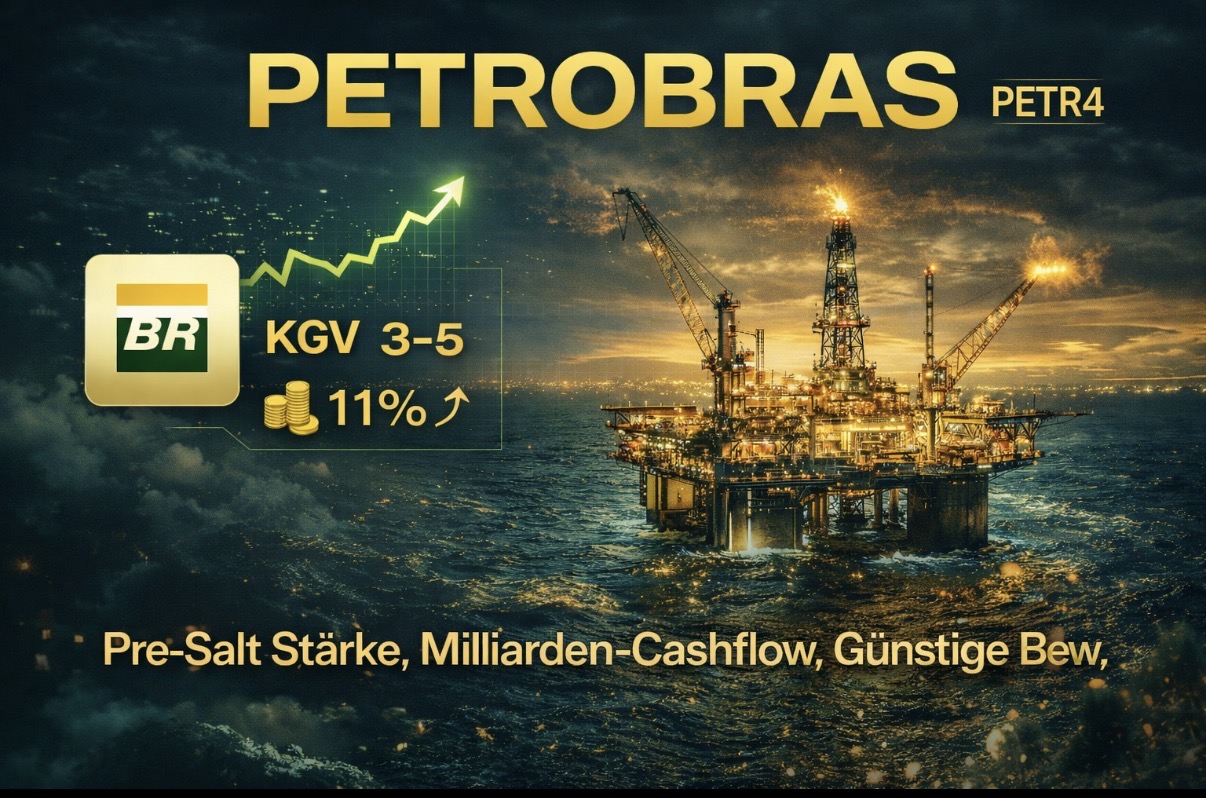
Petrobras (PETR4) - Said to be dead, but the numbers tell a different story
Ticker: PETR4
Stock exchange: B3 (Brazil)
Sector: Oil & Gas (focus on offshore & pre-salt)
Current share price (last): approx. € 6.50
Petrobras is one of the largest integrated energy companies in the world and the dominant oil company in Brazil. Those who are only guided by headlines quickly overlook what is actually happening operationally.
Business model & strategic position
Petrobras covers large parts of the value chain:
- Exploration & production
- Refinery
- Transportation & Export
The focus is clearly on the Brazilian pre-salt fields - one of the most productive offshore areas in the world.
Advantages:
- High production volume per well
- Comparatively low production costs
- Technological leadership in the deepwater sector
The business remains profitable even at moderate oil prices.
Fundamental key figures (rounded, latest published annual figures)
- Sales: ~100-110 billion USD
- EBITDA: ~45-50 billion USD
- Net profit: ~20-25 billion USD
- Free cash flow: double-digit billions
- P/E ratio: often in the 3-5 range
- Debt: massively reduced since 2016
A company with this level of cash flow strength is currently trading at a valuation that is otherwise more likely to be seen in structural problem cases.
Dividends - the often underestimated factor
A central point is the dividend policy.
Petrobras has regularly paid high dividends in recent years - at times with double-digit yields.
Important here:
- The dividends are strongly linked to cash flow and the oil price.
- In strong years, considerable amounts were returned to shareholders.
- Even with a more moderate payout, the company remains a clear cash flow generator.
Of course, dividends are not guaranteed and are politically influenced. But historically, Petrobras has been highly attractive to income investors.
Political risk - a reality, but priced in
As a state-dominated company, political influence remains a factor:
- Investment priorities
- pricing policy
- Dividend strategy
However, it is precisely this risk that explains the extremely low valuation.
Anyone buying a P/E ratio of 3-5 is also buying the risk discount.
Scenarios up to 2030
It remains crucial:
- Oil price
- Production development
- capital allocation
- political framework conditions
Conservative scenario:
- Oil price ~70 USD
- Stable production
- Moderate dividends
- → Valuation level in the range of € 8-12 per share appears fundamentally justifiable.
More optimistic scenario:
- stable demand
- disciplined investments
- pragmatic policy
- → € 12-18 not unrealistic in the long term until 2030.
This is not a promise, but a range that can be derived from cash flow and valuation multiples.
Classification
Petrobras is:
- not a growth tech stock
- not an ESG favorite
- not a momentum trade
But it is:
- a highly profitable commodity producer
- with globally relevant reserves
- strong cash flows
- attractive dividend history
- and a very low valuation
Whether you invest depends on your own risk tolerance.
But to call a company with billions in cash flow, falling debt and globally competitive production costs "dead" across the board does not seem very number-based, to say the least.
Nevertheless, my personal opinion is that no investment advice should encourage anyone to buy or sell!
$PETR4 (+0,93%)
$PETR3 (+2,24%)
$PBR (+1,75%)
$E (+0,47%)
$SHEL (+1,47%)
3434
12 Commenti
7Mes
Classic EM value play.
Will be seen much more frequently in portfolios in the coming years. 👍
Will be seen much more frequently in portfolios in the coming years. 👍
•
77
•
10Mes·
The curse of the dividend vulture
$PBR (+1,75%) So, dear people
I have now sold my ADR so as not to throw any more money down Donald's throat.
But I still don't want to part with PBR completely and have therefore ordered PBR4. I'm just a dividend vulture.
Now I have to read that Brazil is reintroducing withholding tax on dividends from January.
Never mind, after all, the money should be spread around the world and not just be stuck in dollars, pounds sterling and euros.
I'm well aware that PBR is currently cutting a lot of projects and that there are many good reasons to turn my back on the association, but I won't quit as long as the state sees dividends as a source of income.
55
3 Commenti
8Mes
What do you have against Donald? My depot is having a permanent party while others are still getting popcorn. 😄 Maybe set the morality filter to "humor mode", otherwise returns will quickly turn into "Poverty 3000 the reality show".
••

1Anno·
Portfolio update & suggestions?
Really taken off since the start of the year with $TMC , $OKLO , $BABA (-3,12%) , $PBR (+1,75%) and $ASML (-3,28%) really ripping. $URNJ
$U.UN and other uranium investments have quietly recovered from the sell off after 2023. Cash has sat and behaved nice too.
risk tolerance waned with Oklo since it seemed like the cart got ahead of the horse especially at $20bn USD valuation. Feeling very solid with $TMC and comfortable with that composition at/above 10% weight.
curious if anyone has suggestions or portfolio management ideas
73Posizioni
243.926,18 USD
36,99%
99

1Anno·
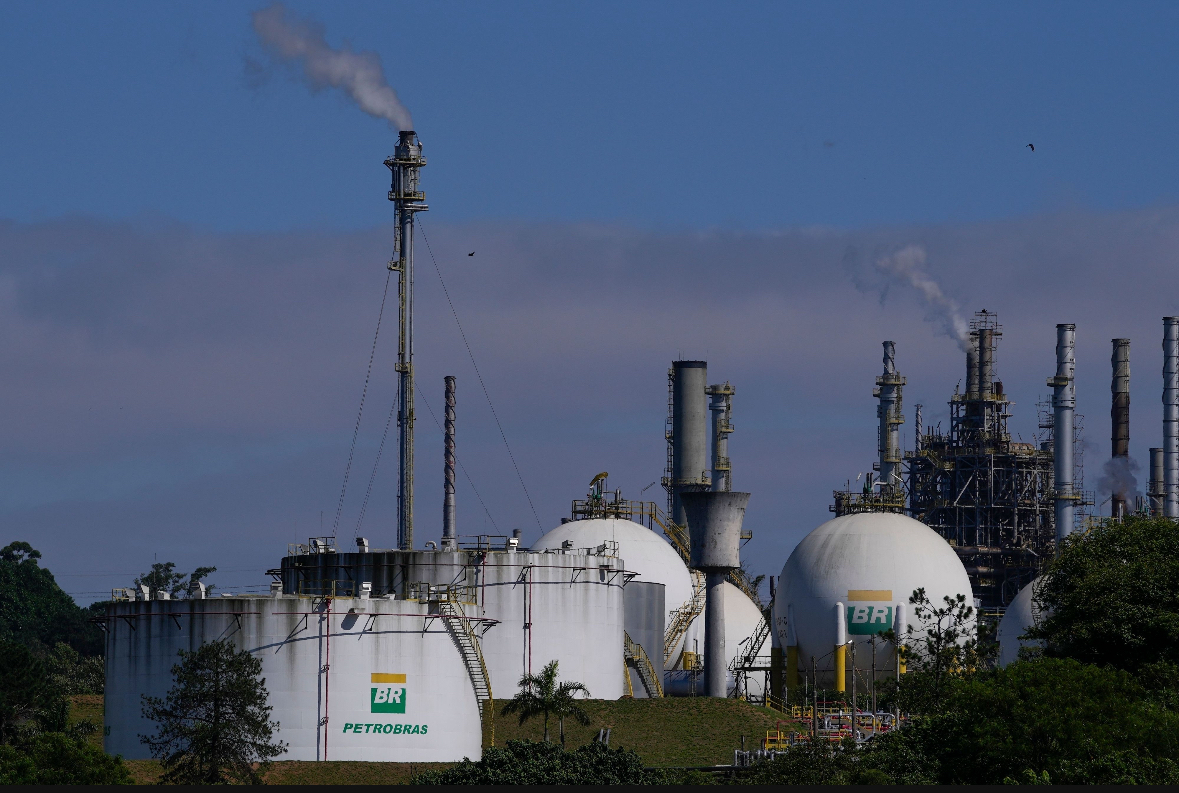
Lula wants to secure his future through oil production
The "law to simplify the environmental approval process" is known in Brazilian environmental circles as the "law of devastation". It was rushed through by the Chamber of Deputies in a night session before the congressional recess in mid-July.
President Luiz Inácio Lula da Silva has now vetoed parts of the law.
The reason for this withdrawal: Lula's left-wing government is afraid of offending the conservative Congress. More than two thirds of MPs had voted in favor of the law.
Environmentalists are up in arms against the law: they fear that simplified approval procedures will lead to greater climate risks and environmental damage, opening the door to one of Brazil's most controversial investment projects.
This is because Brazil also has high hopes for the oil deposits that are believed to be under the seabed of the Atlantic Ocean at the mouth of the Amazon off the north coast of Brazil. Neighboring Guyana is in the process of becoming one of the new global oil giants due to the oil produced there. From a geological point of view, there is much to suggest that the deposits extend into Brazil's sovereign territory.
The Organization of the Petroleum Exporting Countries (Opec) expects Brazil to increase its oil and gas production from the current 4.2 million to 5.8 million barrels per day by 2030. After the USA, this would make Brazil one of the countries that could increase its fossil fuel production the most over the next five years. Brazil currently ranks 8th among the world's largest oil producers; it could rise to 4th place by 2030.
However, the credibility of Brazil's climate policy is at stake with the potential oil production. Brazil has committed to significantly reducing its greenhouse gas emissions as part of the Paris Agreement. An expansion of oil production contradicts these goals.
Politically, however, it looks like the proponents will be successful. They have a strong lobby in Congress, in the cabinet, among the trade unions and in the federal states in the north of Brazil. President Lula is also in favor of the project: he would rather offer poor Brazilians jobs, education and health care financed by oil revenues than do without them in order to protect the environment. International environmental prizes do not win elections in Brazil, but social programs and electoral aid from the oil industry do.
With the decree for accelerated special procedures, a victory for the oil lobby seems likely. The majority of Congress is in favor of oil production. Elections are due next year. Lula can hardly afford to alienate his remaining allies in the north and north-east with an environmental policy with which he himself hardly identifies. A conservative successor would probably remove obstacles to oil production immediately.
$PBR (+1,75%)
$PETR3 (+2,24%)
$PETR4 (+0,93%)
Source: Text (excerpt) & image: Handelsblatt, 13.08.25
66
1 Commento
It's just not that easy for countries whose inhabitants live close to the poverty line or where unemployment is high to pursue the environmental goals of a Paris Agreement. I can certainly understand if people, jobs and education (because of the money) are the first things to be considered. Of course, I also see it from an investor's point of view. It certainly reads well if oil production could be increased in this way.
••