
Let’s talk about arguably the most misunderstood industry right now. An industry where the so-called SaaS-pocalypse narrative is completely counterintuitive: cybersecurity.
I already think the indiscriminate software selloff is overblown. To me, it has been the perfect opportunity to load up on high-growth, high-moat, high-margin champions like Microsoft or ServiceNow. But what has happened in cybersecurity is even more irrational.
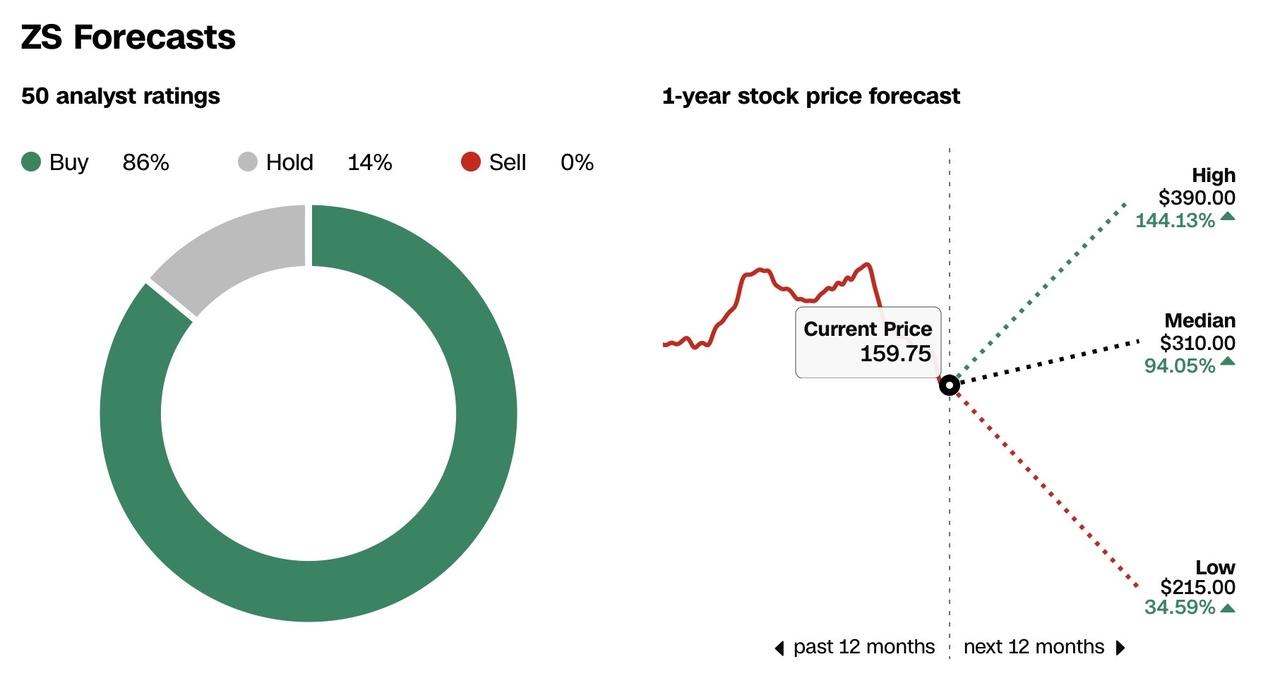
Palo Alto Networks and CrowdStrike, arguably the two MVPs of the industry, are both down more than 30%. Zscaler and Rubrik have more than halved in recent months. Let me stress this again: the selloff makes very little sense.
As AI adoption accelerates and companies automate more processes, relying less on human oversight, the attack surface expands. The total addressable market grows. The complexity of systems grows. The need for protection grows. This is not a headwind. It is a structural tailwind.
The companies we are talking about are digital-native cybersecurity platforms. This is not legacy hardware-centric security. Take Zscaler as an example. It is a cloud-native, AI-driven, next-generation cybersecurity platform that enables zero-trust architectures for global enterprises. AI is not something that suddenly disrupts them. It is embedded in their models and their core product design.
Anthropic or any other AI company is not just going to walk in and take their customers. Could there be partnerships? Possibly. But the idea that cutting-edge cybersecurity firms are about to be replaced by generic AI models massively underestimates the technical depth of these businesses.
Let’s imagine a CEO explaining a major data breach where millions of user records were stolen and saying their security stack was vibe-coded by a 17-year-old using open-source models. The market would crucify that stock. Cybersecurity is not the place where enterprises experiment recklessly. It’s life or death for functioning operations.
If anything, AI heavily subsidizes digital transformation and makes robust cybersecurity more critical than ever. The faster everything moves, the more catastrophic failures become.
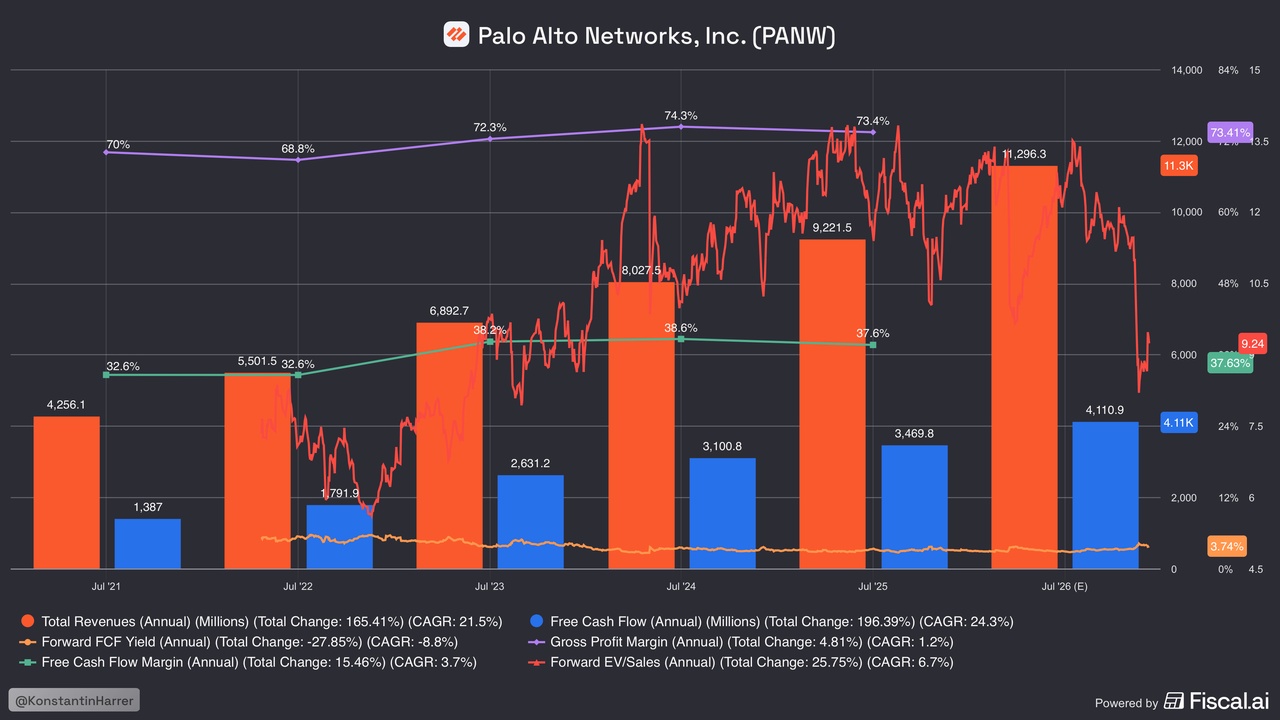
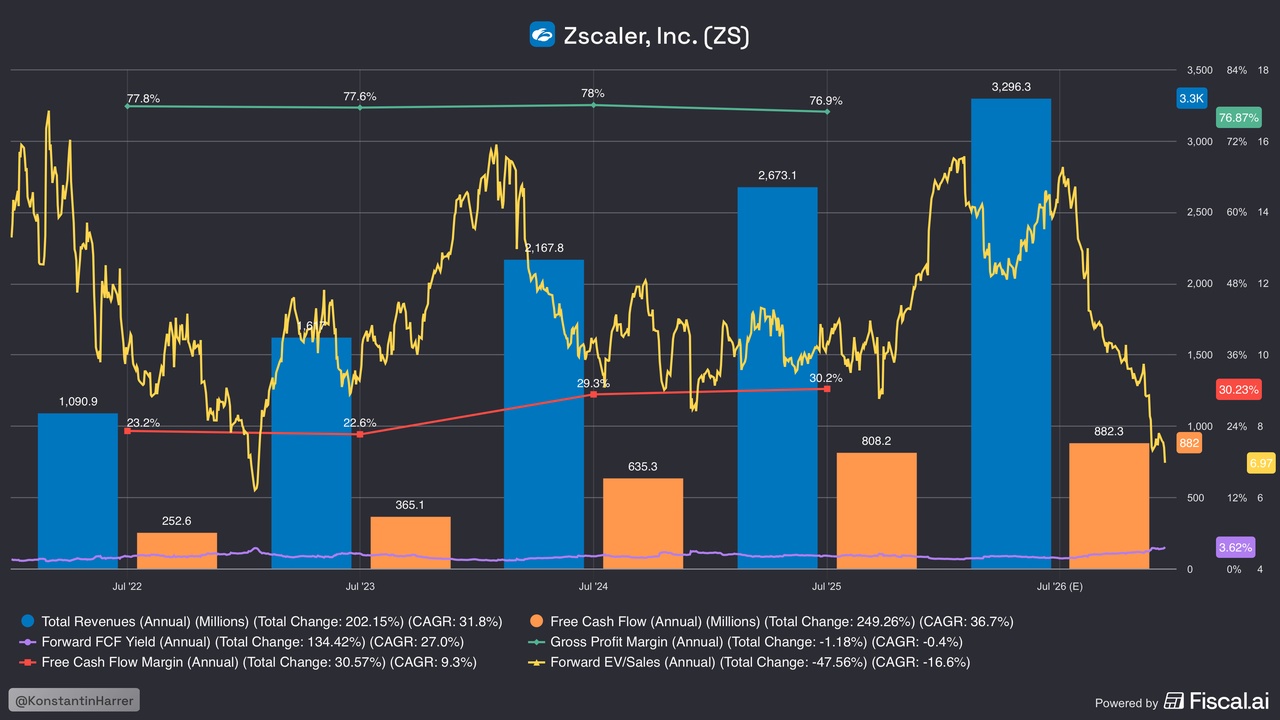
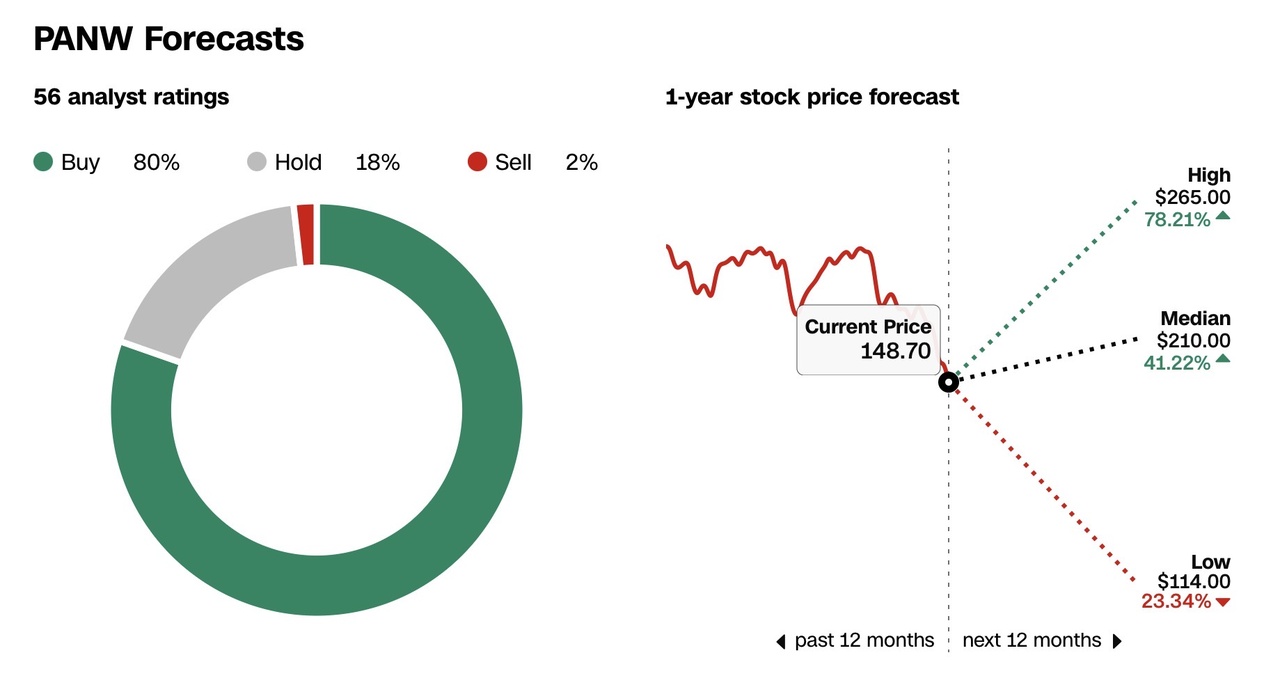
In my portfolio, I own Palo Alto as the largest and most diversified platform in the space, and Zscaler as what I consider the most advanced and future-proof pure play. I chose these two because their valuations are the most reasonable relative to their strategic positioning.
Zscaler trades at roughly a 4% forward free cash flow yield and around 7% based on FY28 estimates, while revenue and free cash flow are projected to grow in the mid-20% range. Palo Alto shows similar growth rates, which is impressive given its scale, and trades at around a 3.5% forward FCF yield and about 5.5% on FY28 cash flow.
These valuations do not scream “sell your last shirt and buy,” at least not compared to some other names in the market right now. But context matters. Multiples have compressed significantly while the long-term structural environment has arguably become more bullish.
My positions are not oversized. Cybersecurity is not a core pillar like Microsoft, Amazon, or Visa for me. Combined, Palo Alto and Zscaler make up less than 8% of my portfolio, roughly the size of a single large core holding. But strategically, I view this industry as one of the clearest long-term AI beneficiaries, not a victim.
$PANW (+0,7%)
$ZS (+0,89%)
$CRWD (+1,16%)
$RBRK (+0,47%)
$S (+0,22%)
$MSFT (-0,48%)
$NOW (-0,91%)