1Semana·

You don't need to buy $SPCX to 10x your portfolio.

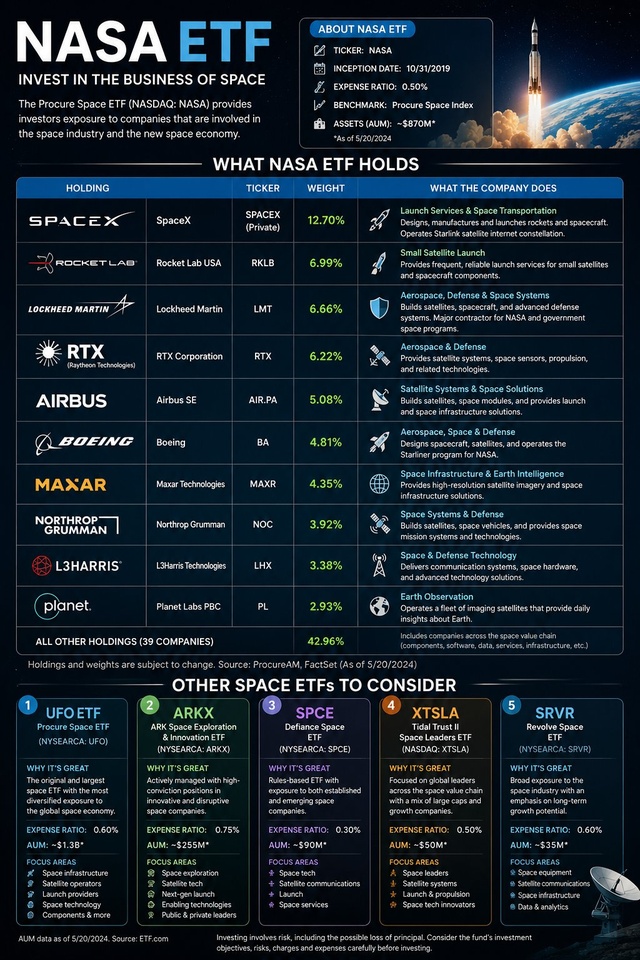
You can buy $NASA ETF which owns:


1. SpaceX $SPCX (-1,63%) — 12.70%

Rockets, spacecraft, Starlink satellite internet


2. Rocket Lab $RKLB (-9,26%) — 6.99%

Small satellite launches, spacecraft components


3. Lockheed Martin $LMT (-1,67%) — 6.66%

Satellites, spacecraft, defense, NASA contractor


4. RTX Corporation $RTX (+0,59%) — 6.22%

Satellite systems, sensors, propulsion, defense tech


5. Airbus SE $AIR.PA — 5.08%

Satellites, space modules, launch infrastructure


6. Boeing $BA — 4.81%

Spacecraft, satellites, Starliner program for NASA


7. Maxar Technologies $MAXR — 4.35%

High-res satellite imagery, space infrastructure


8. Northrop Grumman $NOC — 3.92%

Satellites, space vehicles, mission systems


9. L3Harris Technologies $LHX — 3.38%

Comms systems, space hardware, defense tech


10. Planet Labs $PL — 2.93%

Fleet of imaging satellites, daily Earth observation


Remember, $SOXL which owns $NVDA is up 1200% from $22 to $280 so far. $NASA could be the same.
attachment
10
10 Comentários

imagem de perfil
$SPCX has 12.7% of its capital tied up in dead capital. It would be difficult, from a mathematical standpoint, to justify this as satisfactory performance. A 1% increase in the share price already exceeds the company’s annual revenue…
4
imagem de perfil
@PikaPika0105 Fair point on the high allocation and valuation math. But SpaceX isn’t a typical company, it has massive long-term optionality with Starlink scaling and Starship development. The 12.7% weighting is aggressive, but that’s how thematic space ETFs are built.High risk, high conviction play
1
imagem de perfil
@jaketradingcalls I think the market will tend to become even more fragmented in the future, as more and more providers enter the market, driven in part by governments’ efforts to assert their sovereignty. Starlink doesn’t have a technological moat either; it’s simply the first provider on the market, though that could change. I also view Starship positively, but its valuation is difficult to justify. The space economy is projected to generate only $1 trillion in total revenue by 2040. So SpaceX is already worth twice as much today as the entire market will be in 14 years, even while it is operating at a loss. How realistic, both qualitatively and quantitatively, is a further increase in its valuation, then?
imagem de perfil
@jaketradingcalls it has the potential if everything goes right and perfect. Look at tesla it was based on the same sentimental but instead of climbing it started at the level tesla is now. Too much speculation that already is viewing it very optimistic.
1
imagem de perfil
@PikaPika0105 Currently, no one has launch capacity that even comes close to SpaceX’s launch cadence, let alone its rapid reusability. BO is out of the picture for at least two years after the RUD; Rocket Lab is a factor of 10–15 behind SpaceX and thus already in second place.

SpaceX will charge a fortune for competing satellite constellations, since it’s the only launch provider that can handle them. Such constellations require several thousand satellites to function in LEO.

So I don’t quite understand how Starlink isn’t supposed to have a moat?
1
imagem de perfil
@CMustermann I said that Starlink doesn't have a technological moat, since the product itself (i.e., the satellite and the service) is easy to copy. Currently, they only have a physical moat because they’re the only ones capable of launching so many satellites into orbit. However, it’s not a law of nature that you need thousands of satellites for such a constellation, so that’s a variable that could definitely change over time. On the other hand, the launch monopoly won’t be sustainable in the medium to long term. You’re right that it’s currently inconceivable to build competing constellations using SpaceX rockets, but there are various competing products that will be available soon. Rocket Lab’s Neutron rocket or Blue Origin’s New Glenn, for example. You might say that these aren’t ready yet—which is true—but they’re 100% coming. Technologically, they’re every bit as good as SpaceX’s Falcon 9 and the like. So access to space will be democratized sooner or later. Starship won’t be able to change that either. Then new providers will also be able to launch large numbers of satellites into orbit and operate constellations, which will erode Starlink’s physical moat, forcing them to suddenly compete on a technological level. This will lead to a decline in pricing power, and SpaceX will have to share the market it previously monopolized. Since SpaceX only makes money through Starlink, its valuation—which is already a joke today—will become even more absurd. So by then, they’ll have to have managed to diversify their revenue streams and develop new business models, but I’m not sure if data centers in space are a realistic option. So if you want to buy a hype company with €16 billion in revenue and operating losses at a valuation of over €2 trillion, go right ahead—but there really are better deals out there, and I seriously wonder why so few people ever question numbers like these, especially on that scale.
imagem de perfil
But unfortunately, it's not available in Europe, is it?
1
imagem de perfil
@WarrenamBuffet Unfortunately no, the $NASA ETF is currently only available on US exchanges. European investors can’t access it directly yet. You can still get exposure through individual names like $RKLB, $LMT, or $RTX though
1
imagem de perfil
1
imagem de perfil
@WarrenamBuffet $JEDI is another strong option for space exposure. It gives you a good mix of established defense/space companies. Solid alternative to $NASA if you prefer that route.
1
Participar na conversa