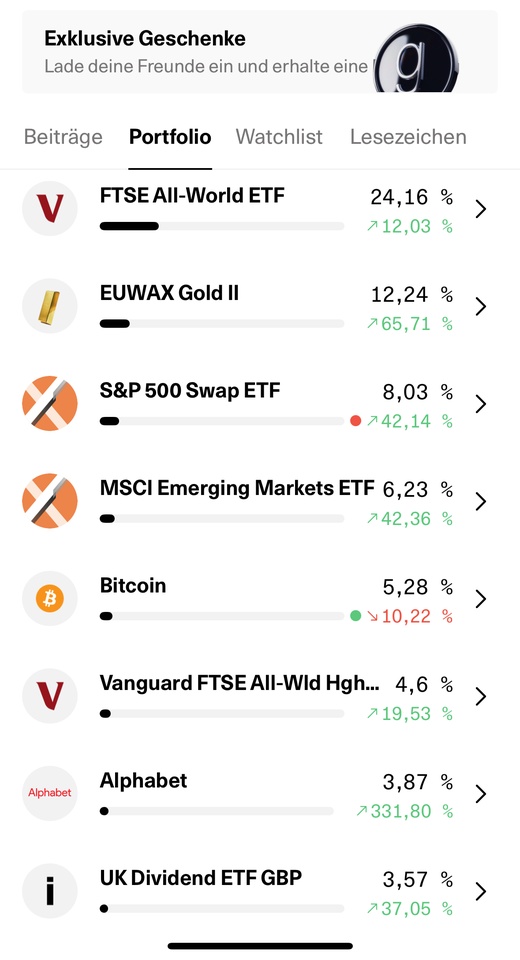
Savings plan has been running since 24 - I'm not interested in ATHs. Buy & hold and that's it :-)
5% of the portfolio achieved - target 10-15%.
I like

Postos
127A little later, but not too late, I'll also have my say at the end of the year, together with an insight into the goings-on of the Opi before @Tenbagger2024 , @SAUgut777 and some others get impatient, as you know, old people are a bit slower. I would also like to take this opportunity to thank and appreciate all those who contribute here on GQ with great analyses and strong contributions, critical comments and a wonderful exchange. I'm deliberately not naming any individuals now, otherwise I won't be able to finish. All of you together are great, whether you're a veteran or a newcomer. The community is alive and I am happy to be a part of it. Thanks also to @christian and the Getquin team, who make this possible by maintaining the platform, even if things sometimes don't run smoothly. The Bavarian says: Basst scho
The year 2025 was exciting and, from my point of view, successful in terms of my expectations. If you don't feel like evaluating a boring dividend strategy, don't want to read about overnight and fixed-term deposits, aren't interested in certificates and don't like the Sparkasse, you are welcome to leave here after Rewind 2025. Many thanks to everyone else for reading and, if necessary, commenting.
At least as far as the majority of shares are concerned, I am known to be invested in dividend stocks in order to generate the highest possible cash flow. I am now almost 62 years old and do not value excessive performance but would like to make a living from the income from my assets and decided to stop working at the beginning of the year when the company where I was employed was dissolved. I see myself as a buy and hold a while. Nothing lasts forever, especially with high-dividend shares. There are regular reallocations without getting into an operational frenzy. In 2025, for example $TRMD A (+1,08%) and a large position $HAUTO (+1,91%) had to leave the portfolio, the high dividend expectations were significantly reduced. The $QYLE (+0,57%) has not recovered from April, $EQNR (+0,89%) and $VICI (-0,27%) led to the brink of capital loss despite respectable dividends and had to give way, as did $MUX (-0,73%) with its inconsistencies. New additions were $NN (-0,79%) , $PFE (+0,25%) , $DTE (-0,77%) and a first position at the end of the year $ARCC (+0,42%) You can see the composition in my profile. I generally try to limit myself to +/- 20 positions and weight them according to purchase. A maximum of 20k per position is invested. This results in the calculation of my dividends and expected income. In its current composition, the portfolio shown here has a value of just over € 340,000 as at 31.12.2025 and has generated gross dividends of just under € 23,000 this year. This corresponds to a dividend yield of 6.73%
The time-weighted yield was 18.63% and therefore well above average, at least better than 67% of the getquin community. I wasn't able to beat the DAX, but at least I outperformed the S&P500 and beat the relevant MSCI World index by some distance. Even on a 5-year view I am on a par. Tobacco stocks did very well $BATS (-0,05%) , $IMB (+0,61%) and $MO (-0,22%) , $HSBA (-0,35%) , and $RIO (-1,34%) and of course $965515 (-0,73%) that I physically hold and the $EWG2 (-0,08%) .
That's all there is to the part of my investments shown here in GQ. What follows is a piece of my life story and the first part inside Dividendenopi.
As I said, I now live off my assets. This amounts to just under € 1.2 million in all the forms of investment I hold. Is that enough for a carefree life? For me in any case. Because on top of that, I have a debt-free, owner-occupied property (a single-family home with a large garden in a quiet rural location near a city of 600,000 inhabitants) and a rented two-family home, appropriately enough, as a neighboring property. Partly financed, rent surplus after installment to the bank a good € 700 per month, flows completely into the maintenance reserve. Claims from BAV, life insurance, building society savings contracts will be added on top in the next few years, but are not taken into account here. There's even a savings account with €18,000..... half of which belongs to my wife and she doesn't want to close it.
My wife (still) works and has a decent income despite working part-time and has other liquid assets in the lower six-figure range. She does it herself, the stock market is the devil's work. Her story is not included here either.
So I / we are doing pretty well after all. It wasn't always like that, anyone who is or was self-employed knows that. But consistent financial planning is important, no matter what the situation, as is sticking to your savings rate. I started investing in real estate at the beginning of the 1990s and have been liquidating it over the last few years. In conjunction with my own wealth accumulation and an inheritance, I am now in a comfortable situation for me.
What do I do with the rest of the money outside the getquin portfolio? A good € 500,000 is (still) in call money and fixed-term deposit accounts. Interest rate hopping on call money and fixed-term deposits from 2 years ago yields around 3% on call money and over 4% on fixed-term deposits. The remaining capital is invested in certificates. Mainly in fixed-coupon express certificates with quarterly payout and partly in bonus certificates with CAP and barrier.
My investments currently generate a net monthly cash flow of € 4000, which is enough for me to live on. Plus € 800 ALG on top until the beginning of 2027.... But before the company closed, I only worked 16.5 hours a week. With my wife's income, that's a good €6500, which is bearable. You can certainly do more with your assets, depending on your needs. We live rather modestly, don't have any children and aren't the consumer type.
How am I invested outside of dividends, why certificates and which broker, where and how overnight and fixed-term deposits? I thought that would go beyond the scope of this article, so I'll come back to it in a second part. Thanks for your participation so far and see you soon

I have looked at my portfolio review of 2025 and my start to 2026 - not just "how much", but above all: why and what I have learned from it. I am happy to share this with you and look forward to discussion & feedback and, above all, your views: what was the result and also your perception of your stock market year 2025 - and what set-up are you starting the new year with?
Time to reflect 🧘♂️
1) Change of mood at the end of 2024
After a rather sobering (for me) stock market year 2024, there was a clear turnaround in sentiment in November 24: on the day of Trump's election victory in Nov 24, the market jumped significantly (Dow +3.57 %, S&P 500 +2.53 %, Nasdaq +2.95 %). This made the "risk-on" narrative credible again - and you could see it in the behavior of many portfolios. At least in mine, if I'm honest with myself ;)
2) Q1/Spring 2025: Unusually Europe-friendly
The first few weeks of 2025 were indeed unusually Europe-heavy: in the first six weeks of 2025, the STOXX 600 was up >5.5%, while the S&P 500 was only up +2.7% in the same period.
This also became clear later in hindsight: in 2025, defense and banks were extremely strong drivers in Europe at times. I was also right in this upswing ($DHL (+0,49%) , $GBF (+0,3%) , $RIO (-1,34%) ) but unfortunately also some disastrous ($NESN (-0,81%) , $MC (-2,66%) , $NKE (-0,21%) ,$NOVO B (+3,27%) ) decisions were made. Partly also trend- and community-driven -> yes, you are to blame ;)
3) Beginning of April: Bad times
Then came the break: The strong start to the year was literally "wiped out" in just a few sessions, partly due to the customs/trade war shock. YTD turned completely negative, and by April 7 the STOXX 600 was around 12% below the closing price on April 2. $TSLA (+0,38%) and $NVDA (+0,5%) purchases. I also $PEP (+0,13%) I bought cheaply, but a real breakout is still a long way off.
4) Shortly afterwards: fireworks
Then a tailwind came back in the US from the middle/end of April, when the market repriced parts of the Trump escalation in the direction of "negotiations/de-escalation". The Donald kept a few election promises that were perhaps not quite official .-)
5) H2/late year: AI + interest rates as a "macro tailwind"
Towards the end of the year, the environment was then more strongly characterized by two factors: AI-driven risk assets and falling interest rates. It was an AI-driven rally, which also supported sentiment and inflows into US equity again.
And on the interest rate side: the Fed set the key interest rate at 3.50 % to 3.75 % in December after a further cut.
At the end of the year, the major benchmarks were also closer together again: STOXX 600 +16.66 % in 2025, S&P 500 ~+17 %.
6) Golden times 🥇🏅
Then there was the beautiful gold (u.W.). 2025 was a real exclamation mark: spot gold was up around 66% over the year (according to Reuters, the strongest increase since 1979).
Silver was even more extreme at around +168 % per year.
I have already written about gold in more detail here on getquin - if you are interested in the topic, you can find the article in my profile.
Personal performance 2025
The figures confirm what I described above: in my opinion, I made very good operational decisions (realized profits, used tax aspects, built up cash flow). At the same time, the TTWROR shows quite clearly that the portfolio structure was too volatile and too strongly growth/trend-oriented in the meantime. Too often, I have taken the "falling knife".
Before the turn of the year, I invested in $NVDA (+0,5%) , $TSLA (+0,38%) , $GBF (+0,3%) and $DHL (+0,49%) - each with positive returns - for the following reasons:
Starting point Jan 2026:
Brief overview of the 2026 start setup
Asset mix
Regional breakdown
Sector structure
Start to the new year
Parallel to the sales at the end of 2025, I reallocated or increased my holdings in January, including in $O (-0,05%), $VNA (+0,14%) and $ZAL (-0,67%)- with the logic:
Why I am thinking more defensively in 2026
Next week, the purchase of an apartment on beautiful Lake Tegernsee 🏝️ will be notarized. This is a step into a completely new asset class for me, as it's my first property of my own. - In addition to construction financing, it will of course also be a liquidity issue over the next few weeks.
I may make a separate post about this, perhaps some of you are also currently facing this step?
I can mentally cope well with drawdowns. But: being able to bear risk does not automatically mean having to bear risk.
My portfolio should fit in with this new phase of my life.
What I will do differently in 2026
Because a new asset class will be added to my portfolio in 2026 with the purchase of an apartment, I want to position my portfolio more defensively in future - without completely foregoing opportunities for returns : risk. Otherwise we would be completely wrong on the stock market :)
1) ETF core should dominate
I want my portfolio to be dominated by my ETFs in future. My target scenario is therefore
Important! This is a start-in-2026 setup
Of course, as always in life, a plan is there to be thrown overboard - so you have to wait and see how assets perform in the year ahead and reassess regularly.
2) Stocks yes - but with more discipline
Turnaround/opportunity stocks and trends remain part of my approach, but clearly limited. I want these positions to be what they should be again: An addition, not a foundation.
I will reduce (basic) consumption and strengthen healthcare. And tech?
3) Tech: more controlled
Tech will remain a driver of returns in 2025 - but I want to build it up again in a controlled manner after my sales. I will monitor the trend from a distance for the first few weeks and possibly months and bet on corrections. You can't do without it - as you can see from the Mag-7 performance in 2025:
On that note, happy new year!
$VWRL (+0,05%)
$EWG2 (-0,08%)
$O (-0,05%)
$PEP (+0,13%)
$MSFT (-0,01%)
$P911 (-0,92%)
$BLK (+0,22%)
$NKE (-0,21%)
$RIO (-1,34%)
$MC (-2,66%)
$NOVO B (+3,27%)
$NESN (-0,81%)
$ZAL (-0,67%)
$COMM (-0,36%)
$IEMS (-0,25%)
$BTC (-0,17%)
$ETH (-0,09%)
$XRP (-0,76%)
$PEPE (+0,42%)
Hello everyone,
I want to add a Japanese satellite to my portfolio. In future, my setup will consist of 75% core ($FWRG (-0,07%)
$EQQQ (+0,45%)
$EWG2 (-0,08%)
$BTC (-0,17%)) and 25 % satellites (e.g. $NOVO B (+3,27%)
$ASML (+1,74%)
$1810 (-2,43%)
$LMND (+0,68%)
$IREN (+0,56%)
$HIMS (+0,6%)
$601318).
After I have $6920 Lasertec and $3350 (-4,24%) Metaplanet, the decision was made in favor of $6861 (+1,23%) Keyence.
For me, it's the ideal quality anchor to balance out the volatility of my crypto bets (Irish/BTC) without sacrificing massive growth potential.
How do you currently see Japan? Are you more interested in chip stocks like Lasertec or quality machines like Keyence? 👇
Gold broke its previous all-time high of just over $4,400 today.
On that note, have a good start to the last full week of 2025 😌
$GLDA (-0,69%)
$GOLD
$4GLD (-0,68%)
$GOLD (-0,15%)
$GDXJ (-1,25%)
$GDXJ (-0,68%)
$EWG2 (-0,08%)

🌟 Gold price soaring
The gold market remains in absolute rally mode. After several days of strong gains, the price remains at an extremely high level - and the jump to an all-time high could happen at any time.
_________________________
💸 Fed interest rate cut boosts precious metals
The latest push is mainly due to the Fed's decision:
The whole thing acts as fuel for gold and silver, as neither yields any current interest - making them particularly attractive in periods of low interest rates.
_________________________
🏅 Gold price scratches the record
Three strong trading days in a row have catapulted the market upwards. Silver is also close to its own record.
_________________________
📈 Reasons for the mega rally
Precious metals are a phenomenon in their own right in 2025:
The whole thing is driven by:
_________________________
🔮 Outlook: 2026 could be even hotter
According to market analyst Hebe Chen (Vantage Markets):
The World Gold Council confirms:
→ Gold ETF holdings to rise almost every month in 2025
→ Silver additionally benefits from shortages and supply disruptions
_________________________
💹 Market overview (Friday morning)
$4GLD (-0,68%)
$GLDA (-0,69%)
$GOLD
$GOLD (-0,15%)
$NEM (-0,35%)
$ABX (-0,8%)
$AEM (-0,91%)
Source:
https://finanzmarktwelt.de/goldpreis-nimmt-rekordhoch-ins-visier-fed-sorgt-fuer-auftrieb-373384/?amp
A joint analysis by V-Bank and the Institut für Vermögensaufbau provides fascinating insights. More than 53,000 custody accounts managed by 170 independent asset managers were examined. V-Bank is a custodian bank that holds the securities and carries out transactions on behalf of the asset managers.
The first thing that stands out is that index funds (ETFs) now dominate when it comes to equity vehicles. While actively managed equity funds account for a good eight percent of portfolios, more than eleven percent are invested in equity ETFs. The situation is different for mixed funds or bond vehicles. Here, the professionals still rely on the skills of fund managers, i.e. actively managed products.
When selecting their products, the professionals rely on the large, liquid battleships of the ETF world with low costs from well-known providers. The logic behind this is simple and consistent: maximum diversification at minimum cost. The ongoing charges of the favorites are usually between 0.07 and 0.20 percent. Special sustainability criteria hardly play a role in the choice of ETF.
One thing is striking in the construction of the underlying investments. In their global index funds, the professionals do not rely on combined products that combine industrialized countries and emerging markets in one ETF, such as the MSCI All Country World or the FTSE All World, but prefer to invest separately in the MSCI World and the MSCI Emerging Markets and can thus mix the two components individually. The advantage: the emerging markets are weighted very low in the combined products, and this problem can be better addressed by the professionals' strategy.
Gold is a must for the professionals. It is not high-tech shares or exotic theme funds that dominate the professional portfolios, but the oldest safe haven in financial history. Xetra-Gold is by far the most frequently represented product: the ETC is held in 14,180 professional portfolios. Alternatives such as Euwax Gold II can also be found thousands of times over. And the courage to be safe has been rewarded. While traditional stock markets only made moderate gains in 2025 - the iShares Core MSCI World is up around 6.3% - gold shone with an impressive performance of 47.5%. The message is clear: in uncertain times, gold is not jewelry, but a foundation.
To stabilize the overall portfolio, asset managers are also turning to bonds. Around 28% of assets are invested in bonds, preferably in corporate bonds with good credit ratings. In the ETF segment, the iShares Global Corporate Bond EUR is in the top 20, combining a defensive approach with current yields. In the current year, the ETF has made 4.4 percent, while many bond products are in the red. In the money market, the Xtrackers II EUR Overnight Rate ETF is the most popular ETF product. The principle of balance applies to currency risk: although the euro dominates at 53%, the US dollar is a key component of the hedge at 34%.
In the end, the professionals' figures do not tell a story of hectic changes of direction, but one of structure, cost awareness and clear priorities. Gold serves as both a protective shield and a yield driver. Equities are broadly and favorably represented via global, US, emerging market and Japanese indices. Fees are consistently kept low. And ETFs and ETCs are playing an increasingly important role: almost 20 percent of customer funds are now invested in these instruments - and the trend has been rising since 2023.
This is a reassuring realization for the overburdened private investor. There's no need to reinvent the wheel. A look at the books of the professionals shows that it is often the simple, cost-effective and broadly diversified solutions - supplemented by a good portion of gold - that point the most reliable course in a storm.
$4GLD (-0,68%) | $EWG2 (-0,08%) | $CSEMU (+0,06%) | $EIMI (-0,65%) | $MEUD (-0,03%) | $EXSA (+0,09%) | $XMME (-0,62%)
Source text (excerpt) & graphic: World, 20.12.25
Sentence with X, probably nothing...
As the good Warren used to say, rule number 1 is:
Never lose money.
And rule number 2:
Never forget rule number 1
But the most important thing is that I was better than @DonkeyInvestor 😜
But joking aside, what was the problem?
Short and sweet, $BTC (-0,17%) and $ETH (-0,09%) are highly weighted in my portfolio.
I did make a few profits at the beginning of the year with $BTC (-0,17%) and in the middle of the year with $ETH (-0,09%) but obviously not enough. 😅
The fact that the overall portfolio has remained green is due to the fact that my multi-factor strategy on the equity side has beaten the market.
Emerging markets and value stocks have massively outperformed this year.
It is therefore not surprising that the ETF that has performed best is an EM value ETF $5MVL (-0,52%)
Apart from factor funds, gold has also boosted the portfolio considerably,
although it is only part of the investment reserve. However, I'm starting to have too much of it, which is why I'm currently trying to have parts of my $EWG2 (-0,08%) and sell it tax-free. (you have to do this in Austria)
Which is going more badly than right and Flatex and the Stuttgart Stock Exchange are currently passing the buck back and forth. (for 2 months) 😩
When the process is completed, I may write a report on my experiences.
What will change in 2026?
Nothing really, the portfolio will remain as it is, in rising prices $BTC (-0,17%) and $ETH (-0,09%) sold off further until my crypto allocation is just under 10%. (it is currently ~16%)
Should crypto continue to fall and fall below the targeted 10% allocation, I can imagine $BTC (-0,17%) to buy more.
In the meantime, I will continue to $IQSA (+0,02%) position further and wait for setbacks to take new positions in $GTIS (-0,49%)
$DE000LS9UK98 (+0,2%) and $C9DF (+0,15%) build up or $U5W0 (+0,21%) buy more. 😘
Oh yes, and the annual return of the MSCI World in EURO $IWDA (+0,09%) is ~ 6.7% and not 20!
Dear getquin team. Please stop $AAPL (-0,34%) to compare with 🍐.

$EWG2 (-0,08%) has already been down around 1% for half an hour, at least the selling price. The spread has widened to almost 2%.
$IGLN (-0,9%) is close to 0%.
Something is wrong. This is not normal.
Risk of failure? Delivery problems?
To all $EWG2 (-0,08%) I would advise all holders to keep a closer eye on the next few days and possibly swap into other ETCs.
Your Epi
Principais criadores desta semana