Since my buy call for $SBLK (+0,72%) nine months ago, the stock have been up a whooping 35%.
Thank you all for listening 🤑💰🚢

Postos
26Since my buy call for $SBLK (+0,72%) nine months ago, the stock have been up a whooping 35%.
Thank you all for listening 🤑💰🚢
Troubled Waters: Dry Bulk Market Challenges
The dry bulk market has been battling persistent turbulence in recent years, facing headwinds from a global economic slowdown, particularly in China. As the world’s largest importer of iron ore—accounting for 70% of global imports—and a major consumer of coal at 27.5% of global imports, China’s economic deceleration has had a profound impact on shipping demand. However, supply-side dynamics have compounded the situation. The market is grappling with a significant oversupply of vessels, which, despite steady demand, has driven freight rates downward and intensified competition across the industry.
Geopolitical conflicts have added another layer of complexity. The ongoing war between Russia and Ukraine has disrupted global grain shipments, further straining an already fragile trade environment. These pressures are clearly reflected in the Baltic Dry Index (BDI), which on February 18th stood at just 792 points—down 49.9% year-over-year and 20.6% since the start of 2025.
SBLK: A Strong Contender in a Challenging Market
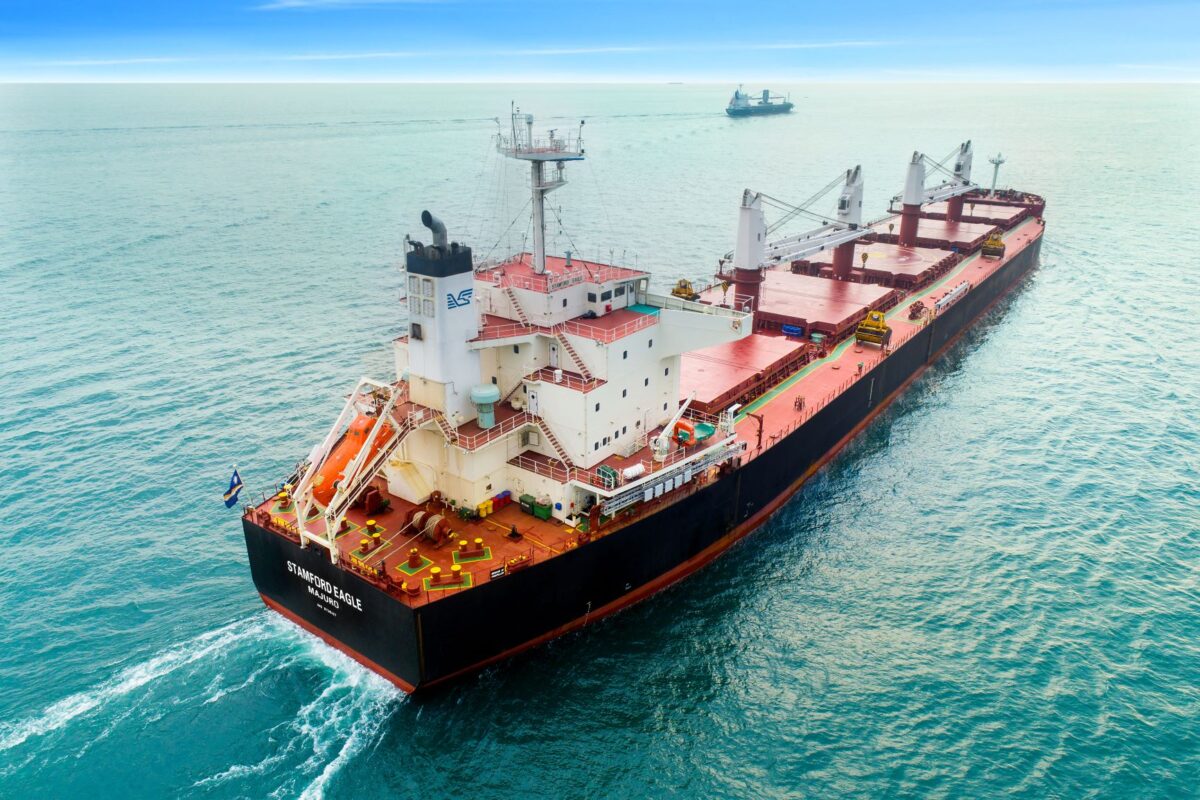
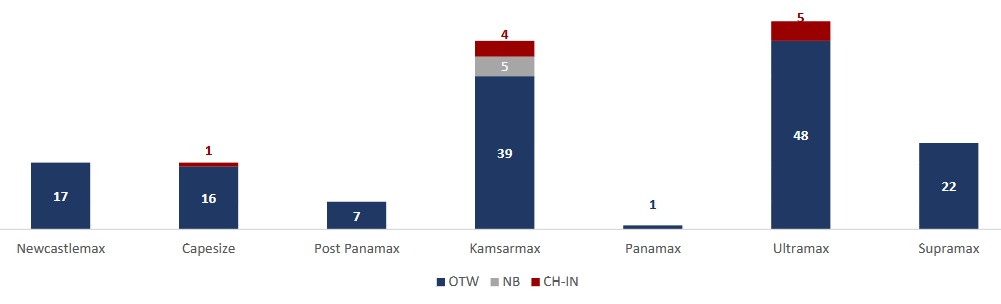
Despite the industry-wide downturn, Star Bulk Carriers ($SBLK (+0,72%)) continues to set itself apart with a combination of cost efficiency, fleet scale, and operational excellence. The company operates one of the lowest-cost fleets in the world, with a daily operating expense (OPEX) of just $5,056 per vessel per day in Q4 2024. This efficiency, paired with its 155-vessel fleet spanning various classes with an average age of 11.8 years, provides a solid foundation for long-term resilience.
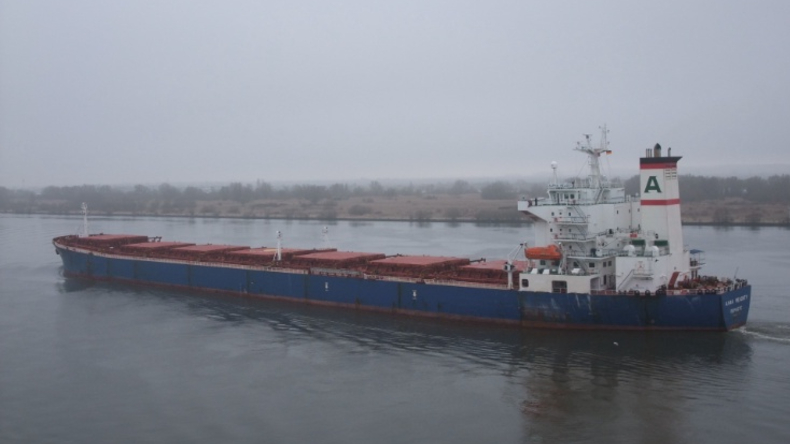
SBLK Fleet composition including 5 newbuilding vessels and
Sustainability is also a priority for SBLK, and the company has been proactive in meeting environmental regulations. By equipping its vessels with cutting-edge emissions technology, SBLK has earned a “B” score in environmental and water management from the 2024 Carbon Disclosure Project (CDP). This commitment to responsible shipping is further reinforced by an ESG risk rating of 18.4, making SBLK the top-ranked U.S.-listed dry bulk company in ESG performance.
Delivering Value to Investors
Through strategic financial management, SBLK has consistently prioritized shareholder value. Since 2021, the company has generated $2.6 billion in returns for investors. This commitment is evident in the recently announced $100 million share buyback program, which saw 900,000 shares repurchased in December and January at an average price of $15.08, largely financed by free cash flow and vessel sales.
Dividends remain a key pillar of SBLK’s strategy, with 60% of quarterly free cash flow allocated to payouts. The company also maintains a strong financial position, with $440 million in cash on hand post-Q4 2024. Over the past four years, net debt per vessel has been reduced by 54%, from $11.9 million to $5.4 million, while 13 ships are now fully debt-free, collectively valued at $250 million.
SBLK Shareholder commitment since 2021
Financial Performance: Growth Despite Market Conditions
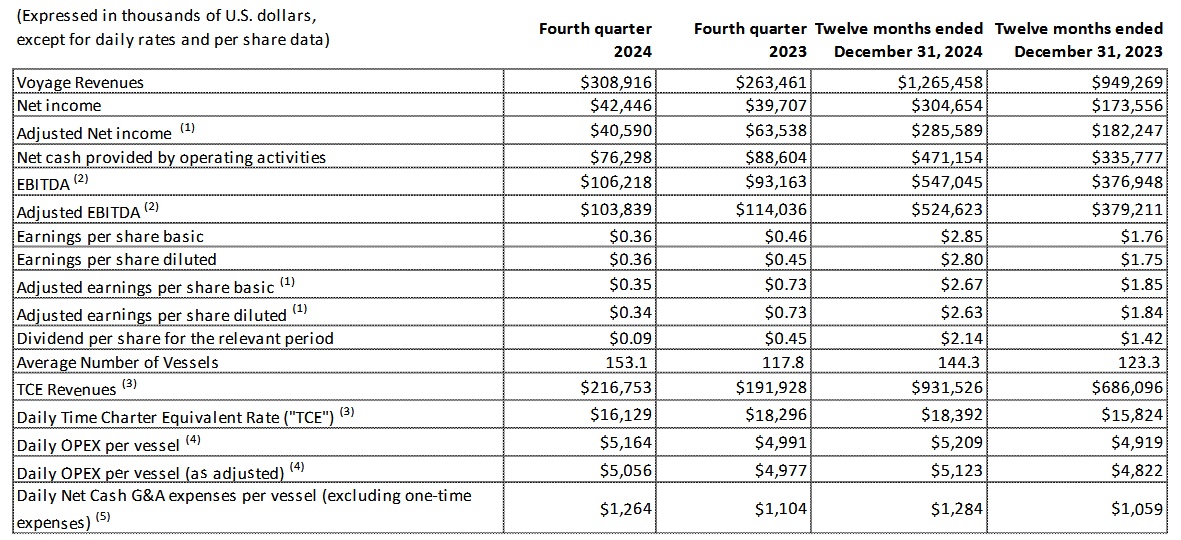
Even amid the broader market downturn, SBLK has continued to deliver strong financial results. In Q4 2024, the company reported total revenues of $308.9 million, marking a 17.25% year-over-year increase compared to Q4 2023. Earnings before interest, taxes, depreciation, and amortization (EBITDA) also rose by 14% YoY, reaching $106.2 million, up from $93.1 million in the same quarter the previous year.
A key driver of this growth has been the 2024 acquisition of Eagle Bulk, a strategic move that has strengthened SBLK’s market position and operational efficiencies.
Q4 24 SBLK Earnings + YOY + 2023 vs 2024
Eagle Bulk Integration: Unlocking Synergies
The integration of Eagle Bulk has been progressing smoothly, unlocking significant cost savings and operational efficiencies. By bringing crewing operations in-house and phasing out third-party management, SBLK has substantially reduced operating expenses. Further efficiencies have been achieved through the centralization of procurement for spare parts, bunkers, lubricants, and other vessel necessities.
Technical oversight of the former Eagle Bulk fleet has also been fully integrated into SBLK’s Athens headquarters, ensuring uniform maintenance protocols and enhanced marine safety standards. Additionally, the company’s scale and strong relationships with shipyards and service providers have led to significant reductions in dry dock costs for the Eagle fleet.
SBLK has also benefited from lower interest expenses following the Q2 2024 refinancing of Eagle Bulk’s debt, further strengthening its balance sheet. To date, synergies from the Eagle Bulk integration have resulted in more than $22 million in cost savings, with additional opportunities expected in 2025, particularly in OPEX and dry dock expenses.
Conclusion: Positioned for Long-Term Success
The dry bulk shipping industry continues to face turbulent waters, but SBLK has proven its ability to navigate through uncertainty with operational efficiency, financial discipline, and strategic growth initiatives. While market challenges persist, the company’s low-cost structure, commitment to sustainability, and shareholder-focused approach set it apart from its peers.
With the successful integration of Eagle Bulk, a disciplined financial strategy, and continued efforts to optimize costs, SBLK is not only weathering the current market downturn but also positioning itself for long-term success. As the industry eventually rebounds, SBLK stands ready to emerge stronger, leaner, and more resilient than ever before.
I rate for myself SBLK as a "BUY" on the long term with a 1Y price target of 23$.
The analysis provided in this post reflects my personal views and opinions on Star Bulk Carriers (SBLK) and the broader dry bulk market. I currently hold a position in SBLK, which may create a potential bias in my perspective. This analysis is for informational purposes only and should not be considered financial advice. Investors should conduct their own research and consult with a professional before making any investment decisions. I am not responsible for any financial losses or decisions made based on the information presented.

+ 1

Mid-May 2025 finds the dry bulk market charting turbulent seas. Capesize vessels ride a bullish wave, Panamax struggles with Atlantic oversupply, Ultramax/Supramax sees regional disparities, and Handysize holds steady with balanced fundamentals. China’s shifting imports, U.S. tariff relief, and potential peace talks shape the horizon, while monsoon seasons and logistical hiccups add complexity. This sector is a bulker navigating global trade winds—let’s dive into its journey.
🚢 Capesize: Riding a Bullish Wave
Rates Rebound
Capesize vessels, the behemoths of bulk, close the week on a firm note. The Baltic Capesize Index (BCI) 5TC recovers $2,382 week-on-week to $16,736 per day. West Australia-to-China (C5) rises to $8.195 per metric tonne (pmt), up from low-mid $7 levels. Brazil-to-China (C3) firms to $19.405 pmt, finding a floor at $18.00 mid-week. The fronthaul C9 index surges, reflecting North Atlantic tightness. Clarksons reports Capesize spot rates at $16,500 per day, up 9% week-on-week, driven by miner engagement—Capesize sails with renewed momentum.
Cargo Currents
Pacific markets see robust enquiry, with East Australia maintaining peripheral volume and miners pushing rates. Atlantic demand strengthens from South Brazil and West Africa, despite logistical issues [San Nicolas loader breakdown]. Far East spot tonnage thins slightly, though June ballast lists remain heavy. A 180,000-dwt vessel fixes at $19 pmt for early June Brazil-to-China, up from sub-$18 levels. China’s iron ore imports [1.12 billion tonnes in 2024, up 6%] and bauxite flows [110.2 million tonnes, up 11.2%] fuel demand—Capesize thrives on tightening tonnage.
Global Tides
U.S.-China tariff relief [24% cut, effective May 14] boosts trade sentiment, indirectly supporting Capesize via Brazilian routes. Potential peace talks [Russia-Ukraine, Iran] could spur reconstruction demand, per Star Bulk’s Petros Pappas, adding upside. China’s domestic iron ore production [up 7% in 2024] and coal import declines [down 8.3% in Q1] temper gains. Clarksons forecasts 1.5% dry bulk demand growth in 2026, lagging 2.5% fleet growth, but tight North Atlantic tonnage signals near-term strength—Capesize navigates with bullish caution.
🌾 Panamax: Atlantic Struggles Persist
Rates Under Pressure
Panamax vessels, vital for grain and coal, face a lackluster week. The Baltic Panamax Index averages $11,800 per day, down 5% week-on-week. Atlantic fronthaul rates slide, with an 82,000-dwt vessel dropping from $20,000 to $14,000 mid-week for a U.S. East Coast-to-India run [Continent delivery]. Pacific rounds hold at $9,500-$10,000 per day, with an 82,000-dwt vessel fixing at $11,000 for East Coast Australia-to-Japan. East Coast South America (ECSA) softens, with June oversupply looming—Panamax grapples with bearish sentiment.
Regional Ripples
Atlantic markets weaken as growing tonnage outpaces demand, particularly from North Coast South America (NCSA). Trans-Atlantic runs see wider bid-offer spreads, with sub-index fixtures. ECSA grain [Brazilian soybeans, 19.6 million tonnes in Q1] provides short-term support, but ample June tonnage pressures rates. Pacific markets remain flat, with long tonnage lists and scarce NoPac cargoes. A 5-7 month period fixture at $13,750 [82,000-dwt, China delivery] reflects cautious optimism—Panamax seeks a demand spark.
External Currents
U.S.-China tariff relief boosts Brazilian soybean exports [up 9% year-on-year], supporting Panamax tonne-miles. Potential Red Sea normalization [post-Houthi ceasefire] could shorten Pacific routes, per Bimco’s Paul Pathy, reducing demand. China’s coal import decline [down 8.3% in Q1] and weak macroeconomic signals limit upside. Clarksons’ 2026 forecast [2.5% fleet growth, 1.5% demand] and monsoon-related cargo drops in West Coast India add headwinds—Panamax navigates with guarded hope.
⚓ Ultramax/Supramax: Regional Disparities
Rates Hold Mixed
Ultramax and Supramax vessels, versatile mid-sized carriers, show regional contrasts. The Baltic Supramax Index stabilizes at $11,600 per day. U.S. Gulf and South America maintain strength, with a 58,000-dwt vessel fixing at $17,850 for Fazendinha-to-Otranto. Indian Ocean rates shine, with a 64,000-dwt vessel at $20,000 plus $200,000 ballast bonus [Saldanha Bay-to-China]. Asian markets soften, with a 63,000-dwt vessel at $17,000 [Surabaya-to-Thailand]. Continent-Mediterranean rates dip, with limited enquiry—Supramax balances localized gains with Asian weakness.
Market Movements
U.S. Gulf and South America see steady demand, though trans-Atlantic runs ease late-week. Indian Ocean activity remains robust [South Africa-to-China], but monsoon season looms. Asian markets lack impetus, with a 58,000-dwt vessel at $12,500 [Singapore-to-China]. Continent-Mediterranean markets stay subdued, with downward rate pressure. Star Bulk’s sale of five Supramaxes [average age 17 years] to Chinese buyers signals fleet renewal—Supramax seeks catalysts amid holiday slowdowns.
Broader Waves
U.S.-China tariff relief supports Brazilian grain routes, boosting Supramax tonne-miles. Potential peace talks [Ukraine reconstruction] could lift demand, per Star Bulk. China’s reduced coal imports [down 8.3% in Q1] and stricter environmental regulations pressure older vessels. Clarksons’ 2026 forecast [2.5% fleet growth, 1.5% demand] and 5% newbuild deliveries in 2025 add risks. Indian Ocean strength offers upside, but Asian oversupply and monsoon slowdowns cloud prospects—Supramax sails with cautious resilience.
🛳️ Handysize: Steady Amid Quiet Seas
Rates Remain Flat
Handysize vessels, nimble bulk carriers, maintain balance with minimal activity. The Baltic Handysize Index (BSHI) holds at $9,900 per day. South Atlantic rates stabilize, with a 36,000-dwt vessel at $15,500 [Recalada-to-NC South America]. U.S. Gulf softens, with a 37,000-dwt vessel at $10,500 [Hampton Roads-to-Continent, coal]. Asian rates steady, with a 38,000-dwt vessel at $13,500 [CJK-to-Continent, concentrates]. Mediterranean markets remain soft, with a 37,000-dwt vessel at $7,000 [Bejaia-to-Samsun]—Handysize anchors in regional stability.
Trade Flows
South Atlantic balances steady grain demand [Brazilian exports, 71% soybeans] with growing tonnage. U.S. Gulf faces pressure from lengthening lists, depressing rates. Asian markets stabilize, with cargo volumes [concentrates, steel] offsetting tonnage increases. Mediterranean and Continent markets lack fresh enquiry, staying positional. Pangaea’s 17 Chinese-built Handysizes benefit from U.S. tariff exclusions [below 80,000 dwt]—Handysize relies on localized demand pockets.
Influencing Factors
U.S.-China tariff relief boosts Brazilian grain routes, supporting Handysize. Potential Red Sea normalization could reduce Asian tonne-miles, per Bimco. China’s grain production [up via genetically modified crops] and coal import declines [down 8.3% in Q1] limit upside. Clarksons forecasts 6% Handysize fleet growth in 2026, outpacing 1.5% demand. C3is’ debt-free Handysizes [$16,202 per day average] signal resilience—Handysize seeks momentum in a flat market.
🌐 What’s Moving It: Trade Shifts and Geopolitical Winds
Commodity Currents
China’s iron ore imports [1.12 billion tonnes, up 6%] and bauxite flows [110.2 million tonnes, up 11.2%] drive Capesize demand. Brazilian soybean exports [19.6 million tonnes in Q1, up 9%] boost Panamax and Handysize tonne-miles. Indian Ocean trades [South Africa-to-China] support Supramax, but China’s coal import decline [down 8.3% in Q1] and domestic grain production [up via GM crops] reduce volumes. Monsoon season in West Coast India threatens Supramax cargoes—commodity shifts steer bulker dynamics.
Policy and Trade Pressures
U.S.-China tariff relief [24% cut, effective May 14] supports Brazilian routes. Potential peace talks [Russia-Ukraine, Iran] could spur reconstruction demand, boosting tonne-miles, per Star Bulk. U.S. tariff exclusions for vessels below 80,000 dwt benefit Pangaea’s Handysizes. Red Sea normalization risks tonne-mile losses, per Bimco. Clarksons’ 2026 forecast [2.5% fleet growth, 1.5% demand] and China’s domestic production [iron ore up 7%] pressure rates—policies shape the bulker path.
🌐 Market and Stocks: Balancing Volatility and Value
Stock Signals
Dry bulk stocks navigate mixed currents. Star Bulk $SBLK (+0,72%) reports a $462,000 net profit [Q1, down from $74.9 million], with a $0.05 per share dividend and $74.4 million in share buybacks. Pangaea $PANL (-1,68%) posts a $2 million adjusted net loss [Q1], cutting its dividend to $0.05 per share and launching a $15 million buyback. EGD Shipping Invest boosts its KCC $KCC (+0,82%) stake to 6.04% [$900,000]—stocks reflect resilience amid weak rates.
Investor Compass
Capesize benefits from China’s imports and Atlantic tightness, but oversupply risks linger. Panamax struggles with coal declines, though Brazilian grains offer hope. Supramax leans on Indian Ocean demand, while Handysize stabilizes with tariff exclusions. Star Bulk’s Supramax sales [31 vessels, $500 million] and Pangaea’s buybacks signal undervaluation. Potential peace talks and tariff relief could lift tonne-miles. Investors balance geopolitical upside with 2026 fleet growth [2.5%-6%]—strategies target long-term value.
Sector Horizon
Tariff relief and peace talks fuel optimism, but China’s import declines [coal down 8.3%] and monsoon slowdowns pose risks. Clarksons’ 2026 forecast [earnings softening] highlights oversupply, particularly for Supramax/Handysize. Capesize and Panamax benefit from long-haul trades, while stocks like Star Bulk [undervalued] and C3is [debt-free] offer opportunities if demand holds—investors navigate short-term volatility with supply constraints.
🌐 Outlook: Charting the Next Voyage
Market Projections
Capesize ranges $16,500-$19,000 per day—tight tonnage drives gains—bullish. Panamax at $9,500-$14,000—Atlantic weakness persists—challenged. Ultramax/Supramax at $11,600-$20,000—Indian Ocean strength fades—mixed. Handysize at $7,000-$15,500—South Atlantic stabilizes—steady. Monsoon season and fleet growth signal volatility—2026 could soften for smaller vessels.
Strategic Course
Capesize leverages China’s iron ore and bauxite imports, but Panamax needs grain demand to rebound. Supramax relies on Indian Ocean trades, while Handysize banks on South Atlantic stability. Tariff relief, peace talks, and 2026 fleet growth [2.5%-6%] challenge margins, but China’s import surge and supply constraints offer upside. Investors must navigate trade shifts while betting on fundamentals—strategic moves will define bulker fortunes.
Your Call
Will Capesize’s bullish run lead the charge, or can Handysize’s stability steal the spotlight? Share your take—let’s conquer the markets! 🚢
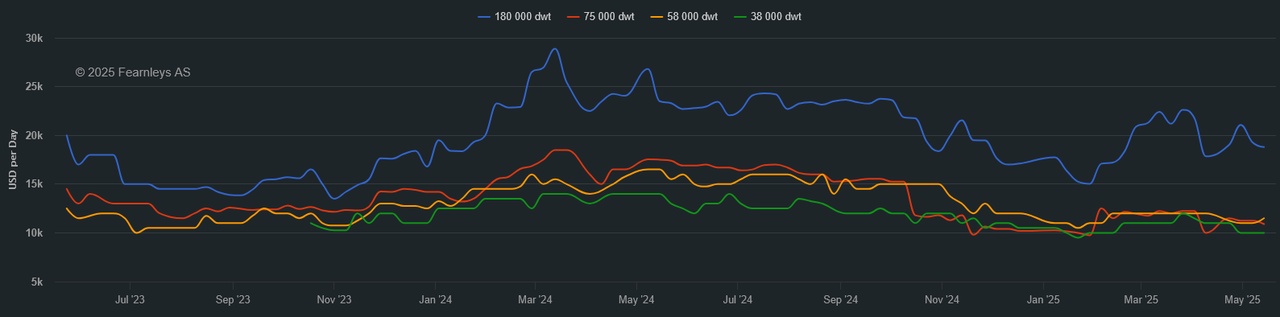
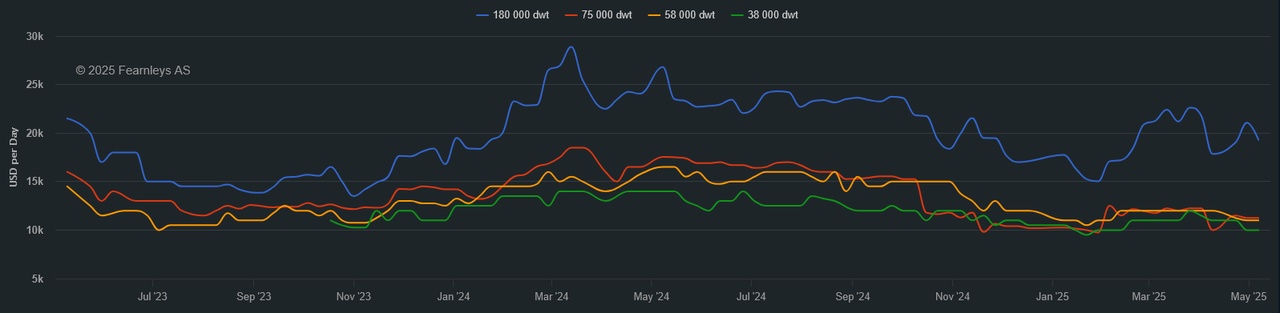
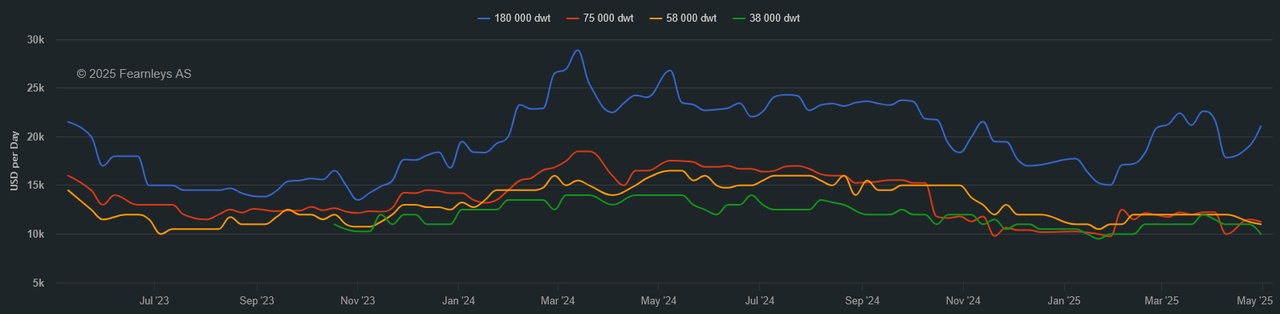
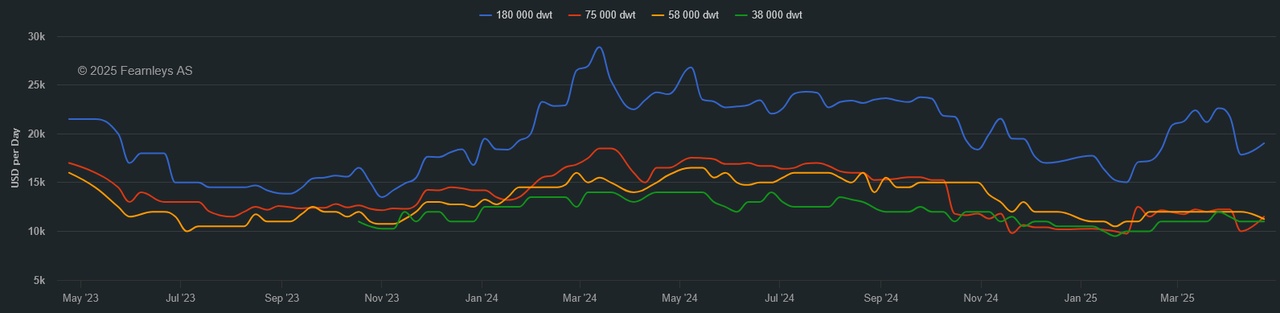
1 Year T/C Dry Bulk - May 14th


+ 1


💹Revenues : $230.65M ( Est. $164.34M) 🟢 BEAT
💵 Earning Per Share : -$0.07 (Est. -$0.28) 🟢 BEAT
💰Dividend : $0.05 / shr on June 20th for shareholder as of June 6th
💬CEO Comments : Despite the seasonal market weakness during the first quarter 2025, Star Bulk remained in the black with Net Income of $0.5 million, EBITDA of $58.0 million and TCE per vessel per day of $12,439.
Our disciplined capital allocation strategy continues to prioritize shareholder value by combining dividends and share buybacks. The Board declared a $0.05 per share dividend, marking our 17th consecutive quarter of capital returns, totaling ~$1.35 billion to date. Using vessel sales proceeds at net asset value, we repurchased approximately 1.3 million shares, at prices significantly below net asset value, capitalizing on recent market dislocations to enhance shareholder returns. Going forward, we plan to remain committed to this strategy.
On the S&P front, we continue to selectively dispose of older and smaller tonnage that does not fit our commercial profile, having agreed to sell an additional five Supramax vessels.
Operationally, we significantly surpassed our $50.0 million cost and revenue synergy target, delivering meaningful cost savings to our shareholders.
With over $500.0 million in liquidity, net debt below scrap value and 13 unencumbered vessels, we believe we are well-positioned to seize opportunities in the dry bulk market.
Despite the global market volatility, and the uncertain effect of tariffs on global economic growth and trade, we are constructive about the medium/longer-term prospects of our industry, supported by a favorable order book and the IMO’s recent decision to implement global market-based measures to reduce GHG emissions, a decision that will effectively reduce supply of tonnage.
Mid-May 2025 sees the dry bulk market navigating shifting currents. Capesize vessels soften amid limited enquiry, Panamax gains traction in the Atlantic, Ultramax/Supramax remains subdued, and Handysize stabilizes with steady South Atlantic demand. China’s bauxite and iron ore import surge, Brazilian soybean exports, and U.S.-China trade tensions shape the horizon, while Guinea’s Simandou mines and holiday slowdowns add complexity. This sector is a bulker charting global trade routes—let’s explore its journey.
⏬ Capesize Market: Softening Amid Thin Enquiry
Rate Declines
Capesize vessels, the titans of dry bulk, face a softening market after a holiday-dampened week. The Baltic Capesize Index (BCI) 5TC falls $3,072 week-on-week to $14,169 per day. The C8 trans-Atlantic route settles at $13,071 per day, dragged by a low time-charter equivalent (TCE) on a short-duration voyage. Brazil-to-China (C3) drops to $18.215 per metric tonne (pmt), down from high $19 levels for June dates. Pacific routes weaken, with West Australia-to-China (C5) fixing at mid $7s pmt (from $7.90). Clarksons reports Capesize spot rates at $15,200 per day, down 8% week-on-week, as miners fix at softer rates—Capesize navigates a cautious decline.
Cargo Dynamics
China’s bauxite imports (110.2 million tonnes in 2024, up 11.2%) drive Capesize demand, with Guinea supplying 69.41% of the market via Africa Atlantic Coast (AAC) routes. Iron ore imports rise, with Guinea’s Simandou mines (120 million tonnes per year at full capacity) set to supply 10% of China’s seaborne needs. East Australia maintains peripheral volume, but Brazil and West Africa see thin enquiry for end-May dates, shifting focus to June. Far East spot tonnage tightens slightly, though ballast tonnage remains heavy for mid-June. A 180,000-dwt vessel fixes at $18 pmt for Brazil-to-China, reflecting softer sentiment—Capesize relies on China’s import surge.
Global Forces
U.S.-China tariff tensions curb U.S. grain exports (down 54% to China), indirectly supporting Capesize via longer Brazilian routes. A potential Houthi ceasefire may normalize Red Sea routes, reducing tonne-miles. China’s aluminium demand (70% import-reliant) and Simandou’s ramp-up signal upside, but low fleet growth (2.5% in 2026) and holiday slowdowns temper gains. Clarksons forecasts 1.5% dry bulk demand growth in 2026, outpaced by 2.5% fleet growth, pressuring rates. Rising inventories could lift rates in a contango market—Capesize sails with guarded optimism.
For illustrative purposes only
⏳ Panamax Market: Atlantic Gains
Rate Improvements
Panamax vessels, key for grain and coal, gain momentum in the Atlantic despite a muted start. The Baltic Panamax Index averages $12,238 per day, down 35% year-on-year but up week-on-week. North Atlantic routes achieve $18,500-$19,000 per day for grain runs (NC South America to Far East, Gibraltar delivery). South Atlantic softens, with 82,000-dwt vessels fixing at $16,500 plus $650,000 ballast bonus for end-May. Pacific rates weaken, with Far East trips at low $12,000s for 82,000-dwt vessels (Philippines delivery, 10-12 months). Tight North Atlantic tonnage and Brazilian soybean exports (19.6 million tonnes in Q1) drive gains—Panamax thrives in premium routes.
Regional Trends
North Atlantic sees tight spot tonnage and consistent NC South America grain demand, supporting fronthaul and trans-Atlantic runs. East Coast South America (ECSA) remains quiet, with limited fresh enquiry. Pacific markets struggle, with growing Far East tonnage and weak NoPac/Aussie rounds pressuring rates. Brazilian soybean shipments (up 9% year-on-year) boost tonne-miles (1,270 nautical miles longer than U.S. routes), absorbing surplus tonnage. A 82,000-dwt vessel fixes at $12,500 per day for a Pacific round-trip, reflecting fragility. Atlantic premium routes counter Pacific weakness—Panamax leans on grain-driven strength.
External Pressures
U.S.-China tariffs reduce U.S. soybean exports (16% market share), boosting Brazilian cargoes and Panamax tonne-miles. A Houthi ceasefire could normalize Red Sea routes, impacting Pacific trades. Brazil’s 9% soybean harvest increase and China’s import momentum (through Q2) support rates, but Clarksons’ 2026 forecast (2.5% fleet growth, 1.5% demand) signals pressure. Potential U.S.-China trade talks could restore U.S. exports, per BRS, shifting tonne-miles. Low period market activity (e.g., one 82,000-dwt fixture) reflects caution—Panamax navigates with Atlantic optimism.
For illustrative purposes only
⏱️ Ultramax/Supramax Market: Subdued Sentiment
Rate Stability
Ultramax and Supramax vessels, versatile mid-sized bulkers, remain subdued amid holiday slowdowns. The Baltic Supramax Index holds steady at $11,500 per day. U.S. Gulf fixes a 63,000-dwt vessel at $16,000 per day for a trans-Atlantic run, while EC South America achieves mid $20,000s for an Ultramax on similar routes. Mediterranean rates weaken, with a 56,000-dwt vessel at $10,000 per day (Spain to NC South America). Indian Ocean sees demand, with a 64,000-dwt vessel fixing at $16,000 per day (Tema to China via South Africa). Asian rates soften, with a 63,000-dwt vessel at $13,000 per day (Thailand to Indonesia)—Supramax treads water.
Market Dynamics
South Atlantic and U.S. Gulf show sporadic strength, with Ultramax fixtures outperforming Supramax. Mediterranean markets remain patchy, with limited fixing. Indian Ocean demand rises for West Africa-to-Far East routes, supporting rates. Asian markets weaken, with growing prompt tonnage and scarce cargoes (e.g., a 63,000-dwt vessel fixes at $14,000 per day, China to Arabian Gulf). Holiday-dampened enquiry limits momentum, though South Atlantic stability absorbs tonnage. A two-year period fixture for a 63,000-dwt vessel (West Coast India) signals long-term confidence—Supramax seeks demand catalysts.
Broader Forces
U.S.-China tariffs indirectly support Supramax via Brazilian grain routes, but Red Sea normalization risks tonne-mile losses. China’s bauxite and iron ore imports (e.g., Guinea’s 110.2 million tonnes) boost West African demand, though Asian oversupply caps gains. Clarksons’ 2026 forecast (2.5% fleet growth, 1.5% demand) and 5% newbuild deliveries in 2025 pressure rates. Sporadic Indian Ocean and South Atlantic demand offers upside, but holiday slowdowns and weak Asian enquiry cloud prospects—Supramax navigates with cautious resilience.
For illustrative purposes only
⏸️ Handysize Market: Steady but Flat
Rate Trends
Handysize vessels, nimble bulk carriers, stabilize with mixed regional performance. The Baltic Handysize Index (BSHI) averages $9,800 per day, flat week-on-week. South Atlantic rates rise slightly, with a 37,000-dwt vessel fixing at $17,000 per day (Recalada to Mediterranean). U.S. Gulf weakens, with a 35,000-dwt vessel at $8,000 per day (SW Pass to UK-Continent). Asian rates hold, with a 40,000-dwt vessel at $12,000 per day (Hong Kong to Colombia). Mediterranean markets soften, with limited activity. A period fixture at 120.5% of BSHI for a 40,000-dwt vessel (June-July 2025) reflects stability—Handysize balances steady demand with oversupply.
Trade Patterns
South Atlantic maintains steady activity, with fresh demand supporting rates. U.S. Gulf faces pressure from growing tonnage lists, depressing rates. Asian markets stabilize, with gradual tonnage increases offset by demand (e.g., steel cargoes to Colombia). Mediterranean and Continent markets remain soft, with sparse fixtures. Brazilian grain exports (71% soybeans) and West African bauxite flows support Handysize, though cargo volumes remain flat. A 37,000-dwt vessel fixes at $17,000 per day for a South Atlantic run, reflecting localized strength—Handysize relies on regional pockets of demand.
Influencing Factors
U.S.-China tariffs boost Brazilian grain routes, supporting Handysize tonne-miles. Red Sea normalization could reduce Asian tonne-miles, but South Atlantic stability mitigates risks. Clarksons forecasts 6% Handysize fleet growth in 2026, outpacing 1.5% demand, pressuring rates. China’s bauxite imports and Brazil’s harvest (9% up) offer upside, but holiday slowdowns and U.S. Gulf oversupply limit gains. Period market caution (e.g., sporadic fixtures) reflects geopolitical risks—Handysize seeks momentum amid flat sentiment.
For illustrative purposes only
🌐 What’s Moving It: Trade Shifts and China’s Demand
Commodity Shifts
China’s bauxite imports (110.2 million tonnes, up 11.2%) and Guinea’s Simandou iron ore (120 million tonnes per year) drive Capesize demand. Brazilian soybean exports (19.6 million tonnes in Q1, up 9%) boost Panamax tonne-miles, replacing U.S. cargoes (down 54%). West African bauxite and Indian Ocean trades support Supramax, while South Atlantic grain and Asian steel cargoes stabilize Handysize. China’s aluminium demand (70% import-reliant) and infrastructure upgrades fuel bauxite flows, but coal and grain shipment reductions increase segment competition—commodity shifts shape bulker dynamics.
Trade and Policy Pressures
U.S.-China tariffs curb U.S. grain exports, boosting Brazilian routes and tonne-miles. Potential U.S.-China trade talks could restore U.S. soybeans, per BRS, shifting demand. A Houthi ceasefire may normalize Red Sea routes, reducing Pacific tonne-miles. Clarksons’ 2026 forecast (2.5% fleet growth, 1.5% demand) and 5% newbuild deliveries in 2025 pressure rates. Guinea’s bauxite exports (69.41% of China’s market) and Brazil’s harvest offer upside, but holiday slowdowns and oversupply cloud prospects—trade policies steer the bulker path.
🌐 Market and Stocks: Balancing Volatility
Stock Performance
Dry bulk stocks navigate trade shifts. Star Bulk Carriers $SBLK (+0,72%) sees John Fredriksen’s Famatown increase its stake to 11.4% ($200 million) and Danaos Corp acquire 5.23% ($95 million), signaling confidence despite a 20% share price drop since March. 2020 Bulkers $2020 (+0,74%) reports $200,000 net profit (Q1), down from $28.7 million, with TCEs at $19,000 per day, but April dividends rise to 10 cents per share ($27,100 per day). Clarksons notes dry bulk earnings at $12,500 per day (20% below 10-year average)—stocks reflect resilience amid softening rates.
Investor Insights
Capesize may rebound with Simandou and bauxite demand, but oversupply risks persist. Panamax benefits from Brazilian soybeans, though Pacific weakness caps gains. Supramax and Handysize rely on South Atlantic and Indian Ocean trades, but 2026 fleet growth (2.5%-6%) pressures rates. Star Bulk’s shareholder backing (Fredriksen, Danaos) and 2020 Bulkers’ dividend hike signal long-term optimism. Potential U.S.-China trade easing could shift tonne-miles, per BRS. Investors weigh tariff risks against China’s import surge—strategies balance volatility with fundamentals.
Sector Outlook
Tariffs, Red Sea dynamics, and holiday slowdowns pressure rates, but China’s bauxite/iron ore imports and Brazilian soybeans drive demand. Clarksons’ 2026 forecast (earnings softening) highlights oversupply risks, particularly for Supramax/Handysize. Panamax and Capesize benefit from long-haul trades, while stocks like Star Bulk (undervalued) and 2020 Bulkers (dividend-focused) offer value if demand holds—investors navigate short-term challenges with long-term supply constraints.
🌐 Outlook: Charting Future Currents
Market Projections
Capesize ranges $13,000-$15,200 per day—Simandou offers upside—cautious. Panamax at $12,000-$19,000—Atlantic strength persists—buoyant. Ultramax/Supramax at $10,000-$16,000—subdued sentiment lingers—flat. Handysize at $8,000-$17,000—South Atlantic stabilizes—steady. Red Sea normalization and newbuilds signal volatility—2026 could soften with fleet growth.
Strategic Horizons
Capesize leverages China’s bauxite and iron ore imports, but Panamax thrives on Brazilian grain. Supramax needs Indian Ocean demand, while Handysize relies on South Atlantic stability. Tariffs, 2026 fleet growth (2.5%-6%), and trade talks challenge margins, but Guinea’s Simandou and Brazil’s harvest offer upside. Investors must navigate trade shifts while betting on supply constraints—strategic moves will define bulker fortunes.
Your Call
Will Capesize lead with Simandou’s iron ore, or can Panamax’s grain surge steal the spotlight? Share your take—let’s master the markets! 🚢
1 Year T/C Dry Bulk - May 7th


+ 1
Early May 2025 finds the dry bulk market at a pivotal moment. Capesize vessels maintain strength on iron ore and bauxite flows, Panamax softens under holiday disruptions, Supramax/Ultramax struggles with muted activity, and Handysize battles persistent oversupply. U.S. tariff policies and Chinese steel export probes cast shadows, while Indian iron ore imports and rerouted pulp trades offer glimmers of opportunity. This sector is a freighter navigating turbulent seas—let’s chart its path.
⏬ Capesize Market: Anchored by Iron Ore Demand
Rate Stability
Capesize vessels, the behemoths of iron ore and coal transport, hold a steady course. The Baltic Capesize Index (BCI) 5TC reaches $17,241 per day, up 10% week-on-week, with average rates at $16,408 by April 29, a 19% seven-day gain. The Western Australia-to-China (C5) route hovers around $8.005 per tonne, with 170,000-tonne iron ore cargoes from Dampier-to-Qingdao fixed at $8.05 and Port Hedland deals at $8.00. Brazil-to-China (C3) slips to $19.345 per tonne by May 2 (from $19.695), though mid-May fixtures hit $19.00. North Atlantic fronthaul routes shine, with the C9 index jumping $1,126 to $38,719, driven by a 181,319-dwt vessel fixed at $39,000 from Rotterdam via Port Cartier—steady demand underpins this resilience.
Cargo Currents
West Australia sees robust enquiries for mid-to-late May cargoes, with miners and operators active, while Pacific volumes rise modestly. Brazil and West Africa-to-China routes focus on second-half May and early June, with a 170,000-tonne cargo from Puerto Drummond-to-Iskenderun at $13.25 per tonne. Pacific tonnage tightens as spot vessels in the Far East dwindle, though ballaster lists remain lengthy. Guinea’s bauxite shipments (up 12.3 million tonnes in Q1) bolster Atlantic demand, offsetting Australian iron ore losses (down 13.7 million tonnes due to Port Hedland weather disruptions). Brazil (down 2.0 million tonnes) and Canada (down 1.5 million tonnes) add pressure, but Indian iron ore imports (2.3 million tonnes in Q1, up from 0.8 million) support Capesize—cargo flows sustain market firmness.
Global Influences
U.S. port fees ($18-$33 per net tonne by 2028) exempt bulkers under 80,000 dwt, minimally impacting Capesize. U.S.-China tariff hikes (affecting 4% of dry bulk tonne-miles) and anti-dumping probes into Chinese steel by Mexico, South Korea, and others threaten minor bulk trades, particularly flat steel for construction. China’s steel export surge (115 million tonnes in 2024, up 25%) faces uncertainty, but rerouting to ASEAN markets supports tonne-miles. India’s 6-7% steel output growth drives iron ore imports, boosting Capesize demand from Oman and Australia. A low orderbook (10.3% of the fleet) and Q1 demand losses (down 11.3 million tonnes) temper optimism—seasonal demand and supply constraints keep Capesize buoyant but cautious.
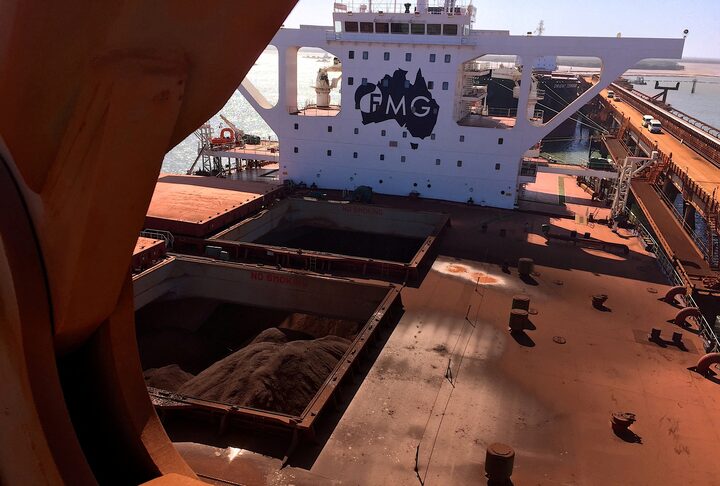
The logo of Australia's Fortescue Metals Group (FMG) can be seen on a bulk carrier as it is loaded with iron ore at the coastal town of Port Hedland in Western Australia, November 29, 2018 - For illustrative purposes
⏳ Panamax Market: Holiday-Induced Softness
Rate Pressures
Panamax vessels, versatile grain and mineral carriers, face headwinds from holiday disruptions. Rates weaken as U.S. and Canadian grain exports decline seasonally, with transatlantic fixtures holding steady at $17,750 for an 82,000-dwt scrubber-fitted vessel from the Spanish Mediterranean via North Coast South America-to-Far East. South America sees pressure for end-May Asia arrivals, with few fixtures emerging. Indonesian coal round trips drop to $10,850 by May 2 (from $11,500), and an 82,000-dwt vessel in China secures $12,000 for an 8-10 month period. The Baltic Panamax Index reflects softening trends, with limited upside—holidays and oversupply dim Panamax’s spark.
Regional Dynamics
Atlantic markets see minimal fresh demand, but tight tonnage counts stabilize transatlantic and fronthaul routes. North Coast South America supports activity, while South America remains quiet amid the Geneva Dry conference. Mediterranean tonnage builds, yet sentiment holds cautiously firm. Pacific markets falter as oversupplied tonnage lists and slow cargo replenishment weigh on NoPac and Australian trades. Indonesian and Australian coal demand rises, but high Chinese inventories cap gains. East Coast South America grain volumes provide stability, but holiday slowdowns (e.g., May Day) curb momentum—Panamax navigates a fragmented market.
External Pressures
U.S. port fee exemptions for sub-80,000 dwt bulkers shield Panamax, with only 4% of tonne-miles affected by U.S.-China tariffs. Anti-dumping probes into Chinese steel (hot-rolled coils) by Brazil, India, and others risk curbing minor bulk flows, particularly to ASEAN markets. China’s property sector crisis and coal demand drop (down 2-3% in 2025) weaken Panamax cargoes, per Bimco’s outlook. Rerouting U.S. coal to Asia and potential Indian steel growth (6-7% in Q1) offer upside, but holiday disruptions and trade uncertainties cloud prospects—Panamax treads cautiously, leaning on Atlantic stability.
⏱️ Supramax/Ultramax Market: Muted Momentum
Rate Stagnation
Supramax and Ultramax markets lack clear direction, with subdued activity across basins. South Atlantic rates hold steady, with a 63,000-dwt vessel fixing Recalada-to-SE Asia at $13,750 plus a $375,000 ballast bonus. U.S. Gulf rates weaken, with a 55,000-dwt ship at $9,750 for Mississippi-to-North Coast South America. In Asia, Indonesian demand wanes, with a 57,000-dwt vessel fixing Indonesia-to-China at $9,250. Indian Ocean routes fare better, with a 63,000-dwt ship at $18,000 from Fujairah-to-Bangladesh and a 57,000-dwt vessel at $10,000 from Mormugao-to-China. Baltic Supramax indices show marginal movement—oversupply and holiday slowdowns stifle progress.
Tonnage Trends
South Atlantic remains positional, supported by steady transatlantic cargo flows, but U.S. Gulf and Continent markets falter with minimal enquiries. Asian markets stagnate as Indonesian cargo demand weakens and tonnage builds in Southeast Asia. North Pacific routes see some activity, with a 63,000-dwt vessel fixing West Canada-to-India/Bangladesh at $13,250 plus a $370,000 ballast bonus. India’s iron ore export slump (down 5.9 million tonnes in Q1) hits Supramax hardest, though rising imports (2.3 million tonnes) offer partial relief. The Geneva Dry conference and May Day holidays curb activity—Supramax/Ultramax drifts in a cautious market.
Broader Forces
U.S. port fee exemptions ease Supramax/Ultramax concerns, but U.S.-China tariffs and Chinese steel probes threaten minor bulk trades, particularly flat steel. China’s steel export growth (115 million tonnes in 2024) faces risks from anti-dumping actions, potentially redirecting flows to ASEAN. India’s steel output rise supports inbound Supramax demand from Oman and Australia, but domestic ore absorption curbs exports. Bimco forecasts stagnant iron ore shipments and a 2-3% coal demand drop in 2025, pressuring rates. Rerouting and low fleet growth (1.5-2.5% in 2025) offer hope—Supramax/Ultramax awaits fresh impetus.
For illustrative purposes
⏸️ Handysize Market: Oversupply Challenges Persist
Rate Weakness
Handysize vessels, the smallest bulk carriers, face ongoing struggles. Rates soften across regions, with a 36,000-dwt vessel fixing North Spain-to-Dakar/Tema at $9,000 for gypsum. South Atlantic holds firmer at $17,000 for a 36,000-dwt ship from Paranagua via Recalada-to-Algeria. U.S. Gulf rates weaken as tonnage builds, while Pacific rates stagnate at $14,700 for a 38,000-dwt vessel from East Australia-to-Japan with clean cargo. Q1 time-charter equivalent (TCE) earnings lag at $10,252 per day (down from $12,150 in Q4 2024), though outperforming benchmarks by 21%. The Baltic Handysize Index shows minimal movement—oversupply casts a long shadow.
Market Sentiment
South Atlantic remains the strongest region, driven by transatlantic cargoes, but Continent and Mediterranean markets flatten with limited cargoes against rising tonnage. U.S. Gulf sentiment sours as vessel counts grow, and Asian markets stall with increased tonnage in Southeast Asia and North Pacific. India’s iron ore export decline (down 5.9 million tonnes) impacts Handysize, though rising steel imports offer some support. The Geneva Dry conference and May Day holidays dampen activity, with owners and charterers cautious—Handysize seeks stability amid challenging conditions.
Influencing Factors
U.S. port fee exemptions for sub-80,000 dwt vessels shield Handysize, but U.S.-China tariffs and Chinese steel probes risk disrupting minor bulk flows. China’s property crisis and coal demand decline (down 2-3% in 2025) weaken Handysize cargoes, while India’s infrastructure push (absorbing domestic ore) curbs exports. Rerouted wood pulp trades (e.g., U.S.-to-Europe, Brazil-to-China) provide new opportunities, per G2 Ocean’s insights. Low fleet growth (1.5-2.5% in 2025) and potential scrapping offer long-term upside—Handysize perseveres, eyeing new trade lanes.
🌐 What’s Moving It: Commodities and Trade Policies
Commodity Shifts
Iron ore volumes face pressure, with Australian exports down 13.7 million tonnes in Q1 due to Port Hedland weather, compounded by Brazil (down 2.0 million tonnes) and Canada (down 1.5 million tonnes). Guinea’s bauxite surge (up 12.3 million tonnes) supports Capesize, while India’s iron ore imports (2.3 million tonnes in Q1) bolster demand from Oman and Australia. China’s steel exports (115 million tonnes in 2024) drive minor bulk trades, but anti-dumping probes threaten flows to ASEAN. Coal demand drops 2-3% in 2025, per Bimco, though Indonesian and Australian coal cargoes rise. Rerouted wood pulp (U.S.-to-Europe, Brazil-to-China) and Syrian wheat imports (6,600 dwt) signal new Handysize trades—commodity dynamics steer the market.
Trade and Policy Pressures
U.S.-China tariffs (affecting 4% of tonne-miles) and anti-dumping probes into Chinese steel by Mexico, Brazil, and others risk curbing minor bulk flows, particularly flat steel. U.S. port fee exemptions for sub-80,000 dwt vessels ease costs, but trade policy uncertainties (e.g., Trump’s erratic policies) deter operators like Klaveness from U.S. trades. China’s property crisis and renewable energy push weaken iron ore and coal demand, while India’s 6-7% steel growth absorbs domestic ore. Rerouting (e.g., U.S. pulp to Europe) and a shrinking orderbook (10.3% of the fleet) support tonne-miles—trade tensions and commodity shifts shape the horizon.
For illustrative purposes
🌐 Market and Stocks: Navigating Uncertainty
Stock Performance
Dry bulk stocks face mixed fortunes amid trade uncertainties. Norden $DNORD (-0,56%) reports a $33 million Q1 net profit (down from $62 million), beating expectations at $25 million, with its dry operator unit earning $112 per vessel day. Golden Ocean $GOGL and CMB.Tech , both cut to “hold” from “buy” by Arctic Securities, trade at $7.77 and $9.14, respectively, post-merger (0.95 share exchange). The merger’s 69% loan-to-value ratio signals debt reduction over dividends, with Golden Ocean at 0.75 times its $12.20 net asset value. Norden sells 12 ships, raising its 2025 profit guidance to $50-$130 million. Clarksons Securities praises Norden’s transparency, maintaining a “buy” rating at DKK 250—stocks tread cautiously but show resilience.
Investor Insights
Capesize rates may hold firm into mid-May, with FFA contracts reflecting seasonal iron ore support, but oversupply of prompt ballasters caps upside. Bimco trims 2025-2026 demand growth by 0.5% due to U.S. tariffs, with Panamax weakest due to coal exposure (over 50% of cargoes). Low Capesize fleet growth (10.3% orderbook) supports higher rates relative to other segments. Norden’s cautious approach—redelivering costly charters, focusing on short-term deals—reflects market uncertainty, but its long-term 5% annual growth target remains. Decarbonization pressures (e.g., IMO’s carbon cost platform) and an aging fleet (needing fuel changes by 2040) signal 2030 supply tightness—investors eye fundamentals amid volatility.
Sector Outlook
U.S. tariff wars and Chinese steel probes risk softening minor bulk demand, but rerouting (e.g., pulp from Brazil-to-China) and Indian steel growth offer opportunities. Low orderbooks (1.5-2.5% growth in 2025) and potential scrapping (driven by lower rates) point to 2026 tightness. Secondhand prices may weaken, with newbuilding prices falling, per Bimco. Capesize leads with stable rates, while Panamax, Supramax/Ultramax, and Handysize lag due to oversupply and coal weakness. Stocks like Norden trade at discounts to asset values (DKK 372 per share), offering value if demand rebounds—investors weigh trade risks against supply-driven potential.
🌐 Outlook: Sailing Toward 2026
Market Projections
Capesize ranges $16,000-$18,000 daily—iron ore and bauxite flows sustain strength—steady. Panamax at $10,000-$17,000—holiday softness and coal weakness limit upside—cautious. Supramax/Ultramax at $9,000-$18,000—South Atlantic outperforms, but oversupply caps gains—mixed. Handysize at $9,000-$17,000—oversupply and weak demand persist—challenged. Rerouting and tight supply signal volatility—2026 could peak if trade stabilizes.
Strategic Horizons
Capesize benefits from Indian iron ore imports and Guinea’s bauxite surge, but Panamax risks further softening without coal demand recovery. Supramax/Ultramax’s South Atlantic strength offers resilience, while Handysize relies on new trades like pulp and wheat. Trade policy risks (e.g., steel probes, tariffs) and decarbonization costs (e.g., fuel changes by 2040) challenge margins, but low orderbooks and scrapping provide long-term upside. Investors must balance near-term uncertainties with 2030 supply constraints—strategic bets will shape dry bulk’s future.
Your Call
Will Capesize’s iron ore strength lead the rally, or can Handysize find new trade winds? Drop your take—let’s conquer the markets! 🚢
1 Year T/C Dry Bulk - April 30th


Late April 2025 marks a turning point for the dry bulk market. Capesize vessels surge on seasonal iron ore demand, Panamax thrives on Atlantic grain and mineral trades, Supramax/Ultramax diverges by basin, and Handysize battles persistent oversupply. Softened U.S. port fees ease pressures, Chinese steel production cuts loom, and recycling markets brace for tariff-driven volatility. This sector is a freighter powering through global currents—let’s navigate its journey.
⏬ Capesize Market: Surging on Seasonal Strength
Rate Rally
Capesize vessels, the giants of iron ore and coal transport, are charging forward with momentum. The Baltic Capesize Index (BCI) 5TC rises to $15,667 per day (up from $13,774 earlier in the week), with average rates reaching $15,307 by April 24, a 10% week-on-week gain. The Western Australia-to-China (C5) route climbs 10% to $7.755 per tonne, with 170,000-tonne cargoes from Dampier-to-Qingdao fixed at $7.35 and Port Hedland-to-Qingdao deals in the low $7s. Brazil-to-China (C3) advances to $19.485 per tonne, fueled by fixtures like a 190,000-tonne cargo from Tubarao-to-Qingdao at $19.00—seasonal vigor drives this ascent.
Cargo Catalysts
Northern Hemisphere weather improvements boost iron ore volumes, aligning with historical seasonal trends. West Australia sees healthy demand for early-to-mid-May cargoes, with second-half May and June bookings emerging. East Australia’s mineral exports grow, while West Africa-to-China trades (e.g., 170,000 tonnes at $19.85) add impetus. Pacific tonnage tightens as owners ballast west, shrinking spot availability. Record bauxite shipments from Guinea (45% above 2024 year-to-date) bolster Atlantic routes, though Australian iron ore exports trail 3.1% behind last year. Brazil’s 3.6% export growth supports fixtures—cargo flows propel Capesize’s robust recovery.
Global Forces
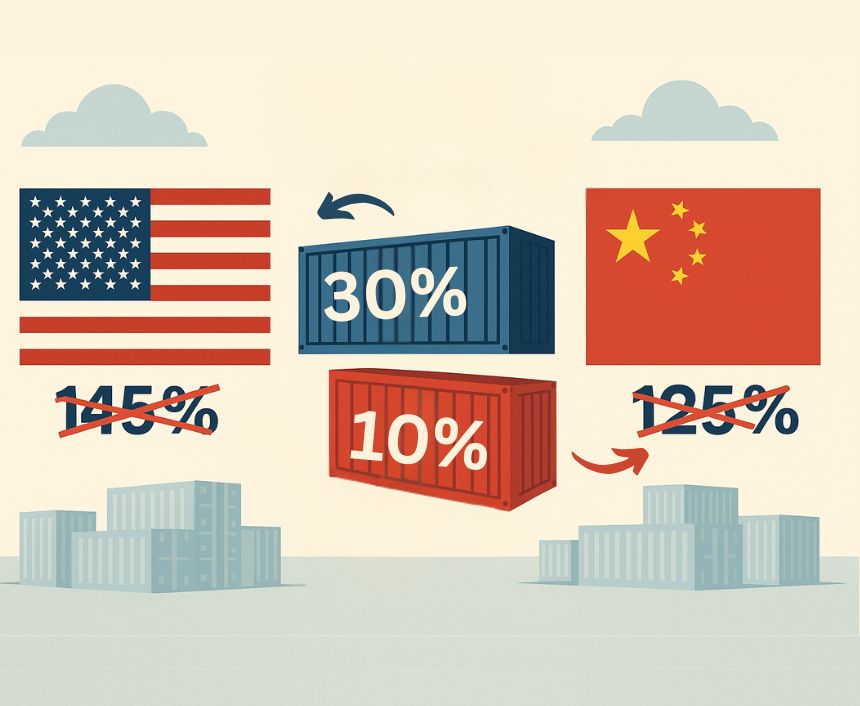
U.S. port fees ($18-$33 per net tonne by 2028) exempt bulkers under 80,000 dwt and ballast vessels, sparing Capesize significant costs. U.S.-China tariff negotiations (potentially easing to 50-65% from 145%) lift market sentiment, but Chinese steel output reductions (up to 75 million tonnes) and India’s rising domestic demand curb iron ore exports. China’s 5% GDP growth target relies on stimulus, which could spark Q3 commodity demand. A 25-year low Capesize orderbook and aging fleet (15% over 20 years) signal supply constraints—seasonal tailwinds and tight tonnage fuel Capesize’s bullish outlook.
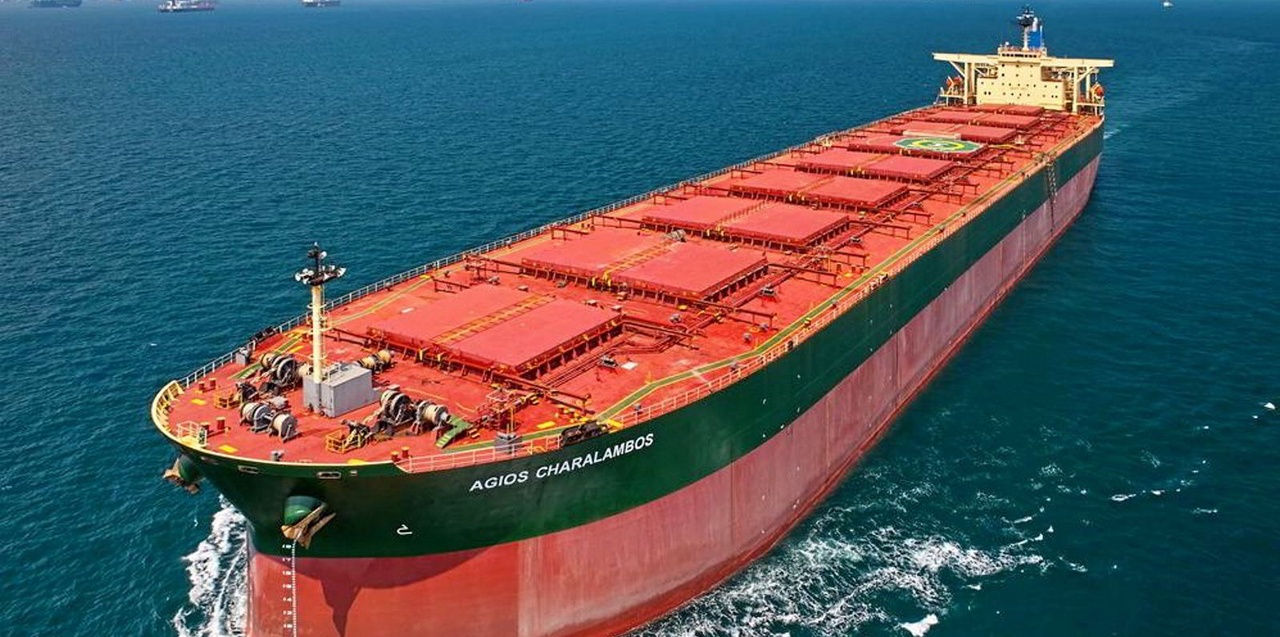
184,872-dwt Capesize bulker Agios Charalambos (2003 built) - For illustrative purposes
⏳ Panamax Market: Atlantic Dominance
Earnings Boom
Panamax vessels, versatile carriers of grain and minerals, excel in the Atlantic. North Coast South America-to-China fixtures hit $20,000 daily for 82,000-dwt vessels, while transatlantic grain routes reach $14,000-$15,000. Indonesia-to-China period charters secure $15,500 for 5-8 months on an 82,000-dwt ship. Pacific rates hold steady at $12,000 for North Pacific grain, bolstered by East Australian minerals. The Baltic Panamax Index reflects consistent gains, with Atlantic demand outshining Asia—Panamax capitalizes on regional strength.
Regional Dynamics
Atlantic vessel availability tightens off the Continent, balancing steady grain shipments from East Coast South America, though an early June slowdown looms. Pacific markets firm as Indonesian tonnage absorbs Chinese coal demand, but high Chinese inventories cap upside. North rallying Atlantic transatlantic runs benefit from U.S. Gulf activity, and South America’s fronthaul surge drives fixtures. Limited period charters and rising forward freight agreement (FFA) values signal optimism, but Asian grain cargoes from the North Pacific remain quiet—Atlantic momentum shapes Panamax’s trajectory.
External Pressures
U.S. port fee exemptions for sub-80,000 dwt bulkers shield Panamax, with only 9% of 2024 U.S. port calls affected. U.S. tariffs on Canadian and Mexican steel (25%) risk depressing global scrap prices, impacting recycling markets. Trade war risks could dent industrial activity, though rerouting (e.g., U.S. coal to Asia) may boost tonne-miles. China’s steel production cuts and India’s 5% annual steel growth absorb iron ore, but potential stimulus could lift Q3 demand—Panamax sails with Atlantic-driven confidence, monitoring global shifts.
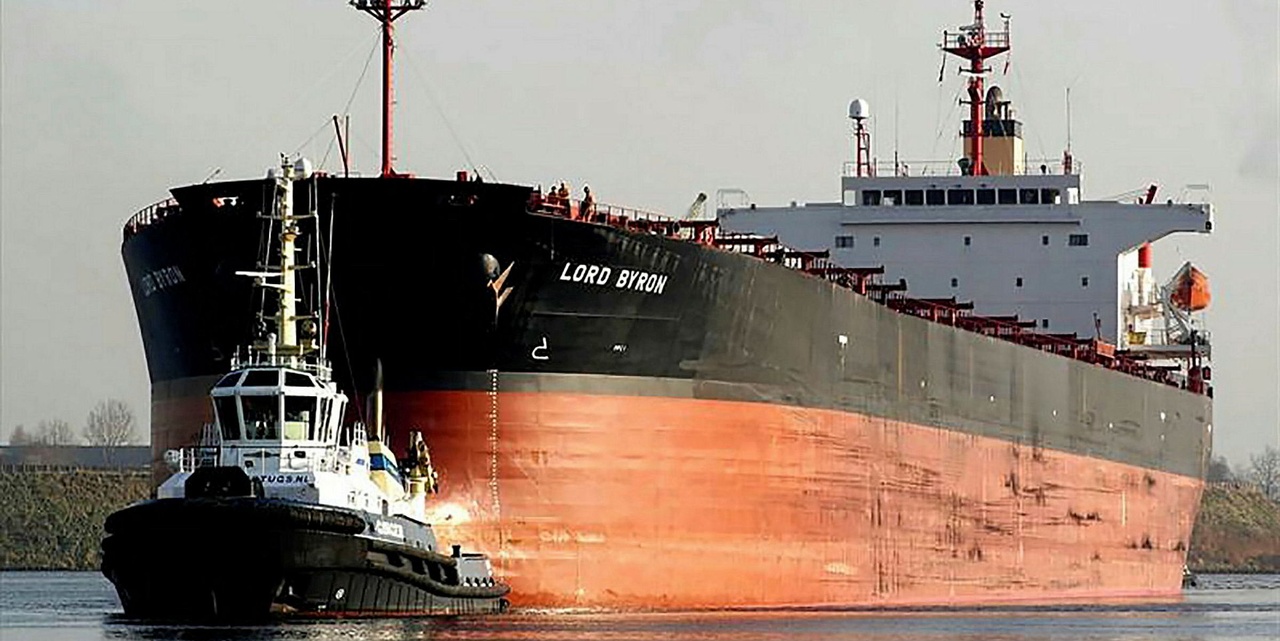
76,800-dwt Panamax bulker Lord Byron ( 2005 built) - For illustrative purposes
⏱️ Supramax/Ultramax Market: Regional Divide
Rate Contrasts
Supramax and Ultramax markets split sharply by geography. In Asia, rates rise with a 63,000-dwt vessel fixing South Africa-to-China at $17,000 plus a $170,000 ballast bonus, and a 54,000-dwt ship securing Bontang-to-China at $16,000. South China-to-West India runs hit $17,000 for 63,000-dwt vessels. The Atlantic lags, with a U.S. Gulf Ultramax fixing transatlantic at mid-$14,000s and Continent-Mediterranean rates softening. Baltic Supramax indices show Asian routes up 5%, while Atlantic trades stagnate—regional divergence defines this market’s rhythm.
Tonnage Trends
Asian demand from Indonesia and South Africa tightens tonnage, with fresh enquiries sustaining rates. Atlantic markets weaken as Continent-Mediterranean and U.S. Gulf see limited activity and growing tonnage lists. Late-week South Atlantic gains offer some relief, but oversupply persists. India’s iron ore export slump (47% of Supramax cargoes) hits Paradip and Dharma ports (83-87% iron ore), pressuring rates. Period charters remain slow, with a 58,000-dwt ship fixing at mid-$11,000s for 4-6 months—Asia’s buoyancy contrasts with Atlantic inertia.
Broader Forces
U.S. port fees spare sub-80,000 dwt vessels, easing Supramax/Ultramax concerns. China’s steel output cuts and India’s domestic ore demand (300 million tonnes by 2030) curb exports, challenging Supramax rates. U.S. tariffs on steel exporters (Canada, Mexico) risk flooding global markets, depressing scrap prices and impacting recycling. Rerouting to Asia and potential Chinese stimulus provide upside, but Atlantic oversupply limits gains—Supramax/Ultramax navigates a split market with guarded optimism.
⏸️ Handysize Market: Wrestling Oversupply
Rate Challenges
Handysize vessels, the smallest bulk carriers, face persistent headwinds. Mediterranean rates slip, with a 33,000-dwt ship fixing Damietta-to-South America at $7,000. South Atlantic holds firm at $13,500 for Brazil-to-Continent, and U.S. Gulf reaches $14,250 for SW Pass-to-Central America. Pacific rates stagnate at $9,750 for Hakata-to-SE Asia runs. Q1 time-charter equivalent (TCE) earnings average $10,252 per day (down from $12,150 in Q4 2024), outperforming benchmarks by 21%. The Baltic Handysize Index drops 23.21% year-on-year—oversupply dims this market’s spark.
Market Sentiment
Both basins see subdued activity, with Continent-Mediterranean weakening and U.S. Gulf tonnage lists lengthening. South Atlantic benefits from steady demand, but Pacific markets falter despite fresh enquiries. India’s iron ore export decline (25% of Handysize cargoes) weighs on rates as domestic steel demand grows. Recycling markets see Handysize sales (e.g., 23,600-dwt vessel at $448 per ldt, 37,000-dwt at $450 per ldt), driven by tariff fears. Fleet coverage at $13,117 per day for 43% of 2025 days offers stability—Handysize perseveres, seeking new trade lanes.
Influencing Factors
U.S. port fee exemptions for sub-80,000 dwt vessels protect Handysize, with minimal impact on 2024 U.S. port calls. U.S. steel tariffs risk oversupplying global markets, depressing scrap prices and hurting recycling. China’s steel cuts and India’s infrastructure push (25 million housing units by 2030) curb ore exports, but potential steel imports via Handysize offer hope. Rising scrapping (e.g., 28,200-dwt vessel at $465 per ldt) could tighten supply if rates weaken—Handysize endures oversupply, banking on rerouting and stimulus.
Ship-breaking outside Chittagong - For illustrative purposes
🌐 What’s Moving It: Commodities and Global Trade
Commodity Dynamics
Seasonal weather improvements lift iron ore volumes, with Australia’s exports (down 3.1% year-to-date) and Brazil’s growth (up 3.6%) driving Capesize and Panamax. Guinea’s bauxite exports (45% above 2024) bolster Atlantic routes. China’s steel production cuts (75 million tonnes) and India’s domestic demand (300 million tonnes by 2030) reduce iron ore exports, impacting Supramax and Handysize. Coal demand hits four-year lows, but Pacific coal cargoes rise. Syria’s wheat imports (6,600 dwt) signal new Handysize opportunities—commodity shifts shape this market’s course.
Trade and Policy Shifts
U.S.-China tariff talks (50-65% vs. 145%) and softened port fees (affecting 9% of 2024 U.S. port calls) boost sentiment. U.S. steel tariffs on Canada and Mexico (25%) risk flooding global markets, depressing scrap prices. China’s 5% GDP target depends on stimulus, potentially sparking Q3 commodity demand. Rerouting (e.g., U.S. coal to Asia) and low orderbooks (4.4% geared fleet growth in 2025) support tonne-miles. Trade war uncertainties and stimulus prospects define the horizon—global dynamics steer the dry bulk path.
🌐 Market and Stocks: Rallying Through Volatility
Stock Momentum
Dry bulk stocks spearhead a 1.8% surge in the Dow Jones US Marine Transportation Index, with the SonicShares Global Shipping ETF $BOAT up 2.5%. Himalaya Shipping $HSHP (-3,84%) leaps 7.7% to $4.90, Golden Ocean $GOGL climbs 7.5% to $7.57, and Seanergy Maritime $SHIP (-2,12%) gains 4%. Q1 bulker sales plummet 58% (77 transactions vs. 182 in 2024), with 15-year-old 80,000-dwt Panamax values down 22% to $14.4 million, reflecting tariff concerns. Golden Ocean’s merger with CMB.Tech (0.95 share exchange) divides investors, valuing shares at $14.49—stocks rally but face uncertainty.
Investor Perspectives
Capesize rates are poised to rise into mid-May, with FFA May contracts at $18,446 per day, driven by seasonal iron ore flows. Trade war risks could dampen demand, but rerouting may boost tonne-miles. A 25-year low Capesize orderbook signals supply squeezes, with no newbuilding slots before 2028. BlackRock trims its Genco $GNK (+0,18%) stake to 8.1% (from 10.1%), while Berge Bulk acquires 7.3%. The CMB.Tech merger removes noise, focusing on fleet growth—investors weigh tariff volatility against supply-driven upside.
Sector Outlook
Softened port fees and tariff relief ease pressures, but Chinese steel cuts and global scrap price risks loom. Low orderbooks (4.4% growth) and rising scrapping (e.g., 43,900-dwt vessel at $485 per ldt) point to 2026 tightness. Stocks trade below net asset value (e.g., Golden Ocean at $14.49 vs. CMB.Tech’s $15.23), offering value if stimulus revives demand. Capesize and Panamax lead, while Supramax/Ultramax and Handysize trail—investors balance short-term risks with long-term potential.
Golden Ocean logo - For illuistrative purposes
🌐 Outlook: Charting Future Currents
Market Projections
Capesize ranges $15,000-$18,000 daily—iron ore and bauxite flows drive gains—bullish. Panamax at $12,000-$20,000—Atlantic strength persists—robust. Supramax/Ultramax at $11,000-$17,000—Asia outperforms Atlantic—mixed. Handysize at $7,000-$14,000—oversupply limits upside—steady. Rerouting to Asia and tight supply signal volatility—2026 emerges as a peak if stimulus materializes.
Strategic Horizons
Capesize could lead if Chinese stimulus revives steel demand, but Handysize risks stagnation without new trades. Panamax’s Atlantic edge ensures stability, while Supramax/Ultramax’s Asian strength highlights adaptability. Tariff-driven steel oversupply and recycling pressures ($448-$485 per ldt sales) challenge margins, but low orderbooks and scrapping offer long-term upside. Investors must navigate trade war uncertainties while betting on supply constraints—strategic moves will define dry bulk’s future.
Your Call
Will Capesize dominate, or Panamax’s Atlantic hull Atlantic surge take the lead? Share your take—let’s master the markets! 🚢
1 Year T/C Dry Bulk - April 23th
+ 1
Mid-April 2025 finds the dry bulk market caught in a stormy swirl of trade wars, weather woes, and shifting cargo flows. Capesize rates falter under tariff pressures, panamax struggles with muted demand, yet supramax and handysize find flickers of resilience. Sanctions, port fees, and production cuts reshape routes, while AI whispers promise for efficiency. This is a sector battling headwinds with grit—let’s chart its course.
⏬ Capesize Market: Weathering the Squall
Earnings Snapshot
Capesize bulkers, the iron ore titans, sail through choppy waters as rates skid to a six-week low. The Baltic Exchange’s index averages $15,148 per day, a 9% drop week-on-week, with a mid-week dip to $14,367 before a slight rebound. March highs of $24,000 per day feel distant, with West Australia-to-Qingdao (C5) rates plunging to $7.79 per tonne (down 25% weekly, though up 35% in a day) and Brazil-to-China (C3) at $18.74 per tonne after an 18% tumble. Weak Chinese iron ore imports (down 6% year-on-year in March) and tariff shocks drag sentiment, yet fundamentals hint at stabilization.
Demand and Supply Pressures
Extreme weather batters key exporters. Rio Tinto’s Pilbara shipments fall 9% to 70.7 million tonnes in Q1, hit by four cyclones costing 13 million tonnes—2025 guidance leans toward the low end of 323-338 million tonnes. Vale’s Brazilian output slips 4% to 67.7 million tonnes, though sales rise 4% to 66.1 million tonnes. China’s Q1 iron ore arrivals drop 9%, with port stocks down 6 million tonnes to 150 million. Yet, Fearnley Securities eyes April import normalization, and Brazil’s March exports climb 8%. Tariff fears curb Pacific activity—Rio Tinto fixes Dampier-to-Qingdao at $7.70 per tonne—while Atlantic routes like Tubarao-to-West Africa hit $18.15 per tonne.
Global Headwinds
U.S.-China tariffs (145% vs. 125%) and EU countermeasures jolt the market, with Braemar noting a “freefall” tied to Trump’s trade moves. A three-month tariff pause lifts forward freight agreements (FFAs) to $16,000 per day for April and $18,000 for Q2, signaling cautious optimism. However, Vale’s vague 325-335 million tonne guidance and Colombia’s coal cuts (Cerrejon down to 11-16 million tonnes) dim cargo hopes—capesize battles to hold its course.
Iron ore is loaded at the Ponta da Madeira terminal in Brazil - For illustrative purposes
⏳ Panamax Market: Adrift in Uncertainty
Rate Struggles
Panamax bulkers, versatile grain and coal carriers, drift in a softer market. Baltic Panamax Index rates hover around $11,500 per day, down 7% week-on-week, reflecting tariff-driven gloom and weaker coal flows. Secondhand prices for five-year-old vessels fall 12% from Q3 2024 peaks, per Veson Nautical, as global uncertainty stifles demand. Activity remains subdued, with limited fixtures reported—owners eye stabilization as bunker price swings complicate voyage trades.
Regional Dynamics
Colombia’s coal output cuts weigh heavily—Cerrejon’s reduction to 11-16 million tonnes (from 19 million in 2024) slashes capesize and panamax cargoes. Exports to Asia-Pacific (South Korea: 10 million tonnes, China: 6.65 million tonnes) rise, but long voyages (55-67 days) and high freight costs deter buyers. China’s coal imports from Colombia drop to 2 million tonnes in Q1 (from 3.9 million), favoring Australian coal’s $14 per tonne CFR price edge. Panamax shipments fall 24.6% to 11 million tonnes as capesize takes share—owners face a thinning cargo pool.
Trade Shifts
U.S. port fee fears for Chinese-built ships (70% of panamax orderbooks) push buyers toward Japanese tonnage, per Pacific Basin’s Martin Fruergaard. Scaled-back fees ($18 per net tonne, rising to $33 by 2028) ease concerns, but contractual haggling looms. Glencore’s Colombian cuts and EU decarbonization shift coal to Asia, stretching tonne-miles yet exposing fragility—panamax treads water, seeking firmer ground.
Coal being loaded onto a ship in the port of Jiujiang - For illustratives purposes
⏱️ Supramax Market: Flickers of Fortitude
Earnings Resilience
Supramax bulkers, nimble mid-sizers, show grit amid market malaise. Pacific Basin’s supramax fleet earns $12,210 per day, 55% above the Baltic Supramax Index, with Q1 operating margins up 61% to $820 daily. Secondhand prices dip 9% from Q3 2024, but fleet renewal (e.g., purchasing a 2018-built 38,000-dwt handysize) bolsters efficiency. FFAs for Q3-Q4 signal $9,000-plus daily—owners hold steady, banking on cargo coverage.
Activity and Coverage
Pacific Basin covers 95% of Q2 supramax days at $12,400, with 37% of H2 at $12,090—strong bookings shield against softening. China’s equipment exports (up 10.8%) and ASEAN trade (up 7.1% to CNY1.71 trillion) lift minor bulk demand. However, iron ore weakness and Colombia’s coal volatility (February exports down 21.1% year-on-year) cap gains. Supramax thrives on flexibility—steel trades optimize port times, dodging 2024’s congestion woes.
External Forces
U.S. sanctions on Iranian oil and Chinese refiners ripple indirectly, tightening tanker markets and nudging bunker costs. Tufton Assets sees bulkers benefiting from trade rerouting—tariffs spur new routes, favoring supramax’s versatility. AI adoption, led by South Korea, streamlines claims and fixtures—supramax sails with cautious optimism, leaning on operational savvy.
⏸️ Handysize Market: Steady Under Strain
Rate Rundown
Handysize bulkers, the fleet’s smallest stalwarts, navigate with poise. Pacific Basin’s handysize earnings hit $10,940 per day, 37% above the Baltic Handysize Index, with Q2 77% covered at $11,390 and H2 25% at $10,150. Secondhand prices fall 9% from Q3 2024, yet fleet upgrades (e.g., buying a 2020-built 40,000-dwt vessel, selling 21-year-old units) keep margins firm. Operating days rise to 6,950, up 300 year-on-year—efficiency drives returns.
Market Moods
China’s Q1 export growth (6.9% to CNY6.13 trillion) and ASEAN trade surge bolster cement and grain flows, but U.S. port fee threats (exempting vessels under 55,000 dwt) shift focus to Japanese-built ships (70% of Pacific Basin’s fleet). Colombia’s coal export swings (4.2 million tonnes in February, up 54.7% month-on-month) disrupt planning—handysize leans on diversified cargoes to weather volatility.
Influencing Factors
Tufton’s Q1 earnings dip to $8 million (from $11.76 million), with a -10.4% NAV return, reflecting rate softness. Yet, the fund eyes tariff-driven rerouting as a boon—handysize’s agility suits reconfigured trades. Rio Tinto’s bauxite boom (15 million tonnes, up 12%) lifts capesize and handysize tonne-miles—handysize holds firm, banking on niche strength.
🌐 What’s Moving It: Trade and Turmoil
Cargo and Supply
Iron ore falters—Rio Tinto’s $RIO (+1%)
$RIO (-0,31%)
$RIO (-0,31%) 9% shipment drop and Vale’s $VALE (+2,19%)
$VALE3 (+1,69%) 4% output decline shrink capesize cargoes, with China’s Q1 arrivals down 9%. Colombia’s coal cuts (10 million tonnes lost) hit capesize and panamax, though Brazil’s 8% March export rise and China’s equipment trade (up 10.8%) offer lift. Weather (Australian cyclones, Brazilian rains) and blockades (Colombia) disrupt flows—cargo volatility shapes the market’s pulse.
Global Forces
U.S.-China tariffs and U.S. port fees ($18-$33 per net tonne by 2028) spark uncertainty, though exemptions (small vessels, ballast arrivals) soften the blow. U.S. sanctions on Iranian oil and Chinese refiners tighten bunker markets, while Houthi strikes in Yemen add geopolitical heat. Bulkers benefit from rerouting—Tufton sees them outpacing containers—yet trade war fears cloud the horizon.
🌐 Market and Stocks: Value Amid Volatility
Stock Swings
Dry bulk stocks reel under tariff pressures. Tufton’s $SHIP Q1 profit falls to $8 million from $11.76 million, with a -10.4% NAV return as asset values slide. Pacific Basin’s $2343 (+2,05%) shares trade at a “big discount” to NAV, prompting a $40 million buyback. Secondhand prices drop—capesize down 11%, panamax 12%, supramax and handysize 9% from Q3 2024—yet Q1 rates defy the gloom, hinting at undervaluation.
Investor Perspectives
Analysts view the sell-off as overdone. Firms with lean balance sheets (25% debt-to-asset ratios) trade at trough levels despite firm rates and high newbuild costs. Pacific Basin’s fleet renewal and margin gains (up 61%) position it for resilience, while Tufton bets on rerouting to lift yields. Veson’s Park predicts a 2026 price rebound if trade stabilizes—investors weigh near-term pain against long-term promise.
Sector Outlook
U.S. tariff pauses and scaled-back port fees lift sentiment, but Chinese tariffs threaten consumer costs. Aging fleets (15% over 20 years) and low orderbooks (down 26% in Q1) signal future tightness—2026 looms as a turning point. Stocks lag fundamentals, ripe for a rebound if tariffs ease—bulkers stand poised, undervalued in the storm.
🌐 Outlook: Choppy Yet Hopeful
Fluid Futures
Capesize lingers at $15,000-$18,000 daily—tariffs bite, fundamentals nudge recovery. Panamax at $11,000-$12,000—coal cuts sting, stabilization looms. Supramax holds $12,000-$13,000—coverage shields—resilient. Handysize at $10,000-$11,000—agility endures—steady. AI and rerouting offer upside—2026 glimmers if trade steadies.
Your Call
Will capesize rebound or handysize hold the edge? Drop your take—let’s navigate the seas! 🚢


The dry bulk market in mid-April 2025 is wrestling with softening rates and a whirlwind of global trade tensions. Capesize battles a tonnage glut, with rates dipping despite late-week flickers of recovery, while Panamax sees soybean support erode under oversupply and macro uncertainty. Supramax and Ultramax limp along with cautious owners, and Handysize remains stagnant as tonnage builds. U.S.-China tariff wars—escalating to 145% vs. 125%—and EU countermeasures jolt sentiment, while Black Sea grain woes and Chinese-built ship fees add pressure. Companies tweak strategies, but the market’s grit is tested as of April 11, 2025.
This update dives into Capesize, Panamax, Supramax/Ultramax, and Handysize, highlighting the forces at play. From trade wars to tonnage shifts, here’s a clear, engaging rundown !
⏬ Capesize Market: Tonnage Drags, Rates Rebound
Market Trends and Rates
Capesize bulkers, the titans of dry cargo, hit choppy waters this week—average time-charter rates slid from $16,728 to $14,952 by week’s end, reflecting midweek slumps. In the Pacific, Western Australia-to-China rates dropped from $7.95 to $7.20 per tonne, clawing back to $7.70 as miners stayed active. Atlantic Brazil-to-China rates fell from $20.67 to $18.71 midweek, recovering to $19.185 with late bids, while North Atlantic fixtures softened. Spot rates settled at $14,768/day—a 6% weekly dip—though a late $401 uptick suggests a tentative floor.
Demand and Tonnage Dynamics
West Australia sees steady enquiries for late April and May, with solid Pacific cargo volumes, but spot tonnage remains heavy, and May ballasting is thick. South Brazil and West Africa keep cargo flowing in the Atlantic, yet surplus ships mute gains. One operator unwound freight hedges from $31,300/day to $23,700/day for May-June, pocketing a $900,000 gain as spot rates lagged—Newcastlemax premiums hold, but the market’s soft, leaning on late-week lifts for hope.
Tariff and Trade Impacts
U.S.-China tariffs—now 145% vs. 125%—and EU countermeasures at 25% on U.S. goods from April 15 stoke trade war fears. Analysts flag bulkers’ exposure to a potential recession and U.S. grain/coal export tariffs, though a 90-day U.S. tariff pause (excluding China) boosts stocks like some major players by over 11%. Black Sea grain forecasts disappoint—Russian wheat exports for 2025 are pegged at 41M tonnes, down from 52.4M—curtailing Capesize demand further.
⏳ Panamax Market: Oversupply Prevails, Grains Weaken
Market Performance
Panamax bulkers, the mid-size workhorses, face mounting pressure—Atlantic rates plunged as oversupply and tepid demand handed charterers the reins. Pacific rates sagged too, with scant enquiries from northern regions and Indonesia, plus a growing tonnage list widening bid-offer gaps. South America’s soybean surge—fueled by pricing—lost steam, with late April fixtures hovering at $15,250 plus a $525,000 bonus, down from prior levels. Macro clouds keep sentiment dour, despite midweek Australia-to-China rates at $11,500 for larger vessels.
Regional Dynamics
Trans-Atlantic routes bore the brunt—low demand and softer oil prices dragged rates below benchmarks. North Coast South America grains offered a lifeline, but gains faded as the week closed, with Asia’s northern basin stalling—midweek Australian demand provided a brief uptick. Black Sea grain exports—projected at 94.4M tonnes for 2025, a 16% drop—hit Panamax hard, especially with Russian volumes down sharply. Period deals stayed scarce—future uncertainty stifles action.
Tariff and Strategic Shifts
The U.S.’s 145% tariffs on China, met with China’s 125% retaliation, cast a shadow—EU’s 25% on U.S. soybeans from April 15 could redirect flows. One Greek firm shifted years ago from Capesize to smaller ships, eyeing regional trades to dodge trade war fallout—others brace for impact as U.S. grain exports face risks. Panamax clings to soybean support, but oversupply and tariffs threaten the balance.
⏱️ Supramax/Ultramax Market: Quiet Persists, Caution Reigns
Regional Activity
Supramax and Ultramax, the versatile mid-tier haulers, stayed subdued—Atlantic rates sagged under tonnage oversupply and weak backhaul demand, with U.S. Gulf fronthaul rumored in the $13,000s. South Atlantic held steady—a 63,000-dwt fixed at $19,000 to Denmark—while West Africa saw a scrubber-fitted vessel at mid-$13,000s to China. Pacific demand split—Indonesia showed life with a 64,000-dwt at $16,000 to East India, but northern routes lagged, fixing at $12,000 for a Japan round. The 11TC average slipped from $12,429 to $12,058 by week’s end—sentiment’s soft.
Market Sentiment
Owners resist rate cuts in the Mediterranean and Indian Ocean, but caution rules—period activity’s nearly stalled amid tariff war jitters. South Atlantic balances out, yet Atlantic and Pacific weakness dominates, with oversupply in Asia dragging the mood. Analysts note steel and cement—key cargoes—face tariff hits, though rerouting could offset some losses. The sector’s quiet—small positives flicker—but confidence remains elusive.
Trade and Tariff Pressures
U.S. tariffs at 145% on China, countered by 125%, and EU’s 25% on U.S. goods from April 15, per global reports, threaten Supramax/Ultramax volumes—Black Sea’s 49.5% Q1 export drop (notably ultramax at zero) adds strain. Proposed U.S. fees on Chinese-built ships widen valuation gaps—owners like one Norwegian hybrid carrier limit U.S. calls as a precaution. The market treads water—trade shifts loom—but near-term softness persists.
⏸️ Handysize Market: Stagnation Holds, Tonnage Builds
Market Conditions
Handysize bulkers, the smallest dry cargo movers, saw another tough week—Continent and Mediterranean stayed quiet, rates dipping slightly with little action. South Atlantic and U.S. Gulf weakened too—a 36,000-dwt fixed at $16,000 to West Africa, and a 39,000-dwt at $12,500 to West Med—as tonnage counts rose. Asia’s list grew all week, pushing rates down—a 38,000-dwt hit $11,500 with steel to Indonesia. Sentiment’s flat—pressure mounts, no relief in sight.
Activity and Dynamics
Activity’s minimal across basins—steady but uninspired, with owners holding rates where they can. Black Sea’s grain slump—Q1 at 9.4M tonnes, down 49.5%—clips Handysize wings, with Russian and Ukrainian drops steep. One hybrid carrier fleet reported $22,400/day Q1 earnings, down from $28,527, hit by dry bulk softness and less optimal trading—others feel the same pinch.
Tariff Considerations
U.S.-China tariff escalation and EU’s 25% on U.S. goods from April 15 could ripple to Handysize—regional pivots by firms like one Greek player aim to sidestep fallout. U.S. port fees on Chinese-built ships loom—11 of 16 vessels in one fleet are China-made, prompting U.S. pullbacks. The sector’s stuck—stable but lackluster—awaiting trade clarity.
🌐 What’s Driving It: Tariffs, Trade, and Tonnage
Global Trade Tensions
U.S. tariffs hit 145% on China, met by 125% retaliation—EU counters with 25% on U.S. goods from April 15—sparking fears of recession and trade freezes. A 90-day U.S. tariff pause (ex-China) lifts shipping stocks, but Black Sea grain deals falter—exports down 49.5% Q1—curbing bulker demand. Analysts see short-term pain, long-term tonne-mile gains as flows reroute—DNB flags dry bulk’s tariff exposure.
Market and Strategic Moves
Tonnage oversupply dogs all tiers—Pacific Capesize and Atlantic Panamax hit hardest—while Q1 newbuild orders tanked to 39 globally, with China at a 32-year low (13). Deliveries rose to 152 units, skewing small, as firms like one Norwegian hedge fund and a Greek operator shift strategies—some exit Capesize, others dodge U.S. ports over Chinese ship fees. IMO’s carbon deal falls short—30% by 2030, not enough—adding decarbonization pressure.
🌐 Outlook: Uncertain Tides
Capesize at $14,000-$15,000/day—tonnage drags, late lifts tease—trade wars key. Panamax near $11,000-$15,000/day—soybeans wane, oversupply bites—uncertainty grows. Supramax/Ultramax around $12,000/day—muted, positional—tariffs loom. Handysize steady—rates slip, no spark—flatline persists.
1 Year T/C Dry Bulk - April 9th
💬 Your View?
Capesize poised to rebound, or Panamax set to sink? Share your take—let’s dig in! 🚢

+ 2
The dry bulk market in early April 2025 is a tale of cautious stability and looming disruption, shaped by seasonal swings and global policy shifts. Capesize sees a Pacific rebound fade as Atlantic demand wanes, while Panamax rides a soybean wave but faces tariff uncertainty. Supramax and Ultramax stay subdued amid slow activity, and Handysize remains flat with little spark. Trump’s new U.S. tariffs—34% on Chinese imports—and sanctions on Russian grain movers are rattling trade flows, while fees on Chinese-built ships loom large. Coal cuts in Colombia and holiday lulls in Asia add to the mix. It’s a market balancing resilience with risk, with headlines driving the narrative as of April 4, 2025.
This update digs into Capesize, Panamax, Supramax/Ultramax, and Handysize, spotlighting the events shaping them. From trade wars to tonnage trends, here’s a clear, engaging breakdown—easy to read, packed with insight.
⏬ Capesize Market: Pacific Flicker, Atlantic Fade
Market Activity and Rates
Capesize bulkers, the giants of dry cargo, kicked off the week slowly with holidays in Singapore (Hari Raya Puasa), but the Pacific saw a midweek lift—Western Australia-to-China (C5) rates climbed from mid-$8 per tonne to $9.235, with miners fixing in the low $9s. By April 4, though, momentum fizzled—holidays in Hong Kong and China softened activity, pulling C5 back to $8.78. In the Atlantic, Brazil-to-China (C3) held at $21.815 by week’s end, down from $22.45 midweek, while West Africa-to-China edged lower despite steady tonnage. Baltic Exchange spot rates dropped 6% to $20,198/day, with the BCI 5TC at $18,404, signaling a bearish turn.
Demand and Tonnage Trends
West Australia enquiries for mid-April and May dates are healthy, per April 2 reports, with East Australia coal cargoes—like KLC’s $22,750 time-charter—adding support. Pacific spot tonnage tightened midweek as prompt ships cleared out, though ballasting west grew for May. The Atlantic’s North saw transatlantic cargoes fail to soak up ships, tanking the C8 index, while South Brazil and West Africa held steady early on. Allied Shipbroking notes owners banking on fresh May cargoes to revive the market after a sluggish stretch.
Tariffs and Trade Impacts
Trump’s April 2 “Liberation Day” tariffs—34% on Chinese imports—could hit steel and cement, though Greek owner Stamatis Tsantanis sees core Capesize cargoes (iron ore, coal) as less exposed. Glencore’s 5-10M tonne coal cut at Colombia’s Cerrejon mine, slashing 2025 output to 11-16M tonnes, may trim longer-haul trades to Europe and Asia, per MB Shipbrokers. Replacement volumes from Australia or Indonesia—shorter runs—could dent tonne-miles, with Colombian freight to China ($34-$35/tonne) outpacing Newcastle ($13.50/tonne).
⏳ Panamax Market: Soybean Support, Tariff Shadows
Market Performance
Panamax bulkers, the mid-tier haulers, are at a turning point—Baltic spot rates hit $13,489/day by April 1, a 5% weekly rise and 43% monthly jump, surpassing six-month highs. The Atlantic shows a split—North softens with weak mineral demand and rising tonnage, while South America’s soybean exports prop up rates, per April 2 updates. Asia’s Pacific basin faltered—holiday slowdowns and fading NoPac/Australia cargoes met owner resistance, though coal from Indonesia and South American grains lent some lift. By April 4, momentum stalled as U.S. tariff uncertainty widened bid/offer gaps.
Fixtures and Sentiment
Clarksons notes strong Atlantic fronthaul demand—e.g., an 82,000-dwt fixed at $18,750 from North Spain to Singapore-Japan, now closer to $17,000s. In Asia, an 82,000-dwt scored $15,500 for a year-long charter from China. The Baltic reports fixtures like the 87,285-dwt Climate Justice at $18,250 via East Australia to Singapore-Japan, though activity muted post-holidays. Fundamentals seem balanced, but low coal shipments and U.S. grain declines temper optimism beyond the seasonal peak, per April 2 analyses.
Tariff and Macro Pressures
Trump’s 34% tariff on Chinese imports, announced April 2, seeps into sentiment—Braemar Research warns of trade war risks, though Greek owner John Coustas sees long-term shipping gains from rerouted flows. Low coal prices and Glencore’s Colombian cuts could soften demand, while USTR’s $1M-$1.5M fees on Chinese-built ships worry charterers, per April 1 reports. The market holds firm for now—soybeans buoy it—but macro headwinds loom large.
Bulker delivers coal to a terminal in Jiujiang, in China’s Jiangxi province
⏱️ Supramax/Ultramax Market: Quiet Waters, Mixed Signals
Regional Activity
Supramax and Ultramax, the versatile smaller bulkers, stayed subdued—U.S. Gulf wavered with a 61,000-dwt fixed at $16,000 to Japan, while South Atlantic gained traction, like a 64,000-dwt at $14,500 plus $450,000 bonus to SE Asia, per April 4. The Continent-Mediterranean saw slow fixing—e.g., a 58,000-dwt at $14,000 to East Med—while Asia weakened with tonnage oversupply and holiday lulls. Indian Ocean runs, like a 63,000-dwt at $12,000 to Bangladesh, stayed lackluster, though a 61,000-dwt to WC India hit $16,000, per April 2 reports.
Market Sentiment
Global holidays muted activity—sentiment’s mixed, with U.S. Gulf fragile and Asia’s NoPac/backhaul demand poor, per April 2 updates. Slight rate upticks in South Atlantic and Continent-Med offer glimmers, but oversupply in Asia drags overall mood. Trump’s tariffs on steel and cement—key Supramax/Ultramax cargoes—could hit U.S. imports (60M tonnes annually), per AXS data, though trade shifts might offset losses, per Braemar.
Trade and Tariff Impacts
Steel imports, down from 35M tonnes (2017) to 20M (2020) in past trade wars, face new 34% tariffs—cement from Vietnam (3.8M tonnes, 46% tariff) may pivot to Turkey (6.8M tonnes, 10% tariff), per April 3 analyses. USTR’s Chinese ship fees add pressure—Clarksons sees valuation gaps widening, impacting these mid-sized fleets. The sector’s quiet—some positives flicker—but tariffs cloud the horizon.
Self-unloading cement carrier
⏸️ Handysize Market: Flatline Across Basins
Market Stagnation
Handysize bulkers, the smallest dry cargo movers, saw minimal action—Continent-Med stayed flat, with a 35,000-dwt fixed at $7,250 to NC South America, per April 4. South Atlantic and U.S. Gulf held steady—e.g., a 38,000-dwt at $15,250 to Algeria—while Asia’s gradual tonnage rise met modest demand, like a 40,000-dwt at $16,000 to China. Sentiment’s unchanged—long tonnage lists pressure rates across basins, per April 2 reports.
Sanctions and Activity
The U.S. Treasury’s April 2 sanctions hit the Russia-flagged 37,200-dwt Zafar for moving Ukrainian grain to Yemen’s Houthis—linked to Russia’s Salmi Shipmanagement, it’s a rare dry bulk blacklist. Activity stayed low—holidays and weak cargo volumes kept rates stable but uninspired. The market’s in a holding pattern—no big shifts, just quiet consistency.
Tariff Considerations
Trump’s tariffs could ripple to Handysize—steel and cement flows may reroute, though core demand holds, per Greek owner insights. USTR’s Chinese ship fees loom, but impact’s unclear on this smaller tier. For now, it’s steady but subdued—no fireworks here.
" Zafar " (picture above) carried grain from the Crimea to Houthi-controlled Saleef port on at least two occasions last year
🌐 What’s Driving It: Tariffs, Sanctions, and Supply
U.S. Policy Shifts
Trump’s 34% tariffs on Chinese imports (April 2) and sanctions on Russia’s Zafar for Ukrainian grain (April 2) disrupt steel, cement, and coal trades—Braemar sees short-term pain, long-term gains. USTR’s $1M-$1.5M fees on Chinese-built ships widen valuation gaps—Clarksons predicts 7-10% discounts, per April 2. Greek owners like Harry Vafias eye tonne-mile boosts from trade rerouting, per April 3.
Commodity and Tonnage Dynamics
Glencore’s 5-10M tonne coal cut in Colombia shrinks long-haul demand—MB Shipbrokers note shorter Australia/Indonesia runs may follow, per April 1. Holiday lulls and tonnage oversupply in Asia/Pacific weigh on rates, though Pacific Capesize and Atlantic Panamax resist softening, per April 4. Low coal prices and cautious S&P activity—Allied counts 168 dry bulk sales in Q1, down from 237—signal restraint, per April 2.
🌐 Outlook: Cautious Currents
Capesize at $18,000-$20,000/day—Pacific dips, Atlantic weakens—May cargoes key. Panamax near $13,500/day—soybeans prop, tariffs loom—stability tested. Supramax/Ultramax steady—South Atlantic lifts, Asia drags—trade shifts ahead. Handysize flat—rates hold, no spark—quiet persists.
1 Year T/C Dry Bulk - April 2nd
💬 Your Take?
Panamax riding high, or Capesize set to bounce? Drop your thoughts—let’s unpack it! 🚢


+ 2
The dry bulk shipping market in late March 2025 shows a split picture. Capesize rates softened from recent highs as Pacific activity slowed, while Panamax keeps climbing, buoyed by grain and coal demand in both basins. Supramax and Handysize hold steady but lack fireworks—Asia’s quiet, and the Atlantic’s mixed. U.S. port fee threats on Chinese-built ships stir unease, a Russia-Ukraine ceasefire cuts insurance costs, and China’s soy shift could jolt routes. It’s a market with some muscle, some stumbles, and big changes brewing.
This update tracks Capesize, Panamax, Supramax, and Handysize moves, plus what’s driving them. From rate swings to global twists, here’s the latest—clear and unpacked.
⏬ Capesize Market: Easing Off the Gas
Capesize, the bulk giants, started strong but faded—BCI 5TC dropped from $22,311 to $20,503, a 2% overnight slip to $21,810/day by week’s end.
West Australia to China (C5) fell from $9.30 to $8.65/tonne—Rio Tinto fixed $9.30 for early April—hit by muted miner activity and heavy tonnage lists.
Brazil to China (C3) slid from high $25s to $24.71/tonne, despite a $25.90 fixture on Cape Pride—South Atlantic ballast lists shrank, offering some lift.
North Atlantic saw fronthaul flickers from West Africa, but trans-Atlantic cargoes stayed scarce—sentiment’s softening as tonnage piles up.
Congestion in West Africa props up the Atlantic—spot rates stabilized near $20,000/day—yet Pacific slowdowns drag the vibe down.
Australian iron ore shipments rose 3.3% week-on-week, but China’s high inventories and flat demand cap upside—new West African supply looms for 2026.
FFA contracts peg Q2 at $21,800-$23,000/day—Allied notes a reassessment as traders eye tariffs and quieter fundamentals ahead.
Clarksons flags trade uncertainty as the year’s driver—rates hold three-month highs, but the rally’s losing steam.
⏳ Panamax Market: Grain Fuels Gains
Panamax, the mid-size haulers, broke $13,108/day—up 5.7% weekly—riding a second ECSA grain wave and solid Pacific demand.
North Atlantic fronthaul hit $17,000/day—like Falkonera’s NC South America-to-Pakistan run—while ECSA late-April stems keep bids firm, if spread wide.
Pacific strength surprised—Australia and Indonesia coal runs, plus NoPac at $15,000/day on Maine Soleil, defied China’s high coal stocks and India’s dip.
South America to Singapore-Japan fetched $15,250 plus a $525,000 bonus on Yasa Pioneer—P5 rates jumped $1,800 week-on-week as tonnage tightened.
China’s U.S. soy imports soared 84% to 9.1M tonnes in Jan-Feb—Brazil’s harvest (70% done) gears up for a Q2 surge, boosting tonne-miles.
Short-period fixes ranged $14,500-$16,500—Alpha Vision scored $14,500 for 5-7 months—showing owners’ confidence in tight prompt lists.
MB Shipbrokers see Brazil’s port congestion lifting rates—Beijing’s U.S. tariffs might flip flows, keeping Panamax hot into mid-year.
The market shrugs off seasonal lulls—Atlantic and Pacific demand align for a rare double-barreled push.
⏱️ Supramax Market: Steady but Stalled
Supramax, the smaller bulkers, stayed flat—the 11TC average wobbled with no big moves—sentiment’s cautious amid political noise.
ECSA teetered on imbalance, while Continent-Mediterranean perked up with more enquiries—US Gulf rates stuck in the mid-teens for Ultramax fronthaul.
A 63,000-dwt fixed $18,000 from Recalada to Egypt—South Africa held firm with a $15,000 Lagos-to-China run on a 64,000-dwt.
Asia sagged—downward pressure grew with thin cargoes—an Ultramax nabbed $13,000s for a NoPac round, and a 64,000-dwt got $16,000 to Bangladesh.
Backhaul was tame—a 52,000-dwt scored $15,000 Jingtang-to-Med—but fresh enquiry’s lacking, and tonnage lists lengthen.
MEG-WC India stayed hushed—cargo volumes didn’t budge—period deals were rare, though a 57,000-dwt fixed a year at $13,000s in Hong Kong.
USEC and North Atlantic tightness split some Panamax cargoes to Supramax—still, it’s a wait-and-see market with no spark yet.
Rates hover, but Asia’s lull and Atlantic’s balance keep things grounded—demand needs a kick to shift gears.
⏸️ Handysize Market: Mixed but Holding
Handysize, the smallest carriers, showed a split bag—Continent-Mediterranean stayed steady with a solid cargo book—$14,000-$15,000 trips to Morocco/Algeria.
South Atlantic and US Gulf lagged—a 39,000-dwt got $14,750 Recalada-to-Salvador, but slow fundamentals kept gains in check.
Asia hummed along—a 38,000-dwt fixed $13,300 via Dampier to China—Southeast Asia’s balance of demand and ships propped up rates.
Period action was light—a 28,000-dwt nabbed $10,350 for 3-5 months in North China—but strong fixtures signal quiet resilience.
Russia-Ukraine ceasefire cuts Black Sea insurance costs—Ukraine’s 70M tonnes of grain exports roll on, unfazed by past risks.
Grain demand’s steady, not booming—China’s 35% import drop (corn, barley) dents upside, but local stability holds the line.
It’s a mixed run—Europe and Asia chug, Atlantic drags—Handysize keeps afloat without big waves.
🌐 What’s Driving It: Trade and Tensions
Iron ore’s $100/tonne stability masks oversupply—China’s flat steel output and West Africa’s 2026 boost cap volume pops.
Panamax rides soy and coal—China’s U.S. tariffs and Brazil’s harvest could stretch tonne-miles, though grain’s soft in spots.
U.S. port fees ($1.5M/call) on Chinese ships threaten chaos—Seaboard and Tropical warn of collapse, smaller operators like World Direct face ruin.
Russia-Ukraine truce eases Black Sea costs—inspections might slow Ukraine’s 110M-tonne trade—Russia ties it to sanctions relief.
China’s grain slump (down 35%) and feed drop (1.7%) hit demand—SDTR’s Gao sees no newbuild case amid oversupply.
Tariffs and fees loom large—Clarksons flags them as the year’s wild cards—rates might swing if trade reroutes.
1 Year T/C Dry Bulk - March 26th
🌐 Outlook: Push and Pull Ahead
Capesize could settle near $20,000/day—West Africa congestion helps, but Pacific tonnage weighs—May lists grow.
Panamax eyes $14,000+/day if Brazil’s soy surge holds—U.S. tariff shifts might juice it, though coal’s iffy.
Supramax and Handysize hover—Asia needs cargo, Atlantic a nudge—$15,000-$18,000/day’s in play if demand stirs.
Fees and trade wars could jolt costs—rates look solid now, but volatility’s on deck for Q3-Q4.
💬 What’s Your Call?
Backing Panamax’s rally, or watching Capesize steady? Share your take—let’s break it down! 🚢

Principais criadores desta semana