

Earnings season is in full swing🏃
Still, I don't want to keep this stock from you today—one that stands apart from the well-known quantum players like $IONQ (+6,5%) , $QBTS (+5,46%) or $IBM (+2,02%) I.
Today, though, I’m not primarily concerned with whether the stock will rise or fall 20% tomorrow or what the key metrics look like. I find the technology and the business model behind it much more exciting—and why this company “might—and I mean just might”—turn the tech world upside down in the coming years or decades 'might'—and I mean just maybe—turn the tech world upside down.
Let’s Go
⚛️ Infleqtion Inc. $INFQ
“The attempt to use physics itself as a computer, sensor, and clock.”
While the tech world is mesmerized by the cloud computing power of IonQ $IONQ (+6,5%) or Rigetti $RGTI (+7,18%) , Infleqtion $INFQ (formerly ColdQuanta, founded in 2007, headquartered in Louisville, Colorado) has quietly maneuvered itself into a different position:
Instead of waiting for that one big breakthrough in fault-tolerant quantum computing, the company is already selling sensors and precision timers to NASA, defense departments, and telecommunications infrastructure.
Since its SPAC merger with Churchill Capital Corp X, the stock has been listed on the **NYSE** since February 17, 2026 and has experienced one of the most volatile trading ranges in the entire quantum sector—from $27.50 (all-time high in Oct. 2025) to an intraday low of $8.52, and currently (July 23, 2026) at ~$9.72.

## 1. The Business Model: Three-Pillar Architecture ⚙️🛰️📡
The key point: Two of the three pillars are **already generating revenue today**, not just in some hypothetical future.
**① Quantum Timing – the commercial spearhead ⏱️**
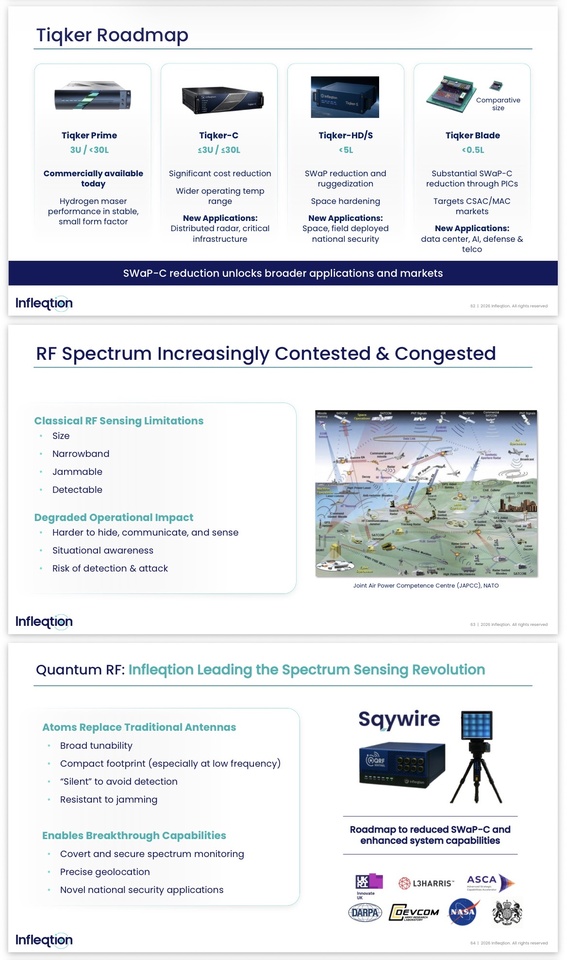
Miniaturized, optical atomic clocks (Tiqker) measure the resonance frequency of rubidium hyperfine states rather than relying on mechanical oscillation like classic MEMS timers (SiTime). Applications: Synchronization of 5G/6G towers, high-frequency trading, and military units. May 2026: Partnership with Safran Electronics & Defense, combining Tiqker with Safran’s White Rabbit/SecureSync systems for GNSS-jammed environments.
High-precision optical atomic frequency reference
• 10,000 times higher atomic transition frequency than microwave clocks for superior precision and environmental stability.
• Hydrogen maser-like short-term performance in a smaller, lighter, and more energy-efficient package.
• Cs-beam-like holdover of up to 7 days.
• 3U, 19-inch rack form factor.
Infleqtion $INFQ is bringing this transformative technology from the lab to the world.
Key benefits of the Tiqker atomic clock:
• Active hydrogen maser performance in a rugged, transportable form factor.
• Phased array / multistatic synchronization
Improved beam accuracy and directional accuracy for over-the-horizon tracking, directional listening, and low-probability of interception data links.
• Drone Defense
Low-phase-noise oscillator for next-generation radar detection, tracking, and control.
• Secure PNT
• Onboard time scales for GPS-denied and GNSS-denied environments (submarines and UUVs).
•
• Enhanced space operations
• High-bandwidth, multichannel connectivity (even without GPS) for improved tracking and geolocation.
• Autonomy
• Synchronization and coordination across platforms and swarms.
AI-enabled precision timing and resource optimization
Precision Timing & Synchronization
Ensures that AI workloads are processed with minimal latency and that all data is consistently and accurately timestamped —crucial for coordinating AI models and real-time inference.
Efficient Resource Utilization
Optimizes resource allocation across computing clusters, which helps data centers handle dynamic AI demands more efficiently while reducing the risk of system overload.
Future-Proof for AI Growth
As AI scales, Tiqker serves as a foundational timing technology that improves the efficiency and reliability of the infrastructure to meet rising demand.
Applications of the Optical Atomic Clock
Defense
• UAV detection and countermeasures
• C5ISR systems
• Electronic warfare
• Hypersonic missile tracking
• Radar beamforming and tracking (phase/multistatic)
Commercial
• Tracking of space assets
• Data center resilience
• Precise geolocation
• Coordination of autonomous systems
**② Quantum Sensing & A-PNT – the Defense Sweet Spot 📡**
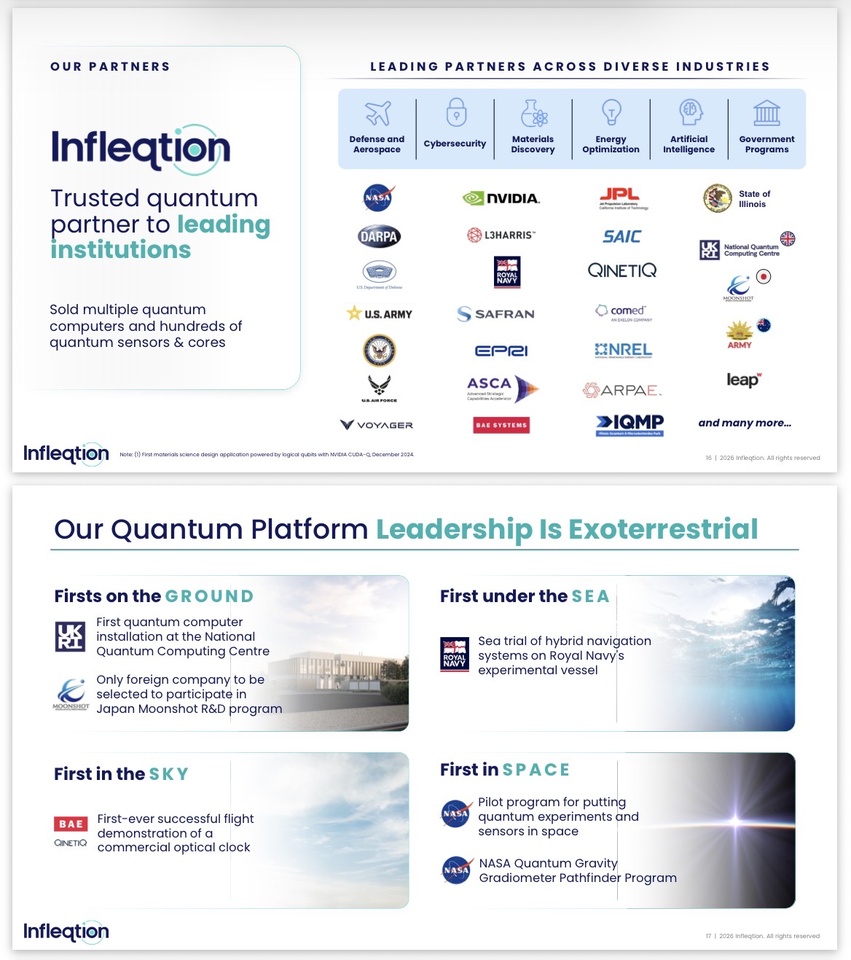
RF receivers (SqyWire) and inertial sensors (Exaqt) measure gravity, magnetic fields, and acceleration at the atomic level for GPS-free navigation. The “Quantum Spectrum” program is already underway with Dell Federal $DELL, L3Harris $LHX, and SAIC $SAIC in the U.S., the U.K., and Australia.
Quantum Spectrum: Next-Generation RF Sensor
Ifleqtion’s Quantum Spectrum technology uses Rydberg atomic detection to detect, locate, evaluate, and classify RF signals, replacing conventional RF antennas and enabling unmatched broadband sensitivity and a compact form factor.
Revolutionizing Spectrum Acquisition with Quantum
Quantum spectrum technology utilizes Rydberg (excited) atomic states to detect RF signals without conventional antennas or solid-state analog receivers.
The result: ultra-wideband reception, compact deployment, and resilience in environments where the proliferation of drones, GPS spoofing, jamming, electronic warfare, and spectrum congestion are becoming increasingly challenging.
How Quantum Spectrum Sensor Technology Works
Quantum Spectrum replaces conventional RF front-ends with a three-step quantum sensor process:
• Laser excitation: Excites atoms to Rydberg states.
• RF interaction: The RF field disrupts the atomic energy levels.
• Optical detection: Changes in the probe beam are detected, converting the RF signal into an optical domain.
This is similar to RF photonics, but without an antenna, which allows for a smaller aperture and a greater operating range.
Key advantages of the quantum spectrum
• Full-spectrum sensor with a small aperture.
• Ultra-wideband coverage (3 MHz–6 GHz, with a roadmap extending to sub-kHz – 100s GHz).
• Resilient to interference in complex RF environments.
• Robust, modular, and compact SWaP system.
• Scalable roadmap for future miniaturization and performance enhancements.
Enabling RF Convergence
Infleqtion’s single- and multi-channel quantum spectrum receiver can simultaneously replace RF/VHF/UHF, L/S-band, C-band, X-band, and Ku/K-band receivers.
Unparalleled accuracy. Reliable performance. No GPS required.
Infleqtion’s quantum inertial sensor technology is inherently stable and accurate over long time scales, as atoms possess unchanging properties. This virtually eliminates bias and drift errors—critical limitations in conventional inertial sensors such as gravimeters, accelerometers, or gyroscopes.
• Ultra-high-precision gravity mapping for national security, geoscientific exploration, and Earth observation
• Long-term GPS-independent navigation for aerospace and defense, providing resilience and autonomy
• Absolute measurements reduce the need for calibration and recalibration, improving uptime
Inflektion Inertial Sensor System Key Benefits
• Miniaturized ultra-high vacuum (UHV) technology at the core of our inertial sensors
• Integrated photonic circuits (PICs) for robust, compact laser systems
• Advanced use of Bose-Einstein condensates (BECs) for new sensor functions
• High-bandwidth detection for dynamic applications
The Inflexion Point
• Expertise in atomic interferometry, which delivers ultra-precise measurements
• Decades-long track record in quantum research and deployment
• Leveraging hardware and software development from Infleqtion’s range of quantum technology disciplines
Mission-Critical Inertial Sensor Applications
National Security & Defense
Precise positioning in GPS-denied environments for ships, aircraft, and autonomous operations.
Space & Frontier
Gravity mapping for planetary exploration and advanced aerospace missions.
Energy and Resource Exploration
Identify underground resources with unmatched accuracy for the energy and mining sectors.
Collaboration with Global Leaders
Infleqtion is proud to collaborate with world-class organizations on unique quantum-enabled customer missions:
• NASA Cold Atom Lab: A 12-year collaboration to advance ultracold atom science in space.
• NASA Quantum Gravity Gradiometer Pathfinder (QGGPf): Development of a groundbreaking space-based quantum sensor for mapping Earth’s gravity.
• QNAV Project: Partnership with the British Royal Navy to advance quantum navigation technology.
•
**③ Quantum Computing – the Long-Term Option 💻**
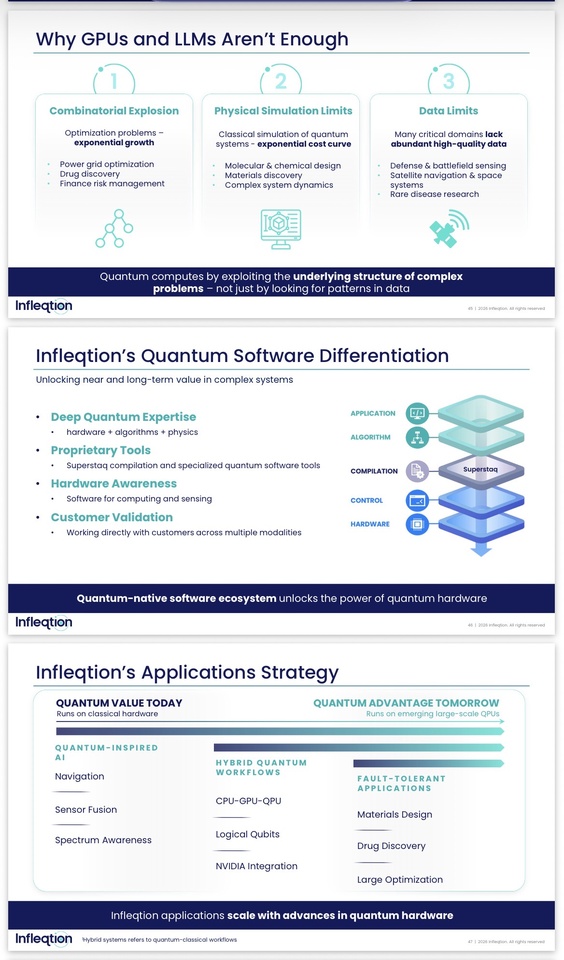
Cold, neutral atoms in laser-optical lattices at room temperature instead of cryostats weighing several metric tons. Current status: 12 error-corrected “logical qubits” (4,2,2 code); target of 30 logical qubits by the end of 2026 and 1,000 by 2030.
---
The Technology: Why Neutral-Atom Physics Is More Than Just a Story 🔬
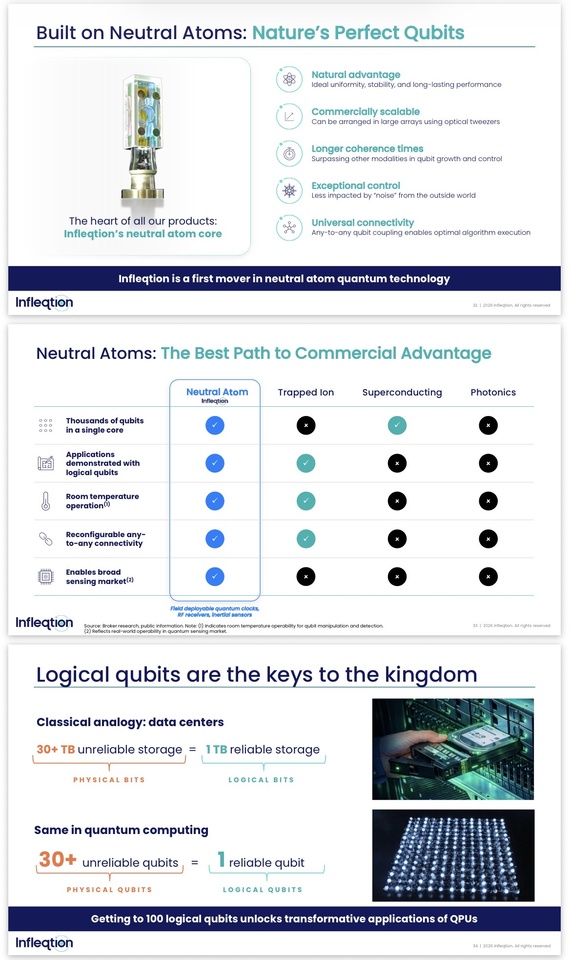
Unlike IBM $IBM (+2,02%) /Google $GOOGL (-0,22%) (superconducting qubits, cryogenic cooling near -273°C) or IonQ $IONQ (+6,5%) (charged ions with electrostatic repulsion), Infleqtion uses neutral atoms (cesium/rubidium), which are slowed down to microkelvin temperatures via laser cooling and positioned in dense lattices using optical tweezers. Because the atoms are uncharged, there is no repulsion, which limits ions—this allows for significantly denser qubit packing without the massive cooling towers used by the superconducting competition.
Three concrete, verifiable metrics prove that this is more than just a marketing concept—this is the actual numerical foundation that was missing from the original presentations:
| Metric | Value | Meaning |
|---|---|---|
| Coherence time | ~2.8 seconds | Orders of magnitude longer than superconducting qubits (μs–ms range) |
| Entangling Gate Fidelity | 99.73% ± 0.03% | Top value among neutral-atom systems (scale computers) |
| Dual-Species Rb-Cs Rydberg Gate | 97.5% ± 0.2% | World record; core component for surface-code error correction |
| Array size | up to 1,600 trap sites | Individual optical addressing of single atoms |
| Power consumption | Kilowatt range | vs. megawatts in classical supercomputers – field-ready |
A theoretical paper by Chief Scientist Mark Saffman also outlines a path to >99.9% gate fidelity—the threshold at which error correction becomes practically viable.
____________________________________________________________________________________
Competition & Moat ♟️
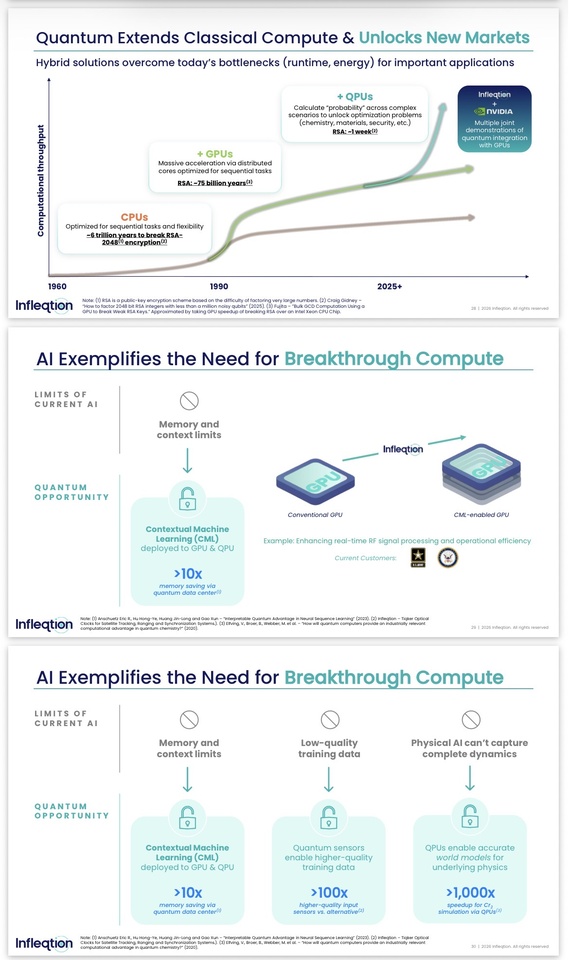
The list of established quantum players is impressive, but there is a fundamental misunderstanding here: Almost all of the heavyweights mentioned build only computers (computing) and use completely different physical approaches to do so.
While Infleqtion plays in the same league, it differs drastically from the competition in both its technological foundation and its range of applications.
1. Technological Comparison: Infleqtion vs. the Competition ⚔️
The key lies in what the qubits are made of and how they are controlled:
❶ IBM $IBM (+2,02%) (Superconducting Qubits)
Technology: Tiny, artificial circuits made of superconducting metal on silicon chips.
The catch: They require massive refrigerators (cryostats) that maintain temperatures near absolute zero (-273 °C). The qubits are very sensitive (short coherence time in the microsecond range).
Infleqtion’s difference: Infleqtion uses real, identical atoms found in nature (rubidium/cesium) in vacuum cells, not artificial circuits. This saves a tremendous amount of space and cooling energy.
❷ IonQ $IONQ (+6,5%) & Honeywell $HON (+0,89%) / Quantinuum $QNT (+10,91%) (Trapped Ions)
Technology: Charged atoms (ions) held in suspension by electric fields.
The catch: Because ions are charged, they repel each other electrically. This makes it extremely difficult to pack thousands of ions closely together on a single chip.
Infleqtion’s difference: Infleqtion uses neutral atoms (without an electric charge). They can be packed extremely close together in 2D and 3D lattices using laser beams (“optical tweezers”) without repelling each other.
❸ D-Wave Quantum $QBTS (+5,46%) (Quantum Annealing)
Technology: Specialized superconducting chips that are not universal quantum computers. They can only solve specific optimization problems (e.g., logistics/route planning).
Infleqtion’s Difference: Infleqtion builds universal (gate-based) systems that can theoretically execute any algorithm and also covers sensor technology.
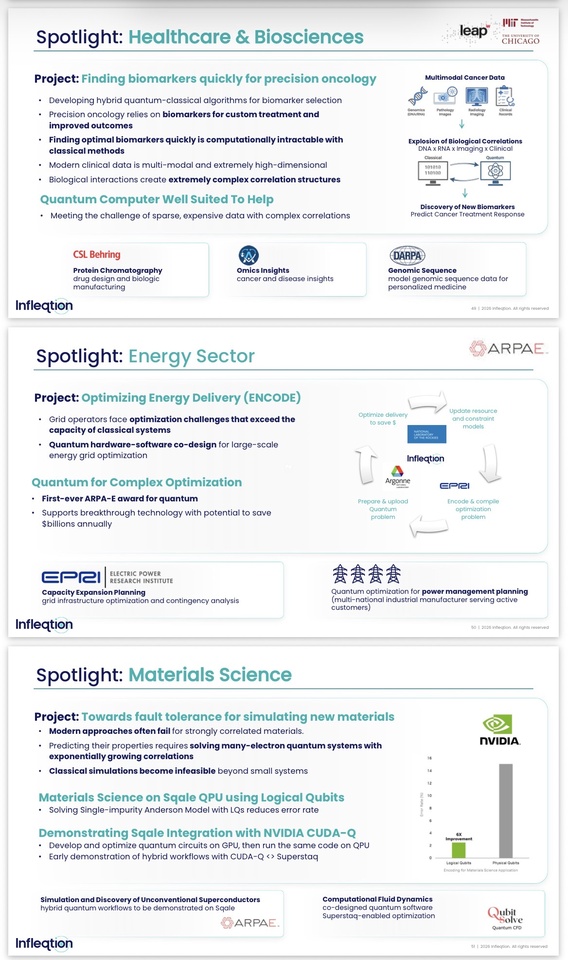
Vision for the Future: How could Infleqtion further expand its technology? 🚀
If we take the Neutral Atom platform a step further, three major areas of expansion emerge that go beyond today’s portfolio:
🌐 1. The Quantum Internet (Quantum Networking & Repeaters)
To connect quantum computers or quantum sensors to one another, you can’t use standard fiber-optic signals (they would destroy the quantum states). So-called quantum repeaters are needed.
Expansion potential: Since Infleqtion has already mastered precisely control atoms with lasers and make photons (light) interact with atoms, they can build the hardware for the tamper-proof quantum communication of the future. They could evolve from a sensor manufacturer into a network equipment provider for the quantum era.
🔬 2. High-Precision Medical & Biochemical Sensors
So far, the sensing business (Exaqt/SqyWire) has focused heavily on defense, GPS-free navigation, and space exploration.
Growth Potential: Infleqtion’s atomic interferometry and magnetometers are so sensitive that they can measure the tiniest magnetic fields in the human body.
Applications: Next-generation brain-scanning devices (MEG) or imaging techniques for cancer diagnostics that do not require massive MRI tubes. This opens up a massive commercial medtech market.
🏭 3. Semiconductor & Materials Analysis (Quantum Microscopy)
Potential for expansion: By using Rydberg atoms as RF and field sensors, it’s possible to non-destructively scan the surfaces of silicon wafers or novel materials at the atomic level. Infleqtion could develop tools for chip manufacturers (such as TSMC $2330 or Intel $INTC ) to detect defects in next-gen chips at the nanometer scale.
💡 Summary
Compared to IBM/IonQ: Infleqtion has the structural advantage of higher qubit density and independence from massive cooling systems thanks to neutral atoms.
Compared to pure-play computing companies: They’re not just burning through money for a distant computing future—they’re already monetizing the same atomic technology today in the sensing and timing markets.
Outlook: If Infleqtion succeeds in miniaturizing its components even further (at the chip level / photonic integrated circuits), it will transform itself from a niche hardware manufacturer into a universal modular solutions provider for navigation, communications, and medical technology.
________________________________________________________________________________
Looking Ahead to the Next 5 to 10 Years
The coming years will reveal whether Infleqtion will succeed in making the transition from a “hardware manufacturer with research contracts” to a “scalable industrial supplier.”
• Phase 1 (Near Future / 1–3 Years): Defense & Infrastructure Wave
In the coming years, Infleqtion will not be building mass-market consumer products. The driving force is geopolitical pressure. Armed forces worldwide are desperately seeking navigation solutions in case GPS is disrupted in an emergency (A-PNT). Here, Infleqtion has a real opportunity to become the standard supplier for submarines, drones, and aircraft.
• Phase 2 (Medium Term / 3–7 Years): Chip Miniaturization
Success depends on whether they can scale their optics and vacuum chambers down to chip size (Photonic Integrated Circuits). Only when a quantum atomic clock is no longer a rack in a server room but fits into a smartphone or a drone will the addressable market explode.
• Phase 3 (Long-Term / 7–10+ Years): The Future of Computing
This is where it will be determined whether Infleqtion’s valuation was justified. If neutral atoms establish themselves as the leading architecture for fault-tolerant quantum computers (e.g., over IBM’s superconductors), Infleqtion will be right at the forefront.
BUT:
Well-funded niche competitors aren’t sitting idle: QuEra, Pasqal, and Atom Computing/Microsoft $MSFT (+0,19%) are pursuing the same physical approach with substantial venture capital.
No recurring revenue model: NASA contracts and defense projects are project-based business, not a subscription model.
The worst-case scenario:
It’s plausible that Infleqtion will be commercially successful in 5–10 years—but primarily as a diversified sensing/timing/photonics infrastructure company, not as the quantum computing company that is actually driving today’s valuation. That wouldn’t be a bad outcome from an operational standpoint, but it would mean a multiple compression: A P/E ratio of 60x is tied to the big computing narrative, not to a solid but ordinary sensor business. So anyone who invests today may be “proven right” that the company will survive and grow, yet still lose money because the market recalibrates the valuation.
________________________________________________________________________________
Let’s now turn to the
advantages vs. risks compared to competitors
To realistically weigh the opportunities and risks, one must pit Infleqtion against two distinct camps: the computing giants (IBM, IonQ) and the focused niche rivals (QuEra, Pasqal).
Focused rivals
(QuEra, Pasqal)
100% focus on computing
No risk of distraction
But: Cash burn
INFLEQTION
Timing + Sensing + Computing
Actual revenue
Risk of spreading resources too thin
Key Advantages
1. No cryogenic refrigerators (vs. IBM, Google, D-Wave):
IBM’s superconducting qubits require massive cooling towers operating at minus 273 °C. Infleqtion’s neutral atoms operate in compact vacuum cells at room temperature. This makes their technology field-ready—it can be mounted on an airplane or a satellite rocket.
2. Density & Scalability (vs. IonQ, Quantinuum):
Trapped ions (IonQ) repel each other electrically. Infleqtion’s neutral atoms have no charge; thousands of them can be arranged extremely close together in a 2D/3D lattice using a laser beam. This promises a much higher qubit density in the long term.
3. Commercial Grounding:
While IonQ thrives purely on future expectations, Infleqtion builds real hardware for real customers. If the quantum computing hype were to cool off tomorrow, Infleqtion would remain a specialist in precision sensor technology.
The Dangerous Pitfalls (Risks)
1. The risk of spreading oneself too thin (loss of focus):
This is my biggest criticism. While competitors like QuEra or Pasqal (which also use neutral atoms!) put 100% of their energy and capital into the quantum computer, Infleqtion is simultaneously building atomic clocks, RF receivers, inertial sensors, and quantum computers. There is a risk that Infleqtion will be “good” in all disciplines but not the absolute No. 1 in any of them, because a focused rival will overtake it.
2. B2B/defense cycles are extremely slow:
Contracts with defense ministries or NASA take years from the initial testing phase to mass production. This market does not scale exponentially like a software app, but rather at the painfully slow pace of government procurement processes.
3. The Valuation Gap:
Infleqtion is traded on the stock market like a groundbreaking quantum stock (high multiples). Even if the company were to be very successful operationally in 5 years—but “only” as a highly specialized defense and sensor supplier— the stock price could still fall because the market will bring the unnaturally high quantum valuation back down to earth.
So which factor carries more weight? The advantages or the risks? My personal opinion:
🟩Why the advantages outweigh the risks from a long-term perspective
Infleqtion differs from almost all pure-play quantum startups in one crucial detail: It has a mathematical and technological safety net.
🚀A real, existing business instead of mere promises:
Infleqtion is already generating real revenue in the millions (2025: approx. $32.5 million; 2026 forecast: around $40 million). While companies that focus solely on software development could go bankrupt if the quantum breakthrough is delayed, Infleqtion sells precision hardware (atomic clocks, sensors) to partners such as Safran, the U.S. Department of Defense, or NASA.
🚀Asymmetric risk-reward profile (upside vs. downside):
Downside: In the worst-case scenario, the quantum computing division fails. What remains is a highly specialized B2B and defense supplier for post-GPS navigation and timekeeping.
Upside: If the Neutral-Atom platform prevails in quantum computing, Infleqtion will be at the forefront of a multibillion-dollar wave of growth.
🚀Geopolitical Tailwind:
Dependence on GPS is one of the greatest vulnerabilities of Western infrastructure. Governments are currently investing heavily in autonomous navigation solutions (A-PNT). Infleqtion addresses precisely this national security issue.
🟥When the risks outweigh the benefits
For those seeking stability or steady profits over a 1- to 3-year horizon, the drawbacks are significant:
📉Operating Loss & Capital Requirements:
Despite growing revenue, the company is posting operating losses (2025: approx. $35 million operating loss). Deep tech consumes an enormous amount of capital for research and development in integrated photonics (PICs).
📉Risk of Scattering Resources (Execution Risk):
The biggest internal risk is focus. While rivals like QuEra are concentrating all their resources on computers, Infleqtion is simultaneously developing sensor technology, timing systems, and hardware components. If they spread themselves too thin, they could be overtaken in individual segments by more focused niche players.
📉High price fluctuations (volatility):
On the stock market, the stock is often heavily influenced by sentiment across the entire quantum sector. Bad news from competitors or delays in government contracts can lead to significant price drops.
CONCLUSION:
- How big do you estimate Infleqtion’s technological lead over the competition to be?
- In your view, is the current business model already viable, or does the story still rely too heavily on future prospects?
- Where do you see the biggest risks: technology, commercialization, financing, or valuation?
- Do you believe that quantum sensing will become commercially relevant sooner than quantum computers themselves?
- How do you currently assess Infleqtion $INFQ at present?
- Do you think Infleqtion is capable of playing a key role in global defense, navigation, and tech infrastructure over the next 5–10 years?
I haven’t invested (yet) 👀 and don’t plan to get involved anytime soon.
I’m not a technical expert myself and don’t have a particularly deep understanding of quantum technology. To be honest, there’s a lot I don’t understand. 😅 That’s why I’d love it if a few people here with a technical background or industry knowledge could weigh in and share their assessment. I’m looking forward to hearing your opinions!
@Get_Rich_or_Die_Tryin
@Multibagger
@Tenbagger2024
@Raketentoni


