I'm staying invested in Kawasaki through the 2036 portfolio.
Hello, everyone,
When it comes to gas turbines, most people immediately think of $ENR (+3,27%) Siemens Energy or $GEV (+1,64%) GE Vernova.
But very few people here have the Japanese companies on their radar. Many have already declared hydrogen dead. But the Japanese certainly haven’t. This seems to be catching on here in Germany as well, and hydrogen is absolutely not dead.
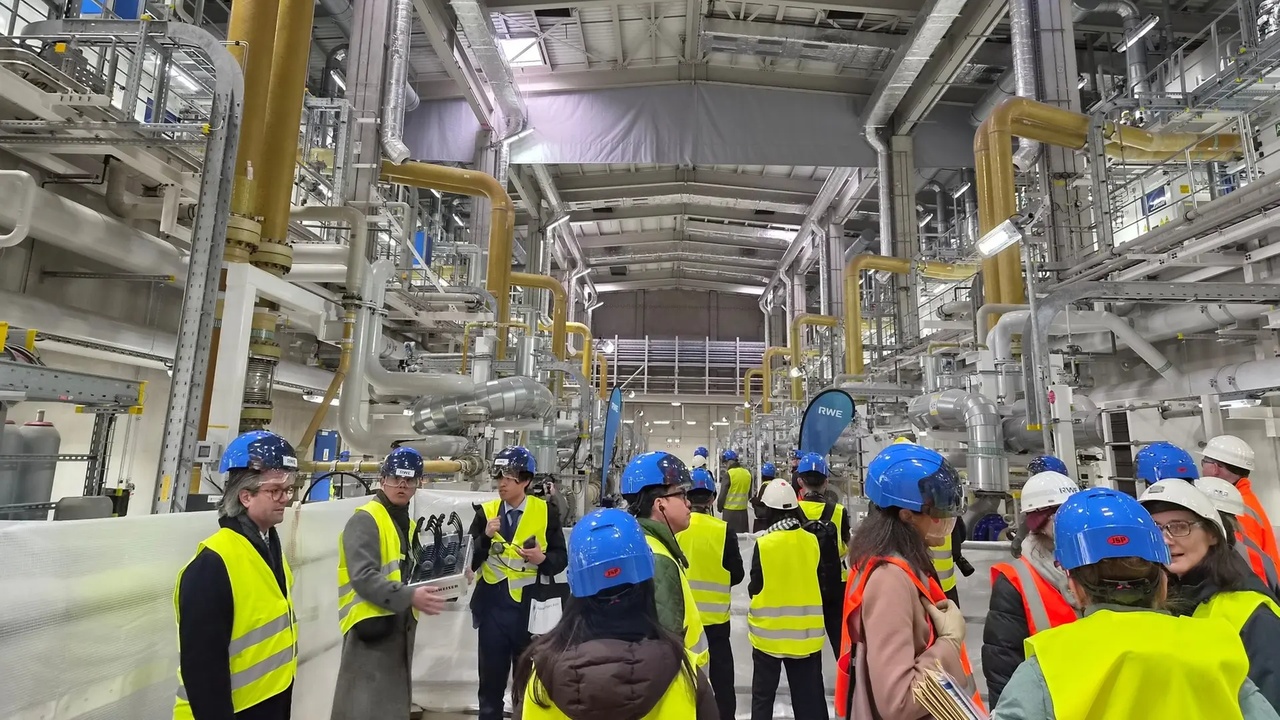
In Lingen, a hydrogen gas turbine began test operations on Friday—according to RWE, one of the largest of its kind. Representatives from Japan also traveled to the event.
Many prominent figures attended the symbolic launch of the new hydrogen turbine: Even the Japanese ambassador was in attendance, since the turbine was built by Kawasaki in Japan. The turbine itself isn’t directly visible. It operates in a facility on RWE’s grounds and is hidden behind walls and sheet metal.
Electricity initially from natural gas and later from hydrogen
The electricity produced here still comes from natural gas, but will gradually be blended with hydrogen. “We are the number one energy region. We are the number one hydrogen region. We can generate and store energy,” said Minister President Olaf Lies (SPD). Until now, the problem has been: “Can we also convert it back to electricity? Will there be gas-fired power plants in the future that, during times when I don’t have enough direct renewable energy, ensure that I have climate-neutral electricity?” said Lies.
Hydrogen Turbine Aims to Bridge Energy Gaps
Once the 34-megawatt turbine eventually enters full-scale operation, it could supply electricity to around 40,000 households simultaneously and step in during so-called “dark lulls”—that is, when there is too little wind and the sun isn’t shining. But until then, it still needs to be tested. According to RWE, there is still a lack of empirical data for the new green hydrogen-powered system. A hydrogen-powered turbine could supply electricity very quickly if other sources, such as wind or solar energy, were to fail, the operator says. Hydrogen is still up to five times more expensive than natural gas. In the medium term, the operators believe prices will converge.
Lingen: Teststart von Wasserstoff-Gasturbine mit Besuch aus Japan | ndr.de
My personal assessment:
Hydrogen turbines are an interesting topic for the future, especially when considered in conjunction with two major developments: the energy transition and the enormous increase in electricity demand driven by AI data centers.
This is creating a market for flexible power plants that can reliably supply electricity regardless of wind and sun. Hydrogen could play an important role here in the long term.
There are several well-known companies already working intensively on this technology.
1. The key players in hydrogen turbines
Siemens Energy $ENR (+3,27%)
- Hydrogen-capable large gas turbines (Germany)
GE Vernova $GEV (+1,64%)
- Large-scale H2 turbines, up to 100% H2 (U.S.)
Mitsubishi Heavy Industries $7011 (+3,33%)
- Large turbines, hydrogen and ammonia (Japan)
Kawasaki Heavy Industries $7012 (+0,47%)
- Hydrogen turbines and hydrogen infrastructure (Japan)
Baker Hughes $BKR (+4,77%)
- Industrial gas turbines and hydrogen compression (U.S.)
Doosan Enerbility $034020
- Hydrogen and ammonia turbines (South Korea)
2. Companies of Particular Interest
I would take a closer look at five companies.
1. Siemens Energy – the German technology conglomerate
- Develops hydrogen-capable gas turbines.
- Working on the combustion of up to 100% hydrogen.
- Already has concrete hydrogen projects in Germany.
- Also benefits from the expansion of power grids and rising electricity demand.
Of particular interest: Siemens Energy covers several areas of the future energy infrastructure.
Siemens Energy – Wasserstoffkraftwerke
2. GE Vernova – American technology leader
- Over 120 gas turbines with hydrogen operation experience.
- Combustion technology for hydrogen blends of up to 100%.
- Significant business in gas turbines for power generation.
- Of interest due to the enormous U.S. energy demand.
GE Vernova – Hydrogen Turbines
3. Mitsubishi Heavy Industries – Japanese technology conglomerate
- Develops hydrogen and ammonia turbines.
- Large-scale power plant technology.
- Invests in the further development of hydrogen combustion.
- Potentially set to benefit from the expansion of Asia’s energy infrastructure.
An exciting Japanese technology stock.
4. Kawasaki Heavy Industries – particularly exciting!
There’s a particularly interesting development here:
On November 6, 2026, RWE and Kawasaki began trial operations in Lingen of a 34-MW gas turbine designed to run on up to 100% hydrogen.
This is an important step toward industrial hydrogen-based power generation. RWE
Kawasaki is thus not only a developer but is now also involved in specific European demonstration projects.
5. Baker Hughes – the infrastructure player
Baker Hughes is interesting because the company does more than just develop turbines.
Other business areas:
- Hydrogen compression
- Compressors
- Pumps
- Hydrogen infrastructure
- Industrial gas turbines
This means Baker Hughes has a broader presence across the hydrogen value chain. bakerhughes.com
3. My assessment: Where does the greatest future potential lie?
I see three interconnected waves of investment:
1. AI requires electricity
Data centers require a reliable power supply around the clock. Gas turbines can serve as an important complement to renewable energy and battery storage systems in this context.
2. Hydrogen as energy storage
Excess renewable electricity can be used to produce hydrogen. This hydrogen can later be converted back into electricity in power plants.
3. Existing power plants are being retrofitted
The ability to gradually convert existing gas turbines to run on higher proportions of hydrogen opens up additional business opportunities in modernization and service.
However, hydrogen is still expensive at present, and the necessary infrastructure must first be built.
An interesting investment thesis would be:
The second wave of AI requires more than just chips, storage, and data centers. Above all, it requires energy. Hydrogen-capable gas turbines could become a key component of the future power supply.
You should take a closer look at Kawasaki and Mitsubishi in particular, because in addition to traditional power generation, they are also developing technologically interesting hydrogen solutions.