Everyone likes to show off their profits, but today I'm sharing my losses—completely transparently.
I'm going to hold onto my shares in $EYPT (-5,13%) anyway; I know @Multibagger was also an investment.
That’s just how it goes on the stock market.
After our latest speculation, which $NEOV (+3,21%) a gain of over 100%, the stock is now plummeting today.
Here’s the company announcement:
EyePoint Announces Strategic Prioritization
October 19, 2026
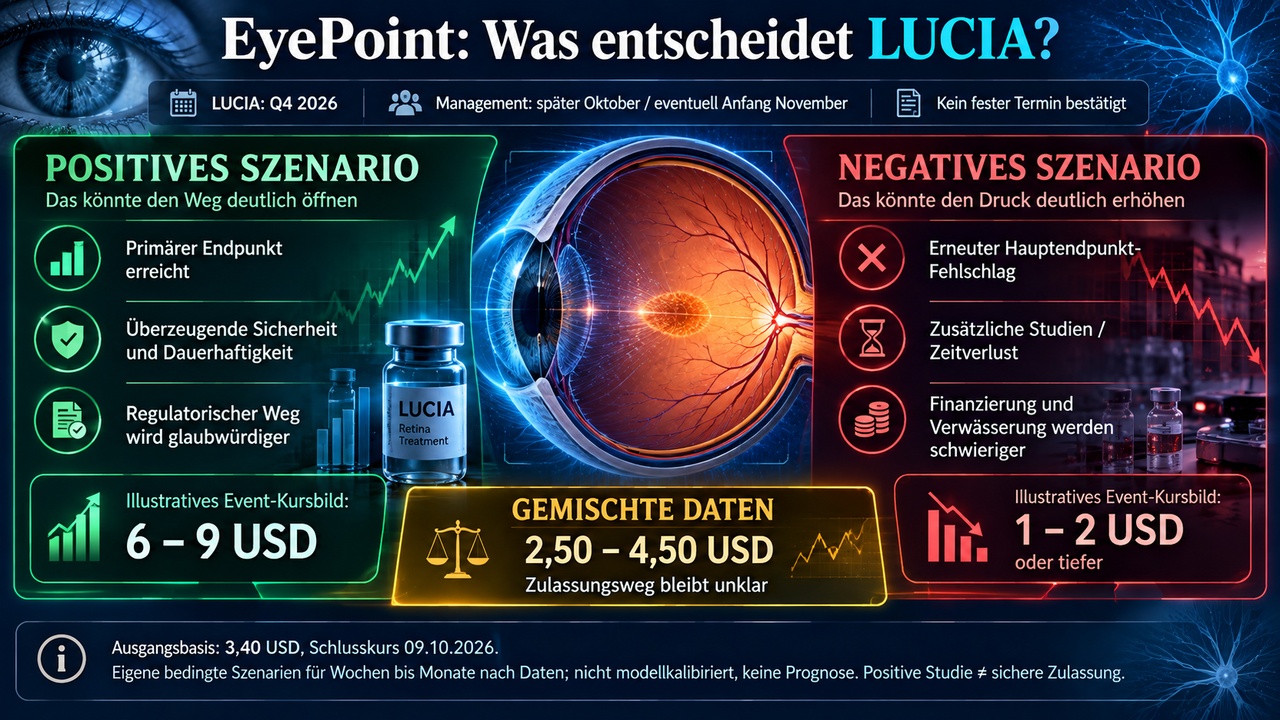
WATERTOWN, Massachusetts, October 19, 2026 (GLOBE NEWSWIRE) -- EyePoint, Inc. (Nasdaq: EYPT), a company dedicated to the development and commercialization of innovative therapies to improve the quality of life for patients with severe retinal diseases, announced a strategic realignment today. The goal is to reduce operating costs and focus resources on the advanced development program for DURAVYU™ in diabetic macular edema (DME). This strategic realignment follows the results of the Phase 3 LUCIA study of DURAVYU in wet AMD, which were released today. The primary non-inferiority endpoint was not met, despite improvements in visual acuity and the achievement of key secondary endpoints such as reduced treatment burden, substitution-free rates, anatomical control, and safety with repeat dosing.
To secure capital and maximize shareholder value, the Board of Directors has approved a plan to reduce the workforce by approximately 53% and to prematurely terminate the pivotal Phase 3 trials for wet AMD without fully completing the second year of the trials. EyePoint plans to prioritize the development of DURAVYU as a potential treatment for DME. The first results from the pivotal Phase 3 trial are expected in the fourth quarter of 2027.
EyePoint thanks all employees affected by these measures for their dedication and contribution to the company’s mission. While today’s setback in the clinical trial underscores the challenges of drug development, it does not diminish the team’s achievements or the company’s commitment to improving the quality of life for patients with severe retinal diseases.
Key Financial and Operational Updates
- Cash Conservation: The strategic prioritization and associated operational adjustments are expected to yield annual savings of approximately $30 million.
- Workforce Reduction: Affects approximately 53% of positions company-wide. The majority of the workforce reduction is expected to take place in the fourth quarter of 2026 and be completed in the first half of 2027.
- Clinical Prioritization: The organization is focusing on the clinical development of DURAVYU for the potential treatment of DME. Results from the pivotal Phase 3 trials are expected in the fourth quarter of 2027.
- One-time charges: The company estimates total charges of approximately $9 million related to termination benefits, including severance pay and other associated costs.
“Decisions that involve workforce reductions are extraordinarily difficult, and we sincerely thank our departing colleagues for their dedication and valuable contributions. Even though the volatility inherent in clinical development presents significant challenges, our core mission remains unchanged: We are overcoming these challenges to develop sustainable therapies that can significantly improve patients’ lives,” said Jay S. Duker. “This strategic prioritization allows us to focus on our next milestone: the pivotal Phase 3 trial evaluation for diabetic macular edema (DME). This will evaluate DURAVYU’s potential as a durable, long-term treatment option that safely reduces the burden of injections for patients. The DME program is supported by positive Phase 2 data from the VERONA study, which demonstrate sustained visual acuity and a supplement-free rate of over 70% of patients over six months. DURAVYU also enables continuous intracellular drug release that targets the pan-VEGF, PDGF, and IL-6 signaling pathways, thereby addressing both the vascular and inflammatory causes of the disease. Given the nature of this disease, DURAVYU is therefore a particularly promising potential treatment option.”
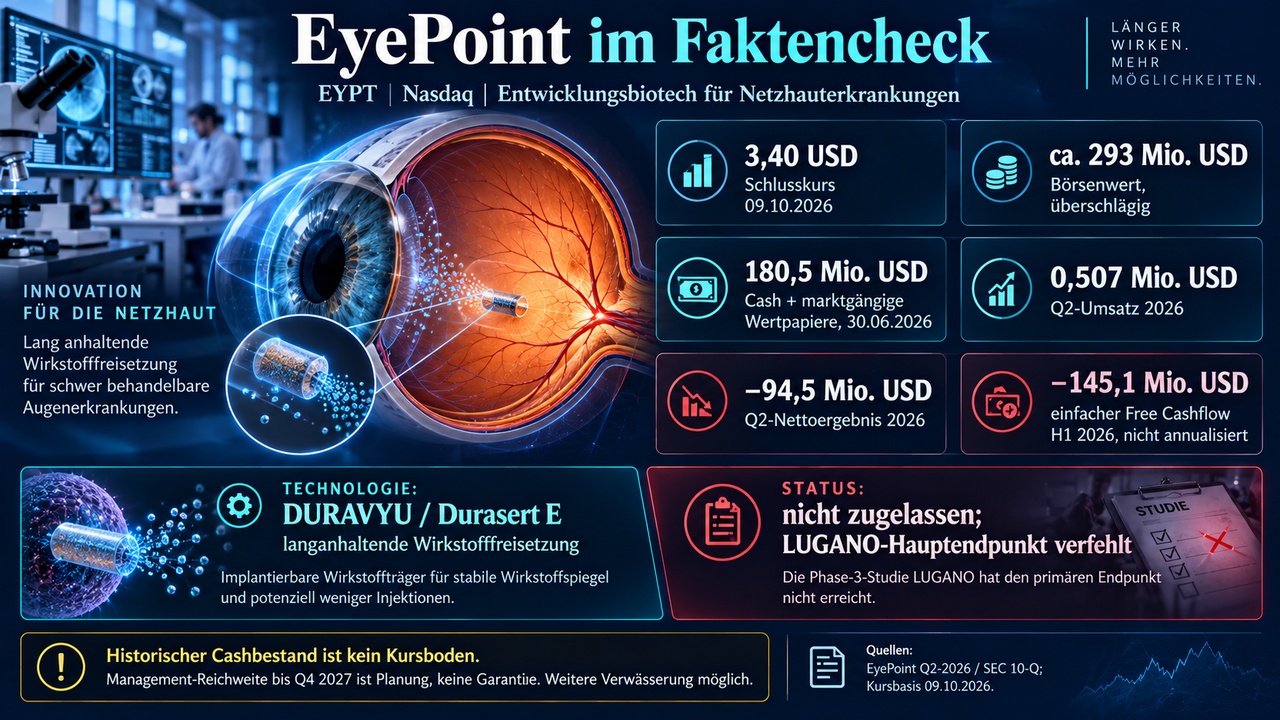
EyePoint estimates that it has approximately $118 million in cash, cash equivalents, and short-term investments as of September 30, 2026. The
About the Phase 3 DME Program
The Phase 3 program for diabetic macular edema (DME) includes COMO and CAPRI, two global, randomized, double-blind, aflibercept-controlled non-inferiority studies designed to evaluate the safety and efficacy of DURAVYU 2.7 mg in patients with active DME. A total of 551 patients participated in the studies, of whom approximately 75% were treatment-naive and 25% were pretreated. Patients were randomized in a 1:1 ratio and received either 2.7 mg of DURAVYU every six months or aflibercept every eight weeks, as approved, as the control treatment.
The primary endpoint is non-inferiority with respect to the mean change from baseline in best-corrected visual acuity (BCVA) at the combined 52- and 56-week time points. Secondary endpoints include safety, superiority in terms of reducing treatment burden, the proportion of eyes without additional aflibercept injections, and anatomical outcomes measured by optical coherence tomography (OCT). For more information, see www.clinicaltrials.gov (COMO: NCT07449936; CAPRI: NCT07449923).
About Diabetic Macular Edema
Diabetic macular edema (DME) is the leading cause of vision loss in people with type 1 and type 2 diabetes. It occurs when damaged blood vessels in the retina leak fluid into the macula, the central area of the retina responsible for sharp vision. The resulting retinal swelling can lead to blurred vision and severe vision loss, including blindness. The pathophysiology of DME is multifactorial and involves vascular permeability as well as inflammatory processes mediated by signaling pathways such as VEGF, PDGF, and interleukin-6 (IL-6).
Diabetic macular edema (DME) affects an estimated 28 million people worldwide, and its prevalence is expected to rise as the global prevalence of diabetes increases. Current treatment options for DME patients include short-acting intravitreal anti-VEGF biologics, corticosteroids, and laser photocoagulation. Since DME is a chronic condition affecting an active population, the need for frequent treatment can place a significant burden on patients, caregivers, and physicians and contribute to under-treatment in clinical practice.
About DURAVYU™
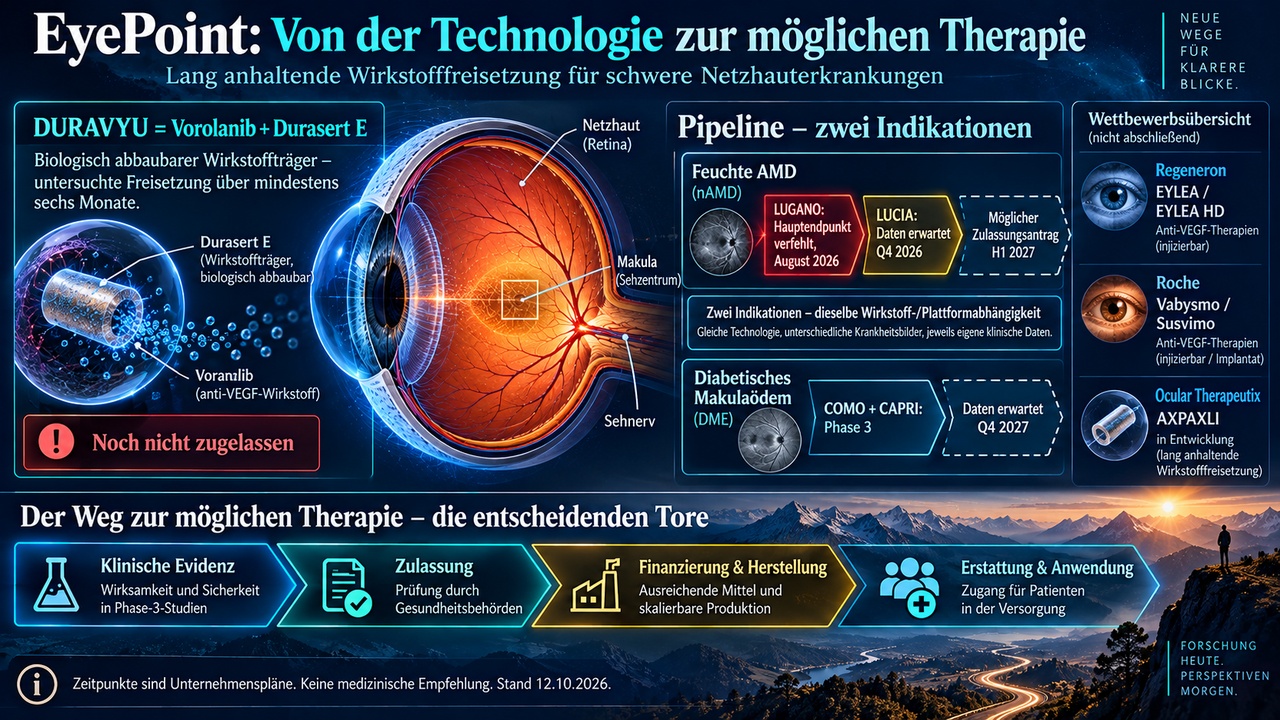
DURAVYU™ (vorolanib insert for intravitreal administration) is a controlled-release therapy currently in development for patients with severe retinal diseases. DURAVYU combines vorolanib, a selective and patented tyrosine kinase inhibitor (TKI), with EyePoint’s proprietary, next-generation biodegradable Durasert E™. This innovative IVT (intravitreal) technology ensures continuous drug release for at least six months without free drug particles.
DURAVYU offers a potentially novel mechanism of action and a new treatment paradigm for retinal diseases that goes beyond existing therapies with VEGF ligand blockers. Vorolanib acts intracellularly by suppressing angiogenesis through the inhibition of all VEGF receptors and PDGFR, while simultaneously inhibiting inflammation by blocking interleukin-6 (IL-6)/JAK1 signaling. Furthermore, vorolanib demonstrated in an in vivo model of retinal detachment.
DURAVYU has been evaluated in several clinical trials for wet AMD and DME, including the Phase 2 DAVIO 2 trial and the Phase 3 LUGANO and LUCIA trials for wet AMD, as well as the Phase 2 VERONA trial for DME. DURAVYU is currently being evaluated in the ongoing Phase 3 COMO and CAPRI studies for DME. In six completed clinical trials—including three Phase 2 and two Phase 3 studies—no drug-related safety concerns were observed in over 630 patients.
The Phase 2 VERONA study in diabetic macular edema (DME) met its primary and secondary endpoints and demonstrated rapid and sustained improvement in visual acuity and anatomical features, as well as a consistently favorable safety and tolerability profile with dosing intervals superior to those of standard therapy. Key data from the Phase 3 program for DME are expected to be released in the fourth quarter of 2027.
About EyePoint
EyePoint, Inc. (Nasdaq: EYPT) is a clinical-stage biopharmaceutical company dedicated to developing and commercializing innovative therapies to improve the quality of life for patients with severe retinal diseases. The company’s lead product candidate, DURAVYU™, is an innovative, investigational sustained-release therapy for the treatment of severe retinal diseases. It combines vorolanib, a selective and patented tyrosine kinase inhibitor, with EyePoint’s proprietary, biodegradable Durasert E™ technology. DURAVYU is currently being evaluated in pivotal Phase 3 trials for the treatment of diabetic macular edema (DME).
The company is committed to collaborating with the retinal community to improve patients’ lives while creating long-term value. This is evidenced by four approved drugs over more than three decades and the treatment of tens of thousands of eyes with EyePoint innovations.
EyePoint is headquartered in Watertown, Massachusetts, and has a commercial manufacturing facility in Northbridge, Massachusetts.
Vorolanib is exclusively licensed to EyePoint by Equinox Sciences, a subsidiary of Betta Pharmaceuticals, for the topical treatment of all eye diseases outside of China, Macau, Hong Kong, and Taiwan.
DURAVYU™ has been provisionally accepted by the FDA as the brand name for EYP-1901. DURAVYU is an investigational drug and has not yet been approved by the FDA. FDA approval and the timeline for potential approval are uncertain.
Forward-Looking Statements
EYEPOINT NOTICES PURSUANT TO THE U.S. PRIVATE SECURITIES LITIGATION REFORM ACT OF 1995: To the extent that statements in this press release relate to information that is not historical, they constitute forward-looking statements within the meaning of the Private Securities Litigation Reform Act of 1995. Such statements include, among other things, statements regarding our expectations regarding our clinical development and regulatory plans; our strategic prioritization plan and the associated expected annual savings; our plans to prioritize the development of DURAVYU® for the treatment of DME; our plans to reduce operating costs, conserve capital, and maximize shareholder value through the strategic prioritization plan; our expected costs and expenses related to our strategic prioritization plan; the potential of DURAVYU® to provide a stable, long-term treatment option that safely reduces the overall burden of injections for patients; our belief that DURAVYU® offers a potentially novel mechanism of action and a new treatment paradigm for retinal diseases beyond existing anti-VEGF ligand-blocking therapies; our expectations regarding the timing of the availability and release of clinical data on DME, including the release of topline results from the Phase 3 COMO and CAPRI studies on DME in the fourth quarter of 2027; our belief that DURAVYU has the potential to treat patients with active disease for six months or longer without additional anti-VEGF therapy; and other statements regarding the Company’s future plans, goals, strategies, and beliefs, which are identified by words such as “will,” “potentially,” “could,” “may,” “believe,” “intend,” “continue,” “plans,” “expects,” “anticipates,” “estimates,” “may,” or other words of similar meaning, or the use of future tense verbs.
By their nature, forward-looking statements relate to matters that are subject to varying degrees of uncertainty. Uncertainties and risks could cause EyePoint’s actual results to differ materially from those expressed or implied in EyePoint’s forward-looking statements. For EyePoint, these risks and uncertainties include, among other things, the timing, progress, and results of the company’s clinical development activities; the risk that the strategic prioritization plan may not be successful and could lead to a distraction or uncertainty that could negatively impact operating results, the business, or investor perception; uncertainties and delays related to communications with the U.S. Food and Drug Administration (FDA) and the ability to obtain FDA approval to market DURAVYU; unexpected costs and expenses; the Company’s cash reserves may not be sufficient to support its business plan for as long as planned; the risk that the results of clinical trials may not be predictive of future results and that interim and preliminary data are subject to further analysis and may change as more data becomes available; unexpected safety or efficacy data observed during clinical trials; uncertainties related to the regulatory approval process and the available development and approval pathways for the Company’s product candidates; changes in the regulatory environment; disruptions at the FDA; changes in U.S. and international trade policy; changes in expected or existing competition; the success of current and future licensing agreements; our reliance on contract research organizations and other external vendors and service providers; product liability; the impact of general business and economic conditions; the protection of our intellectual property and the prevention of intellectual property infringements; the retention of key personnel; Delays, interruptions, or failures in the manufacture and delivery of our product candidates, including due to unexpected regulatory compliance issues or warning letters regarding the Company’s manufacturing facilities; the availability of and need for additional financing; our ability to obtain additional funds to support our clinical development programs; uncertainties regarding the FDA’s warning letter concerning the Company’s manufacturing facility in Watertown, Massachusetts; and other factors described in our filings with the Securities and Exchange Commission. We cannot guarantee that the results and expectations expressed, anticipated, or implied in forward-looking statements will occur. A variety of factors, including these risks, could cause our actual results and other expectations to differ materially from the results or other expectations expressed, anticipated, or implied in our forward-looking statements. Should known or unknown risks materialize or underlying assumptions prove to be incorrect, actual results may differ materially from past results and from the results expected, estimated, or projected in the forward-looking statements. Please take this into account when considering forward-looking statements. A more detailed discussion of the risks and uncertainties that could cause our actual results to differ materially from the forward-looking statements contained in this press release can be found in the “Risk Factors” section of our most recent annual report (Form 10-K), in our other filings with the U.S. Securities and Exchange Commission (SEC), and in our future reports filed with the SEC, which are available at the following link:www.sec.gov . Our forward-looking statements speak only as of the date they are made. EyePoint undertakes no obligation to update or revise any forward-looking statements, whether as a result of new information, future events, or otherwise.
Investors & Media:
Robin Garner
, Vice President of Corporate Communications & Investor Relations