

It's great to have you stop by my winter garden here in Denmark again!
The coffee's ready.
Today, though, no cozy dividend payer, but rather a stock where the next clinical trial announcement could have a bigger impact than three years’ worth of quarterly earnings reports.
I’m talking about EyePoint, Nasdaq ticker EYPT $EYPT (-5,13%) .
The company develops long-acting treatments for severe retinal diseases. The idea is appealing: fewer injections into the eye, without having to compromise on vision.
However, following a disappointing Phase 3 trial, the market has—for now—pulled the plug on the hope machine.
Is this an interesting second chance—or is the stock price in the gutter for a reason?
Analysts see great potential here, so speculators, take note!
We’re taking a closer look—with a flashlight, not through rose-colored biotech glasses.
Research date: October 12, 2026. Price basis: $3.40, U.S. closing price as of October 9, 2026. The charts provided show a pre-market price of approximately $3.36.

1. Business Model – What Does EyePoint Actually Do?
EyePoint develops drugs with sustained-release formulations for retinal diseases.
The company emerged from pSivida and was renamed EyePoint Pharmaceuticals following the acquisition of Icon Bioscience in 2018.
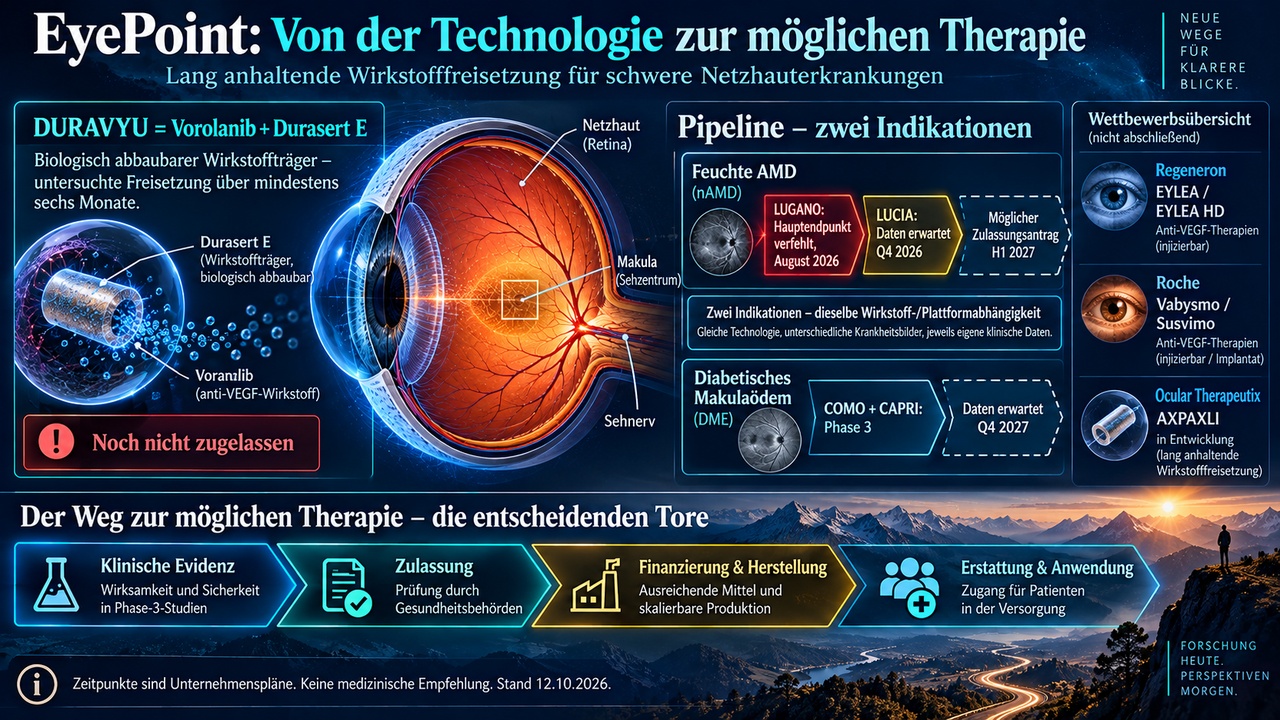
The focus is on DURAVYU, formerly EYP-1901: a biodegradable drug carrier designed to release vorolanib over at least six months. It is administered via an injection into the eye.
The treatment is being developed for wet age-related macular degeneration and diabetic macular edema.
Important: DURAVYU has not yet been approved. The stock is currently driven by its development potential, not by an established pharmaceutical business.
2. Market Position & Moat – Technology in Place, Proof Still Pending
Specialized drug delivery, development experience, and licensing rights are genuine assets. However, these do not yet constitute a secure economic moat.
My assessment:
Technologically, there’s more to this than just a nice lab presentation.
Commercially, though, EyePoint still has to earn its position.
Furthermore, a great deal hinges on DURAVYU. Multiple study names do not automatically mean multiple independent products.
Or to put it another way: Four door signs don’t turn a single house into a row house neighborhood.
3. Core Quality Formula – this time with a warning label
Our usual framework is:
Revenue growth + operating margin.
For a development-stage biotech, this equation can yield absurd results.
EyePoint generated only about $0.507 million in revenue, compared to $5.333 million in the prior year.
That corresponds to approximately −90.5%. At the same time, the operating loss amounted to approximately $97.38 million. The decline in revenue is largely due to the recognition of prior YUTIQ licensing revenue.
Dividing research costs by a minuscule amount of licensing revenue does not yield a meaningful quality rating.
Therefore: no artificial score.
EyePoint is currently not an operational “quality-growth” stock. Clinical evidence, financing, and the regulatory approval pathway are the decisive factors.
The Excel spreadsheet is welcome—it just shouldn’t try to call the shots.
4. Cash Flow Quality Formula – the tank is full, but the engine is guzzling fuel
In the first half of 2026:
- Operating cash flow: −142.9 million USD
- Capital expenditures: $2.2 million
- Simple free cash flow: approximately −145.1 million USD
- Cash and marketable securities as of June 30: $180.5 million.
Management expects secured financing through Q4 2027.
A purely mechanical extrapolation of current cash burn, however, results in a significantly shorter cash runway.
This extrapolation is not a forecast of insolvency: study costs may decline, and payments may fluctuate.
However, it shows that: The future cost trajectory is crucial.
And $180 million in a June account does not automatically equate to $180 million in today’s account.
5. Dividend Filter – The Payout Is Research
EyePoint does not pay dividends.
This means the stock is not an income stock. It also currently lacks a self-financing operating business.
That does not mean that non-dividend-paying companies are inherently bad. With EyePoint, it is simply a bet on development and events.
6. P/E Ratio – Minus One Isn’t Particularly Cheap
A negative P/E ratio is not an indicator of a bargain when the company is reporting losses.
A risk-adjusted pipeline value would make more sense: potential profits after approval, probability of success, remaining costs, and future number of shares.
Especially in the wake of LUGANO, these assumptions are highly uncertain.
That’s why I’m not providing what might appear to be a precise intrinsic fair value here.
A nice decimal place doesn’t turn uncertain study data into a robust valuation model.

7. KCV – Also Not a “Bargain” Indicator
Operating cash flow is negative. A mathematically negative P/CF ratio therefore has no traditional significance.
Financing is more important.
Dilution is not just a theoretical possibility: EyePoint already sold approximately 1.43 million new shares in Q2 and another approximately 1.21 million shares in July through its ATM program.
I could not confirm any specific upcoming new share issuance.
However, further capital raises remain possible.
Strong results could facilitate financing. Weak results could make it significantly more expensive.
8. P/S Ratio – High Multiple, Incorrect Benchmark
With an estimated market capitalization of around $293 million and very low current revenues, the revenue multiple is in the triple-digit range.
That sounds like a sky-high price, but it’s not a meaningful comparison with a pharmaceutical company that’s already selling drugs.
The right question isn’t:
“How cheap are today’s revenues?”
But rather:
“How much are we paying for a future approval that’s still uncertain?”
9. P/B Ratio – Book Value Is Not an Airbag
Equity stood at approximately $166.4 million as of June 30. This results in a rough P/B ratio of about 1.76.
But research consumes cash. The historical book value is therefore not a stable safety net.
The debt figure in the report also needs to be put into context:
The approximately $22.4 million largely corresponds to operating lease obligations, not a traditional bank loan of the same amount. Nevertheless, they are economically relevant.
Cash is a buffer. It is not a guaranteed minimum price.
10. Current Figures & Catalysts – What Went Wrong at LUGANO?
On August 17, 2026, EyePoint reported that LUGANO failed to meet the primary endpoint: the predefined non-inferiority in visual acuity compared to aflibercept.
Management points to nine DURAVYU patients with significant vision loss, which it attributes to other causes. After excluding these cases, a post-hoc analysis showed non-inferiority.
This explanation warrants further examination. However, it does not turn the study—which missed its primary endpoint—into a successful one.
There were also positive signs: 42% lower treatment burden and 54% without additional treatment through week 56. These patients were not left untreated—they received DURAVYU.
And when will LUCIA be available?
Officially: Q4 2026.
The CEO recently clarified: possibly later in October or early November. A specific release date has not been confirmed.
LUCIA includes more patients than LUGANO. A supporting analysis is intended to incorporate findings from LUGANO; according to management, the primary endpoint remains unchanged.
What matters is success according to the planned analysis protocol—not just a promising subgroup.
11. Competition & Risks – The Competition Isn’t Resting on Its Laurels
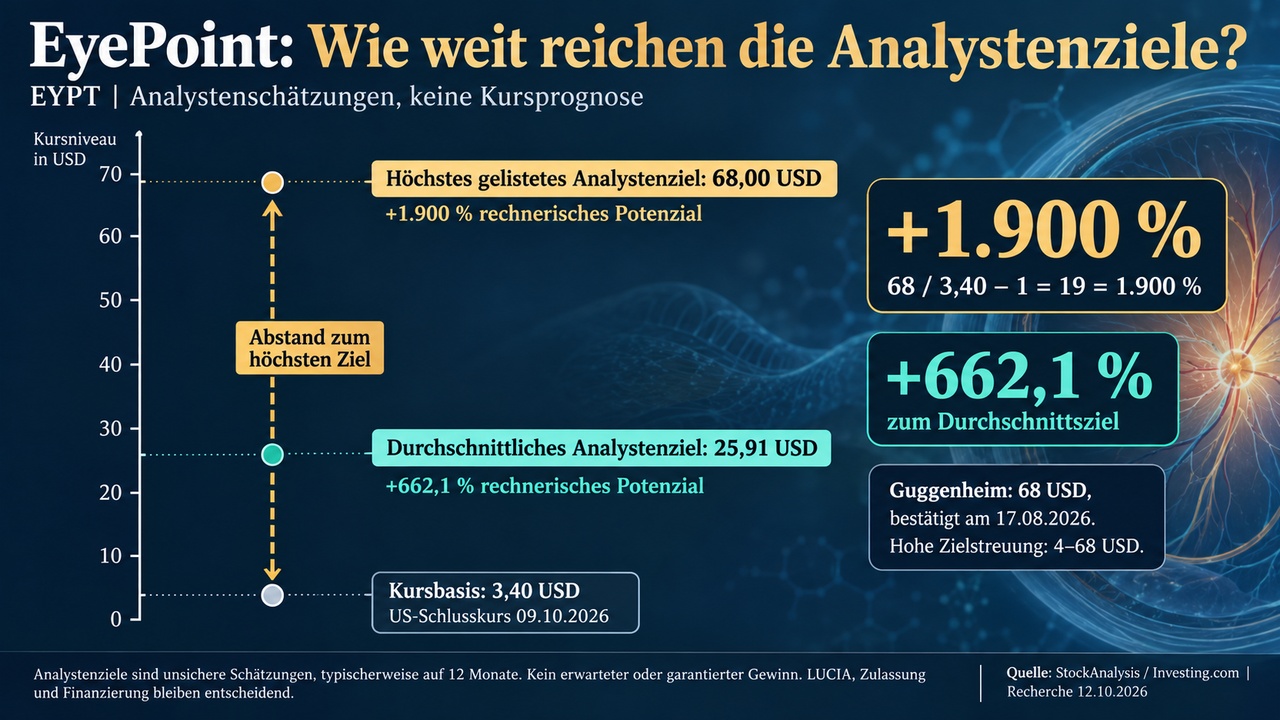
Regeneron offers EYLEA HD, now with extended dosing intervals for suitable patients. Roche has Vabysmo and Susvimo. Ocular Therapeutix is also developing a long-acting therapy with AXPAXLI.
Roche also published new real-world data on Vabysmo on October 1.
The competitive landscape continues to evolve.
The biggest risks:
- Another failure to meet the primary endpoint.
- Additional trials despite positive LUCIA data.
- Financing and dilution.
- Reliance on a single active ingredient.
- Manufacturing, reimbursement, and commercialization.
- Share price gaps following trial announcements.
Incidentally, the FDA warning letter mentioned in the report dates from July 2024 and concerns the YUTIQ manufacturing process at that time. It is not a new DURAVYU warning letter from October 2026. I was unable to confirm the current formal closure status with certainty.
12. Outlook—Three Scenarios Instead of a Magic Number
A positive LUCIA result could restore confidence. EyePoint is aiming for a potential regulatory filing in H1 2027; DME data from COMO and CAPRI are expected in Q4 2027. These are company plans, not guaranteed outcomes.
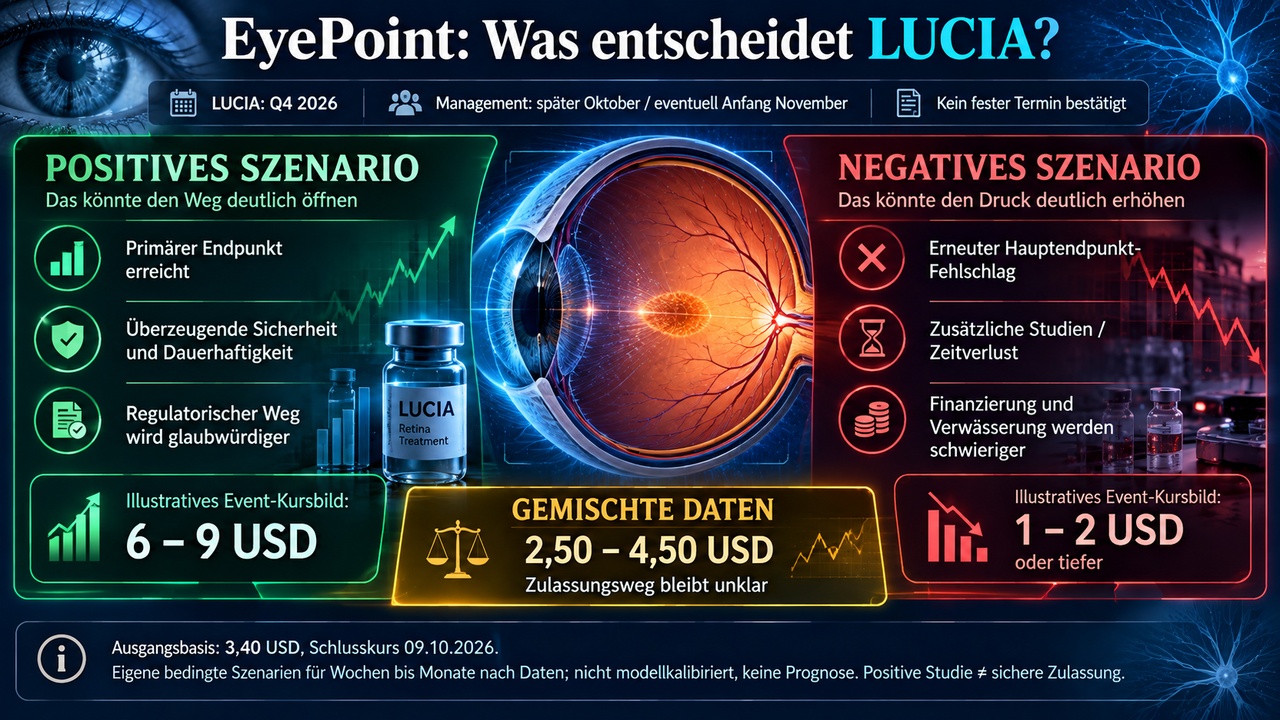
For discussion purposes, here are my own illustrative price charts for the weeks to months following LUCIA:
Positive: $6–9. Primary endpoint achieved, convincing safety profile, and a credible regulatory pathway. This would represent a significant turnaround, though not yet the valuation of an established pharmaceutical company.
Very positive: 9–13 USD. For this, additional regulatory clarity or a value-adding partner would be helpful.
Mixed: $2.50–$4.50. Interesting secondary data, but the regulatory path remains unclear.
Negative: $1–$2 or lower. Another failure, additional years of development, or unfavorable financing could trigger further significant losses.
These ranges are not model-calibrated and are not price forecasts. They translate possible scenarios into orders of magnitude. A total loss falls within the extreme risk spectrum in the long term.
A successful trial does not yet equate to corporate profit. After that, the FDA, financing, and the market await.
13. Technical Analysis – Weekly Chart
On the weekly chart:
- Price approximately $3.40
- 50-day EMA approximately $9.67
- 200-day EMA approximately $10.68
- RSI approx. 28.3
- MACD remains negative.
This is a severely damaged long-term trend.
On the daily chart, the downward momentum is easing somewhat.
The RSI is around 34.8; the MACD histogram is positive, but the lines are still below zero.
My technical observation zones:
- $3.00–$3.20: recent low range.
- $3.60–$3.80: first recovery zone.
- $4.20–$4.50: next major hurdle.
- $5.00–$5.80: previous trading zone and range toward the daily EMA50.
A bottom could be forming. A trend reversal has not yet been confirmed.
Unfortunately, “oversold” does not mean “immune to further losses.”
14. Bargain Hunter’s List – Entry Zones
$3.05–$3.25: speculative entry point.
Only after stabilization and only if a significant technical gap were tolerable. The lower entry price does not reduce the clinical risk.
$2.70–$2.90: lower speculative limit scenario.
No confirmed historical support. Following negative trial data, the previous thesis no longer applies unchanged.
Above $3.70–$3.80: Momentum variant.
Confirmation of the closing price, increased volume, and—ideally—a stable retest would be helpful. However, the next hurdle is already at $4.20–$4.50.
My preferred approach: wait for the data.
Better to pay a higher price for better evidence than a low price for a flawed thesis.
A technical trade with, for example, an entry price of $3.20, an invalidation level of $2.90, and a target of $4.20 would have a calculated CRV of about 3.3.
This CRV does not apply to holding the stock through the study announcement.
A price gap can significantly increase the actual loss.
After a positive jump, I would reassess the resistance zones and, in the event of strong price gains without clear approval prospects, also consider partial sales.
In the event of another failure to meet the primary endpoint, the rule is: first review the thesis; do not automatically sell at a discount.
15. My Personal Conclusion
EyePoint is not an empty biotech shell. It has technology, clinical activity, and a liquidity buffer. A reduced treatment burden would have real medical and economic value.
But today, we’re not buying a proven cash cow.
We’re buying into the betthat the next data set will significantly reduce the doubts raised after LUGANO.
My verdict:
🟠 Speculatively interesting – 🔴 high clinical and financial risk.
Ahead of LUCIA, I view EyePoint more as a limited event-driven speculation. As a long-term investment, I would require better clinical evidence as well as more clarity regarding approval and financing.
I wouldn’t buy just because the stock has fallen sharply. For me, waiting for the data takes priority over a larger investment at this time.
The spot in the sunroom remains reserved. But you won’t get the house key until LUCIA delivers more than just a nice excuse.
What’s your take on this: a statistical blip in LUGANO or legitimate doubts about the therapy? Constructive counterarguments are expressly welcome.
The following sources were used for this analysis:
- EyePoint Investor Relations: Company announcements and quarterly results
- SEC: EyePoint quarterly report for the second quarter of 2026
- EyePoint: Results of the Phase 3 LUGANO study
- Management Q&A at the Cantor Fitzgerald Healthcare Conference on September 10, 2026, via Quartr/StockAnalysis
- FDA: Warning letter regarding the YUTIQ manufacturing process at that time, dated July 2024
- Regeneron, Roche, and Ocular Therapeutix: Product and trial announcements regarding the competition
- StockAnalysis and Investing.com: Stock price data and analyst targets
- Investing.com Pro Research: EyePoint report provided on October 8, 2026
- Daily and weekly charts provided as of October 12, 2026
and, of course, all the others :)

