10H·

Update on my "Bausparer" portfolio

With all-time highs currently skyrocketing, I figured I’d share some positive news for a change


Less max yield—more growth


At the end of February, I started a separate portfolio that was originally funded by a home equity loan.


**Starting point:**


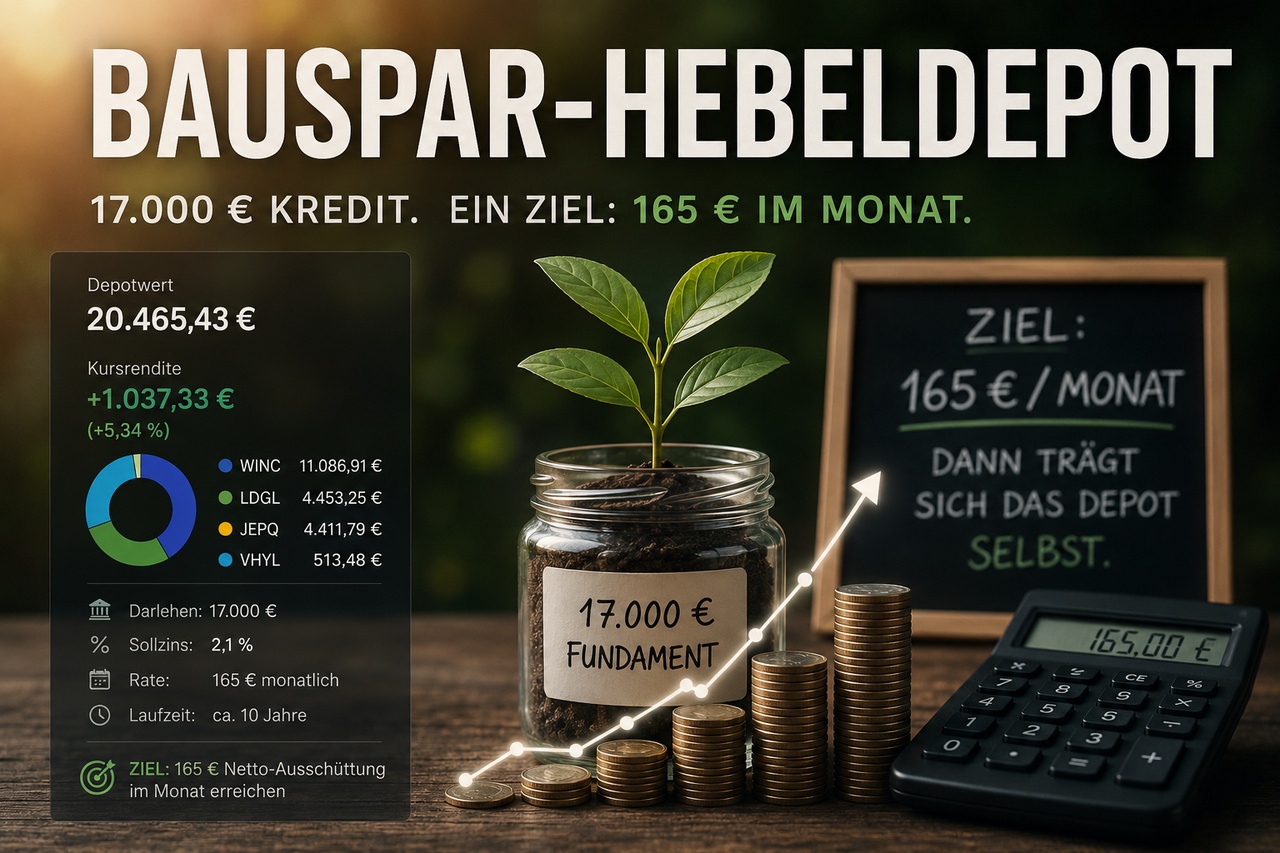
* Loan: €17,000

* Interest rate: 2.1%

* Monthly payment: €165

* Term: approx. 10 years


The basic idea is simple:


Build a portfolio that generates enough dividends over the long term to cover its own financing.


---


My status today


After just under four months, the portfolio currently looks like this:


💰 Portfolio value: **€20,465**


📈 Performance: **+€1,037 (+5.34%)**


Positions:


$WINC (-0,56%) : €11,087

$LDGL (+0,02%) : €4,453

$JEPQ (-0,88%) : €4,412 (covers the loan interest perfectly)

$VHYL (-0,23%) : €513


In addition, two savings plans are currently active:


* €250 monthly in WINC

* €250 monthly in VHYL


All dividends are reinvested.


---


## What has changed


The original portfolio consisted of:


* WINC

* JEPQ

* JEGP


After a few months, I sold the entire JEGP position and replaced it with the L&G Global Quality Dividends ETF.


Not because I think JEGP is a bad ETF.


On the contrary.


JEGP does exactly what it’s supposed to: deliver high ongoing dividends. But as many of us have noticed, unlike its counterpart on the Nasdaq, its price isn’t recovering at all.


However, it became clear to me relatively quickly that my goal isn’t to maximize dividends in the current year.


My goal is a portfolio that will still be growing in 10, 15, or 20 years, generating rising dividends.

That is why the portfolio today deliberately consists of a mix of:


* Cash Flow (JEPQ) to cover interest expenses

* High Income (WINC) to cover principal payments

* Quality dividends (LDGL) to build wealth

* Global dividend growth (VHYL) to build wealth


The actual idea behind the project


The original €17,000 forms the foundation for me.


This foundation is expanded month after month through:


* Savings plans

* Special payments

* Reinvested dividends


I do not measure success by a specific portfolio size.


The decisive milestone is:


➡️ €165 in net dividends per month.


Once the portfolio consistently generates this amount on its own, it will cover its own loan payments.


From that point on, it will be exciting to see how the system evolves under its own steam.


---


I’d be interested to know:


If your goal were not the maximum dividend today, but a long-term sustainable cash flow portfolio:


Would you have kept JEGP or also made the move toward quality dividends and dividend growth?
attachment
4Posições
€ 20.468,57
5,36%
22
13 Comentários

imagem de perfil
Stocks with high dividend growth are my high-yielders of the future. I usually aim for high personal dividend yields, especially when blue-chip and quality stocks are in a drawdown. It’s important to me that these companies reliably and significantly increase their dividends. That way, my personal dividend yield keeps growing over the years.

That’s how you beat interest rates and outperform them entirely through growth alone.
1
imagem de perfil
Looking good
imagem de perfil
I find your post and views interesting. Wouldn’t it have been possible to choose a reinvesting global ETF and, once the target amount is reached, withdraw a fixed sum once a year?

My reasoning:
With an expected average return of 8% per year, withdraw 2.1% and let the remaining gains compound to ensure the growth of the principal.
imagem de perfil
That sounds exciting; I would have taken that step toward investing in high-quality companies and dividend growth as well.
Doesn't the home savings loan have to be used for residential purposes?

Or why can you use it for your investment account?
imagem de perfil
@MoneyISnotREAL No one asks about the total
1
@GoDividend Well then! Let's go 🚀 2.1% "securities loan" these days—where... 😂

I’d still keep an eye on the total return—or rather, on your strategy and what you want to achieve. Whether you use your salary to cover the interest and principal payments on the loan or withdraw funds from your portfolio (whether through sales or dividends) is really a matter of personal preference.

The thing is, the compound interest effect can really kick in with your investment portfolio, which should definitely earn you more over time.
imagem de perfil
Hi @GoDividend
That’s a really interesting idea—I’m always up for something like that.

But two thoughts came to mind as I was reading:
(1) Monthly dividends at the target amount exceed the tax-free allowance, so your portfolio would actually need to pay out €220 gross per month to yield €165 net (once the tax-free allowance is used up—is this your only portfolio?).
(2) With 5–6% growth (dividend ETFs grow slowly), your portfolio will reach around 35k after 10 years and pay out about 150€ per month. So the portfolio won’t quite reach its goal, or it will only do so at the very end of its term. By then, however, you’ll have made 120 payments of €165 toward your loan, totaling €19,800 (just under half of which comes from dividends). Your “profit” would be about 15k (minus any taxes if you exceed the flat-rate allowance).
My question is whether you wouldn’t be better off using the €100 monthly principal payment from your own pocket if it were invested from the start in a well-performing income ETF. In other words, all without any loan at all. At €100/month over 10 years and a 7–8% return, you’d end up with €18k in your portfolio.....
imagem de perfil
@GoDividend Just to add:
I like your idea and don't think it's suboptimal at all 😅—it's just maybe riskier than necessary.

What your system definitely offers is immediate commitment starting on day one. With the €100 savings plan, compound interest doesn’t start working on a broad foundation until much later. However, you need a favorable market for this plan, precisely because you’re “locked in” for about 10 years.
imagem de perfil
@Anakreon

I actually agree with that.

In my view, the biggest advantage of my model isn’t the dividend, but the immediate investment.

The alternative would have been to invest the €165 installment—or €100 savings amount—month after month and slowly build up the portfolio.

I deliberately chose the option of putting the €17,000 into the market immediately and taking advantage of the interest rate differential between the 2.1% financing costs and the long-term expected stock return.

Of course, this only works if the markets remain favorable over the next few years.

On the other hand, the portfolio currently accounts for only about 8% of my total assets. Even if the experiment doesn’t go perfectly, it won’t jeopardize my overall strategy.

For me, therefore, it’s less of an all-or-nothing bet and more a question of:

Is €17,000 invested immediately at a 2.1% financing cost more attractive in the long term than the same amount saved up over many years?


That’s exactly why I find this experiment so exciting. 🙂
1
imagem de perfil
@GoDividend Sorry, one more thing:
Wouldn't it make more sense to let the investment grow on a reinvestment basis for the first few years and then switch to distribution ETFs? Dividend distributions do slow down growth, but then you’d have to pay the €165 entirely out of your own pocket. With dividend distributions, though, you’ll probably reach your goal too late… hmm, tricky.

I’m skeptical about whether this makes much sense with the dividend strategy.

If you absolutely have to take out a loan, it would be smarter to invest it in the MSCI World Index on a reinvestment basis for 10 years (8% p.a.) and then liquidate the 45k portfolio (of which 23k is pre-tax profit) in tranches. In the end, you’d pay more taxes on paper, but overall (and compared to the dividend strategy) less, because compound interest works on the untaxed profit for a longer period (tax deferral effect).
imagem de perfil
@GoDividend I didn't read your reply until after I'd already sent the follow-up.

But yes, it's an interesting approach, and I'll check in from time to time to see how it's going. I also like to experiment with that myself (currently with the 3xGTAA method and a momentum leaders portfolio—very volatile and not for the faint of heart 😂)
imagem de perfil
@Anakreon possible
Under this arrangement, however, I am solely responsible for the loan and interest, plus an upfront fee.
1
Participar na conversa