3Mês·

Is a rise in prices a risk? 📈

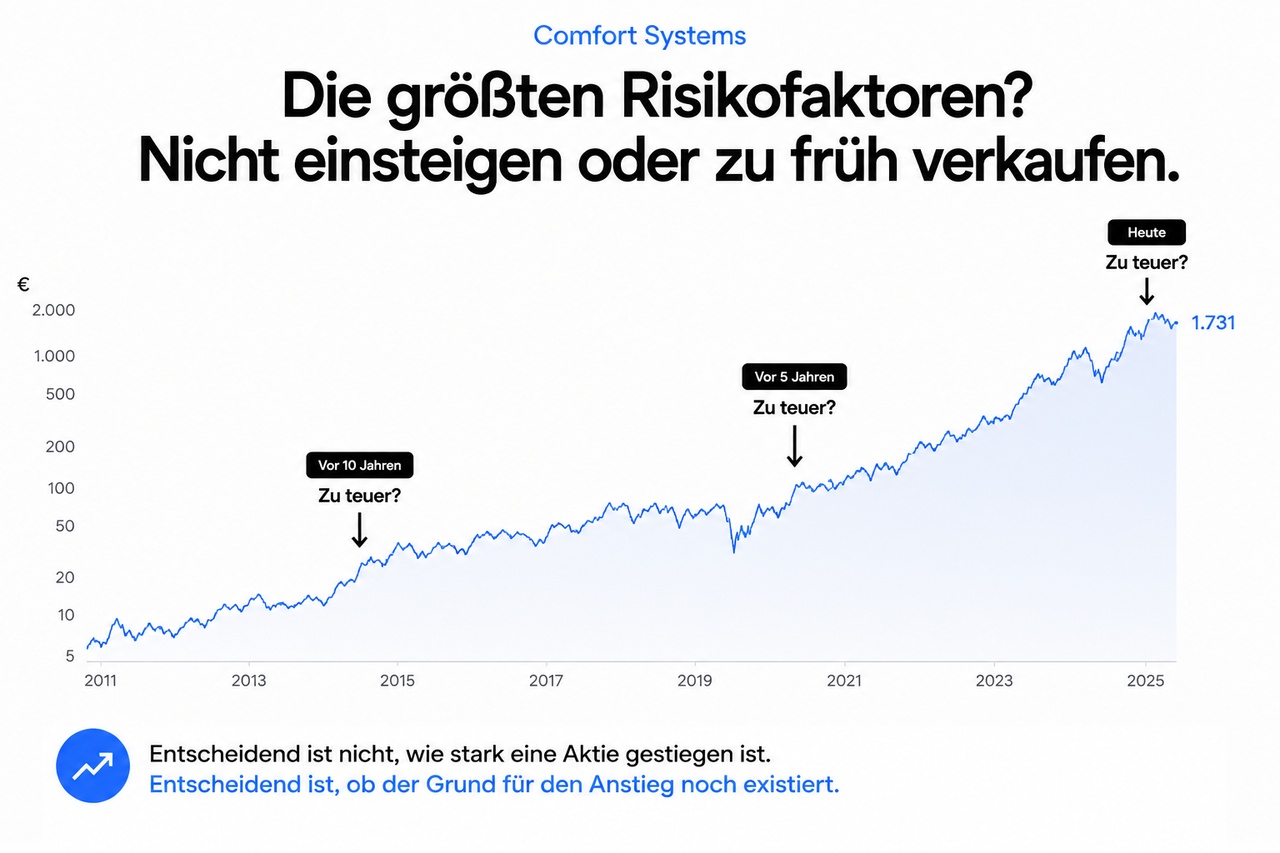
Comfort Systems $FIX (+2,55%) is a good example for me of why I don’t automatically view price increases as a risk . Many investors see a chart like this and think, “Too late. The stock has already risen too much.” I see this in comments on my posts, too.


I try to frame the question differently:


  • Why has the stock gone up?
  • And could that reason still exist in the future?


The stock market doesn’t value the past. It values the future. A rise in the stock price alone therefore says little about whether a stock is attractive or unattractive. What matters to me is whether the company continues to benefit from a structural trend or a relevant bottleneck.


That’s exactly why I focus on technologies, infrastructure, and bottlenecks every day. Some of them disappear after a short time. Others persist for a surprisingly long time.


In my view, Comfort Systems is an example of this. Quanta Services $PWR (-1,78%), Applied Materials $AMAT (+1,36%) or Monolithic Power Systems $MPWR (+4,87%) are as well. If you look back over the last 10 to 15 years, you won’t see a one-time event, but rather often a long phase of continuous value creation. Incidentally, Comfort Systems has risen by 2,445% over 5 years, 5,948% over 10 years, and 24,349% over 15 years.


Of course, this is just my personal perspective. Every investor has a different risk tolerance, different criteria, and a different investment horizon. I’m not claiming that my view is correct. I simply consider it an interesting perspective on the question of what risk actually means in the stock market.


That’s why Comfort Systems, Applied Materials, and Quanta Services are also part of my wikifolio CoreLimits, which focuses on established bottlenecks and stable companies.
attachment

#dibs
#scalelimits
#wikifolio

32
15 Comentários

imagem de perfil
I think you really have to distinguish carefully between different types of value. Are they just riding a wave right now—for example, a surge of several hundred percent in a few weeks or months—or is the company meeting a long-term need backed by a moat?
•
4
•
imagem de perfil
@Multibagger Yes, you should make that distinction. As part of my bottleneck strategy, I generally look for companies where demand is structural in nature—not temporary. Comfort Systems is a prime example of this.

However, I sometimes also bet on certain technologies gaining traction (e.g., optical I/O). That’s why I also hold stocks like Sivers Semiconductors in my portfolio and at NextLimits.
•
1
•
imagem de perfil
@ScaleLimits At $SIVE, for example, I'm already itching to jump back in after the rally. Maybe I'm wrong, but the iron is very hot.
••
imagem de perfil
@Multibagger Fortunately, my worries about Sivers are over 😅 I’ve already taken profits twice—once in my personal portfolio (> 1,000%) and once on NextLimits (> 800%). The positions have long since been closed out. Sivers will be listed on the NASDAQ soon, too.
•
1
•
imagem de perfil
@ScaleLimits But you wouldn't go out and buy more or stock up on them right now either, would you?
••
imagem de perfil
@Multibagger I won't be adding to my Sivers position now, since I've already been gradually reducing it by taking profits. If I didn't already have the stock in my portfolio, though, I'd probably buy a small position. The story could very well turn out to be a big one. But that's speculative, of course.
•
1
•
imagem de perfil
@ScaleLimits Thank you for your feedback
•
1
•
imagem de perfil
I jumped in on Sivers during its strong uptrend, and my first position is currently up 424%. I added to it a few more times after that. I believe in the story and that they can still grow really big.
@ScaleLimits I like your approach because it’s pretty much the same as mine. I’m also always on the lookout for future supply shortages, and that’s worked out very well for me so far.
•
2
•
imagem de perfil
@Investment_Inka What other undervalued stocks have you identified and invested in—especially those that @ScaleLimits hasn't discovered yet? And would you still invest in $SIVE now?
••
imagem de perfil
@Simpson Isn't that your best horse in the stable?
•
1
•
imagem de perfil
@Tenbagger2024 When it comes to financial returns, the second-best bet after Apple 😁
•
2
•
imagem de perfil
@Simpson That's pretty much how I remembered it. But given Apple's rather lackluster performance right now, this stock should become your best bet in the long run.
•
1
•
imagem de perfil
However, it only seems so clear in hindsight. It’s a mix of hindsight bias, survivorship bias, and outcome bias. The question is, for how many stocks did this not work—would it have been better not to buy them or to sell them too early?
••
imagem de perfil
@Dirty30 Nor is this article intended to present a method for stock selection. My focus is on a different point: Many investors rule out companies solely because of a sharp rise in their stock price. It is precisely this fallacy that I wanted to address.
•
4
•
imagem de perfil
I had to learn that this doesn’t work. A company can continue to produce the best products in its field and still see its stock price drop by 90% and never recover. Even though the reason for the rise hasn’t changed, there’s a much stronger reason for the stock’s decline—for example, a drop in demand or new market entrants.

There are plenty of examples of this, and I have almost all of them in my portfolio.
••
Participar na conversa