

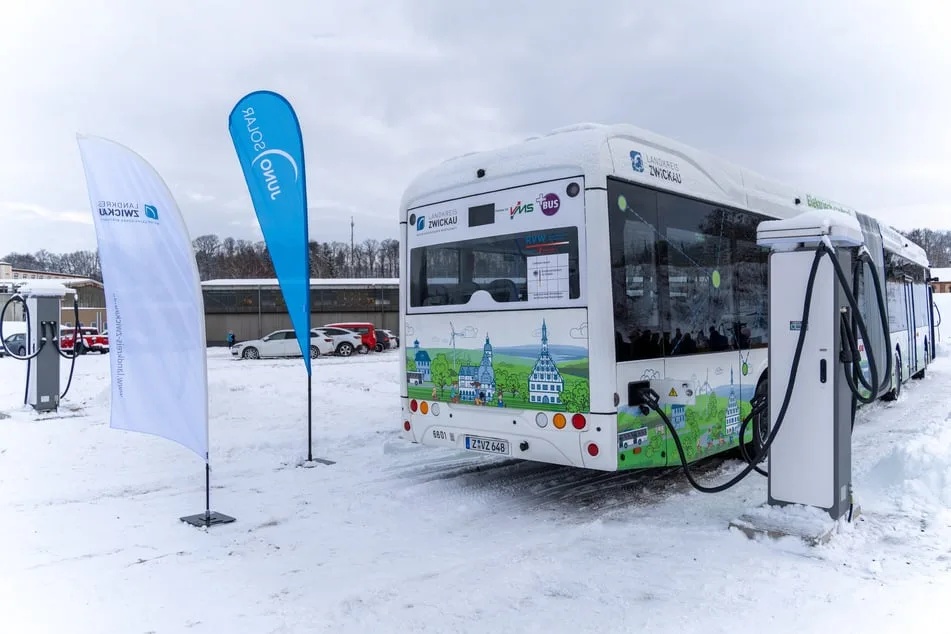
At the end of 2023, when the district of Zwickau extended the operating contract with Transdev subsidiary RVW, it was announced that more than half of the 100 buses in operation would be fully electric in the new contract period between 2026 and 2035.
Now the time has come and the new e-bus fleet is starting operations - with financial support from the Free State of Saxony, which approved around 4.1 million euros for the procurement of five minibuses, three standard buses and, above all, 51 electric regular-service buses for RVW as part of the RL Bus funding program in summer 2024.
"With the start of the new transport contract, we are taking an important step towards the future of local public transport. We are taking responsibility for climate protection and offering the citizens of the district of Zwickau a modern, sustainable mobility solution," says District Administrator Carsten Michaelis. "The district of Zwickau is not only becoming a pioneer in rural areas, but also a flagship project for electromobility in regional transport."
Around 70 percent of the 4.1 million kilometers travelled annually on regional bus services will now be covered by electric vehicles. According to the district of Zwickau, this makes it one of the first regions in Germany to achieve such a high proportion of electrically powered buses in local public transport.
Neither the district nor Transdev are revealing which bus models are being used. However, a photo in the "Freie Presse" newspaper clearly shows that these are solo and articulated buses from the Chinese manufacturer BYD $1211 (-0,23%) are involved.
A picture from the news portal "Tag 24" shows a Sprinter-sized minibus. This is likely to be an electric minibus based on a Sprinter panel van from the specialist HEERO from Ismaning near Munich. However, it is not known how many vehicles of which model are in use and whether RVW may be using other electric models.
André Jalowy, Managing Director of Regionalverkehr Westsachsen (RVW), says in any case: "The electric buses are not only environmentally friendly, but also more economical to operate. This makes the changeover both sustainable and cost-effective in the long term. As a long-standing operator of public transport in the district of Zwickau, we are proud to be able to shape the new contract period together with the district of Zwickau."
》PV system and BESS to power charging stations《
RVW has also purchased the appropriate charging infrastructure for the new electric buses. Juno Solar has installed twelve charging points at the Werdau site: "With the charging points and charging infrastructure, we are making another important contribution to electromobility and supporting the conversion of public transport in the Zwickau district," emphasizes Denny Schädlich, Managing Director of Juno Solar "At the same time, we hope that this project will also encourage other companies to take the step towards electrifying their own vehicle fleets."
According to Juno Solar and Wattkraft, another company involved in the project, the charging stations come from Chinese manufacturer Huawei $833427In concrete terms, they are likely to be several dispensers from the FusionCharge system.
In future, the e-buses will be charged with electricity from a 450 kWp photovoltaic system, which can be temporarily stored in a stationary battery storage system (BESS) with a capacity of 1,600 kWh. This will make it possible to charge the electric buses at night with electricity from the PV system or the BESS.


