4H·

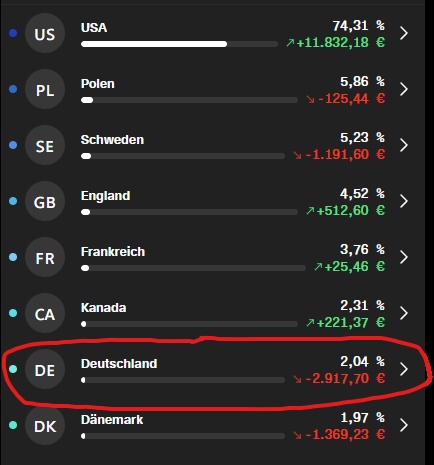
This country is a disaster and should be banned !!!1Itself

Okay, today a little "shitposting" (or as the Germans would say: shitposting).


But you really have to realize how bad the German stock market is actually doing. I really think it's my biggest rookie mistake as an individual stock investor that I bought into this nonsense about "global diversification" and "broad diversification" in the first place.


There are simply countries that are un-diversifiable on average, and unfortunately these include not only various emerging markets but increasingly also some European nations.


And this is actually structural. Topics such as "small caps" and "hidden champions" in particular can now be flushed down the toilet because politicians ... let's say ... create suboptimal economic conditions in Europe.


What we are seeing here is not exclusively due to poor stock picking, but is also indicative of how badly the German stock market as a whole is doing. You can look at the ETX index $DEAM (-0,18%) index and see that the MDAX (which still forms the backbone of the German economy) has not generated any returns at all over a five-year period.


Does anyone remember that a few years ago it was always said that Germany didn't have any great global corporations in the IT sector, but that German SMEs with their technology leaders and highly specialized niche providers would make up for everything? What's left of that? Fiddlesticks! Whether $RAA (-1,28%) or $NEM (-2,08%) or $AFX (-0,53%) or $SRT (-1,98%) or $BC8 (-0,61%) - many German beacons of hope, especially in future markets, have failed and all at the same time. Let's not even start with BionTech this time.


Meanwhile, the DAX is increasingly becoming a "pensioners' get-together" of companies, some of which are 100 to 150 years old and fill the index with their spin-offs. Thus $FRE (-1,84%) Fresenius is represented twice, $MBG (-0,44%) Mercedes is represented twice and $SIE (-1,01%) Siemens is even represented four times. These three companies alone fill eight places in the DAX, while success stories from the rise of a company from an SME to a group like Qiagen are almost non-existent. And in the case of Qiagen, too, we will first have to see whether the company can hold its own in the "Bundesliga" in the long term.


To be honest, the fact that the DAX is still doing relatively well is only due to the success of a few companies and their size advantage, which allows them to lobby at both federal and European level. However, the weaker Germany becomes, the less it will be possible in the long term for finance ministers to use their room for maneuver to the benefit of corporations or for foreign ministers to lobby for international trade agreements.


Unfortunately, things don't look very good in the rest of Europe either. However, the level of economic decline here is not that high anyway. Many European countries have never defined themselves as "economic nations" anyway, but see themselves as cultural nations. But here, too, you can take a look at what has become of the pearls of the European stock markets. The top 10 in Europe are now full of British and Swiss companies, while the heavyweights from Germany and France are losing more and more ground. Yes, Siemens is holding its own, but the German flagship industry used to be car manufacturing. And the only 5-star company in the EU is ASML.


I've now written much more than I wanted to for a fun post and don't even know what point I wanted to make.

I don't know, don't buy so many dubious individual stocks from dubious countries just because you want to diversify. Only buy the best stocks and if you can't think of anything else, put the rest in the S&P 500.

attachment
13
17 Commenti

immagine del profilo
Things are definitely not going so well in Germany at the moment. I know a few people who are back on short-time work, mainly friends who work in industrial companies. A crisis-proof job is worth its weight in gold these days.

I've also sold my European and emerging markets ETFs because I personally think that you mess up your returns with too much diversification and different positions, even if many YouTube influencers preach otherwise.

I would also just like to randomly comment on how cool I think it is to discuss the capital market and stock market topics here. I can't talk to anyone else about it because no one in my circle of friends and acquaintances is even remotely interested.

Thank you very much, guys! 🫡
10
immagine del profilo
@ZPark91 You are not alone 🫂
2
immagine del profilo
@ZPark91 It's the same for me😒
immagine del profilo
At least you guys appears on the chart… ✌🏼😭 my country’s situation is even worse…
If you think Germany economic situation is bad, try to survive Italy… we are literally in a never ending economic crisis since 2008. A lot of industries close everyday and delocalize. we are the only country in Europe with less purchase power than 20 years ago (even Greece did better than us).
Unemployment is extremely high, even if you have a job your salary is 2 times less than what you make in Germany but the cost of leaving is higher than Germany itself.
This situation caused a massive birth collapse and that’s why my country will disappear before 2100.
It’s impossible living here, I will not be surprised if Italy will collapse like Greece in the next 10 years.
I hate living here and I hate being italian.
To summarize: Germany situation is not as bad as you think it is.
3
immagine del profilo
@TheMaverick Interesting to hear an Italian perspective. Because Italy is one of those "culture nations" that historically didn't care about their economy that much anyway.

I always thought Italians are a lot more happy with life even though they suffer from the same issues that Germany has now since the 90s already.

A thing you might find interesting/comforting is this comparison: https://www.bpb.de/kurz-knapp/zahlen-und-fakten/sozialbericht-2024/553236/vermoegen-im-europaeischen-vergleich/

A key takeaway as seen in the first chart is that Italians are among the most wealthiest Europeans still. Sure the income in Italy is bad and continues to be bad but the median Italian person still has a lot of assets and equity: 159 Tsd. Euros compared to only 107 Tsd. Euros in Germany. That's almost +50%

The main reason for that is that Italians usually have a place to live in like a house or apartment in their own or their families name. Almost 80% of Italians have their own home. In Germany only 40% have their own home while most people are entirely dependent to rent someone else's property for housing.
1
immagine del profilo
If necessary, the MSCI World can also be used as a backup. But the worst portfolio is this 75/25 thing with the EM IMI, just because you're afraid of making the wrong decision or because you tell yourself that India is bound to clean up the Ganges and introduce traffic rules at some point.
2
immagine del profilo
@Soprano blindly adding emerging markets to your portfolio is really not a good idea. I prefer the MSCI Developed World Index to anything else.
1
immagine del profilo
@Soprano In general, an ETF strategy that you follow is either always based on the fear of being wrong, or dealing with individual stocks is too time-consuming, or you simply don't want to deal with stocks yourself.
That is perfectly ok. You just shouldn't complain that you always buy a lot of crap that underperforms.
However, what you say is only partially true with regard to small and mid-caps in Germany. There have been various high-flyers in the last 12-18 months that could have been picked.
$AIXA $HOT , $LPK, to name just 3.
Of course, this requires a higher willingness to take risks and also more time. But these opportunities exist both in Germany and in Europe.
2
immagine del profilo
@Multibagger Well, I'm not saying that you can't make money with German shares and that there are no second-line stocks for a trading portfolio. Infineon shareholders are also happy at the moment. But you also have to distinguish whether the companies are in a better position than a few years ago or whether there has simply been a multiple expansion.

LPKF's turnover in 2025 was almost the same as in 2011, and probably even lower when adjusted for inflation.
Hochtief still had a profit margin of 2% - here, too, the P/E ratio was simply beaten up from 15 to 45. Aixtron also has a P/E ratio of 70, Infineon over 100

None of the companies have really earned the money they want to earn yet, these are advance praise.

And in contrast to US companies that are valued at a P/E ratio of 10 to 20, German companies rarely manage to meet these market expectations or maintain their phased growth over several years.
1
immagine del profilo
@Soprano I'm with you there
1
immagine del profilo
@Soprano So I love my $EIMI. So far it has performed better than my S&P500 and I see a lot of potential here in the future.
immagine del profilo
@Da_Fischi It had a good year before that, but also underperformed for 10 years.
immagine del profilo
@Soprano *2 good years - but if you look at the historical development between Developed and EM, it may well be that the trend has switched back to EM 🔮
immagine del profilo
If you want to "shitpost", you have to think about whether you're serious or not. 😘
2
immagine del profilo
@SchlaubiSchlumpf I sometimes find it difficult to satirize reality. A lot of things are simply too true to be beautiful these days.
1
immagine del profilo
I think your poor performance in Germany is due to your stock picking.

Try putting a stop-loss in your portfolio, because there were plenty of times when you could sell $AFX -10%, -20% or -30% before it went to -60%. But it did nothing.

A simple DAX ETF $EXS1 would have made your German exposure look completely different.

Germany is not un-investable. The whole of Europe is.
immagine del profilo
@TechNav Well, I certainly could/must have limited the loss. But it's not bad stock picking. I bought companies with good technology, healthy balance sheets, solid valuations and undistruptable moats.

When investing in individual stocks, you are actually primarily looking at company-specific risks, such as the competition simply becoming too strong, rather than structural things like tariff wars, export restrictions, etc: Customs wars, export restrictions, electricity price explosions and skills shortages that bring the company to its knees.

As I said, it affects the entire MDAX. I could have chosen almost any company there and would have been hit more or less hard depending on when I entered.

As I said about the DAX: fundamentally, things are not going well here either. There are individual companies with a good order situation, a few with good relations to Berlin and Brussels. But here, too, the champagne corks are no longer popping.
1
Partecipa alla conversazione