3G·

The snowball is getting bigger. My Dividend Recap 📶

This post has no value for you unless you're a dividend investor!


So far, my portfolio has generated a return of just under 5 years around €11,000 in net dividends. For the next €11,000 , it will likely take not another five years, but a little more than two. If the dividends are reinvested, it will happen even faster.
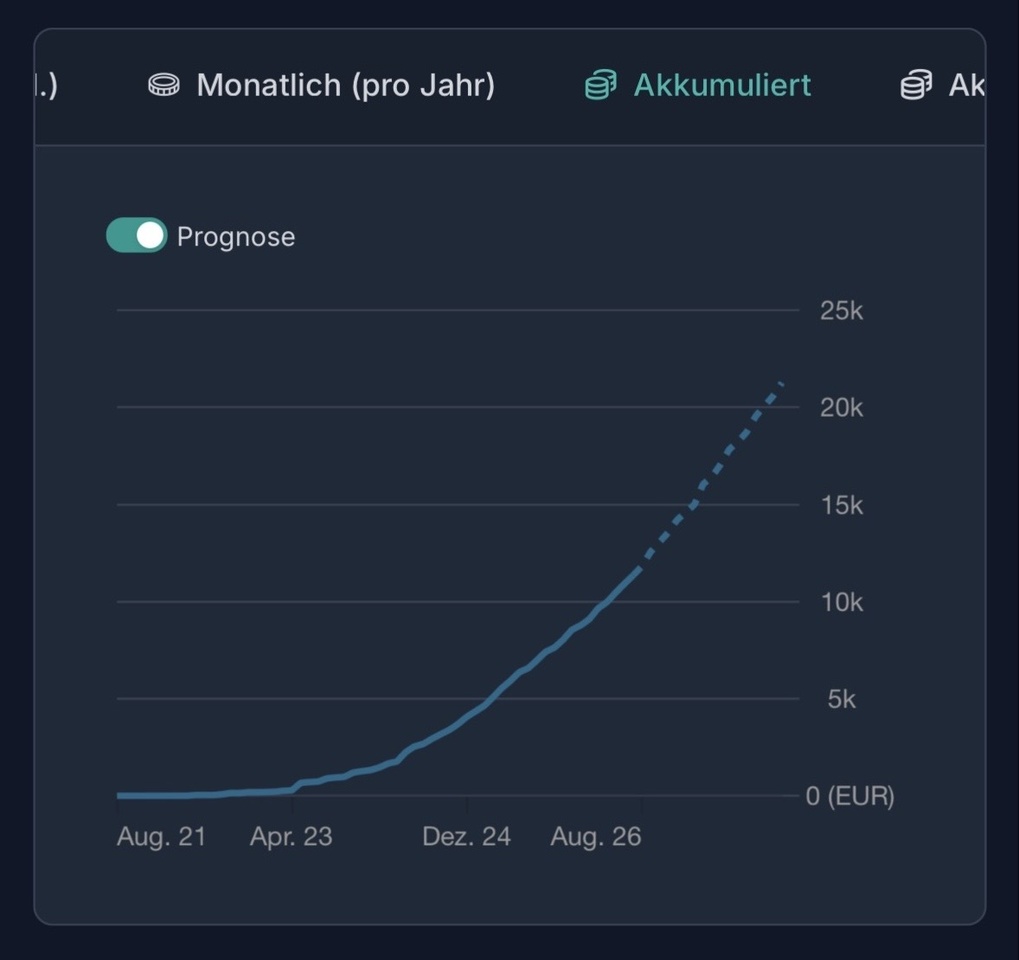
attachment

My portfolio currently pays out over €400 net in dividends, which currently amounts to a 3% net dividend yield based on my portfolio. I think that the net quarterly dividend will increase to approximately €3,000 per quarter over the next 3 to 4 years. It took 5 years to reach that amount.
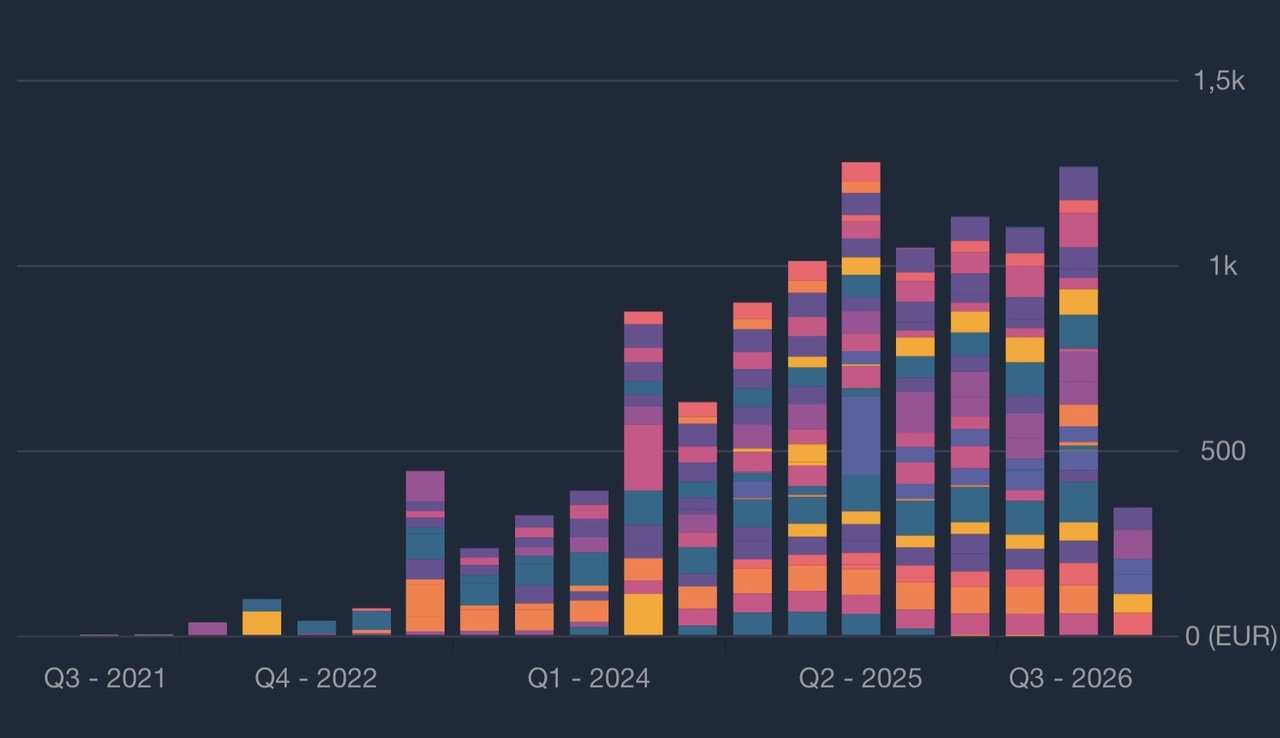
attachment

The dividends are specifically reinvested thatthat offer an attractive dividend yield and, at the same time, increase their payouts by more than 8% year after year. Dividend Growth


As a result, the dividend should grow through the compound interest effect grow exponentially over the long term.


My first major goal is €10,000 in dividends per year. That’s roughly equivalent to the effect of a portfolio worth €10,000 were to grow by 7 to 8% … but in the form of dividends ⛄️ Provided, of course, that the companies can maintain this standard over the long term. 💪
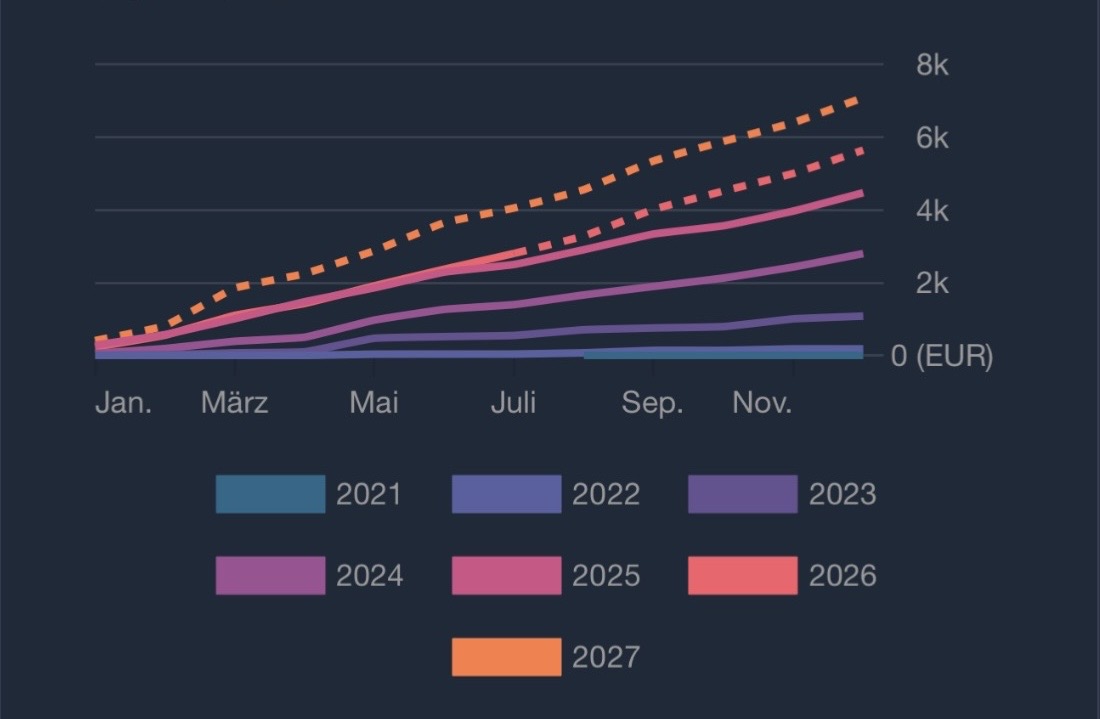
attachment


Actually, I wanted to reach the €10,000 in gross dividends per year by the end of the year. Instead, I’ve deliberately focused on adding companies to my portfolio that I absolutely want to own for the long term, regardless of their current dividend yield.

Well, not entirely independent of the dividend yield... I’ve made it a habitto buy stocks when they happen to stumble , so I can secure a good entry yield . This way, earn interest earn a high personal dividend yield.
I call this “drawdown investing.” However, I absolutely do not recommend this TO ANYONE, because you’ll often end up a falling knife than into a bowl full of gifts! :D


These include, among other things, $MCD (-0,06%)
$MSFT (-0,09%)
$UNH (+0,16%) and $HD (+0,07%) etc… very valuable for my strategy


These companies have excellent dividend growth. Together with the other stocks in the portfolio, they should reach the goal of €10,000 per year—and significantly exceed it—over time.


Ultimately, I’m aiming for a combination of steady price growth, high-quality dividends, and dividend growth, so that there’s always something to buy more of in the long run.


I wanted to show you, without any context, what it might look like once the dividend snowball starts rolling.

attachment

*Not investment advice*

63
24 Commenti

immagine del profilo
I like your approach and, above all, your strategy. I’m pretty much on the same page as you when it comes to the income aspect of my investment—my goal is to have additional income in my old age.

​For the Stoic Dividend Foundation, I follow these rules:

​1. The Dividend Filter (Income Basis)

​Dividend yield: At least ≥ 3.5%. I’ll only accept a lower yield in exceptional cases, when dividend growth is extremely high and the balance sheet is absolutely rock-solid.

​Sustainability: No “pseudo-dividends” drawn from equity or financed by new debt. The dividend must be fully covered by actual cash flow.

​2. The Most Important Valuation Ratios

​Whenever I analyze a company, I routinely calculate and review these five ratios:

​P/E Ratio (Price-to-Earnings Ratio): Must align with earnings power to avoid including overpriced stocks in the portfolio.

​P/CF (Price-to-Cash Flow Ratio): Extremely important for assessing net asset value.

​P/S (Price-to-Sales Ratio): Used to contextualize the fundamental valuation within the industry.

​P/B Ratio (Price-to-Book Ratio): Shows me how the market values the company’s net asset value.

​Dividend Yield: (calculated based on the current market price).

​3. The Cash Flow Quality Formula (The Cash Machine)

An FCF yield of > 5% is considered attractive; at > 8%, it is very attractive.

A negative FCF is an absolute deal-breaker for the earnings foundation.

​4. The Ironclad Exclusion Rules (Immediate Veto)

​I won’t buy the stock if:

​Revenue growth is stagnant or negative.
​The operating margin is consistently < 5%.

​The narrative becomes more important than the raw numbers (no stocks based purely on hype or wishful thinking).

I’ll see if there are any stocks in your portfolio that might be right for me.

Have a great weekend
16
immagine del profilo
@Raketentoni That's a great list—those are definitely very important criteria for a strategy like this. However, if you get too caught up in individual metrics, you often lose sight of the big picture. Furthermore, metrics can vary significantly from sector to sector, which is why you should always evaluate companies within the context of their respective industries.
1
immagine del profilo
@PoorDad First of all, congratulations on what you’ve already built up! It’s exactly this snowball effect that makes long-term dividend investing so exciting to me!

I also find the 8%+ dividend growth to be an interesting approach. But I’d be curious to know what other metrics or criteria you primarily focus on when selecting your companies.
1
immagine del profilo
@DividendenPapa Thanks! I look at several key metrics. But these are the most important ones: First and foremost, a growing company. A company that isn’t growing can’t increase its dividend in the long run. After all, that’s what’s implied by the word “growth.”

When gross margins exceed 40%, I take a closer look. Low debt is also a huge advantage because the money isn’t lost to interest payments but can serve as a buffer for future dividend increases.

Return on equity and similar metrics also play an important role. However, revenue growth, profit growth, and free cash flow are among the most important figures for me.
2
immagine del profilo
@PoorDad Thanks for sharing. That actually aligns pretty closely with my approach. Revenue growth, profit growth, and strong free cash flow are also among the most important metrics for me.

I’ve even set up a small pre-screening process for my watchlist that filters companies based on exactly these criteria before I begin a full analysis. While I weight the metrics slightly differently depending on the type of company, I generally look for high-growth companies with sustainable cash generation and a healthy payout ratio. It’s important to me that dividends are financed by a strong operating business and don’t come at the expense of the company’s net worth.
1
immagine del profilo
Great. I think the chart really shows how the whole thing is gaining more and more momentum. I also find dividends very motivating for staying on track with my investing.
1
immagine del profilo
@NichtRelevant It's definitely very motivating to see a new, bigger bar appear every time. It's getting more and more impressive 😄🥳
1
immagine del profilo
I have a question about this, because that’s how I’d always seen it until my tax advisor took a different view. Doesn’t the more favorable tax treatment of accumulating ETFs actually push us in that direction? (In the long run)
1
immagine del profilo
@Alesch The biggest advantage for me is having full control over my portfolio. I love getting up early on the weekends, sipping coffee while I analyze my portfolio and do a lot of thinking. With an ETF, I wouldn't have those perks. But in the end, the joy I get from it is simply the biggest advantage, regardless of everything else.
1
Hmm, that’s what I thought, too, but since I don’t have time to pick out individual companies, I’ve limited myself to four ETFs that pay dividends quarterly, and now I’m going to try to maximize my savings as much as possible. My goal is to maybe cut back to 80% of my current workload soon and make up the difference with my dividends.
1
immagine del profilo
@AxelS That sounds like a plan. Keep it up!
immagine del profilo
Congratulations—you're on the right track! I'm also counting on dividends, and my projection for 2027 is already over 12k gross. I find it motivating when I don't just have to hope for capital gains, but actually get "real money"!
1
immagine del profilo
@Svengus A lot of people are against it and talk it down. But I hope you reach your next destination as soon as possible🏁
Is $GIS part of your investment strategy?
immagine del profilo
@PoorDad if dividend is the strategy isn't $GIS something with yield close to 7%
1
immagine del profilo
@stocker_119 I don't like buying stocks just because of a high dividend yield. Sometimes, it's actually a red flag. I sold GIS to buy another company where I see more potential. Of course, I think GIS will achieve a turnaround, but no longer in my portfolio, because the company is currently struggling to keep up with its peer group.
2
Are you currently interested in Accenture?
immagine del profilo
@Robin2100 Accenture is my most recent addition
1
immagine del profilo
I also didn’t start building up a portfolio until 2021—a bit by trial and error, and of course, by learning the hard way. Currently, with about 150KEuro in the portfolio, roughly 80KEuro of that is invested in dividend-paying stocks, which CURRENTLY generates a gross monthly dividend income of about 1,200 Euro. And the trend is upward. The reason behind this move was the partial retirement offer I accepted three years ago—the active phase will end this year, after which I’ll enter the passive phase for another three years at the same salary. Let’s see what kind of growth we can still achieve with that. These are mainly ETFs, preferably those from GlobalX, which are based in Ireland and are therefore exempt from withholding tax. There are plenty of other investment companies as well, most notably Blackrock Capital (BCAT)—that alone pays out over 300 euros every month, which is reinvested immediately. To round out the diversification, I’ve included holdings like RWE, SITC, Suntien Green Energy, Hercules Capital, as well as Whitehorse, Oxford Lane, Oxford Square, Windenergie, and several other shipping companies, etc., etc.—it’s just very heavily diversified. I’m aiming to increase my dividend income to at least 2K gross per month within three years. Then I would have maintained my salary level even with the statutory pension starting at age 65 (with reductions). Unadjusted for inflation, of course.
immagine del profilo
@ZaphodB Not bad—so let me get this right… you invested 80K in a way that pays out €1,200 a month?
Hello @PoorDad,
Thank you for sharing your ideas with us. Can you explain why you decided against dividend ETFs and in favor of hand-picking individual dividend stocks, as @AxelS had already described?
I invest monthly in a Van Eck dividend ETF, which has posted a price gain of about 26% over the last 12 months and pays a 3% dividend. Combined with three other ETFs, this results in a quarterly dividend payout.

Thanks, and continued success. I firmly believe in the power of compound interest, even with dividends, which, by the way, are also less sensitive to price corrections.
immagine del profilo
@CashCovv Hi! My first books on the stock market were by Peter Lynch. From them, I learned how to see things through the “Lynch lens” when observing, from morning to night, the companies we deal with every day. From brushing my teeth to eating breakfast to driving, when I stop in front of stores, while shopping, or when I notice where lines are forming and people are gathering to get something.

In the early days, I learned from those books how to evaluate companies for the future, and that’s how my strategy took shape. I’m actually still in the early stages.

It just turned into a passion, and I love buying, holding, and selling stocks. I also love receiving my dividends directly from the company.

I don’t see anything wrong with ETFs or stocks. I just find one of them more appealing.
@PoorDad Thanks for the quick reply. I can see where you're coming from.

Keep up the good work, and have fun!
Partecipa alla conversazione