1G·

Depot conversion? 😊

Good evening getquin community,


First of all, a bit about me:

I am 25 years old and have been investing for 2.5 years. I'm currently training to become a technical product designer because I just didn't like my old job anymore. In relation to this, my monthly savings rate is "only" around €400. In 1.5 years, however, I will have finished my training and my savings rate will increase.


Now to my problem:

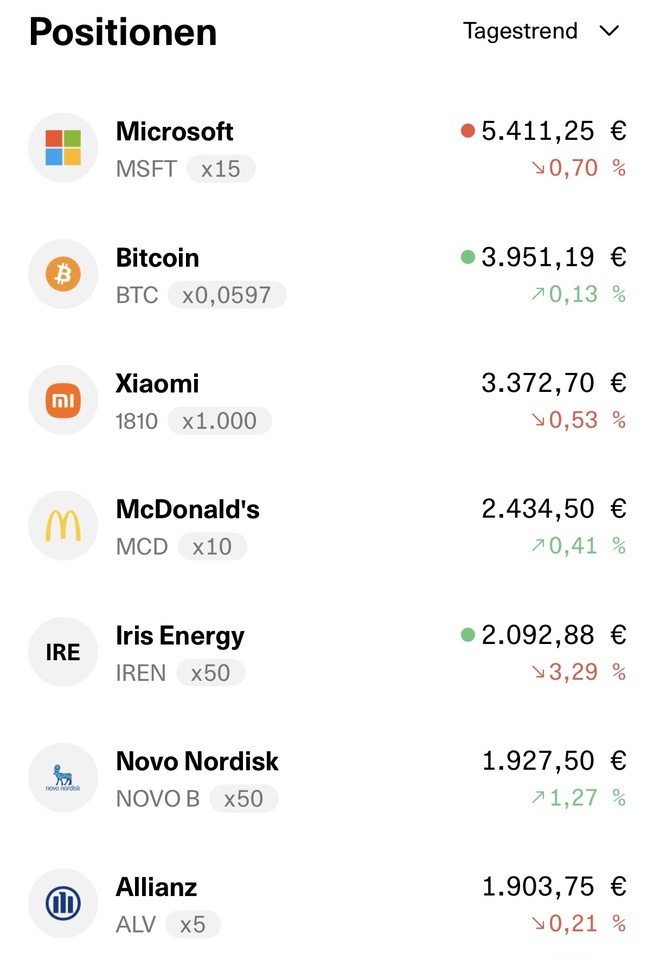
I have a - in my opinion - (very) vulnerable portfolio where there is some gambling involved. Maybe that's because I think I want to get a lot out of it with a low savings rate per month. So far, however, nothing has really gone wrong. In any case, I'm happy with the companies I've chosen in the long term. Despite all this, I can't get rid of the idea of simply investing stubbornly in 2 ETFs and continuing to invest in Bitcoin. That would put less stress on my inner self and I can just let my savings plan run its course.


How would you go about it? Continue with the current portfolio and buy on dips? What is your opinion on my current portfolio? Do you think I am better off with 2x ETF ($IWDA (+1,01%) & $EIMI) (+1,99%) and 1x $BTC (+0,97%) better?


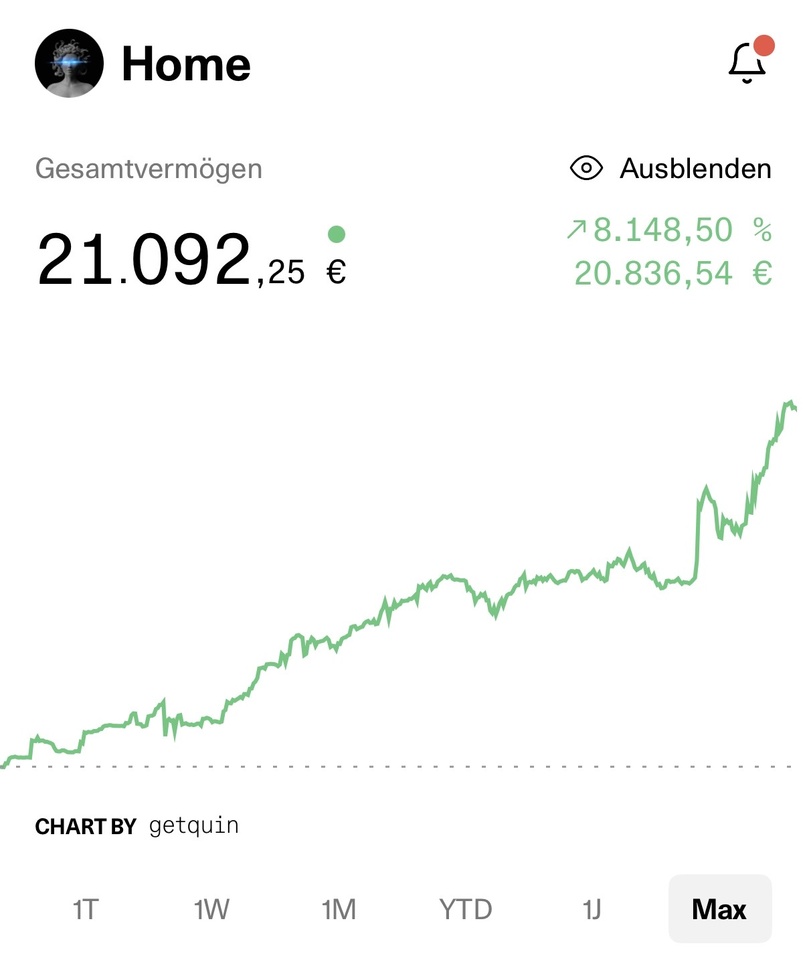
Attached is my current portfolio.


I look forward to any comments and would be grateful if you could help me with my decision!😊🐍☝🏼
attachment
attachment
10
26 Commenti

immagine del profilo
In the long term, it is very difficult to beat the MSCI World. Many have tried, but few have succeeded.

Boring is sometimes better, in the long run you are probably better off with a 70/30 or 100% all world.

But since you've already started, you could consider selling your Microsoft, MC Donald and Allianz shares and putting them into one or more ETFs. The core, so to speak. You can then add speculative stocks such as Xiaomi, Iren and Novo Nordisk as satellites. I also have all three in my portfolio. Bitcoin as well.

But as I said, boring is usually better.

You can also save in an All World and add the Nasdaq100, there are several options.

It is important to think about a strategy: when do I get out, when do I buy in, how long is my investment horizon, etc...
6
immagine del profilo
@SchmonInvest Yes, I can only agree with that. An alternative to the nasdaq might also be the World Momentum if you want to reduce your US exposure. But basically there's nothing wrong with an All World / World + small return booster, depending on your risk appetite. Less is more 😉
immagine del profilo
@SchmonInvest the problem with trying to beat the MSCI world is not the attempt itself but HOW most people try! There could be many more investors trying to beat the MSCI world, but most are taking the wrong approach
1
immagine del profilo
@SchmonInvest 70/30 or all world which one you prefer and why? thanks
immagine del profilo
@Krush82 You're always smarter with hindsight. What is your approach?
immagine del profilo
@SchmonInvest Thank you for the detailed comment!
1
immagine del profilo
@SchmonInvest my approach is the focused momentum approach
1
immagine del profilo
@Krush82 What do you think of momentum ETFs?
immagine del profilo
@SchmonInvest not very much, which is why I developed my own strategy
2
immagine del profilo
@Krush82 and what do you think of crypto?
immagine del profilo
@SchmonInvest perfectly ok as an add-on - but do not see the outperformance of past days in the near future
Visualizza un'altra risposta
One is the question: at what risk would you beat the world market? The next question: Reliable over a long period (> 15 years)?

There are many possibilities, but I doubt very much that you can beat the world market within the equity universe at the same risk. The correlation within the stocks is so high ...

The other question: do you really have to beat it? Most people become wealthy not because they have achieved incredible returns, but because they have been disciplined over a long period of time. The biggest lever in your wealth pool is yourself! Increase your human capital, i.e. further education after training, more salary, ... These are your levers. Whether you take share A, which has a correlation of 0.8 to the global market. That won't take it out, rather increase your risk (individual value risk). If you really have a top pick, it was more luck than skill.

Next: How much time do you want to invest? You would have to multiply your invested time by your hourly rate and subtract it from the excess return of a stock (compared to the global market), as a cost due to labor, so to speak: research, selection, tracking ... Otherwise it is a hobby and will cost you money. Studies show that 2/3 of all investors systematically underperform the market when choosing individual stocks - study is on stocks from the S&P500 and compared to the S&P500. The facts are against you.
To beat the market, you need strategies that are not based on "buy & hold" of individual stocks and require attention. That involves work.

Epi is about to come around the corner and contradict you on all points 😂
He pursues a completely different strategy (momentum strategy?) with different assets that he weights in relation to each other using key figures and, depending on the market situation, checks daily using key figures and, if necessary, reallocates after a short time.

So the question you want to ask yourself is: Am I overconfident and do I think I belong to the 1/3 that consistently beat the market? How much time do I want to invest? What risk is it worth to me?
3
immagine del profilo
@MoneyISnotREAL Thank you for your comment!
1
@MedusaFi With pleasure! This in no way means that you shouldn't deal with it or try it out. Just a few thoughts from a stranger on the internet. ✌️

Here on getquin there are many very readable and worthwhile contributions from some members!
immagine del profilo
@MoneyISnotREAL I'm not epi, but of course I still have to disagree 😅 the implementation of the strategy takes about 15 minutes per month. It does not have to be checked or traded daily
2
immagine del profilo
The positions are not wrong in themselves. However, I would still recommend simply setting up a savings rate on ETFs and Bitcoin for the €400 now. If the savings rate increases in the future, some of the additional money can flow back into the previous positions, for example.
2
immagine del profilo
According to my user name, I naturally think boring = dead boring. Therefore, an investment in only 2 ETFs would be out of the question for me. But I am also not afraid of high volatility. I take high risks and am confident that I can beat the MSCI World in the long term.
2
immagine del profilo
I would let the positions run and from now on let the savings installment run fully into a $SPYI.
Then you have something from both worlds and the ETF gets bigger and bigger.
1
immagine del profilo
@Wealth-Accelerator sounds good too
1
immagine del profilo
@MedusaFi I like 1 ETF solutions, you don't think much about it and just invest.
immagine del profilo
@Wealth-Accelerator has its charm. Then you no longer have to worry about how to invest, just how much.
For me, this is the best solution for anyone who has better things to do than browse through financial market theory or rebalance regularly. And that's actually most of us. Some just don't want to admit it. You should actually log out of this forum afterwards so as not to be irritated by the noise 😂
1
immagine del profilo
@SchlaubiSchlumpf or it's fun to share your experiences with other people and let them go astray for a shorter period of time 😅
1
immagine del profilo
The nice thing is that with age, you can still make mistakes. But that doesn't mean you have to make them, of course. If you feel like taking a risk with the high potential for mistakes, then keep going. Bigger upside, bigger downside. The expected value will be similar, tending to be worse, as with a broad market index. The probability of ending up at -50% could be greater with your portfolio than with the ACWI.

The problem is that the risk of individual stocks is not a structured risk factor. This means that individual stocks are not subject to a structural return advantage, but they do add structural risks. What they do give you, however, are structurally random upward and downward deviations from the market as a whole. If you want this and are prepared to accept the additional risks, go for individual stocks.
If you want to eliminate as many risks as possible but want to participate in the market premium (I don't know the German term here), broad diversification via ETFs is probably the way to go.
In my view, individual stocks always have a bit of a gambling factor. Even if some people probably disagree with me.
Partecipa alla conversazione