
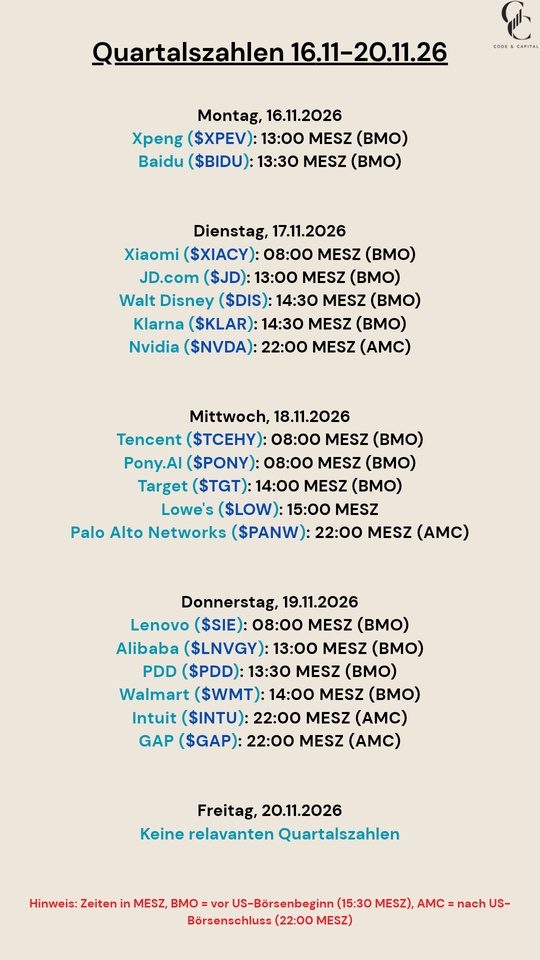
$XPEV (-4,14 %)
$BIDU (-3,97 %)
$XIACY (-3,67 %)
$JD. (-5,29 %)
$DIS (-1,8 %)
$KLAR (-12,19 %)
$NVDA (-3,15 %)
$TCEHY (-3,8 %)
$08X (-5,37 %)
$TGT (+0,66 %)
$LOW (-1,7 %)
$PANW (-1,75 %)
$BABA (-0,91 %)
$LNVGY (-6,89 %)
$PDD (+11,35 %)
$WMT (-1,09 %)
$INTU (-4,68 %)
$GPS (-4,8 %)

Intuit
Action
Action
Ticker: INTU
INTU
Price
Discussion sur INTU
Postes
584J·
Quarterly Results: Nov. 16–20, 2026
66

1Mo·
💻 New Position Opened: Intuit Inc.
Last Friday, I also added $INTU (-4,68 %) to my Blue Chip Fibonacci Portfolio.
Intuit operates in the software and financial technology sector, providing business and tax solutions used by millions of customers worldwide. I particularly like companies that combine strong brands, recurring revenues, and high switching costs.
As always, this investment isn't based on trying to predict where the stock will be next week. It's about identifying a quality business that fits my strategy and giving the investment thesis time to play out.
Looking forward to seeing how this position performs over the months and years ahead.
#trading
#long
#intu
#intuit
#stocks
#fintech
#software
#bluechipfibonacci
#usa
#mikeupegui
99
2 Commentaires
Pelo@pelo
1Mo
•
11
•Afficher la réponse
2Mo·
INTUIT delivers! And how!
Here's the hot stuff from the Intuit $INTU (-4,68 %)
(NASDAQ: INTU) Q4 & Full-Year FY26 Earnings Release, fresh off the US market close:
🚀 Top-line performance & record FY26 figures
Intuit delivers its usual strong finish in the fourth quarter and closes fiscal year 2026 with double-digit growth:
Q4 Revenue Surge: Fourth-quarter revenue climbed by +14% to over $4.28 billion, hitting analysts’ estimates ($4.27 billion) spot on.
Full Year FY26: For the full year, the platform generated brought in $21.4 billion into the coffers (+14% YoY).
Global Business Solutions as the driving force: The core segment centered on QuickBooks, Payroll, and Payments grew by +16% to $12.9 billion. The B2B ecosystem and the migration to the mid-market are running like clockwork.
🔮 Profitability & Cash Cow
While many SaaS players are struggling with margin pressure, Intuit demonstrates excellent operating leverage:
Net Income & EPS: Non-GAAP EPS for full-year FY26 jumped to $24.24 (up from $13.67 in the prior year).
Gross Margin: Best-in-class software economics with a gross margin of a robust 80.8%.
Free Cash Flow: With an FCF yield of just under 7.8% , Intuit underscores its status as a pure cash machine for shareholders.
🤖 FY27 Outlook & AI Scaling
A Conservative Reset as a Catalyst: For the new fiscal year FY27, management is laying a solid foundation and expects revenue growth to be in the range of 10 to 11% .
Focus on the AI Platform: The monetization of Intuit Assist is underway. More in-depth strategic details on AI integration and mid-market goals will follow at the Investor Day on September 17, 2026.
⚡ 💡 Jack’s Take
Not some biotech gamble, but a flawless, high-quality compounder! Intuit has done its homework. While the market has recently valued the stock like a sluggish utility (P/E ratio near a historic low at ~15x), the operating business continues to show absolute dominance with 14% growth and gross margins of over 80%. The foundation for the next bull run is in place!
2121
6 Commentaires
Thanks a lot. Just like after the last earnings report, the stock is plummeting. You don't have to understand it.
•
22
•
3Mo·
Are the biggest AI losers the next stock market winners?
Hello, everyone,
I'm staying invested in my software stocks. How about you?
$SAP (-3,36 %)
$NEM (-4,15 %)
$ADBE (-1,81 %)
$INTU (-4,68 %)
$ADSK (-4,28 %)
$ROP (-1,63 %)
$CPRT (-1,92 %)
$SNPS (-0,32 %)
$MSFT (-2,01 %)
Many investors have already written off software stocks. But what if artificial intelligence doesn’t destroy their business models—but instead makes them more valuable?
The days of software companies like Adobe, SAP, and Nemetschek are numbered, and their business models will become obsolete—this narrative has recently dominated the stock markets. The result: billions in market value were lost. Adobe fell 43 percent within a year, SAP 48 percent, and Nemetschek as much as 56 percent.
But recently, there have been increasing signs that call this view into question. Denis Machuel, CEO of Adecco, the world’s largest staffing agency, told the Reuters news agency that artificial intelligence (AI) will not trigger a job apocalypse or lead to massive job cuts. Nvidia CEO Jensen Huang also considers the assumption that so-called AI agents will render traditional software obsolete to be unfounded.
This raises the following question, particularly for investors who have recently had to absorb heavy losses in software stocks: Are the supposed losers of the AI boom poised for a comeback?
Software Companies Could Now Follow in the Footsteps of Chip Winners
Stefanie Dyballa, portfolio manager at KSW Vermögensverwaltung, sees a good chance that software companies will now catch up after chip manufacturers. AI does not render software obsolete, but rather enhances its utility. “AI agents require applications, data, and processes, making powerful software more important than ever. Established providers stand to benefit from this,” says Dyballa.
So far, investors have primarily favored companies that provide the technical infrastructure for AI—such as Nvidia, Micron, Taiwan Semiconductor, Marvell, Seagate, Western Digital, and Dell. These companies are considered the “shovel makers” of the AI boom because they provide the chips, memory, and hardware on which AI applications run.
With share price gains of more than 500 percent in some cases within a single year, they were among the biggest winners. SAP, on the other hand, has been among the weakest DAX stocks since the start of the year, down about 35 percent. But according to Dyballa, there are growing signs that the tide could be turning.
Why AI Doesn’t Work Without Software
The decline in share prices of many software and data analytics companies—such as Adobe, Intuit, Thomson Reuters, Autodesk, Roper, Copart, and Synopsys—stems primarily from concerns that AI will eventually take over tasks for which companies previously required software subscriptions. Fewer subscriptions would mean lower revenue and profits. The result would be the loss of thousands of jobs.
Jensen Huang disagrees with this assessment. He emphasizes that the markets are underestimating the impact of AI on the software industry. AI will not replace software, but rather enhance it and even increase its use. Companies will need more software in the future, not less—but it must be developed in such a way that AI agents can use it.
In this context, Dyballa points to the transition to so-called agent-based AI systems. These do not operate in isolation but access enterprise software, databases, and existing workflows. Software will not be replaced as a result, but will become the operating system for AI agents.
Why Data Is Becoming a Decisive Competitive Advantage
This trend is particularly evident in the example of the German software manufacturer Nemetschek. The company sells software for highly specialized applications in the fields of architecture, structural engineering, physics, construction management, and building management. Many investors fear that AI will eventually generate construction plans and 3D models at the push of a button, thereby rendering specialized software obsolete.
However, analysts at Deutsche Bank and JPMorgan consider this assessment too pessimistic. They cite three key reasons.
- First, with platforms such as Allplan and Bluebeam, Nemetschek has proprietary CAD and BIM data built up over decades. AI is only as good as its training data. Open AI models cannot simply replace this sensitive industry data.
- Second, the company is already integrating AI into its own products, for example through the Bluebeam Max features or the acquisition of the AI planning tool mbue. Rather than being displaced, Nemetschek is using AI to make its own offerings more attractive.
- Third, liability and precision play a crucial role. In the construction industry, AI systems cannot afford to make mistakes. Incorrect structural analysis or design data can cost millions and endanger human lives. Nemetschek’s software therefore remains the authority that verifies AI-generated designs.
Investors Are Rediscovering Software Stocks
The first reactions are already evident on the stock market. Following recent statements by Nvidia CEO Huang, numerous software stocks rose significantly. “Investors are realizing that AI not only increases the demand for computing power but also gives rise to new generations of software,” says Dyballa.
Companies such as Adobe, SAP, and Nemetschek have recently benefited from this revaluation. There is another advantage: AI tools boost the productivity of software developers. According to the expert, this reduces development costs, brings innovations to market faster, and could increase profit margins—a combination that is often viewed positively by the stock market.
Despite new opportunities, the risks remain high
Nevertheless, caution is still warranted. AI-native startups are increasing competitive pressure, and established providers must consistently adapt their products to the new agent-driven world. “Those who miss this shift will lose market share,” warns Dyballa.
For investors, therefore, careful selection remains crucial. Especially in markets with high barriers to entry and where sensitive customer data is processed, established providers such as SAP, Microsoft, and Nemetschek are likely to maintain their strong positions for the time being.
Added to this are compliance, liability, and security requirements that limit the use of autonomous AI systems. If Denis Machuel and Jensen Huang are correct, the next phase of the AI revolution is therefore unlikely to take place solely in data centers, but rather primarily in the software that companies use every day.

www.t-online.deNvidia-Chef widerspricht: Darum hat sich der Markt bei Software-Aktien gründlich geirrt
4343
27 Commentaires
3Mo
In my opinion, this is the biggest opportunity right now. I'm buying MSFT and CSU.
•
1111
•4Mo·
Proceeds from BE are partially reinvested
Today I took the proceeds from my $BE (-1,16 %) sales and treated myself to something $IONQ (-3,45 %) . That brings down my cost basis quite a bit.
I also bought 2 $INTU (-4,68 %) and 10 shares $ASTS (-0,22 %) were added. Both were already in my portfolio, and both were also intended to lower my cost basis.
All of these transactions are long-term investments through 2030 and beyond.

1414
4Mo·
Shopping Spree
Today I made some additional purchases and bought a new stock.
$NFLX (-2,71 %) New to the portfolio.
I added to my holdings with €300–400 each in $INOD (-4,18 %) , $INTU (-4,68 %) , $IONQ (-3,45 %) and the recommendation from my dear @Raketentoni
$SHB A (-0,52 %)

1616
5 Commentaires
Yeah, unfortunately, my stop-loss was triggered at $SHB A at 100 DKK 😬 I don't calculate in euros—it's at 98 now; I'll buy back in at 95, but yeah, a 12.5% dividend is impressive, and the stock is a good one.
•
22
•

5Mo·
INTU (INTUIT)
$INTU (-4,68 %) it's a blood bad Getquin says -8%, it's currently -20% by Yahoo Finance..
Give me that earnings call note, must be something wrong isnt it....?
mamamimaaa.
33
3 Commentaires
TurboTax guidance cut, 17% layoffs, AI is eating the moat..
Mamma Mia, here we go again
tax-app, AI might replace you 🎶
Mamma Mia, here we go again
tax-app, AI might replace you 🎶
•
22
•5Mo·
Intuit with beat and raised forecast -> market says -14%
$INTU (-4,68 %) presented its figures yesterday and exceeded expectations.
EPS USD 12.8 instead of USD 12.57 and sales increase by 10% to USD 8.56 bn (expectations just missed). In addition, approx. 17% of FTEs are to be cut.
AI is clearly described here as a tailwind, but the market sees it differently and sends the share on a downward spiral.
I remain invested and am considering buying more. Still a cash machine and AI will only accelerate this. What do you think $INTU (-4,68 %) ?
1212
11 Commentaires
I already bought more yesterday after the close. Not comprehensible, quite honestly. Even increased dividend by 15%. Guidance even raised 😅
•
66
•6Mo·
77
1 Commentaire
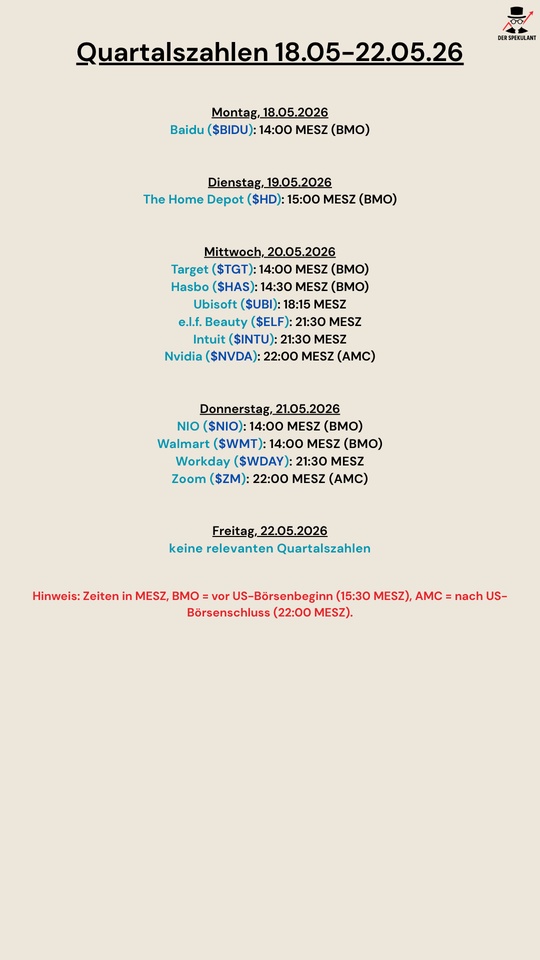
I want to add $INTU to my portfolio. But the question is whether I do this before or after the quarterly figures. But in the long term it probably won't matter anyway
••
Titres populaires
Meilleurs créateurs cette semaine
Données en temps réel par LSX · Données fondamentales et de clôture de FactSet