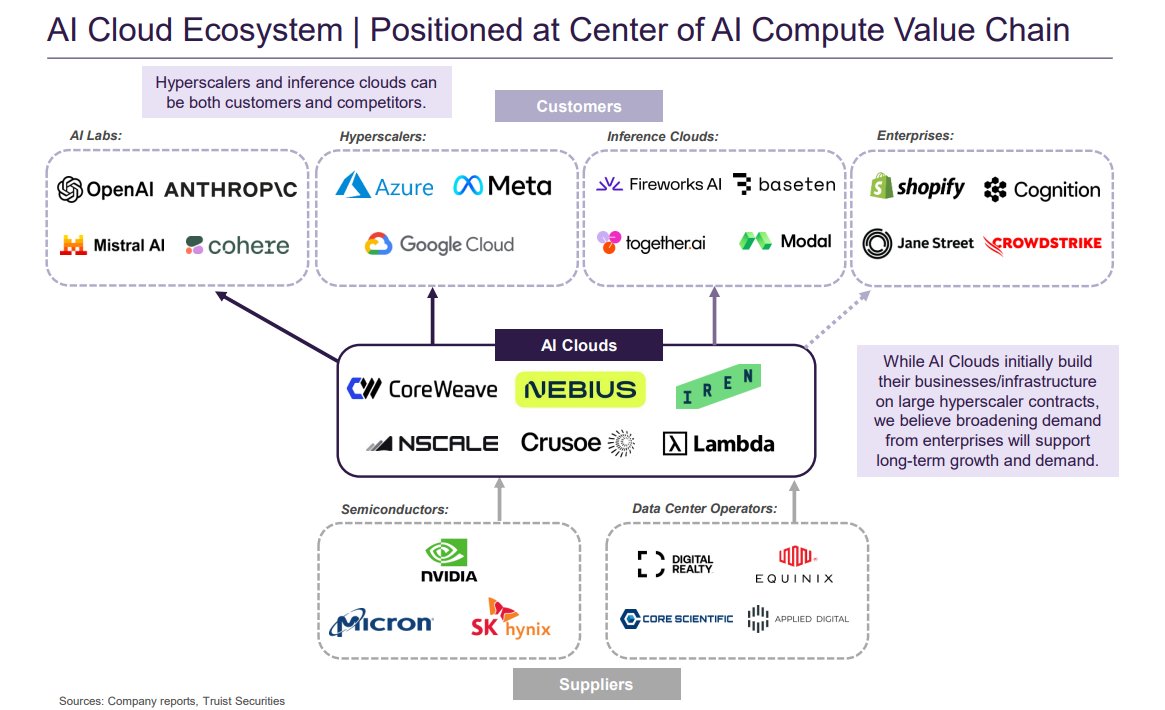
AI clouds are evolving into an intermediary layer between scarce AI infrastructure and companies that actually need computing power.
Who provides the infrastructure for AI clouds?
$NVDA (+1,14 %) (NVIDIA) is at the heart of the computing layer and supplies the GPUs that determine how much capacity these platforms can actually bring online.
$MU (+3,36 %) (Micron) & $SKHY (+0,03 %) (SK Hynix) supply the necessary HBM memory to power the GPUs as model sizes and inference workloads continue to grow.
$DLR (-1,21 %) (Digital Realty), $EQIX (-0,54 %) (Equinix), $CORZ (+3,79 %) (Core Scientific) & $APLD (+5,32 %) (Applied Digital) provide the physical data center infrastructure beneath the cloud layer. This allows AI clouds to scale without having to own every building themselves.
Who transforms this infrastructure into usable computing power?
$CRWV (+1,13 %) (CoreWeave), $NBIS (+2,53 %) (Nebius) & $IREN (+7,07 %) (IREN) are right at the center of this value chain.
They combine GPUs, power, networks, and software into usable AI computing power that customers can rent.
Who buys this computing power?
$MSFT (-0,5 %) (Microsoft), $META (-2,33 %) (Meta) & $GOOGL (+0,89 %) (Google) are particularly interesting because they are both customers and competitors.
They rent external computing capacity when internal capacity is scarce, while simultaneously continuing to expand their own infrastructure.
$SHOP (-0,33 %) (Shopify) & $CRWD (-3,33 %) (CrowdStrike) illustrate where the next stage of growth might come from: demand from businesses is increasing, and the customer base is expanding beyond a small group of hyperscalers and AI labs.
OpenAI & Anthropic represent the customer side of AI labs. Their demand for computing power can grow very rapidly, as both training and inference place increasingly higher demands on resources.