

Reading time: about 5–6 minutes
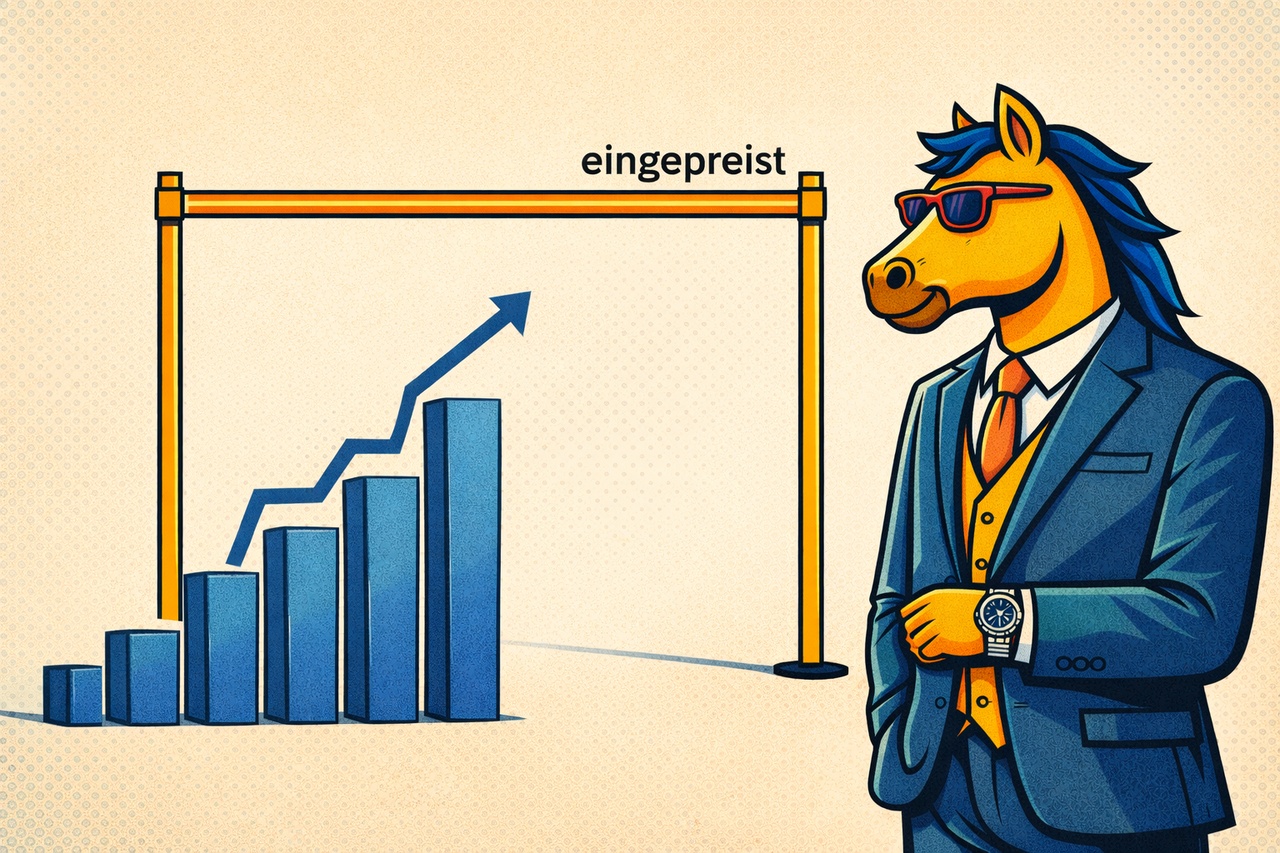
After quarterly earnings reports, I regularly see the same reaction here: The numbers were good—so why is the stock falling?
This question assumes that stock prices react to the numbers. They don’t. The market evaluates expectations relative to price, not revenue or earnings in isolation. What matters is the discrepancy between what’s actually delivered and what the stock price had already priced in.
Expectations aren’t set during the earnings call. They are reflected in the stock price—more precisely, in the P/E multiple. A company trading at 30 or 40 times forward earnings implicitly carries very specific assumptions: high, as consistent as possible growth; stable or rising margins; minimal operational friction; and, ideally, additional upside potential. The higher this valuation level, the narrower the range of expectations becomes. This is not a matter of sentiment, but of valuation mechanics. If this framework becomes even slightly ill-fitting, a multiple adjustment is enough—and the stock price reacts, even in the face of objectively strong numbers.
This is precisely why “good numbers” are often not enough for highly valued companies. A quarter can be operationally impressive and still trigger a sell-off because it merely confirms what was already priced in. In such situations, nothing fundamental needs to change. All it takes is for growth rates to normalize slightly, for margins to stop rising, or for guidance to be phrased more cautiously. The market then isn’t reevaluating the business model, but rather the price it’s willing to pay for it.
A very clear example of this is NVIDIA. Operationally, the company has been delivering exceptional results for quarters on end: explosive demand in data centers, high gross margins, and massive cash flows. Nevertheless, there have been repeated sharp pullbacks following earnings reports. Not because the numbers were bad, but because they were no longer clearly better than what the market had already anticipated. With valuations like these, “strong” is simply not enough—the bar is set at “even stronger.” The business model remains intact, but the price for it is readjusted.
That’s why I approach earnings reports differently today than I used to. I’m less interested in whether the consensus is beaten, and more in whether the results are sufficient to support the current valuation. I try to understand which narrative the market is currently playing out and which metric is in focus. If growth is the narrative, efficiency alone doesn’t help much. If cash flow is what’s in demand, mere revenue beats fall flat. I become particularly cautious when a stock has a very compelling story, is widely loved, and is highly valued. In such cases, the room for positive surprises is often smaller than many believe.
This logic is currently particularly evident in several hot topics.
In the AI and semiconductor sectors, the valuations of many companies are so high that even very strong numbers have little potential to surprise. Growth is taken for granted; what matters most are sustainability, investment cycles, and margin stability. Consequently, the market reacts nervously to any hint of normalization. Typical examples from this sector include
$NVDA (-3,04 %) (Nvidia), $AMD (-6,18 %) (Advanced Micro Devices), $AVGO (-2,94 %) (Broadcom), $ASML (-3,24 %) (ASML Holding), and $INOD (-9,89 %) (Innodata).
In the software and SaaS sectors, the focus is shifting noticeably away from pure revenue growth toward free cash flow, efficiency, and returns on capital. Companies can beat revenue expectations and still see their stock prices fall if margins or cash flow don’t keep pace. The valuation framework has changed—and many market reactions to earnings reports can be explained precisely in this way. Examples include
$MSFT (-1,43 %) (Microsoft), $CRM (-0,59 %) (Salesforce), $NOW (+0,85 %) (ServiceNow), $SNOW (-6,12 %) (Snowflake), and $ADBE (+1,69 %) (Adobe).
In the areas of electric mobility and structural growth, it’s particularly clear how a narrative can shift. In the past, the focus was on unit sales and growth; today, the market is paying closer attention to margins, price pressure, and capital intensity. Figures that would have been celebrated just a few years ago are losing their impact because they no longer address what is currently being valued. Typical examples of this tension are
$TSLA (-1,7 %) (Tesla), $RIVN (-3,18 %) (Rivian), $LCID (-1,67 %) (Lucid Group), $BYDDY (-0,24 %) (BYD Company), and $9866 (-4,09 %) (NIO).
While in the software and SaaS sectors, high valuations and ambitious cash flow expectations mean that even solid quarters can quickly turn out to be disappointing, the opposite is often true for industrial and infrastructure stocks: lower expectations, a more defensive positioning, and thus significantly more room for positive surprises after earnings reports. In this sector, stability or even a slight improvement is often enough to trigger a revaluation. Examples include
$CAT (-2,71 %) (Caterpillar), $DE (+0,45 %) (Deere & Company), $HON (+0,47 %) (Honeywell), and $VRT (-6,34 %) (Vertiv).
For me, all of this boils down to a sobering but crucial insight: When it comes to earnings, the market doesn’t ask whether a company is good. It asks whether the results were better, worse, or exactly as the price had previously implied. The higher the valuation, the tougher this test becomes. Good financial metrics are necessary, but they’re no guarantee of success. They only have an effect when combined with expectations and price.
Outlook:
The next part will explore the flip side of this logic: why stocks can rise after poor earnings reports—and what role fear, positioning, and asymmetric expectations play in this.

