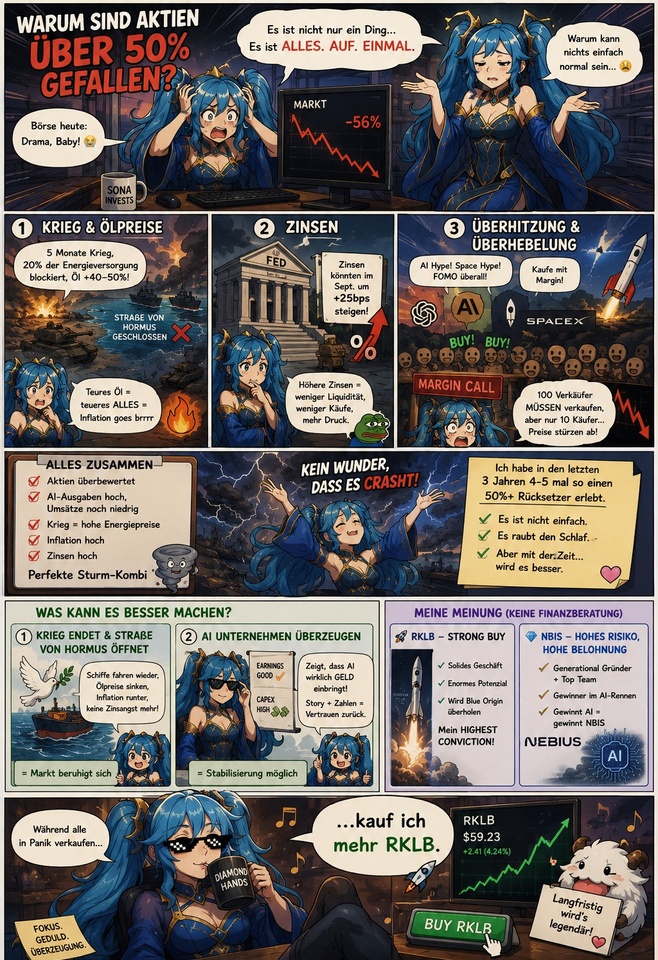
Stocks and companies are two different things. The stock price depends on many external factors.
Right now, the entire market is affected. While no one can say for certain why it’s crashing, I believe it’s a combination of several negative factors that are all coming together at once.
The Causes
1. The War and the Energy Crisis
We’ve been at war for 5 months. The Strait of Hormuz, through which 20% of the world’s energy supply passes, is blocked, and no ships are passing through anymore. Oil prices have been 40 to 50% higher for the past five months. The fact that no ships are passing through means that countries may run out of reserves, which could drive oil prices even higher.
In times of such uncertainty, the market always prices in the worst-case scenario. Last night, the war escalated again, and the U.S. president stated that they will strike the enemy so hard tonight—which means even more escalation, more uncertainty, higher oil prices, and no foreseeable end to the war. Oil affects the prices of everything else, including everyday consumer goods. This can fuel inflation, forcing the U.S. Federal Reserve (Fed) to intervene and raise interest rates to meet its dual mandate of low inflation and high employment.
2. Interest Rates
I have explained the scenarios in which the Fed would have to raise interest rates. Although the Fed announced a pause in rate hikes today, Warsh’s comments pointed to a hike of at least 25 basis points at the next meeting in September. The market is therefore pricing in a 25-basis-point hike as the base case, with the potential for further hikes if the war continues to escalate and oil prices rise above 100 and perhaps toward 150. High interest rates mean that people will pull money out of the stock market if they’ve invested on credit, and they won’t borrow any more money at higher rates. That means less liquidity in the market.
3. AI Hype and Overleveraging (Margin Calls)
The AI and aerospace sectors have become extremely hot because OpenAI and Anthropic have brought incredible AI products to market. Whether they will generate enough revenue, however, is another question. The entire AI sector has triggered a FOMO (Fear of Missing Out) in the market. Retail investors, in particular, have bought stocks on margin and acquired these AI stocks.
The SpaceX IPO was already overvalued, which drove aerospace stocks even higher due to FOMO—people were buying with borrowed money. Now that prices are falling, people are receiving margin calls and are forced to sell. Imagine there are 100 sellers who HAVE to sell, and only 10 buyers. The buyers have the upper hand because there are more sellers, so they’ll keep lowering their bids. In the end, the sellers have to sell at ever-lower prices. Most of the time, the market crashes so hard because of these overleveraged investors.
To sum up: Stocks were already extremely overvalued, AI spending is extremely high with extremely low revenue, the war has led to higher energy prices, inflation is extremely high, and interest rates are high. I think the combination of all these factors has triggered fears and this sharp sell-off.
What could improve the situation
End of the conflict: The most immediate catalyst that could stabilize the market is this: The war must end. Even more important than the war itself is the reopening of the Strait of Hormuz. If Iran and the U.S. (or even Iran and Oman) reach an agreement and officially announce that the Strait of Hormuz is open, and the market sees that ships are sailing at normal levels again, the price of oil will fall. The market will begin to price in lower inflation and no further interest rate hikes, and stocks will rise.
More Convincing AI Numbers: Most of the MAG7 companies have already reported their quarterly results. Although the results are good, capital expenditures (CapEx) are high, which is why the market isn’t buying the narrative that AI will deliver huge returns. The CEOs of these AI and MAG7 companies need to tell the market a convincing story and—even better—present figures that prove AI actually adds value. However, I think the results were good enough to give the market sufficient room to stabilize.
My personal assessment of my largest positions:
$RKLB (-1,59 %) (Rocket Lab): In my opinion, this is a solid company and my stock with the HIGHEST conviction. I think it will surpass Blue Origin’s market capitalization and rank second behind SpaceX $SPCX (-4,24 %) . It has enormous potential. I don’t see anything about Rocket Lab that worries me. Therefore, at prices in the $50 range, I give RKLB a STRONG BUY rating.
$NBIS (-2,65 %) (Nebius) is definitely led by an outstanding founder and team and is clearly a winner—one of Jensen Huang’s $NVDA (+2,15 %) , Mark Zuckerberg $META (+2,62 %) and Satya Nadella $MSFT (+3,6 %) . I continue to believe that AI will prevail. If AI wins, $NBIS wins. There will be bubbles and fears—that’s part of the game—but AI will permeate every industry and product and become part of our daily lives.
Overall, I think all three companies will continue to realize their visions. The decline in stock prices is mainly due to the fact that they may have risen too high and a correction was due. However, this correction was accelerated by high debt (over-leveraging) and the macroeconomic environment.
Over the past three years, I’ve experienced four or five such price drops of over 50% in my investments. It’s not easy. It keeps you up at night. It affects you in ways you never would have imagined. But things get better again over time.