7Mon·

Bitcoin for beginners - Part 1: From bartering to Magic Internet Money

As I have noticed again and again recently that some people are interested in $BTC (-1.06%) and crypto, but they lack the background knowledge to be able to judge what Bitcoin is apart from a "number go up technology", what problem it solves, how it works, what actually distinguishes Bitcoin from altcoins, etc., I thought I'd start a little "Bitcoin for beginners" series here on GetQuin. Then maybe I won't be "Please deal with Bitcoin first" with the question "Which cryptos would you currently buy?", but simply refer to this series of articles. I hope that I can provide you with some added value. For some of you, this series will probably be rather boring, for others it might be a good introduction to the topic.


In order to be able to assess which problem Bitcoin solves, you first have to deal with money. After all, we all spend almost our entire lives trying to earn money, but not a second on the question of what money actually is. That's why I chose the topic "From Barter to Magic Internet Money" for part 1 of this series.


What is money

First of all: money is not an invention of the state, but an invention of people. Unfortunately, people often forget this nowadays, as it is hard to imagine a non-state money. After all, money today is inextricably linked to the state. Money is one of the greatest human inventions - comparable to the wheel. It is an instrument of man, born out of the practical needs of trade.


Before there was money, people traded goods directly for goods. Although this system of exchange in kind worked, it required both parties to offer exactly what the other was looking for - which was quite rare and severely restricted trade. For example, a farmer with surplus grain could only trade with the blacksmith when the blacksmith needed grain.

Because this was too complicated in the long term, simple credit systems were initially set up in smaller communities. People traded "on trust" by owing each other something.

However, as the community grew, this system quickly reached its limits: Not everyone trusted everyone, and without trust, trade no longer worked.

To overcome such difficulties, people eventually began to look for goods that almost everyone was happy to accept and which were used as a "medium of exchange" - such as salt or animal skins. This medium of exchange enabled trade that would otherwise not have taken place.

-> And this is how money was created.


But which goods were used as money?

This has to do with the so-called "salability" of a good. Saleability refers to the relative ability of a good to be sold on a particular market at a particular time and price (Carl Menger in The Origins of Money).

Menger described that the "most marketable good" within a society became money. In other words, the commodity that was most in demand in society. The commodity that nobody could get enough of. The good that could be sold best on the market.


Saifedean Ammous describes in his book The Bitcoin Standard describes three key categories that determine how suitable a particular commodity is as money:

  • Time-based salability: Does the asset retain its value over time?
  • Spatial salability: Can the good be easily transported?
  • Quantity-related salability: Can the good be easily divided into smaller units?


These three categories can then be used to six central characteristics that a good should fulfill in order to become optimal money:

  • Scarcity and durability (time-related salability)
  • Acceptability and transportability (spatial salability)
  • Divisibility and fungibility (quantity-related salability)


A commodity that combines these six properties is perfectly suited as money.


The evolution of money

The history of money from primitive means of payment to Bitcoin is briefly explained below. The history of money is far from complete and of course very abbreviated - I don't want to bore you with it. For more insights into the topic, I can highly recommend the book "Broken Money" by Lyn Alden :)
attachment

Primitive means of payment

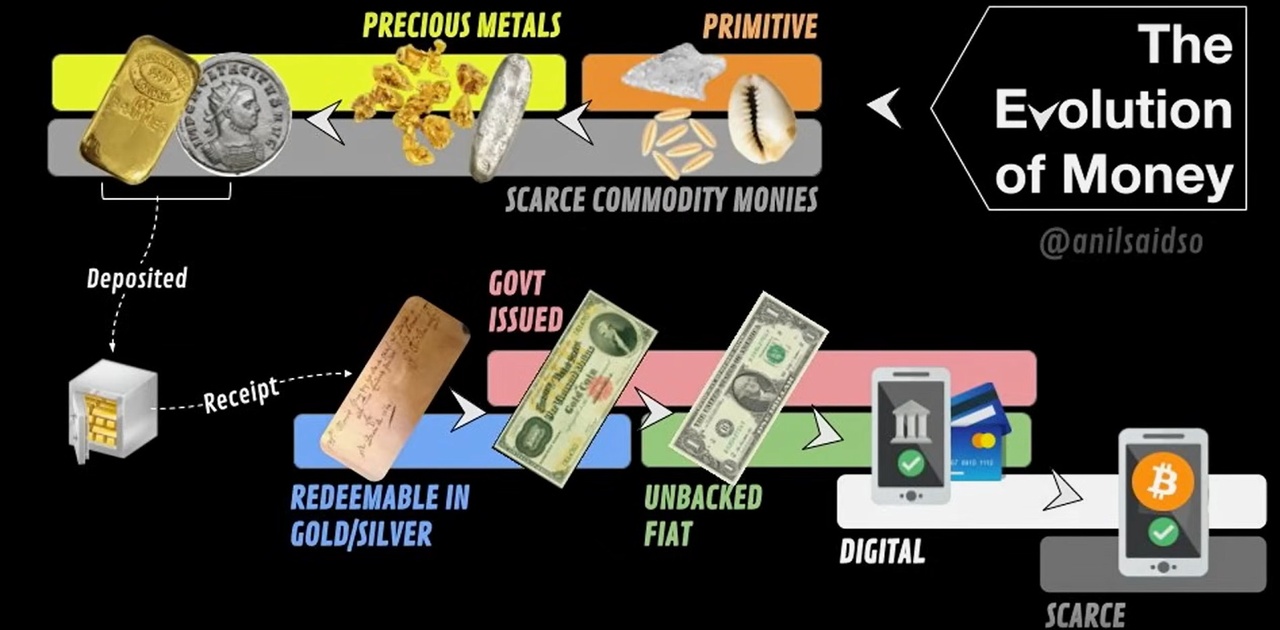
The evolution of money can be seen very clearly in this picture. People first used primitive means of payment such as salt or shells. These were scarce, stable, locally accepted in the respective communities, relatively easy to transport and divide and reasonably fungible.

With increasing technical progress, however, it became easier and easier to produce or mine such primitive means of payment, which is why they were replaced over time because they could no longer fulfill their properties.


Precious metals

Scarce commodity money or precious metals was the next step in the history of money. Precious metals have an extraordinarily high stock-to-flow ratio (S2F). In a way, the S2F ratio means "How much of a good exists in total and how much is added per year in percentage terms?" - These two values are divided and the result is the S2F ratio. This was (and still is) very high for gold and silver, which means that it was relatively rare and could not be increased at will. Furthermore, precious metals do not spoil and retain their properties over very long periods of time. This promoted general acceptance and allowed gold and silver to become money.

However, there were three main problems:

  • Precious metals are not forgery-proof
  • Precious metals are relatively difficult to divide, especially for small transactions
  • Precious metals are heavy and therefore cannot be transported easily and quickly over long distances

For this reason, the first banks developed over time, as explained below.


The emergence of banks

Traders and private individuals began to deposit their precious metals with service providers (banks). In return, they received a receipt for the amount deposited.

These receipts soon became a means of payment themselves: anyone in possession of the receipt could exchange it for the deposited precious metal at any time. This was more practical and safer than transporting gold coins around. What's more, no one had to worry about being sold counterfeit gold or silver. This pre-form of paper money accelerated trade and made larger transactions practicable.

At first, depositors' gold and silver holdings were 100% covered. Over time, the banks then began to lend on parts of the deposited precious metals at interest. This led to the system becoming increasingly unstable.


Redeemable in gold/silver - the gold standard

From the 19th century onwards, the gold standard was officially introduced in many countries. This means that

  • Governments undertook to exchange the banknotes they issued for a fixed amount of gold on presentation.
  • The money supply was thus tied to the existing gold reserves.

This link ensured confidence and stability. Anyone holding gold standard currencies could be sure that there was a real value behind them. This worked for decades, but came under pressure in times of crisis, as governments regularly printed more gold than they deposited new gold. With the end of the Bretton Woods system in 1971 at the latest, the US dollar - and subsequently almost all other currencies - finally broke away from the gold backing. At that time, US President Richard Nixon "temporarily" removed the link between the dollar and gold in the middle of the Vietnam War (war is expensive😅) and blamed the "speculators" for this. This temporary state of affairs continues to this day and leads us to the next statiion.


State-issued fiat money

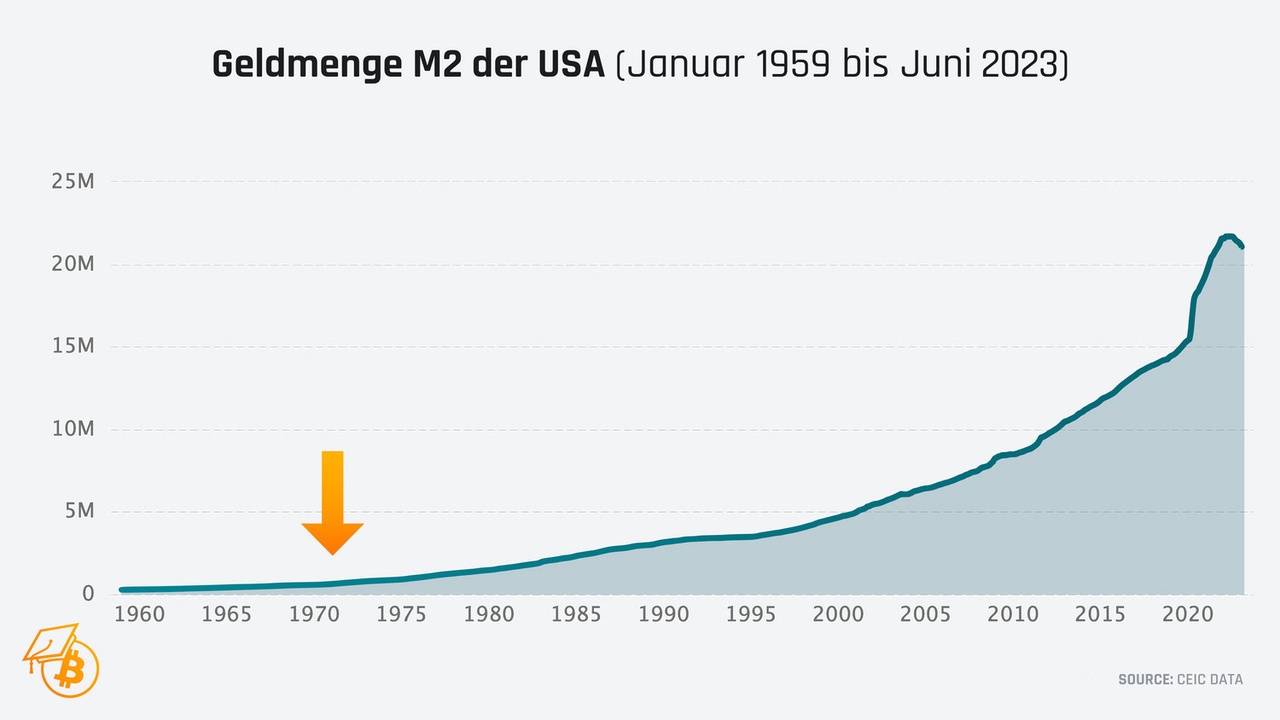
Fiat comes from the Latin and means something like "it shall be" or "it shall happen". From this point onwards (1971), money was no longer linked to any commodity and could be created by states or central banks in virtually unlimited quantities at the touch of a button. And of course they did, as can be seen very clearly from the M2 money shortage in the following image:
attachment

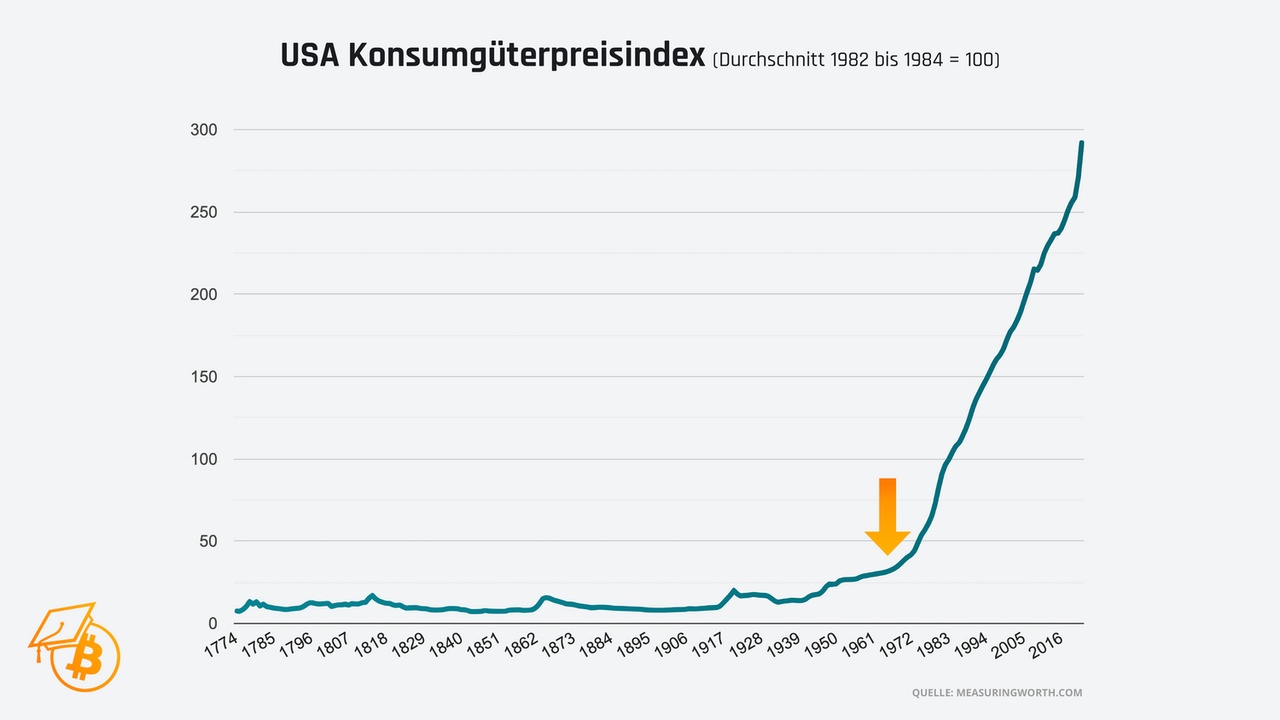
This glut of money also ensured a continuous, sharp rise in the consumer price index, i.e. inflation:
attachment

The pictures are from https://www.blocktrainer.de/blog/wtf-happened-in-1971-die-katastrophalen-auswirkungen-von-ungedecktem-papiergeld and I would really recommend that you take a look at these statistics. You can really see how the world changed after the abolition of the gold standard and the immense problems this caused.


However, like everything in life, there are two sides to the coin with fiat money and there are also advantages. For example, central banks can react flexibly to crises and adjust the money supply to the economic situation. Banknotes and digital account balances are also easy to handle and there is no longer any need to move cumbersome gold in the background when transferring money. Above all, this made trading between different countries easier.


Of course, fiat money is not scarce and is not necessarily stable. It doesn't go bad in that sense, but it continuously loses purchasing power. On the other hand, it has (enforced) acceptance by the state and is transportable, divisible to a certain extent and completely fungible (a €20 bill is worth just as much as another €20 bill. The appearance, weight etc. is irrelevant).

Fiat money therefore has some monetary properties, but not all. This is where the next step and the topic of this series of articles comes into play: Bitcoin


Digital scarcity - $BTC (-1.06%)

Bitcoin was the logical next step in the history of money because, for the first time in human history, it was possible to create a digital good that is scarce, stable, transportable, fungible and divisible at the same time - and all without a central controlling authority such as states or banks. Bitcoin thus combines the advantages of fiat money and gold without inheriting the weaknesses of these two systems.


Bitcoin was created in 2008 by a still unknown person or group with the pseudonym Satoshi Nakamoto and solves one of the most fundamental problems of digital goods: the double-spending problem. Before Bitcoin, it was not possible to create a digital good (such as money) that could not be copied as often as desired. If you send a picture via WhatsApp, for example, you have simply made a copy available to the other person. However, the picture has not really changed hands - you still have the picture. This is because information is shared on the internet and information can only ever be copied. For example, if I have an idea and share it with you, then we both have that idea. It's different with physical objects. If I have a coin and give it to you, then you have the coin and I no longer have it. Satoshi Nakamoto has therefore succeeded in digital scarcity to create digital scarcity.


Bitcoin achieves this by using a decentralized database (blockchain) that is distributed across a global network of computers and is constantly updated. Each transaction is recorded in a block, physically secured and attached to the existing chain of transaction blocks. This chain is publicly visible, which makes forgery or manipulation virtually impossible.


But what makes Bitcoin the optimal combination of the advantages of fiat money and the gold standard?


Scarcity and stability

Bitcoin is limited to (just under) 21 million units, which means that there can never be more than this amount. This absolute limitation is mathematically guaranteed and cannot be influenced by political decisions or central banks. Bitcoin is therefore scarcer than gold, because even gold has no absolute upper limit. Nobody knows how much gold is in the ground. No one knows whether we will be able to produce gold in a laboratory at some point. No one knows whether we will be space mining at some point.


Acceptance and transportability

Bitcoin does not require physical storage and can be easily transferred worldwide. This solves the transportation problems of the gold standard. Bitcoin is an open source protocol. Anyone can check it at any time - but no one is able to change it to suit their wishes. No one can corrupt it. No one can create Bitcoin out of nothing. Bitcoin is independent of any person, any politician, any state. It is money by people for people. Nobody should work for money that others can simply create out of nothing. Bitcoin is this money.

Bitcoin is still far from being accepted globally as money or a store of value. However, the properties of Bitcoin will create this acceptance over time. The more people understand these characteristics and recognize them for themselves, the more acceptance Bitcoin will gain. If you look at where we were a few years ago and where we are now, you can see this development very clearly.

For example, the ECB's "Bitcoin is on its way to irrelevance" became "It is unfair that Bitcoin holders are getting richer compared to everyone else" (-> https://getqu.in/vfltld/).


Divisibility and fungibility

Each Bitcoin can be divided into 100 million smaller units (Satoshis), which makes it perfect for any type of transaction - whether it's a large real estate purchase or a small coffee. What's more, each Bitcoin unit, or satoshi, is worth the same worldwide.

In short, Bitcoin combines the robustness and stable value of gold with the ease of use and flexibility of digital fiat money. At the same time, it avoids the serious disadvantages of both systems: Bitcoin cannot be manipulated like fiat money, nor is it physically difficult to handle like gold.

Bitcoin thus represents the next evolutionary step in the history of money and offers the opportunity to build a financial system based on fair and transparent rules - free from political influence and centralized control.


Conclusion

Bitcoin is the logical evolution of a history of money that spans thousands of years. From impractical bartering, to gold with its transportation and divisibility problems, to state fiat money, which is practical but can be inflated indefinitely - all these historical forms of money had their weaknesses.

Bitcoin now combines the advantages of gold (absolute scarcity, stability) and fiat money (digital usability, simple transferability and divisibility) for the first time, without their disadvantages. No state, no central bank and no individual person can increase or manipulate the money supply. Bitcoin creates digital scarcity, is globally transportable, divisible at will and completely independent of centralized control. It is an absolutely limited, fair, democratically regulated, censorship-resistant monetary network consisting of tens of thousands of computers.


In the next part, I will try to explain as simply as possible how Bitcoin works technically. For part 3, I currently have my eye on the topic of self-custody. Feel free to let me know in the comments what you think of the idea of the "Bitcoin for beginners" series and whether you see a need for it at all. I'm also open to suggestions for the series :)


I hope you have/had a great holiday!

Grüße✌️


PS: My miner unfortunately still hasn't found a block🙄😂


Click here for part 2 -> https://getqu.in/3riEoO/

208
101 Comments

profile image
I didn't read it because I already know everything. But thank you for leading the unbelievers on the path of light
24
profile image
Great again! So well written 🙏🏻
5
profile image
@Kundenservice please in the best of! thank you 🙏
5
The greatest invention of the 21st century. Everyone will need it whether they like it or not
4
4
Thank you for closing my eyes 🙏
3
profile image
There's nothing more to add
3
profile image
Super contribution! Respect!
3
profile image
The only thing that helps against shitcoinery with fiat and crypto is education 😀
Education is good. Hard money is good. Bitcoin is good money. 😅
2
profile image
Thank you, that's all I have 😅👌🏼
2
profile image
Yes thanks. really good. now we still need. where to buy best which walllet is good etc what is scalping or something like that. In which situations the bitcoin is likely to rise or to which other values it may react with
2
profile image
1
profile image
I'm exactly at that point, more please 👍
1
profile image
To the beginners: Bitcoin should not be equated with real values. Bitcoin is based on nothing but the belief in Bitcoin,
1
profile image
@boz Bitcoin is based on math and physics :)
2
profile image
@stefan_21 With regard to physics: electricity consumption is not a value. The opposite is true, so investing in an electricity generator is more advisable. Mathematics is a tool. Bitcoin does not create math and does not enable math. Bitcoin is "generated" by complex finite calculations. If you want to invest in "math", it is better to invest in compute, e.g. NVIDIA, AMD. Bitcoin is based solely on the belief that there is a demand for Bitcoin. Bitcoin itself does not generate any value.
1
profile image
@boz I didn't say that either :)
The power consumption or the physical power secures the network. This is why Bitcoin is the most secure computer network in the world. Mathematics determines the rules of the network. This gives rise to properties that no other asset possesses and which generate the value.
Bitcoin has no intrinsic value in the traditional sense. This is why many people (like you) automatically assume that it must be worth nothing.
However, intrinsic value is only relevant for assets without monetary properties. Then you can calculate a subjective expected return.
Bitcoin has properties that none of these assets have. Properties that make it the perfect store of value. And because it is the asset with the best properties, it is valuable.

If you're now thinking to yourself, "what nonsense is he talking", take a look at gold, for example.
Do you think gold, with a market capitalization of 22 trillion, is by far the most valuable asset in the world because it is used to a small extent in the industry? Or because it is used as Schnuck? Or is it used as jewelry precisely because it is valuable?

Shouldn't steel, which has many more industrial applications and a higher intrinsic value, take on this role?
It is the properties of gold, such as scarcity, durability, etc., that have made it what it is.
Only Bitcoin fulfills all these characteristics better than gold. It is more transportable, more divisible, absolutely limited, forgery-proof, etc.
2
profile image
@stefan_21 So why isn't ETH better, more popular?
profile image
@boz because ETH does not have the properties that Bitcoin has. ETH is not decentralized, not censorship resistant, has a third party risk, in the last 7 years the supply policy has been changed 7 times because a central company - the ETH Foundation - wanted it etc.
ETH has more in common with a central bank than with Bitcoin.
1
profile image
@stefan_21 Gold has unique physical properties and is fundamental for numerous areas of application, a fundamental element for industrial applications. And gold is significantly rarer than iron, from which steel is made.
profile image
@boz Isn't that the case with every currency?
profile image
@boz the industrial use of gold is very low compared to the market cap. The central banks don't buy gold either because it can be used to a small extent in industry.
As you say, gold is much scarcer than iron. Ergo, the value of gold must have something to do with its properties :)
It's the same with BTC.
1
profile image
@stefan_21 The special thing about gold is its unique chemical and physical properties, which cannot be replicated. Nothing about Bitcoin is real or even physical, except for its electricity consumption.

Gold was there before us, gold will be there after us. Gold survives the fall of societies and empires. It survives wars and disasters. Bitcoin has not yet had to survive a test.
profile image
@boz What characteristics do you think that would be?
In contrast to gold, Bitcoin is absolutely limited, much more transportable, easier to store - yes, you can even transport Bitcoin in your head. Storing 0.1 BTC costs no more than storing 10,000 BTC - unlike gold, etc.
Bitcoin's properties cannot be replicated either. I once wrote an article about Bitcoin as a perfect store of value. If you like, you can read it at https://getqu.in/G8t0Nm/ :)
View all 26 further answers
I would be delighted if you would implement your idea
1
profile image
Good article, more of the series please! 👍🏻
1
profile image
1
profile image
@Ash then here outside the comments:
I've also had a node running since last year. You don't need it, but it's still cool if you can send your own transactions via your own node. And somehow it also feels good to do something for decentralization😇

I think he has blocked you/you - I can see his account and his Kommentare🤷‍♂️
1
profile image
@V7Hodl Ah ok, that explains it then. Very weak move from him 😂 But anyway, that's how it usually goes with this kind of person. @stefan_21 Was kind enough to move the topic to another post for me. Have a look here if you still want to get into the conversation:

https://getqu.in/sd8saq/ https://getqu.in/sd8saq/

And thank you for your feedback ✌🏼
1
profile image
GREAT - THANK YOU VERY MUCH!
1
profile image
Nice contribution 🙏
1
1
profile image
Part 2 please :)
1
Thanks for the great article, can you also write a guide on where to buy Bitcoin, i.e. which broker is best to buy from and how to trade it?
1
profile image
@bull_investor_1998 I'll make a note of it :) although the subject of "where to buy" is always an individual decision and depends on the person. There's not really a right or wrong answer.
I can highly recommend 21Bitcoin and Strike, for example. I and everyone I know has had nothing but positive experiences with these two providers.
If you have any questions about buying or custody or anything else, please feel free to ask :)
@stefan_21 is still a somewhat obscure topic for me so far, which is why I haven't invested in Bitcoin
1
profile image
@bull_investor_1998 I understand - the topic can be overwhelming at first. Bitcoin really isn't easy to understand. It takes a lot of work and time to familiarize yourself with it - but it's worth it :)
1
@stefan_21

I'm doing my studies and it's just too time-consuming, so I'd rather hold a few individual stocks and EtFs and if I then also have a higher income, it will be much more interesting 👍🏼
1
I understand the meaning behind it and you explained it very well. However, I don't understand why the value of Bitcoin is growing and growing. Can you understand it because of inflation? From this article I understand that Bitcoin is not tied to anything and there are only a number of Bitcoins. So in an ideal world, the value should remain the same. Hope for an explanation. I am new to this investment world (Bitcoin and stocks) Thank you
1
profile image
@Semiir98 Hi :)
There are several things at play here, and you have to look at it from several perspectives.

The price of Bitcoin in fiat currencies is simply the result of supply and demand.
Bitcoin is the only asset with an absolutely limited supply. No matter how much demand there is on the market, the supply remains limited. More demand therefore inevitably always leads to a rising price (in fiat).

If you compare this with gold, for example, you will see that whenever the price of gold rises, the quantity of gold also increases. But why is that the case?
The higher the price of gold rises, the more lucrative and profitable gold mining becomes. This means that whenever the demand for gold increases, the supply also increases. The gold price then levels out.
No matter how much demand there is for Bitcoin, the supply does not change. In other words, the price shoots up :)

You already mentioned inflation anyway.
You have to imagine that we live in a world in which everything is constantly getting more expensive despite technological progress. Isn't that illogical? If people can produce things cheaper, better, faster, why the hell is everything always getting more expensive?
It's because of our unbacked fiat money. The central banks are aiming for a price increase of 2% per year. That is, their only goal is for prices to rise by about 2% every year. This means that after 35 years, your savings will only be worth half as much.

(You work all your life, you want to save and when you're old you can't buy any more of it - great :D That's why it's so important that you invest. It's about being able to carry your purchasing power into the future)
To achieve this, of course, more money is printed year after year. The supply on the market increases. The value of money decreases.

Let's assume we live in a Bitcoin-only world. Bitcoin would be the only currency in the world. Then not only would there be no inflation, but prices would become cheaper and cheaper year after year with technological progress. And the value would then of course be eternal: 1 BTC = 1BTC :)
1
profile image
Great contribution…
1
profile image
thanks for the explanation :)
Question: so bitcoin should represent a modern currency/money, if I understand correctly.
But shouldn't these have low volatility?
That would refer to the "stability" property. I don't think that necessarily applies to BTC.
Or am I misunderstanding something?
1
profile image
@Stonks3000 Bitcoin is stable in the sense of "it does not depreciate over time" and Bitcoin is stable in terms of maintaining its value over time.
Bitcoin is, as you say, very volatile - but only volatile upwards over longer periods of time.

And that can also be explained logically:
Imagine someone suddenly designs a completely new form of money. Imagine it has all the great properties of Bitcoin.
It is released onto the market and starts at 0.

If you think about it logically, what would happen?
Would you assume that everyone would immediately understand the new type of money and that the market would price it accordingly at the "final price" right from the start and that it would then remain stable in value for years or increase slightly in value compared to other currencies?

Or would you assume that gradually more and more people will understand the new money, use it for themselves, and that it will therefore slowly be understood and adapted by people? And would you expect the money to slowly increase in value or would you expect that there will always be spurts of adoption and temporary over- and undervaluations and speculation?

I would expect exactly the latter and that's exactly how Bitcoin behaves :)

Bitcoin is the best performing asset of all time - and there is a reason for that. The higher the market capitalization of Bitcoin increases, the more volatility will decrease. Simply because more and more capital is needed to move the price in one direction. Once Bitcoin exceeds the market capitalization of gold, it will be much less volatile than it is now - probably similar to gold :)
profile image
Okay, I understand that, thank you.
So in future, BTC should become less volatile and thus better fulfill its actual purpose as a currency.
1
profile image
Thanks for the contribution. I think even I've understood it now 🤣🚀
1
profile image
@Bidax Nice to meet you😁 Thank you for the coins!
1
Thank you!!
1
profile image
I think it's great when someone takes the time to write texts and make people think. Nevertheless, several key points in your presentation are historically and economically incorrect. You present money as a linear development from barter to commodity money to Bitcoin. However, this process has long been refuted by research. Anthropologists such as Marcel Mauss, Caroline Humphrey and David Graeber have shown that pure barter was never a functioning economic system. Barter only took place between strangers without mutual trust. Within real communities, trade almost always worked through credit, debt, obligations and accounting. Your entire deduction that Bitcoin is the logical progression of a barter-to-money evolution is therefore based on a model that has never existed in reality.

Secondly, your depiction of fiat money is greatly abbreviated. Fiat money is not arbitrary problem money, but came into being because it is creditable, scalable, stabilizable and macroeconomically controllable. Without fiat, modern economies, payment transactions, credit markets and crisis stabilization would be impossible. The charts you used from sources close to Bitcoin do not reflect these relationships.

Thirdly, you claim that Bitcoin fulfills the most important monetary properties, but omit the very points where Bitcoin actually fails. Bitcoin is extremely volatile, slow, energetically expensive, hardly scalable and practically unusable in everyday life. These are key monetary properties, not minor issues.

Fourthly, scarcity alone does not create value. Economic value is created through cash flows, functional benefits or stable demand anchors. Bitcoin has no cash flow, no intrinsic utility and its demand is based almost entirely on speculation about future demand.

Fifth, the claim that Bitcoin combines the advantages of gold and fiat and eliminates their disadvantages is factually incorrect. Bitcoin is neither stable like gold nor functional, creditworthy or macroeconomically controllable like fiat. Here you systematically ignore all evidence to the contrary.

Overall, your text comes across less like a neutral analysis of monetary history or Bitcoin and more like a Bitcoin narrative that selectively uses historical, anthropological and economic facts to support a preconceived image.
1
profile image
@Spoon666 Hi :) thank you for your comments.

About bartering: that's exactly what I wrote, isn't it?
I wrote that simple credit systems developed in smaller communities - but this required trust.
For me, this development clearly belongs to the term "bartering", as in the end goods were exchanged for goods.

Re 2:
Of course, my description of fiat money is abbreviated - it is also the case with Bitcoin and the history of money. I can't fit everything into one article and the aim of this series is to give people an understanding of Bitcoin - not fiat.

On your point that modern economies would be impossible with Bitcoin: In your opinion, have modern economies only existed since 1971? :D
Of course an economy based on hard money is possible - it has already been proven in the past. The problem is rather that gold can no longer keep up in the modern world because it is subject to the oracle problem and cannot be transported from A to B so quickly.
The sources close to Bitcoin are well prepared and backed up with data that you are welcome to verify yourself. The data sources are linked to each individual chart on the aforementioned website.

Re 3:
Volatility is not a property - it is a consequence of the properties.
Bitcoin is in its monetization phase. Of course it is volatile until people understand exactly what it is. It needs time. But first and foremost, Bitcoin is volatile to the upside. And that's exactly what I would expect from a new type of money with the best characteristics.
When Bitcoin reaches the market capitalization of gold, it will of course no longer be as volatile in fiat terms, because more and more capital will be needed to move the price.

The entire fiat money system and everything attached to it is also "energetically expensive". But first and foremost, the Bitcoin network is powered by more than 50% renewable energy. Bitcoin mining is therefore one of the cleanest industries in the world - and the trend is rising.

Bitcoin is very scalable - on 2nd layers such as the Lightning Network and many other solutions. You have to think of the Bitcoin main layer as a kind of FED wire. Transactions are settled, but it is not intended to pay for every little coffee. That's what Lightning is for, for example. In the fiat money system, there is Visa, Mastercard and Paypal.

Re 4:
Bitcoin has no intrinsic value - that's true.
But there is no such thing as intrinsic value either. Value is always subjective.

Cash flow is only ever received in compensation for third-party risks and opportunity costs.
The value is not in the assets. We attribute a value to them.
When you buy a share, you are dependent on the decisions of the management, the competition, politics, etc.

With a property, you only get cash flow if you rent it out. In the meantime, however, you have opportunity costs because you can't live in it yourself and you don't have control over the condition of your property. Here too, you are dependent on third parties.

If I now lend my Bitcoin, I suddenly also get a cash flow in exchange for a third-party risk and opportunity costs - and then it would have an intrinsic value, if you go by the economists? That's why I think the concept of intrinsic value is fundamentally wrong and misunderstood.

Bitcoin, on the other hand, has intrinsic properties that make it valuable. It is limited, resistant to censorship, has no third party risk, can be easily transported from A to B (even in your head!), etc.
And these intrinsic properties create a subjective value that is very high for me, for example, and zero for you. This discrepancy also results in the volatility at the moment :D

Re 5:
I have already explained the volatility. I don't see that Bitcoin is not functional. What makes you think that? The Bitcoin network has a 99.99% uptime. Are you aware that banks are starting to accept Bitcoin as collateral for loans? JP Morgan, among others:

https://www.bloomberg.com/news/articles/2025-10-24/jpmorgan-to-allow-bitcoin-ether-as-collateral-in-crypto-push

But it's not just in the USA - VR Bank Bayern Mitte, in cooperation with 21Bitcoin, has also announced something similar in Germany.

The "macroeconomically controllable" is not an advantage of fiat. It creates an "easy way out" of every crisis and shifts the problems into the future - at the expense of those who (have to) use the money.

My aim was not to formulate a neutral account of the history of money, I wanted to write a Bitcoin for beginners series. Unfortunately, I can't be neutral in this respect because I'm not. Pretending to be would simply have been a lie :D

Have a nice evening!✌️
But you said that one criterion for the optimal intermediate good is that it retains its value over longer periods of time. Of course you can argue what longer periods are, but basically I would say that bitcoin does not have this property, right?
profile image
@fund_commander_880 Bitcoin is volatile, but volatile upwards :)
It is absolutely logical that Bitcoin - especially as it is still so young - is not yet fully understood by the market. This results in volatility. Nevertheless, Bitcoin has been the best-performing asset of all time for 16 years.
3
profile image
@stefan_21 Do you think it will still be the best performing asset in the next 16 years?
profile image
@Joris I think that in the next 10-20 years Bitcoin will pull a lot of capital out of other assets that are misused as a store of value. E.g. real estate, stocks, art, bonds, etc.
All of these things will be misused as stores of value because our money no longer fulfills this function.
Accordingly, a lot of capital will flow out of these things and into Bitcoin.
I recently read (I think it was a UBS report) that there are between 600 and 700 trillion US dollars in assets worldwide. Assuming Bitcoin would make up 10% of that at some point, that would be between 60 and 70 trillion in market capitalization, which would correspond to a Bitcoin price of around 3 million per coin, assuming 21 million coins. In reality, between 2 and 4 million have already been lost...
What I simply want to say is that the potential of Bitcoin is enormous and I think that Bitcoin will continue to be the best performing asset for the foreseeable future :)
1
Bitcoin is an intelligence test
1
profile image
profile image
@user3f8e1229dbaf44ab to what extent ? 😅
profile image
@stefan_21 Honestly? Sounds logical 😂
1
profile image
@Joris Bitcoin is an intelligence test because it is complex, difficult to understand and takes time and work to get to grips with.
But in my eyes, Bitcoin is much more of a personality test. Everyone (and I don't know anyone who was different) is against Bitcoin before they are for it. The less you have dealt with Bitcoin, the greater the defensiveness and the more arrogant the opinions. There's everything from "there's nothing behind it" to "tulip mania" to "it'll be banned anyway".
The reason for the personality test is that you eventually reach a point where you have to admit to yourself that you were wrong. And many people can't do that, shut themselves off from Bitcoin and get annoyed year after year because the "worthless asset" keeps on rising.
3
Join the conversation