Okay, today I’m going to do a little “shitposting” (or as a German would say: posting crap).
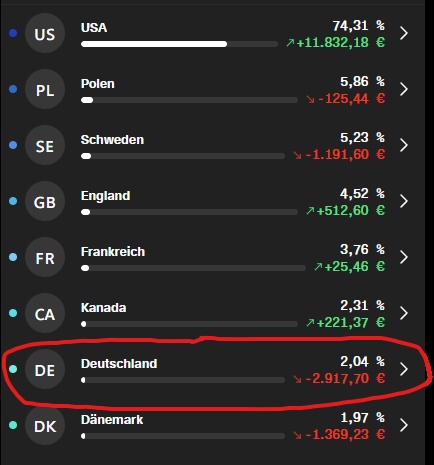
But you really have to realize just how bad things actually are for the German stock market. I now truly consider it my biggest rookie mistake as an individual stock investor that I ever bought into this nonsense about “global diversification” and “spreading your investments widely.”
There are simply countries that, on average, are uninvestable—and unfortunately, in addition to various emerging markets, this increasingly includes some European nations as well.
And this is actually a structural issue. Topics like “small caps” and “hidden champions” can basically be flushed down the toilet at this point, because policymakers are… let’s just say… creating suboptimal economic conditions in Europe.
What we’re seeing here isn’t solely due to poor stock picking, but is also indicative of just how badly the German stock market as a whole is faring. Take a look at the index ETF $DEAM (-0.42%) and see that the MDAX (which, after all, still forms the backbone of the German economy) has shown absolutely no return over the past five years.
Does anyone else remember how, a few years ago, people kept saying that while Germany might not have any great global IT corporations, the German SME sector—with its technology leaders and highly specialized niche providers—would pull everything through? What’s left of that? Not a chance! Whether $RAA (-0.29%) or $NEM (+1.52%) or $AFX (+0.85%) or $SRT (+0.24%) or $BC8 (-0.09%) —many of Germany’s rising stars, especially in future-oriented markets, have failed—all at the same time. Let’s not even get started on BioNTech this time.
Meanwhile, the DAX is increasingly becoming a “retirees’ club” of companies, some of which are 100 to 150 years old and are filling the index with their spin-offs. For example, $FRE (-0.16%) Fresenius is represented twice, $MBG (+1.01%) Mercedes is represented twice, and $SIE (-2.01%) Siemens is even represented four times. These three companies alone already occupy eight spots on the DAX, while success stories of a company rising from an SME to a major corporation—as in the case of Qiagen—are almost nonexistent anymore. And even with Qiagen, we’ll have to wait and see whether the company can hold its own in the “top league” in the long run.
To be honest, the fact that the DAX is still doing relatively well at all is due solely to the success of a few companies and their economies of scale, which allow them to engage in lobbying at both the federal and European levels. However, the weaker Germany becomes, the less likely it will be in the long run for finance ministers to use their leeway to benefit large corporations or for foreign ministers to advocate for international trade agreements.
Unfortunately, things don’t look much better in the rest of Europe either. Here, however, the economy doesn’t have as much room to fall in the first place. Many European countries have never defined themselves as “economic nations” anyway, but rather see themselves as cultural nations. But even here, one can take a look at what has become of the jewels of the European stock markets. Europe’s top 10 is now dominated by British and Swiss companies, while the heavyweights from Germany and France continue to lose ground. Yes, Siemens is holding its own, but Germany’s flagship industry used to be automotive manufacturing. And the only 5-star company in the EU is ASML.
I’ve now written much more than I intended for a lighthearted post, and I’m not even sure anymore what point I was trying to make.
I don’t know—just don’t buy so many dubious individual stocks from shady countries just because you want to diversify. Buy only the best stocks, and if you can’t think of any others, just put the rest into the S&P 500.