

Hi, Community,
I set out on my investment journey because I dreamed of a life where I could afford everything I wanted, without having to compromise. 🏜️
Early on in this journey, I stumbled upon the FIRE movement, and for a long time, that was my motivation—to build up enough wealth that I wouldn’t have to work anymore. 😎
As my wealth grew, my financial goals kept shifting a bit higher every now and then. At some point, I started thinking I’d like to be a millionaire. Then I started thinking I’d like to be a multimillionaire. 🤑
Well, somehow there’s no real limit—or at least, I’ve been subconsciously pondering for quite a while now where that limit actually lies for me personally.
In the last few days, there have been a few posts, including ones by @Dirty30 , @1Chrischi1 , @FinanzPapa ,@Hahajjk and, in particular, from the wonderful @DonkeyInvestor , that have dealt with the withdrawal phase, building up a lifestyle to live off of it, and—in particular—setting concrete goals. 🎯
Over the past few years, the idea has taken root in me that not having to work anymore isn’t a meaningful goal. Sure, I can easily imagine taking lots of vacations and traveling. But even so, I’m increasingly coming to realize that a regular job is fundamentally good for us as human beings and gives us stability. ⚖️
That’s why my goal of no longer having to work as soon as possible has vanished into thin air. 🎈💥
At the same time, over the past three years, I’ve witnessed illnesses and had to cope with unexpected deaths among my close friends and extended circle, which have made my desire to “save everything for later” shift even more clearly toward experiencing as much as possible in the here and now. 🏥⚱️
Not that I haven’t been doing that already. But I’d like to spend less mental energy worrying about the future going forward (does that sentence even make sense?!? :D).
So what does the perfect compromise look like for me? Inspired by our @DonkeyInvestor , I’ve defined a clearer, more tangible goal for myself over the last few days and written it down. I plan to start allocating parts of my assets to my lifestyle much sooner and put my savings plans on hold. 🚢
This also has to do with the fact that, at 34, I’m already much further along than I could ever have dreamed. Now I’d like to share my thoughts on this with you to get feedback on the idea and its theoretical implementation.
Over the last few days, I’ve worked with Claude to develop the rough idea into a more comprehensive simulation, which has now led me to a detailed concept. The concept isn’t set in stone, but I think it will serve as an excellent guideline for me. By experimenting with various parameters and adjusting them in every possible direction, I’ve tried to develop a plan that will allow me, as quickly as possible:
- to make my first withdrawals,
- that won’t leave me broke
- where the assets continue to grow as much as possible
- ensures that the withdrawal amount continues to grow as much as possible
- ensures I’m fully covered starting at age 60
- and allows me to squeeze the maximum lifetime withdrawals out of my savings (because that’s why I started in the first place...). 🧭
The plan:
Once my net worth reaches 1.25 million euros, I’ll stop my savings plans, which will immediately open up entirely new financial possibilities for me, since my wife and I have maintained savings rates ranging from 30% to 70% over the past 10 years. In addition, I’ll withdraw 1% of my net worth and add it to my spending budget. Since my capital isn’t entirely invested in the stock market (we started investing in real estate in our 20s), I calculated using an average return of 5.5% per year and ran the simulation with a variance of 15.5%.
Since the withdrawal is supposed to increase annually, I looked for the best growth rate, which turned out to be 0.10625% per year. The maximum withdrawal should be 6% per year.
To avoid severely damaging the portfolio during negative capital market phases, a 10% guard rail has proven to yield very good results. What does that mean? If my portfolio ever falls more than 10% below its all-time high (ATH), I’ll forgo the withdrawal for that year. Instead, I’ll make up for the missed withdrawal as soon as my portfolio is back above 90% of its ATH. If multiple consecutive years prevent any withdrawals, no more than 50% of the portfolio will be withdrawn when making up for the missed withdrawals (this is a theoretical rule for the simulation; in reality, I would never make such a drastic withdrawal; however, I find it fascinating how robust the simulation still is; to me, this means that things could actually go even better in reality)
You can find the graphical representation of the Monte Carlo simulation here:
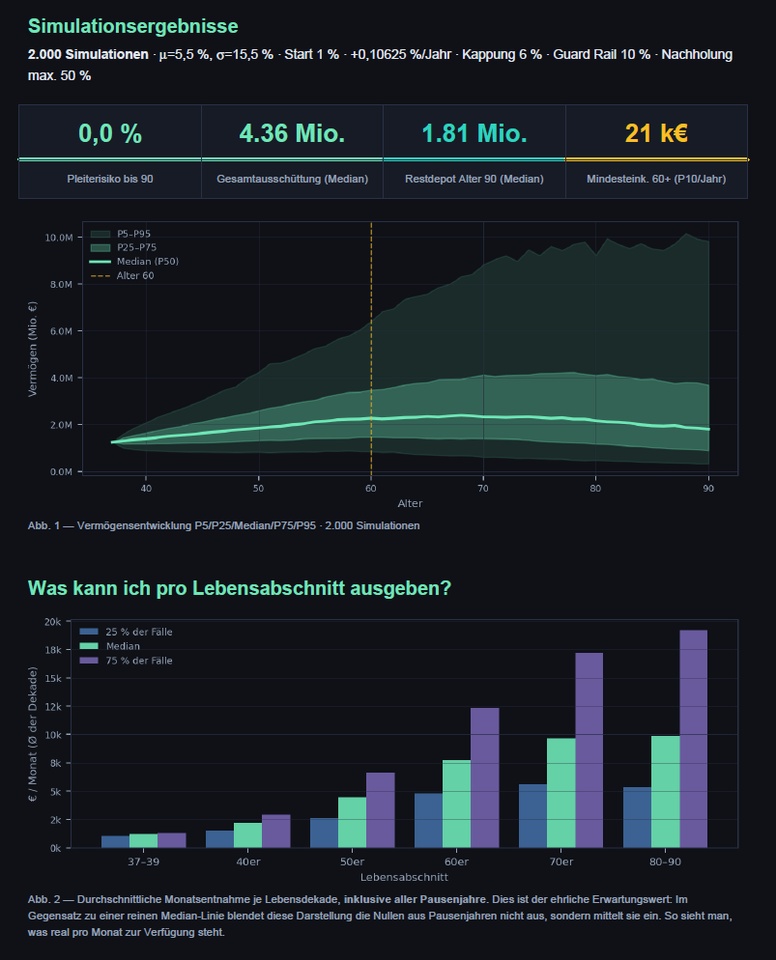
In my simulation, I used my dream scenario, in which I have a total net worth of 1.25 million by age 37. With conservative planning and a 5.5% return, this could result in an incredible 4.36 million spending budget 🚀
With a little luck, the whole thing could, of course, skyrocket… 💣
What are your general thoughts on this? What would you do differently? Have your goals shifted over time, or even changed completely? Why have your goals changed?
I’d be happy if anyone who’s read this far would leave a comment :)


