

Reading time: approx. 3 minutes
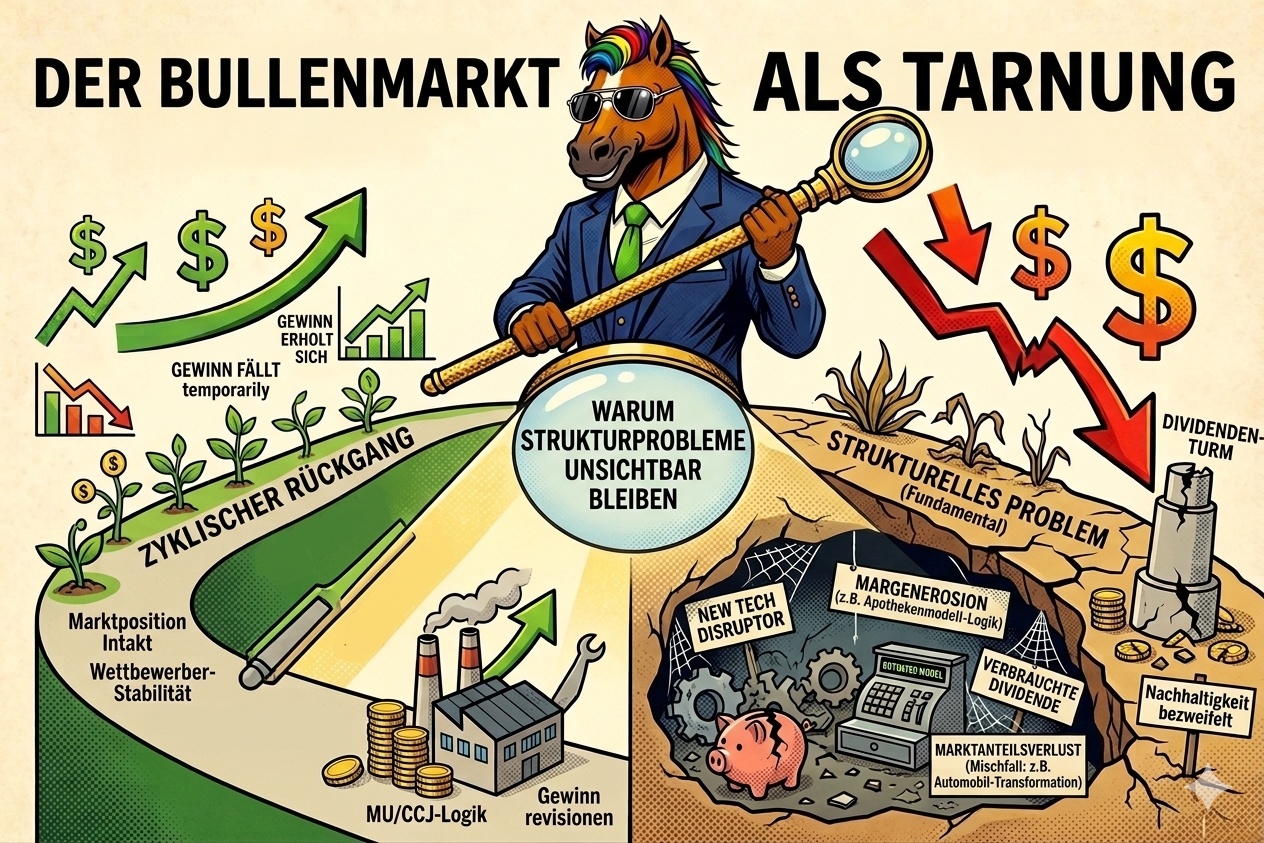
There is one mistake that I consider to be one of the most expensive in investing: confusing a cyclical downturn with a structural problem. Or vice versa. Both cost money, but in very different ways.
The cyclical downturn is temporary. A company earns less because demand is currently weak. The business model is intact, as is the competitive position. Profits recover when the cycle turns. If you sell during this phase, you make a loss and miss out on the recovery.
The structural problem is something else. Here, something fundamental changes in the business model itself. A competitor makes the product redundant, or demand disappears permanently. Profits do not recover because there is nothing to recover. Those who hold on in this phase are waiting for a normalization that never comes.
The difficulty: both look identical on the chart. Price falls, sentiment turns. The difference lies not in the price trend, but in the cause.
I therefore start with a simple question: does the company have a problem, or does the sector have a problem? And if the industry has a problem: Does it resolve itself because it arises from oversupply or temporary weakness in demand? Or is it permanent because a competitor or a technology is changing the basis of the business model?
$MU (-2.19%) Micron Technology is perhaps the most textbook example of the first case. The memory chip market operates in periods of pronounced oversupply and shortage. When prices fall, Micron's numbers look catastrophic. When they rise, profits explode. 2022 was brutal. Demand collapsed, stocks piled up, analysts outbid each other with price target cuts. Anyone who sold back then and bought again in 2023 incurred transaction costs twice and still missed out on the recovery. The core business was never fundamentally called into question.
$CCO (+7.23%) follows a similar logic, with an important overlay. The uranium cycle is slower and politically driven. After Fukushima, it took the market years to separate structural demand from political sentiment. Reactors were shut down and the uranium price collapsed. For many, this looked like a structural problem. But it wasn't. The demand for electricity remained. Nuclear power as a technology remained. What changed was the perception. When that changed, so did the cycle. Those who understood the difference took the reassessment with them.
$CVS (-0.98%) is the counterexample. The pharmacy model has been under pressure for years: pharmacy benefit managers are squeezing margins, bricks-and-mortar retail is losing footfall and the core business is shrinking. CVS is still operating on a large scale and delivering sales. But the market is increasingly pricing in structural margin erosion and regulatory risk, and for good reason. Despite this, CVS was traded as a cheap dividend stock for years. The high dividend yield was seen as a selling point. However, an unusually high dividend yield is often more an indication that the market doubts the sustainability of the payout. This was confirmed in the case of CVS. Anyone waiting for the cyclical recovery was waiting for something that structurally could not come.
$VOW (-0.54%) is the more difficult case, and therefore instructive in another way. The loss of market share in China to BYD and other local manufacturers has a structural core: Chinese suppliers are now competitive in terms of quality and price, this is not a temporary phenomenon. At the same time, a cyclical decline in demand in the premium segment is overshadowing the structural issue in the short term. The two cannot be clearly separated. This makes VW a mixed case: structural core, cyclical overlay. This is not a failure of analysis, this is the reality of many companies in transformation phases. And that is precisely why, in a case like this, I need to at least know which part I attribute to the cycle and which to structural change. Without this separation, a position size can hardly be justified.
What I avoid is holding a cyclical with structural arguments when the cycle is recovering. This is the most common form of self-deception. The story sounds convincing, the share price rises, and at some point you realize that you didn't understand the sector but only participated in the bull market.
The tool that helps me most with this distinction is earnings revisions. That's what the next article is about.


