195,22€ = x23 $FWRG (+0.07%)
50,53€ = x2 $AVWS (+0.53%)
49,06€ = 1x $IUIT (-0.5%)
49,38€ = 0,0006591 $BTC (-0.61%)
Total = 344,19€
This month, I'm aiming for a total investment of 700 euros, so in two weeks I'll invest another 350€ 🤞

Posts
132195,22€ = x23 $FWRG (+0.07%)
50,53€ = x2 $AVWS (+0.53%)
49,06€ = 1x $IUIT (-0.5%)
49,38€ = 0,0006591 $BTC (-0.61%)
Total = 344,19€
This month, I'm aiming for a total investment of 700 euros, so in two weeks I'll invest another 350€ 🤞
My portfolio is currently mainly ETFs, with $FWRG (+0.07%) + $IUIT (-0.5%) + $AVWS (+0.53%) as the core, focused on long-term growth.
I’m considering adding individual dividend stocks as a second layer. The idea comes from my long-term plan: as I get older, I would gradually shift part of my portfolio from growth towards dividend income.
The reason is that I don’t particularly like the idea of having to sell assets to create liquidity later in life. In a FIRE scenario, for example, growth stocks and ETFs would require me to regularly sell part of my holdings to generate income. With dividend stocks, the income is generated without having to sell the underlying assets.
At the same time, I see myself somewhere in the middle right now: I’m still young enough to focus mainly on growth and have many years ahead, but I also feel it could make sense to start building some dividend positions gradually, taking advantage of good opportunities along the way.
So rather than waiting until much later to make that transition, I’m considering starting to build a dividend portfolio gradually alongside my growth ETFs.
Another reason is that my ETFs already give me broad exposure to most of the market, so adding more individual growth stocks would probably mean adding more of what I already own. Dividend stocks could potentially add a different dimension to the portfolio.
A few questions for the community:
I’m more interested in quality, sustainable dividend growth, strong fundamentals and reasonable valuations than simply chasing high yields.
How would you approach this? 🫡

Hi everyone,
I'm 21 and invest €2,000 entirely in ETFs. In September, I restructured my portfolio, and I want to show you what it looks like now and what my reasoning was behind it.
The Strategy Change
Until now, I still held the Xtrackers MSCI World Financials ($XDWF (+0.36%) ) and the individual stock IREN ($IREN (-4.43%) ) in my portfolio. I sold both of them entirely and invested the proceeds in my core ETF. My portfolio was too scattered for my liking: a sector bet here, a single stock there. I wanted a clear structure with a broad core and a few targeted additions where I know exactly why they’re there.
My savings plan (€2,000/month, executed on the 15th)
🌍 €1,000 – SPDR MSCI ACWI IMI ($SPYI (+0.07%)
)
This is my core. Over 9,000 stocks from developed and emerging markets, including small-caps. This essentially gives me the entire global stock market in a single ETF. No matter what else I do, this part ensures a broad base.
📉 €500 – iShares Edge MSCI World Value Factor ($IWVL (+0.15%)
)
Historically, value has been a driver of returns over long periods, and after years of growth dominance, I find undervalued companies particularly appealing. It also helps balance out the heavy weighting of U.S. tech stocks in the global ETF.
💻 €250 – iShares S&P 500 Information Technology ($IUIT (-0.5%)
)
My deliberate bet on tech. I believe that technology and AI will shape the coming decades, and I want to be specifically overweight in that sector. I realize this is a concentration risk, but at 21, I can afford the volatility.
🌏 €250 – iShares Edge MSCI EM Value Factor ($5MVL (-0.74%)
)
Emerging markets are relatively undervalued and have long-term growth potential. Using a value-investing approach, I’m specifically buying the undervalued companies there.
My reasoning behind this
A broad global ETF as a stable core (50%) surrounded by yield-oriented additions (50%). My investment horizon spans several decades, which is why the portfolio is deliberately focused entirely on stocks.
What do you think? Would you weight things a little differently, or do you have any concerns about a particular component?
I’m looking forward to your feedback! 🙌

My dear friends,
Not too long ago, I completely overhauled and restructured my portfolio.
Overall, I’m very happy with the allocation, but that’s just my take on things.
I’d really love to hear your thoughts—what you’d improve, what you like, and what you think is absolute nonsense.
A quick note on the portfolio:
$IREN (-4.43%) This is now my only individual stock, which is exactly what I intended. Anyone who followed my post in May knows that not too long ago I was heavily invested in individual stocks as part of the AI trade, took home some good profits, and have now shifted to a risk-off strategy. $IREN (-4.43%) On the other hand, this is a company I strongly believe in for the long term and am convinced of (I came across the stock independently of Getquin).
On the topic of risk-off, let’s take a look at my ETF positions, which I contribute to monthly as follows:
$IWVL (+0.15%) 700€
$IUIT (-0.5%) €700
$5MVL (-0.74%) €350
$XDWF (+0.36%) 250€
What do you think of this allocation, and what might you improve?
Where do you see further potential?
As always, I look forward to your responses.

Hi everyone,
So far, I've been putting 15% into the $CSNDX (-0.3%) to give my portfolio a little tech boost. 🚀
Now I’m wondering if I should take on even more risk with this $IUIT (-0.5%) , since I’m already taking a conservative approach $VWCE (+0.02%) .
What do you think about this?
Thanks a lot. 😺

The entire position in the S&P 500 Information Technology ETF
$IUIT (-0.5%) was sold and specifically invested in McDonald’s $MCD (+0.76%) , PepsiCo
$PEP (+0.74%) and the L&G Global Quality Dividends ETF
$LDGL (+0.45%) .
The reasons for this decision:
• Less volatility: Following the sharp price increases in the technology sector, I would like to make the portfolio more defensive and reduce its exposure to highly valued tech stocks.
• More cash flow: The focus is shifting more toward regular dividend income rather than solely on price appreciation. The goal is a steadily growing monthly cash flow.
• Attractive valuations: In my view, both McDonald’s and PepsiCo are currently trading at attractive valuation levels. Both companies have strong brands, robust business models, and a decades-long history of rising dividends.
• Greater diversification: The L&G Global Quality Dividends ETF adds high-quality dividend-paying companies from around the world to the portfolio and ensures broader diversification.
• Reduced concentration risk: The technology sector now also has $IWDA (+0.17%) . This rebalancing reduces dependence on a few large tech companies and makes the portfolio more balanced.
For me, this is not a move away from technology—tech remains a significant component of the portfolio via the MSCI World. Rather, the goal is to broaden the portfolio, reduce concentration risk, and place greater emphasis on stable cash flow, quality, and predictable long-term dividend income .


People often ask on our forum how to build up a retirement portfolio—usually as a one-time investment for their parents or, for those over 50, for their own retirement planning. Since I myself plan to retire early in four years and would like to relocate to the Philippines, I’ve given this question a lot of thought: What do I really need to ensure my financial planning for retirement is secure and sustainable?
Here, I’d like to present my “retirement foundation.” It doesn’t represent my entire investment portfolio, but it will form the solid core of my stock portfolio. I’ve deliberately left out other asset classes such as gold, bond ETFs, or individual stocks from this breakdown—this represents purely my ETF foundation.
I’ve gradually built this portfolio over the last four to five
years—both theoretically and, to some extent, in practice—and it has consistently met my standards in backtesting since 2020.
This anchor portfolio presented here remains untouched; it is not actively traded but, at most, topped up at irregular intervals. And eventually passed on to heirs.
My strategy in 6 pillars:
1. Quality: Focus on companies with robust balance sheets.
2. Low Volatility: A portfolio that remains stable during market fluctuations (2022 test: -4%
vs. -13% market).
3. Growth: The goal is a total return performance significantly above the broader market.
4. Cash Flow Focus: Target dividend yield of >4% as a supplemental pension.
5. Allocation: The U.S. is capped at 40%; Europe has a higher weighting. I’ve also weighted the financial sector (where I worked for a long time) similarly to tech.
6. Keep it simple: A portfolio must not become so complex that it becomes unmanageable.
My core holdings consist of:
● VanEck Morningstar DM Dividend Leaders $TDIV (+0.38%)
● iShares MSCI World Quality Factor $WQDS (+0.32%)
● iShares S&P 500 Information Tech $IUIT (-0.5%)
● iShares World Equity High Income $WINC (+0.12%)
● Invesco EURO STOXX High Dividend Low Volatility $EUHD (+0.28%)
In four years, I’ll be taking the plunge out of the workforce and into early retirement. With this portfolio, I’ve built a foundation that provides me with reliable distributions and serves as a solid anchor for my life in Asia. With this portfolio alone, I can lead a very good life there. Now I still have four years to do some speculating so that this portfolio can be built up accordingly. The higher, the better.
These may not be the absolute best ETFs in their respective sectors, nor is this a portfolio that will appeal to 100% of everyone, but taken together, it’s perfect for me and my needs.

Hello, everyone.
When the AI hype really took off in May and my portfolio was up by an unbelievable amount, greed set in.
I didn’t even think about selling, because things were going so well. It was kind of a “sky’s the limit” kind of mindset.
Well, I was wrong. By early to mid-June, all those profits (just under €6,000) were suddenly gone, and last week my portfolio was even down a few hundred euros. So, a complete 180-degree turnaround.
I swore to myself that something like that would never happen to me again, so I started using stop-loss orders more aggressively.
No sooner said than done.
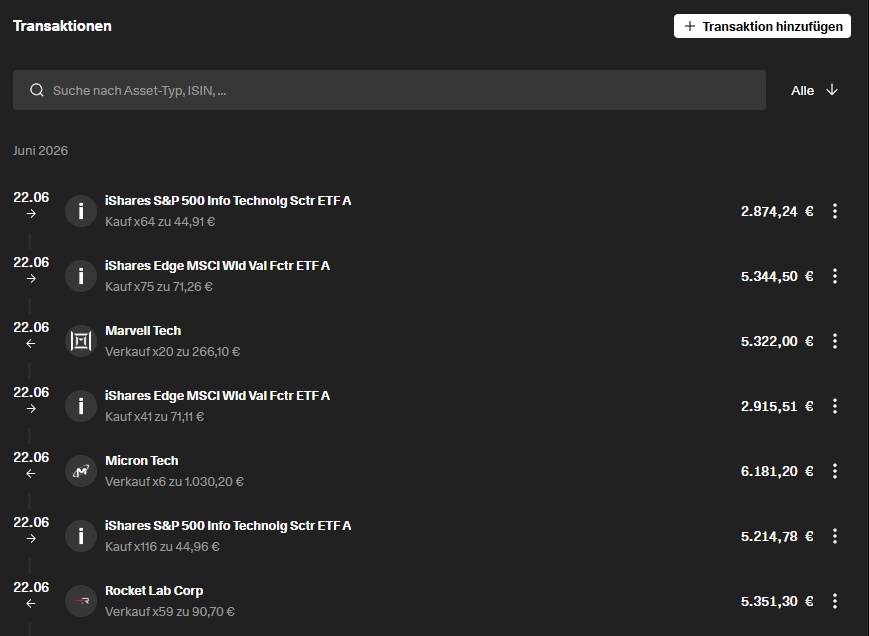
When the market bottomed out a good two weeks ago, I bought:
Today I sold:
$MU (-2%) with a profit of 34.11%
$MRVL (-2.19%) with a profit of 20.08%
$RKLB (-2.32%) with a loss of 9.21%
I’m not too upset about the loss on RocketLab, since 80% of the capital invested consisted of profits I had previously made on the stock, and secondly, the loss also serves as a good tax offset for the other two stocks.
I think I’ll get back into this at the end of the year in light of the Neutron launch, in the hope that it will be successful.
The positions were reallocated to:
$IUIT (-0.5%) and $IWVL (+0.15%)
As I said: Complete profit protection.
If the opportunity arises again, I’ll of course reallocate to individual stocks. Until then, $IREN (-4.43%) this is my only stock position in my portfolio.
At the end of the month, my bank membership bonus of €4,800 will be paid out.
€4,000 of that will go into my third ETF $XEMD (-0.71%)
What do you think of all this?
Best regards,
Don
Today, one year ago I made my first investment with no real strategy, 20/06/2025 I bought my first share of S&P500, started small, €20 here, €50 there, just feeling my way through, buying whatever caught my eye, chasing hype, following trends without any real conviction or framework behind the decisions.
A lot has changed since then. Over the past year I’ve been gradually restructuring, learning what kind of investor I actually want to be, reducing complexity, cutting positions that didn’t serve a clear purpose, and building something I can genuinely stick to for the next 10+ years.
The strategy going forward
Long-term growth portfolio, anchored in global indices, with active conviction in selected factors and companies.
The core is simple: 50% in broad market ETFs
Everything else is built around it with the intention to boost the overall portfolio performance.
Target allocations:
Core = 50-55% $FWRG (+0.07%) + $AVWS (+0.53%) (90%/10%)
World Value ETF = 8-10% $XDEV (+0.23%)
Semiconductor ETF = 6-8% $SEMI (-1.83%)
Emergent Markets = 6-8% $5MVL (-0.74%)
Quality = 3-4% $IUIT (-0.5%)
Mega caps = 3-5% $MSFT (+0.41%)
$AMZN (-0.18%)
$META (+0.21%)
$GOOGL (-0.17%)
Others = 1-3%
$ASML (+0.26%)
$NOW (+1.51%)
Gold = 5-7% $4GLD (-0.33%)
Bitcoin = 3-5% $BTC (-0.61%)
I’ve some names in my watchlist in case the opportunity appears: $TSM (-0.6%)
$MU (-2%)
$NBIS (-3.77%)
$PNG (+1.1%)
$NU (-0.7%)
$SOFI (-0.65%)
$IREN (-4.43%)
$PLTR (+0.34%)
$MA (+0.57%)
Main goal and top priority is to bring my Core
Position as close as possible to the target allocation and Emergent Markets as well, however I’ll keep an eye on market’s volatility.
Special thanks to @Wealth-Accelerator and everyone else that helps me daily in this amazing platform, replying to my posts or comments.
We finding direction. Year two is about executing with discipline and letting time do the work.
Open to questions and feedback, always learning 🚀

Just sold $NOW (+1.51%) for an 8% gain. The more I think about it, the more I realize this type of company just isn’t my style. I already have enough exposure to this type of companies through $IUIT (-0.5%) that’s a position I keep adding to every month.
Now I’ve got €450 to put to work. I’m debating between adding to $FWRG (+0.07%) and $IUIT (-0.5%) (roughly 70/30) or opening a new position in $MA (+0.57%).
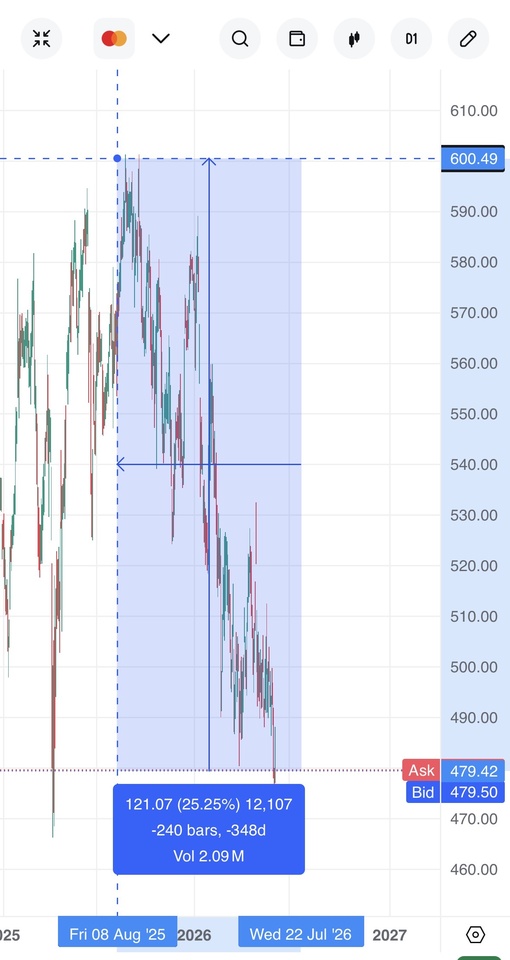
$MA (+0.57%) feels much more like my kind of investment… a quality compounder with a strong moat and predictable long-term growth. At current prices, it also looks like a pretty attractive entry. I don’t think we ever get this type of price again.
Curious to hear your thoughts and I’m also open to suggestions 🫡
Top creators this week