I am currently considering whether it makes sense to switch from $VHYL (+0.1%) to the $TDIV (+0.48%) to switch?
Regarding the high US share in the $IWDA (+0.02%) I already have $EXSA (+0.38%) which also helps me to use the tax-free amount.

Posts
43I am currently considering whether it makes sense to switch from $VHYL (+0.1%) to the $TDIV (+0.48%) to switch?
Regarding the high US share in the $IWDA (+0.02%) I already have $EXSA (+0.38%) which also helps me to use the tax-free amount.

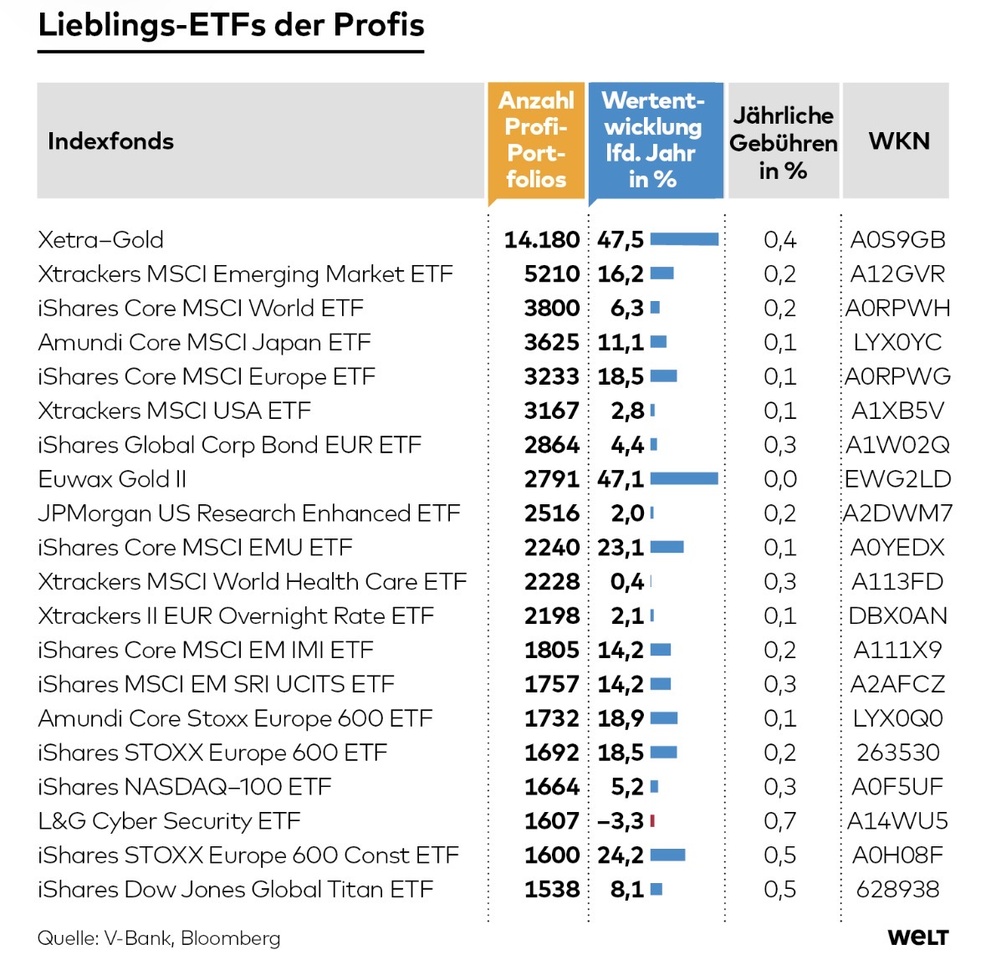
A joint analysis by V-Bank and the Institut für Vermögensaufbau provides fascinating insights. More than 53,000 custody accounts managed by 170 independent asset managers were examined. V-Bank is a custodian bank that holds the securities and carries out transactions on behalf of the asset managers.
The first thing that stands out is that index funds (ETFs) now dominate when it comes to equity vehicles. While actively managed equity funds account for a good eight percent of portfolios, more than eleven percent are invested in equity ETFs. The situation is different for mixed funds or bond vehicles. Here, the professionals still rely on the skills of fund managers, i.e. actively managed products.
When selecting their products, the professionals rely on the large, liquid battleships of the ETF world with low costs from well-known providers. The logic behind this is simple and consistent: maximum diversification at minimum cost. The ongoing charges of the favorites are usually between 0.07 and 0.20 percent. Special sustainability criteria hardly play a role in the choice of ETF.
One thing is striking in the construction of the underlying investments. In their global index funds, the professionals do not rely on combined products that combine industrialized countries and emerging markets in one ETF, such as the MSCI All Country World or the FTSE All World, but prefer to invest separately in the MSCI World and the MSCI Emerging Markets and can thus mix the two components individually. The advantage: the emerging markets are weighted very low in the combined products, and this problem can be better addressed by the professionals' strategy.
Gold is a must for the professionals. It is not high-tech shares or exotic theme funds that dominate the professional portfolios, but the oldest safe haven in financial history. Xetra-Gold is by far the most frequently represented product: the ETC is held in 14,180 professional portfolios. Alternatives such as Euwax Gold II can also be found thousands of times over. And the courage to be safe has been rewarded. While traditional stock markets only made moderate gains in 2025 - the iShares Core MSCI World is up around 6.3% - gold shone with an impressive performance of 47.5%. The message is clear: in uncertain times, gold is not jewelry, but a foundation.
To stabilize the overall portfolio, asset managers are also turning to bonds. Around 28% of assets are invested in bonds, preferably in corporate bonds with good credit ratings. In the ETF segment, the iShares Global Corporate Bond EUR is in the top 20, combining a defensive approach with current yields. In the current year, the ETF has made 4.4 percent, while many bond products are in the red. In the money market, the Xtrackers II EUR Overnight Rate ETF is the most popular ETF product. The principle of balance applies to currency risk: although the euro dominates at 53%, the US dollar is a key component of the hedge at 34%.
In the end, the professionals' figures do not tell a story of hectic changes of direction, but one of structure, cost awareness and clear priorities. Gold serves as both a protective shield and a yield driver. Equities are broadly and favorably represented via global, US, emerging market and Japanese indices. Fees are consistently kept low. And ETFs and ETCs are playing an increasingly important role: almost 20 percent of customer funds are now invested in these instruments - and the trend has been rising since 2023.
This is a reassuring realization for the overburdened private investor. There's no need to reinvent the wheel. A look at the books of the professionals shows that it is often the simple, cost-effective and broadly diversified solutions - supplemented by a good portion of gold - that point the most reliable course in a storm.
$4GLD (-0.31%) | $EWG2 (-0.33%) | $CSEMU (+0.18%) | $EIMI (-0.61%) | $MEUD (+0.19%) | $EXSA (+0.38%) | $XMME (-0.69%)
Source text (excerpt) & graphic: World, 20.12.25

Yesterday, with a heavy heart but with the perspective of risk minimization and stability, I sold the $DX2G (-0.31%) and invested the proceeds in the $$EXSA (+0.38%) invested. The dividend here is not really worse, but in the overall context I much prefer the diversification here to the individual risk of the French economy. Even if their economy currently seems much more stable than their political players. Would you have made the same move?
Good morning everyone,
I am planning to restructure and reorganize my ETF. I had thought about the following allocation. The plan is a one-off investment of €20,000-€25,000 and then monthly savings plans. The whole thing will be divided into percentages.
30% $VWRL (+0.13%) FTSE All-World
25% $HMEF (-0.51%) MSCI EM
20% $EXSA (+0.38%) Europe 600
15% $VHYL (+0.1%) All-World High Div
10% $WAT (+0.35%) MSCI Water (Themes ETF)
Does the community have any tips or suggestions for improvement?
Kind regards
Hello everyone,
I'm back as a silent reader with my portfolio.
Briefly about me: I am 26 years old, employed as an IT specialist in the public sector, live in rented accommodation and my investment horizon is at least another 20 years.
My strategy: I am building a core-satellite portfolio. The ETFs form the core: $IWRD (-0.01%), $EIMI (-0.61%), $EXSA (+0.38%) and as a soon-to-be new addition $WSML (+0.31%) . These are listed alongside $BTC (-0.17%) (lie with $EWG2 (-0.33%) with Bison) in the savings plan. Then there are individual stocks whose business model, sector and geographical location appeal to me.
With this strategy, I am trying to find a healthy balance between the rational assessment of not being able to beat the market and having fun on the stock market.
The allocation is still somewhat skewed, but the goal is:
As future satellite positions I still have $D05 (+0.62%) (to also have a single stock in the banking sector) and $TBS (+0.56%) (because I see opportunities in the South African food market). I will open these positions as soon as I have straightened out the current allocation.
My questions: What do you think of my approach or my desired allocation? Do you have any suggestions for other good individual stocks, especially from the BRICS regions?
Otherwise, happy investing.
Hello.
And the post below is still valid.
Always take it easy-> come on
Payday does not automatically mean that you will receive the dividend in the morning.
The processes can simply take different lengths of time.
And with that, happy vacations from the cote d'azur 🤪 I'm lying in the sun again because ING has already automatically reinvested my dividend from $EXSA (+0.38%) has already been automatically invested again.
You often (sometimes very often and especially on Mondays and Tuesdays) read this question.
OK in the current case $BATS (+0.35%)
$BN4 (-0.28%) and $UNM (-1.59%) . Payday Friday.
All right, payday was Friday. What does that mean and what happens until the money is credited to the clearing account?
Dividend and interest payments are described in the following process flow. As in the case of capital maẞnahem, dividend payments are also decided by the Annual General Meeting of the public limited company. All customers who hold shares in this company in their custody account on a certain key date are entitled to participate.
Income distributions
As soon as the securities are booked into the customer's securities account and the Annual General Meeting of the public limited company decides to distribute income, this is implemented as described in the process below.
Step 1
Publication of an income distribution WM securities notifications LAG = depository (central securities depository)
Step 2
The LAG informs the paying agent of the AG of the portfolio of securities that is entitled to the income distribution on a certain date.
Step 3
The paying agent transfers the total amount of the income distribution in question to LAG.
Step 4
LAG informs the custodian banks that the income distribution has been received in their LAG accounts.
Step 5
Bank checks receipt of payment.
Step 06.
Bank
Starts the processing run in your own WP system.
Step 07.
Posts the income distributions to the accounts of the holding customers.
And after all this has happened, and it doesn't happen in 2 seconds, you can finally rejoice.
And sometimes the process just takes a little while. Stay calm->it will come
#dividende
#wobleibtdiedividende
Source

Hi dear community!
Briefly about myself, I am relatively new to the world of investing... I have been with Trade Republic since last May and now save 4 Etf's per month and have some single stocks like $PEP (-0.25%) , $O (+1.55%) , $MAIN (-0.29%) , $NVDA (-0.39%) etc. which should generate additional cash flow for me.
However, I've been in the crypto world since 2023 and have invested most of my money there, but in the next few months everything will be liquidated, bull run and the parabolic rises will hopefully come soon.
Unfortunately, I currently only have €400 to invest each month.
The ETFs are invested as follows:
iShares MSCI World 200€ (accumulating)
iShares MSCI EM IMI 75€ (accumulating)
iShares Automation & Robotics 50€ (Accumulating)
VanEck Developed Markets Div Lead (newly added a few days ago) 75€
Considering adding more ETFs in the future!
I am very fond of the $JEPQ (-0.04%) and I would also like to invest even more in a Stoxx Europe ETF. But I'm still unsure whether I should go for the Europe 50 or the Europe 600 $EXSA (+0.38%) and whether distributing or accumulating would be the better choice!
If I liquidate my crypto portfolio, I will have a 6-digit sum to reinvest. Above all, Bitcoin will then be heavily invested again at the end of 2026 (most likely the low point of the next bear market)!
I'm looking forward to your answers and your current and future advice.
Thanks and best regards
Chris
Let's give the euro more space in the portfolio.
It can't do any harm after everything is globally reorganized (or not 🤣 depending on what 🍊 feels so good again after getting up)
Hello!
I have been actively working on my portfolio since the beginning of this year, my strategy is to go towards dividends and a safe investment in ETF's with ETF's I want to achieve a balanced weighting that is not too American-heavy but also focuses on Europe.
I have a monthly savings plan of €300 which is divided as follows:
50 € $IWDA (+0.02%)
50 € $EXSA (+0.38%)
40 € $ZPRG (-0.06%)
40 € $WQDS (+0.16%)
20 € $O (+1.55%)
15 € $VZ (-1.18%)
15 € $ULVR (+0.43%)
10 € $JPM (+1.13%)
10 € $JNJ (-0.13%)
10 € $PG (-0.08%)
10 € $ENB (+1.79%)
10 € $ALV (-0.17%)
10 € $KO (-0.16%)
10 € $MCD (-0.12%)
Please do not pay too much attention to the crypto positions, I will liquidate the Shitcoins in the near future when prices are good and switch to ETFs/shares.
Now to my simple question, what do you think of the portfolio? Is it good for my strategy or do you have any tips?
I have a question for you. So far I have only saved one $IWDA (+0.02%) saved. However, I would now like to diversify this core more. In future, I would like to invest 65% in the $IWDA (+0.02%) 20% in a $XMME (-0.69%) 10% in $EXSA (+0.38%) and 5% in $EWG2 (-0.33%) into one. Should I now save the amount I have already saved with the new allocation from next month or should I divide the sums between the new ETFs until the allocation is correct?
Top creators this week