

Time and again, you hear the argument: “Bitcoin isn’t decentralized at all because a few major investors—companies like MicroStrategy and ETFs—own the majority of it!”
But is that really true? Who actually holds how much of the maximum 21 million BTC? And is this distribution a risk or completely normal?
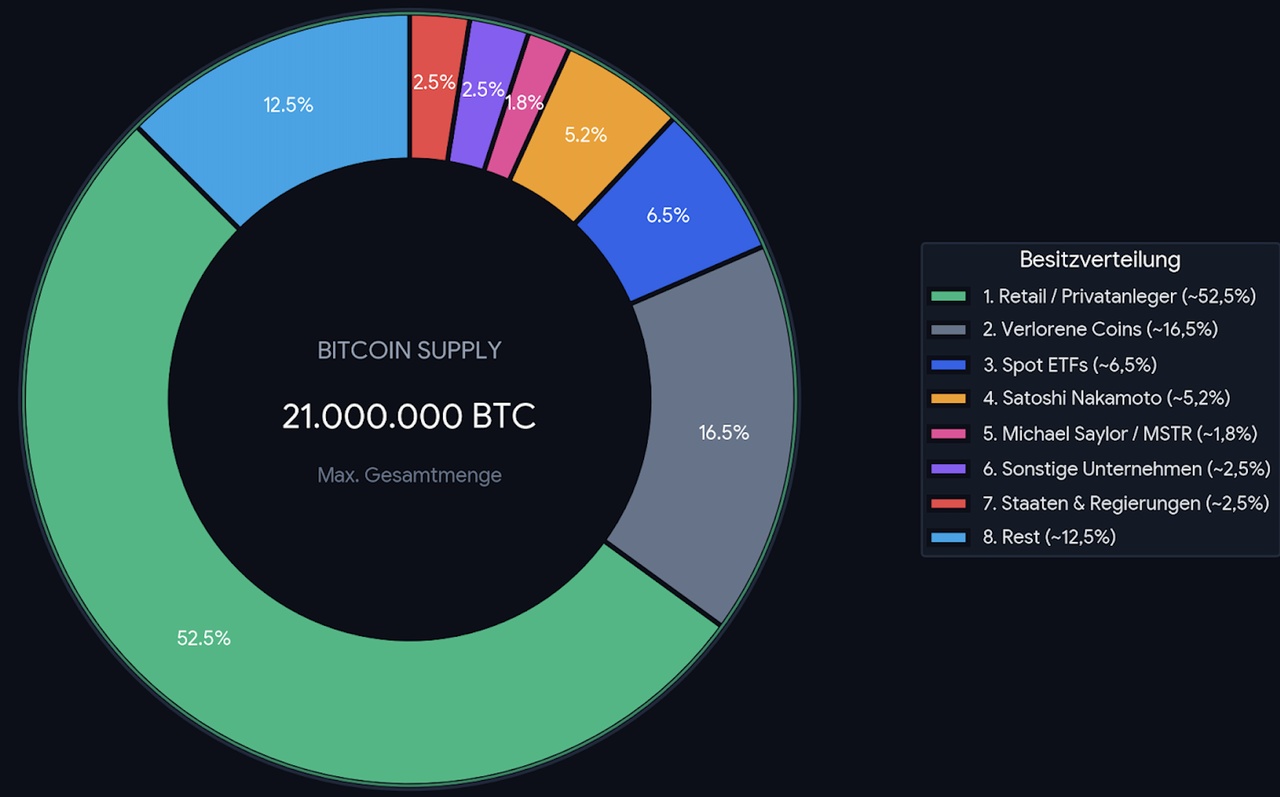
🥧 The Bitcoin pie broken down:
1. Retail / Individual Investors (BTC Stackers): ~50%–55%
The lion’s share of all Bitcoin is still held by millions of small and medium-sized individual investors. Fun fact: The average amount of Bitcoin held by all retail investors is about 0.1 BTC.
However, it’s important to note that a large portion of this ~50%–55% is held by whales (i.e., individuals with >1,000 BTC). These individuals typically bought Bitcoin early on or even mined it themselves.
Retail investors can be divided into the following groups:
· Typical retail investor (occasional investor): 0.005 – 0.05 BTC
· Ambitious BTC stacker (DCA/HODL): 0.1 – 0.5 BTC
· Wholecoiner (1.0+ BTC): Already ranks among the top ~0.5% of all Bitcoin holders worldwide.
2. Lost Coins (“Dead Supply”): ~15% – 18%
An estimated 3 to 3.7 million BTC are lost forever (forgotten passwords, old hard drives in landfills, deceased owners). This makes the remaining supply even scarcer!
3. Spot ETFs (BlackRock, Fidelity & Co.): ~5%–7%
A steadily growing amount of Bitcoin is held in ETF vaults. Important: The ETFs do not own the coins themselves but merely manage them on behalf of their clients.
4. Satoshi Nakamoto: ~5.2% (~1.1 million BTC)
The founder owns bitcoins that have never been moved since 2009.
Of course, there are also theories as to why they’ve never been moved: ranging from his death to maintaining his privacy to the intentional destruction of the keys.
5. Michael Saylor / MicroStrategy: ~1.5%–2% (over 300,000+ BTC)
The undisputed king among corporate HODLers. No other publicly traded company accumulates BTC as aggressively and consistently as a primary reserve asset through debt and equity financing.
6. Other Companies (Corporate Treasuries): ~2%–3%
Other companies such as Tesla, mining firms, or Block Inc., which also hold BTC on their balance sheets.
7. States & Governments: ~2%–3%
Mostly coins seized from criminal activities (e.g., the U.S., Germany), but also government purchases (El Salvador).
8. Remainder: ~12.5%
Mainly coins not yet mined (future supply)—about 4.34%—along with other holdings from exchanges, unclassified wallets, and miner reserves
⚡ The Unique Role of Michael Saylor (MicroStrategy)
Saylor uses traditional debt and equity capital and converts it directly into Bitcoin to maximize his returns.
But is that a problem?
Even if Saylor owns 500,000 or 1 million BTC, that gives him zero voting rights in the Bitcoin network. Bitcoin does not distinguish between an individual user and a billion-dollar corporation.
Of course, it’s important to note that Saylor enjoys a certain level of prestige in the community, and his words and decisions can therefore temporarily influence the market. But changing Bitcoin itself is virtually impossible.
🚨 Is it a bad thing that large investors and “whales” own so much?
No power over the network (governance):
Unlike fiat systems or proof-of-stake projects (such as Ethereum), owning a lot of Bitcoin does not give you any power over the rules. Neither Saylor nor BlackRock can change the 21-million limit or the block size. Only the nodes and miners decide that.
The “Pareto distribution” is natural:
In every economic system (gold, stocks, real estate), wealth concentrates according to the Pareto principle. In short, this means that a small percentage of all Bitcoin addresses holds the vast majority of the total Bitcoin supply. But that’s not a bad thing—it’s completely normal.
With Bitcoin, however, the distribution is extremely transparent compared to the fiat system, since every transaction is visible on-chain.
The seal of approval:
It’s often said that the introduction of Bitcoin ETFs has stripped Bitcoin of some of its sovereignty. I would rather say it was a “seal of approval” and a necessity for Bitcoin: The fact that even the top echelons of the fiat financial industry are interested in Bitcoin and are building a recognized financial product like an ETF around it is a kind of acknowledgment of Bitcoin and promotes its further adoption in the future.
💡 Conclusion
The fact that players like Michael Saylor or ETFs are buying up massive amounts of Bitcoin does not contradict the principle of Bitcoin. Bitcoin’s promise was never “equality of wealth for all,” but rather equality of rules for all (Game Theory). Everyone is subject to the same mathematical laws—whether you own 0.001 BTC or 300,000 BTC.
Stay safe & stack Sats!
$BTC (-0.31%)
#bitcoin
$MSTR (+2.92%)
$MCSTP (-1.12%)
#mstr
#michaelsaylor
#crypto
$BLK (+3.89%)
#finanzen
#investieren
#getquin
#btc
$TSLA (+1.82%)
$BLOCK (+0.04%)