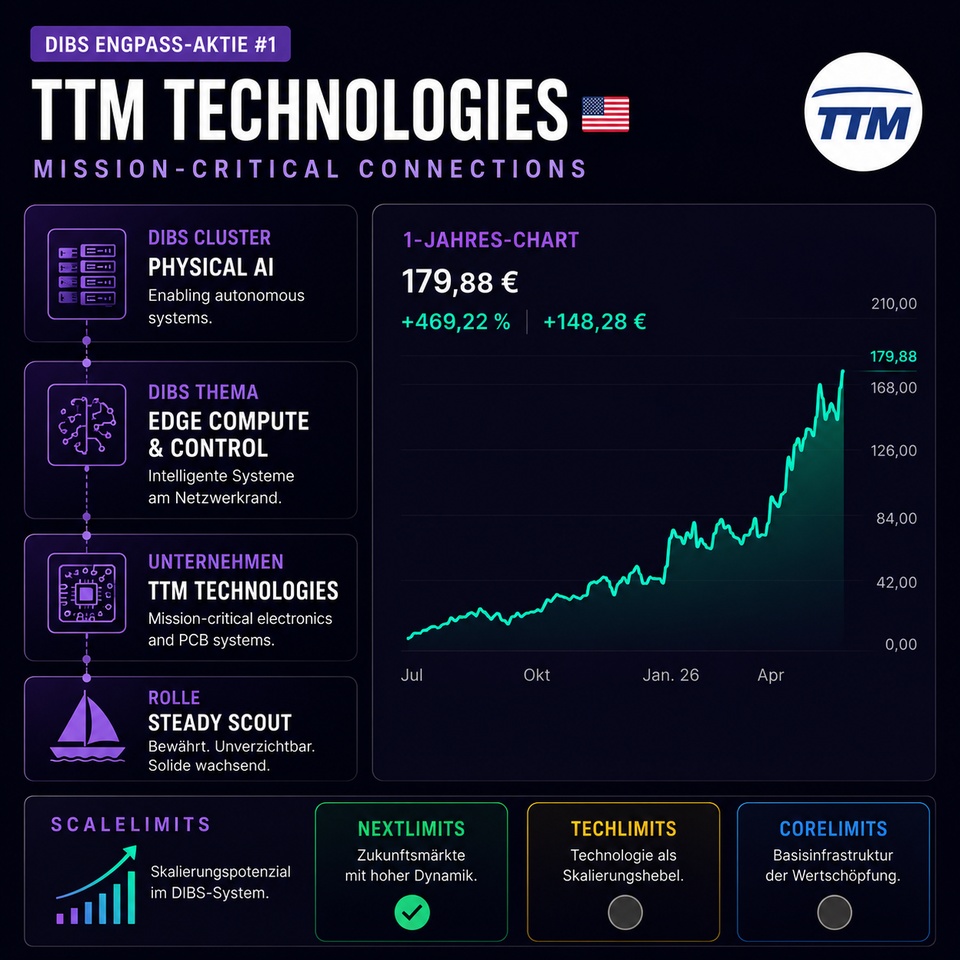
Starting today, I’ll be regularly featuring companies from my investment universe that I find particularly interesting. All of the stocks mentioned are in my portfolio. Many of them are also part of my three wikifolios —NextLimits, TechLimits, and CoreLimits—in the ScaleLimits system (see the checkmarks in the chart). Of course, this applies only as of the time of publication of this post. Things can change.
I’m less concerned with short-term price targets or quarterly earnings. I’m primarily interested in which technological bottleneck a company is addressing and why I’ve added it to my portfolio. The overarching structure of my approach is illustrated by the DIBS Board (Dynamic Infrastructure Bottleneck Stack), which I regularly publish on getquin.
We’ll start today with TTM Technologies $TTMI (+5,81%). When people talk about AI infrastructure, the focus is usually on chips, GPUs, and data centers. Less often discussed is how these components are actually connected to one another.
This is where TTM Technologies comes in. The company develops and manufactures highly complex printed circuit board and interconnect systems for data centers, networking, aerospace, defense, and industrial applications.
A processor alone doesn’t provide any value. It’s only through printed circuit boards, backplanes, and interconnects that chips become servers, servers become systems, and systems become AI applications.
In the DIBS system, TTM is part of the Physical AI and the “Bottleneck” topic Edge Compute & Control . Role: Steady Scout ⛵
TTM does not build AI models and is rarely in the public spotlight. However, the company provides a building block without which modern electronic systems would not function.
For me, TTM is a good example of how interesting investment opportunities are often found not where the headlines are made, but where the technological infrastructure is being built.
The sharp rise in the stock price over the past few months shows that the market is increasingly recognizing the importance of this sector. However, inclusion in this DIBS Bottleneck series is not determined by past stock performance, but rather by the company’s role within the respective bottleneck.