

SpaceX stock is caught in a paradox: The company reported third-quarter revenue of $14.58 billion (+161%) and net income of $4.40 billion, yet on November 5, 2026, the stock price fell 9.05% to $123.62 amid an AI and tech sell-off following the U.S. midterms. This puts the stock about 8% below its initial public offering price of $135 and about 45% below its 52-week high of $225.64. The main factors weighing on the stock in recent weeks have been the lock-up expiration of up to 1.3 billion shares on October 22, 2026, the planned investments of $35 to $40 billion in the fourth quarter alone, and concerns that AI data centers and government contracts will come under greater political scrutiny following the election. Analysts, however, take a different view: Following the earnings report, JPMorgan ($500), Cantor ($345), and Barclays ($300) raised their price targets, with the average ranging from around $242 to $257, depending on the data provider. From a technical analysis perspective, a break below the $130 level puts the all-time low of $105.13 within reach; the situation would only ease if the stock rises above $144. SpaceX does not pay a dividend; the next major lock-up period ends on December 8, 2026.
Key Points
- Price: $123.62 (close on Nov. 5, 2026, −9.05%), below the offering price of $135; 52-week range: $104.83 to $225.64
- Q3 2026: Revenue $14.58 billion (+161%), net income $4.40 billion, earnings per share $0.35, adjusted EBITDA $8.81 billion
- Caveat: Investments of $19.59 billion in Q3 and a planned $35 to $40 billion in Q4, resulting in a negative free cash flow on a pro forma basis
- Outlook: Q1 2027 revenue of $33 to $37 billion; target of $100 billion in annualized revenue by the end of 2026
- Analysts: Average price target around $242 to $257, range $115 to $500 (JPMorgan); Morningstar sees fair value at $70
- Chart: Support at $130 broken; below that, target is the all-time low of $105.13; relief only above $144, with potential up to $172.85
- Dates: Lock-up period ends for up to 797.6 million shares on December 8, 2026; Q4 earnings expected in February 2027 (unconfirmed); no dividend
What are the current key metrics for SpaceX stock?
Following the price drop on November 5, 2026, SpaceX stock is trading at $123.62 (equivalent to approximately €110), giving the company a market capitalization of about $1.68 trillion.
The price is about 45% below the 52-week high, about 18% above the 52-week low, and about 8% below the June offering price. Operationally, SpaceX posted a billion-dollar profit in the third quarter for the first time since its IPO.
- Price (Nasdaq: SPCX): 123.62 USD (−9.05%), equivalent to approximately 110 EUR (close on Nov. 5, 2026)
- Previous day’s closing price: $135.92 (−3.8% following the U.S. midterms) (November 4, 2026)
- Intraday low: $120.39 (November 5, 2026)
- Offering price (IPO): $135 (June 12, 2026)
- 52-week high / all-time high (intraday): $225.64 (June 16, 2026)
- Record closing price: $201.80 (June 16, 2026)
- 52-week low / all-time low: $105.13 (Stock3; Alpha Vantage Intraday: $104.83) (August 3, 2026)
- Distance from 52-week high / low: approx. −45% / approx. +18% (November 5, 2026)
- Market capitalization: approx. 1.68 trillion USD (approx. 13.58 billion shares) (November 5, 2026)
- Revenue for Q3 2026: $14.58 billion (+161%) (October 20, 2026)
- Net income for Q3 2026: $4.40 billion (prior year: −$1.05 billion) (Oct. 20, 2026)
- Earnings per share for Q3 2026 (diluted): $0.35 (9 months: −$0.15) (Oct. 20, 2026)
- Adjusted EBITDA for Q3 2026: $8.81 billion (+306%) (October 20, 2026)
- Capital expenditures (Capex) Q3 / 9 months: $19.59 billion / $48.07 billion (Oct. 20, 2026)
- Operating cash flow for the first 9 months: $13.10 billion (October 20, 2026)
- Liquidity / Financial Debt: $89.86 billion (including securities) / $38.84 billion (September 30, 2026)
- Starlink residential customers: 13.6 million (previous year: 7.2 million) (September 30, 2026)
- Revenue Outlook for Q1 2027: $33 to $37 billion (October 20, 2026)
- Q4 2026 Capex Outlook: $35 to $40 billion (Oct. 20, 2026)
- Average analyst price target: approx. $242 to $257 (depending on data provider) (Oct. 31, 2026)
- Dividend: None; not planned, according to the prospectus
- Next lock-up period: up to 797.6 million shares (December 8, 2026)
- Next earnings report (Q4 2026): February 2027 (estimated, not confirmed)
- WKN / ISIN / Ticker: A42D4F / US84615Q1031 / SPCX
What news is driving SpaceX stock—and why is it falling?
SpaceX stock is falling due to three converging factors: the AI and tech sell-off following the U.S. midterms, lock-up expirations, and record-breaking investments.
On November 5, 2026, the stock lost 9.05%, while the Nasdaq fell by about 5.5% according to the AP. Because the AI business accounted for more than half of revenue in the third quarter, investors are now treating SpaceX like a data center stock. My analysis of Tesla Aktie – it actually lost 10.8% on the same day, and a special committee is already discussing a possible merger of the two companies.
- Nov. 5, 2026 – 9% price drop amid AI sell-off: Closed at $123.62, intraday low of $120.39. Following the U.S. midterms, concerns are growing about regulation, data centers, and government contracts. Nasdaq down 5.5% according to AP, Tesla down 10.8%. (Very bearish)
- November 4, 2026 – Midterms: Stock falls 3.8%: Closed at $135.92. Following the election results, investors fear greater political control over AI infrastructure and government contracts. (Bearish)
- October 30, 2026 – Back below the IPO price: Amid a tech sell-off, the stock falls 6.4% to $134.72 and closes below its IPO price of $135 for the first time since August. (Bearish)
- October 26, 2026 – Bernstein raises price target to $268: “Outperform” rating confirmed; target raised from $248 to $268. Bernstein expects computing power to reach 12.8 gigawatts by the end of 2027. (Bullish)
- Oct. 22/26, 2026 – Lock-up periods: up to 1.6 billion shares become tradable: On Oct. 22, up to 1.3 billion shares will become tradable; on Oct. 26, an additional 328.4 million. The stock falls 9.1% to $144.75 on Oct. 22. (Bearish)
- October 21, 2026 – Wave of price targets following the earnings report: JPMorgan raises its target to $500 (from $240), Cantor to $345, Barclays to $300, Citi to $240, and UBS to $230. The stock closes 7.8% higher at $159.31. (Bullish)
- October 20, 2026 – Q3 Earnings: Revenue +161%, first-ever billion-dollar profit: Revenue $14.58 billion, net income $4.40 billion, earnings per share $0.35. Outlook: Q1 2027 revenue of $33 to $37 billion, Q4 capex of $35 to $40 billion. (Very bullish)
- October 6, 2026 – FCC Approves Starlink Mobile: Mobile satellite system with up to 15,000 satellites approved; two days later, the company purchases 800 MHz of spectrum from Grain Management. The stock closes at $171.92. (Bullish)
What does SpaceX management say about the Q3 results?
Management speaks of a turning point: According to the CFO’s comments in the quarterly report, SpaceX has delivered another strong quarter, driven by Starlink’s momentum and a breakthrough in the AI business (Super Intelligence).
Elon Musk elaborated during the conference call, citing annualized revenue of $500 billion to $1 trillion by the end of 2027. However, this is a verbal estimate and not an official forecast.
What went well: Revenue in the AI segment rose to $7.56 billion, surpassing Starlink’s $5.25 billion. Starlink added 1.6 million residential customers, while revenue from businesses and governments increased by 91%. The bottom line is a profit of $4.40 billion, following a loss of $1.05 billion in the same quarter last year; according to the conference call, the order backlog rose to $63 billion.
The catch: SpaceX is investing more than it earns. Investments totaled $19.59 billion for the quarter and are expected to rise to $35 billion to $40 billion in the fourth quarter. After nine months, $13.10 billion in operating cash flow is offset by $48.07 billion in investments, resulting in a calculated free cash flow of approximately −$35 billion. The Starlink margin of 55% includes a one-time effect of about 3 percentage points from customs refunds; operating income in the AI segment was only $431 million after $1.2 billion in stock-based compensation for the Cursor acquisition. In addition, there have been delays: According to the conference call, the U.S. launch of Starlink Mobile has been pushed back to early 2028, and instead of daily Starship flights, management is now targeting weekly launches for the first half of 2027.
Outlook: SpaceX projects revenue of $33 billion to $37 billion for the first quarter of 2027, with annualized revenue expected to reach $100 billion by the end of 2026. The gross margin is expected to return to the second-quarter level in the fourth quarter. Computing power is expected to grow from 1.7 gigawatts to 2.5 to 3 gigawatts by year-end and to approximately 13 gigawatts by the end of 2027. A special committee is reviewing a potential merger with Tesla; Musk stated there is “no guarantee.”
What does SpaceX do—and how does the company make its money?
SpaceX currently generates revenue in three areas: AI services and data centers (Super Intelligence), the Starlink satellite internet service (Connectivity), and rocket launches (Space).
Elon Musk’s company has been listed on the Nasdaq since June 12, 2026 (ticker SPCX, ISIN US84615Q1031, WKN A42D4F); the offering price was $135. In the third quarter of 2026, SpaceX generated $14.58 billion in revenue.
Super Intelligence (AI): Since acquiring xAI, SpaceX has been operating the Grok language model, the X platform, its own data centers, and—since August—the Cursor programming assistant. In the third quarter, this segment generated $7.56 billion in revenue (+830%) and $4.95 billion in adjusted EBITDA. This is also where the majority of investments are directed: $16.44 billion out of $19.59 billion for the quarter.
Connectivity (Starlink): Satellite internet for 13.6 million residential customers, as well as for businesses, aircraft, and governments. Revenue rose 69% to $5.25 billion, and adjusted EBITDA was $3.50 billion. With Starlink Mobile and the acquired 800 MHz spectrum, SpaceX is directly targeting the mobile phone business of network operators. My analysis of Telekom Aktie —which lost 8% in a single day following the spectrum deal.
Space (rocket launches): Falcon 9, Falcon Heavy, Dragon, and Starship. Thirty-five launches in the quarter—12 of which were for customers—generated $1.77 billion in revenue (+6%). According to Musk, Starship Flight 15 is set to be the first to land both the booster and the spacecraft on the tower.
Here’s how SpaceX makes money: Subscriptions for internet and AI services, computing power for corporate customers, advertising on X, and launch contracts from governments and companies. Starlink revenues are recurring and highly profitable; the AI business is growing the fastest but consumes the most investment.
Fundamental Analysis: Is the SpaceX Stock Still Too Expensive After the Plunge?
Yes, based on traditional metrics, SpaceX stock remains expensive even after the drop: With a market capitalization of around 1.68 trillion USD, the P/S ratio—based on Q3 revenue—is estimated at around 29.
If we use the midpoint of the Q1 forecast of $35 billion per quarter, it drops to around 12. The market is therefore primarily pricing in the expected growth.
Earnings and P/E Ratio: Projected over a full year, the third-quarter earnings per share (USD 0.35) result in a P/E ratio of around 88. Estimates for 2027 vary widely: $2.25 per share according to TIKR, $4.03 according to the Yahoo Finance consensus. That would correspond to a 2027 P/E ratio of around 31 to 55. After nine months, the company still reports a loss of $0.15 per share because the first half of the year was loss-making.
Cash Flow and Balance Sheet: The catch is the cash flow. Operating cash flow of $13.10 billion was offset by $48.07 billion in capital expenditures after nine months, resulting in a free cash flow of approximately −$35 billion. However, with $51.29 billion in cash and $38.56 billion in securities, SpaceX is well-financed; its financial debt stands at $38.84 billion. In the fourth quarter alone, $35 to $40 billion is expected to be invested, with the majority going toward data centers.
AI Valuation Comparison: Because the AI business now accounts for more than half of revenue, the stock market is increasingly valuing SpaceX as an AI stock. You can also see just how ruthlessly the market slashes such valuations during a sell-off in my analysis of Palantir Aktie —the mechanics are the same: the higher the expectations, the harder the setback.
Analyst Valuations: The range is extreme. JPMorgan sees an addressable market of over $28 trillion at $500 per share, while Morningstar considers only around $70 to be fair. The Stock Finder does not yet provide a fair-value calculation for SpaceX because the track record is too short and no key metric is sufficiently stable.
Lock-up periods: Following the releases on October 22 and 26, the regular lock-up period for up to 797.6 million shares ends on December 8, 2026. This will be followed by staggered releases for a pool of major shareholders, with the first occurring after the Q4 earnings report. Elon Musk remains subject to lock-up restrictions until June 12, 2027.
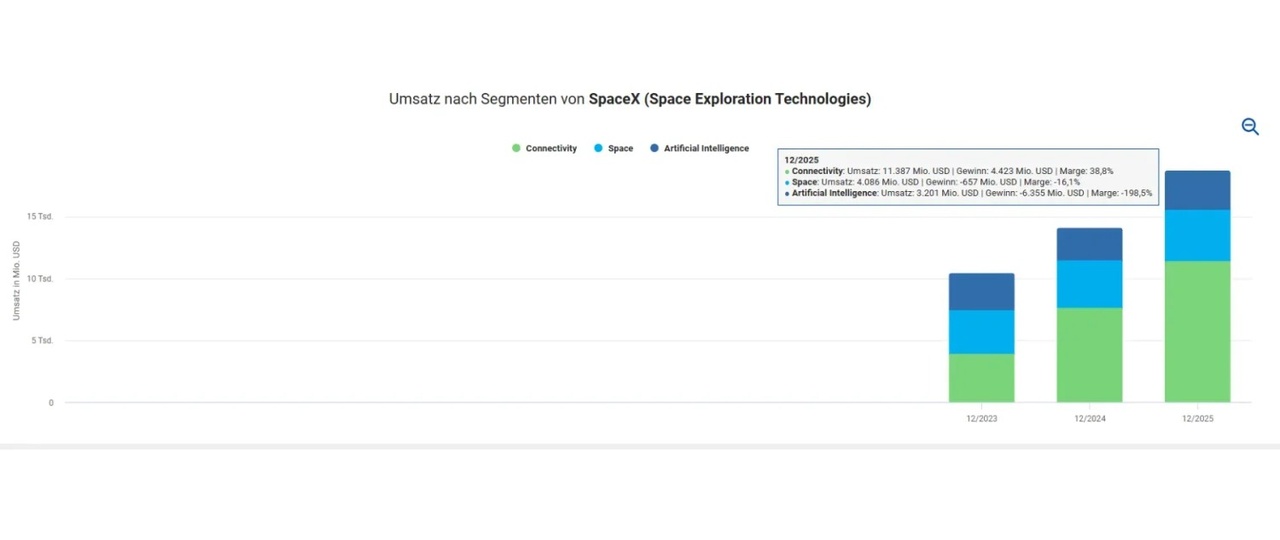
SpaceX Stock (SPCX) Segment and Revenue Breakdown for 2026 (as of November 6, 2026) – Source: Aktienfinder / Christian Lill
SpaceX Stock Price Targets and Forecast for 2026
On average, analysts see a price target for SpaceX stock of around $242 to $257, which is roughly double the current price of $123.62.
Following the Q3 results, nearly all major brokerages have raised their targets, though the range extends from $115 (HSBC) to $500 (JPMorgan). From a technical analysis perspective, the stock has lost an important level by falling below its initial public offering price of $135.
Key price levels:
- 52-week high and all-time high: $225.64 (intraday, June 16, 2026)
- Current price: $123.62 (closing price Nov. 5, 2026, −9.05%, intraday low $120.39)
- First resistance: $130.44 (broken support zone, price gap from November 5, 2026)
- Second resistance: $144.00 (resistance box, Ichimoku cloud, and downtrend line)
- Third resistance: $172.85, above that $190.62
- Critical downside level: Closing prices below $130; next target is the all-time low of $105.13 (Stock3 chart)
Analyst price targets:
- Average price target: approx. $257 (StockAnalysis, 39 analysts, as of Oct. 31, 2026), median approx. $242 (Business Insider)
- JPMorgan: Overweight, $500 (October 21, 2026, previously $240)
- Cantor Fitzgerald: Overweight, $345 (October 21, 2026, previously $246)
- Barclays: Overweight, $300 (October 21, 2026, previously $254)
- Morgan Stanley: Overweight, $300 (October 21, 2026, confirmed)
- Bernstein: Outperform, $268 (Oct. 26, 2026, previously $248)
- Citi: Buy, $240 (October 21, 2026, previously $200)
- UBS: Buy, $230 (October 21, 2026, previously $210)
- HSBC: Hold, $115 (July 2026)
Chart Analysis:
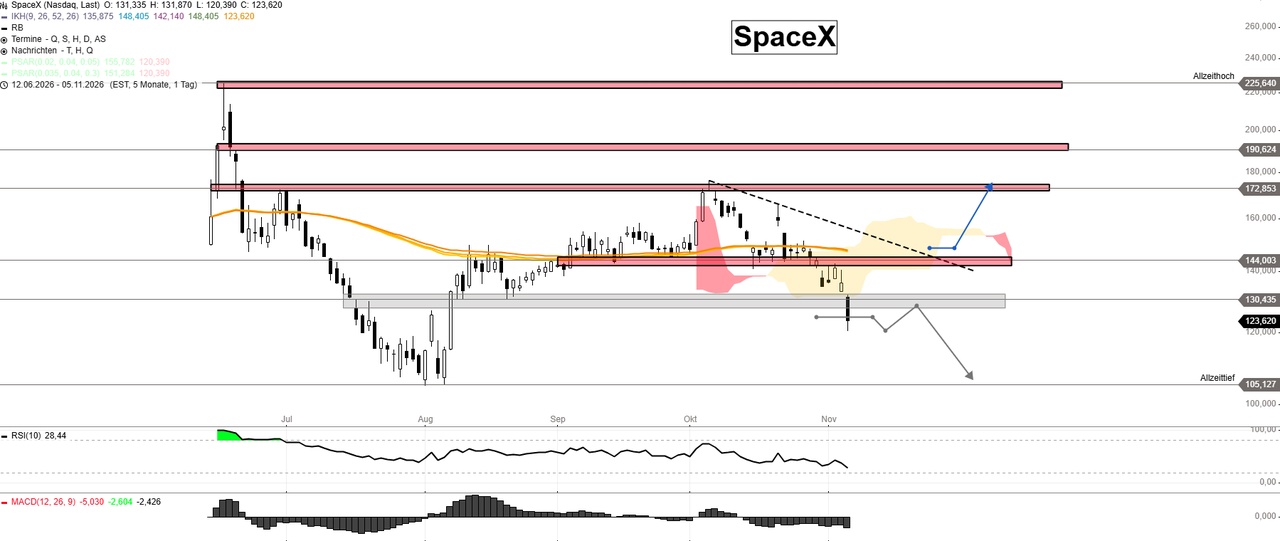
SpaceX Stock (SPCX) Chart Analysis and Price Targets for 2026 (as of Nov. 6, 2026) – Source: Stock3 / Christian Lill
Here is the daily chart. Below $130, the bears have an easy time continuing to sell and pushing the price toward its all-time low. It was precisely this zone that the SpaceX stock broke through on November 5, 2026, during the AI sell-off, with a downward price gap: The gray support level around $130.44 has been breached, and the stock closed at $123.62. If the stock remains below $130, the all-time low of $105.13 comes into focus as the next target (gray arrow).
The RSI(10) stands at 28.44, close to the oversold zone, so a technical rebound is possible at any time. However, the MACD remains clearly negative at −5.03, and the price is trading below the Ichimoku cloud and below the falling downtrend line that has been in place since early October.
A rebound above $144 would be a signal of relief, paving the way for further gains up to $172.85 (blue arrow). The $144 mark is where the red resistance box, the cloud, and the downward trend line converge. Only once the price breaks above this level would the resistance at $190.62 and the all-time high of $225.64 come back into play as long-term targets.
SpaceX Stock Forecast for 2030 and the Next 10 Years: What Is Realistic?
There is no reliable price forecast for SpaceX stock for 2030 or for the next 10 years—the only realistic approach is to consider various scenarios, and these depend almost entirely on whether today’s record-breaking investments will eventually translate into cash flow.
No major research firm publishes an official price target for 2030; analyst targets are valid for 12 months at a time.
What the numbers suggest: SpaceX is targeting revenue of $33 billion to $37 billion for the first quarter of 2027, which would amount to approximately $130 billion to $150 billion on an annualized basis. The Yahoo Finance consensus for 2027 is approximately $180 billion in revenue. Musk’s statement of $500 billion to $1 trillion in annualized revenue by the end of 2027, however, is not an official forecast.
A calculation example instead of a fantasy figure: With approximately 13.58 billion shares, a stock price of $100 per share corresponds to a market capitalization of approximately $1.36 trillion. JPMorgan’s price target ($500) thus implies a market capitalization of approximately $6.8 trillion USD, while Morgan Stanley’s target ($300) implies a market capitalization of approximately 4.1 trillion USD. Anyone reading a forecast for 2030 should always check what market capitalization and revenue figures underlie it.
And 2050? There are no credible price forecasts for 2050. Whether Starship, Starlink Mobile, and data centers in space will be operational in 25 years cannot be translated into a stock price today. Figures for 2040 or 2050 circulating online are based on assumptions, not on company data.
What matters in the long term: First, whether free cash flow will turn positive once the wave of investment subsides. Second, whether Starship will reduce launch costs as significantly as planned. Third, how much value will reach current shareholders after Elon Musk’s lock-up period (June 12, 2027) and a potential merger with Tesla.
Conclusion: SpaceX Stock—Sell, Hold, or Buy More?
SpaceX stock is stronger than ever from an operational standpoint, but under pressure on the stock market: The billion-dollar profit in the third quarter did not prevent the stock from falling below its offering price.
The market no longer pays for every growth fantasy but is demanding cash flow. And with planned investments of $35 to $40 billion in the fourth quarter, that cash flow remains deeply negative for the time being.
Three things will matter in the coming weeks: whether the AI sell-off subsides after the midterms, how the market digests the lock-up expiration of up to 797.6 million shares on December 8, 2026, and whether the stock can fight its way back above the offering price of $135. Analysts see, on average, roughly twice as much potential, but the range of $115 to $500 shows just how uncertain the valuation is. From a technical analysis perspective, the situation is clear: below $130, the bears will have an easy time pushing the price toward its all-time low of $105.13. Only a rebound above $144 would signal relief, with potential up to $172.85.
Anyone who wants to understand what ultimately determines the success of SpaceX’s data center vision should read my analysis Bloom Energy Aktie —because without electricity, not a single gigawatt of computing power can run, and that’s exactly where it will be decided whether the billion-dollar investments will pay off.
✅ Opportunities
- Q3: Revenue up 161% to $14.58 billion and $4.40 billion in net income
- Q1 2027 Outlook: $33–37 billion in revenue, more than double that of Q3
- Wave of price targets: JPMorgan 500, Cantor 345, Barclays and Morgan Stanley 300 USD
- Starlink, with 13.6 million residential customers and high margins, serves as a stable core
- High liquidity: $89.86 billion in cash and securities
- RSI(10) at 28.44, near oversold territory; potential to rise from over $144 to $172.85
⚠️ Risks
- Investments of $35–40 billion in Q4, resulting in a significantly negative free cash flow on a pro forma basis
- Lock-up period ends for up to 797.6 million shares on December 8, 2026
- Political risk following the midterms: regulation, data centers, government contracts
- High valuation: approximately $1.68 trillion market capitalization; Morningstar sees a fair value of only $70
- Delays: Starlink Mobile in the U.S. not until early 2028
- Support at $130 broken via a price gap; target: all-time low of $105.13
Sources
- SpaceX Investor Relations: SpaceX Reports Third Quarter 2026 Results (October 20, 2026)
- SpaceX Investor Relations: Form 8-K, Q3 2026 Earnings Release
- SEC EDGAR: Registration Statement (Form 424B4) Space Exploration Technologies Corp., Lock-Up Periods and Dividend Policy
- SEC EDGAR: Filings for Space Exploration Technologies Corp. (SPCX)
- Stock Prices: Alpha Vantage (SPCX, daily data through November 5, 2026, closing price $123.62); Comparison of StockAnalysis and Gotrade (52-week range: $104.83 to $225.64), WeTalkTesla/AP (November 5, 2026: −9.05%, Nasdaq −5.5%); EUR/USD 1.1218 (Alpha Vantage)
- Q3 2026 earnings call (October 20, 2026): Reports from Finviz, Investing.com, and MarketBeat
- Price targets: Teslarati (Oct. 21, 2026), TIKR (JPMorgan, Oct. 21, 2026), Foreks (Citi, UBS, Macquarie, Oct. 21, 2026), TechFlow (Bernstein, October 26, 2026), StockAnalysis (consensus, October 31, 2026), Business Insider (median), Morningstar (fair value)
- Lock-up periods: Analysis of the IPO prospectus by Orbitalpha and Stockcar; IFR
- Q4 2026 earnings release date: Wall Street Horizon (Feb. 9, 2027, estimated), finanzen.net (Feb. 25, 2027, estimated), MarketScreener
- 2027 Estimates: Yahoo Finance (consensus), TIKR
- Stock Finder: SpaceX company profile, as of Nov. 6, 2026 (no fair value calculation available)
- Stock3: SpaceX daily chart (Nasdaq, USD), June 12 through November 5, 2026, closing price $123.62
This is not investment advice—all information is provided solely for financial education purposes.
What are your current thoughts on $SPCX (+10,35%)?