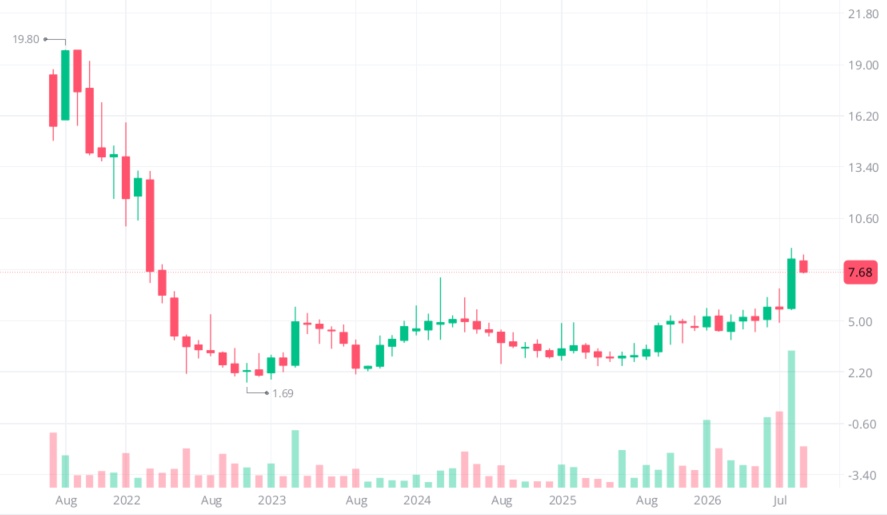
SOPHiA GENETICS $SOPH (+5,73%)

SOPHiA provides the software that hospitals use to analyze genetic data. Unlike companies such as Tempus $TEM (+0,91%) or Caris $CAI (+0,97%) , SOPHiA generally does not perform the tests itself. Hospitals conduct the sequencing on-site and use the SOPHiA DDM platform to interpret the results.
This means SOPHiA earns less per patient and does not have as large a proprietary data set as some of its more integrated competitors. In return, the business model is more capital-efficient and can be scaled more easily worldwide. The company has already built a network of over 1,000 clinics in 75 countries.
What interests me now is that, after more than ten years of building the business, several parts of it seem to be making a leap forward at the same time.
The business can be roughly divided into two parts.
The first is Clinical Genomics, which is the current core business. Hospitals and laboratories pay SOPHiA to analyze genetic test results—for example, for solid tumors, blood cancers, liquid biopsies, hereditary cancers, and rare diseases. Growth comes from adding more clinics, testing more patients, and selling additional services to existing customers.
The second segment is BioPharma. Here, pharmaceutical companies pay SOPHiA for services such as patient recruitment, support for clinical trials, real-world data, and, increasingly, companion diagnostics—that is, diagnostic tests used in conjunction with specific medications. This segment is still significantly smaller today but could become particularly important because pharmaceutical contracts can be much larger, and SOPHiA can additionally market the same clinic network that was established for clinical testing.
Simply put: Clinical Genomics builds and expands the network. BioPharma is increasingly marketing the value of this network.
This distinction is key to understanding why the recent contracts with AstraZeneca are so significant.
Now, let’s look at a few key points of this thesis.
Growth Is Accelerating
Revenue in the second quarter grew 27.2 percent year-over-year to $23.3 million (compared to an expected $21.7 million), which was faster than the roughly 22 percent growth in previous quarters. The number of tests processed rose by 22 percent to a record 115,000.
Performance was particularly strong in the U.S., where revenue grew by 64 percent and the volume of tests by 60 percent.
Management has consequently raised its revenue forecast for 2026 to $94 million to $96 million, representing growth of 22 to 24 percent.
Management is convinced that falling sequencing costs, improved reimbursement, and a growing recognition among hospitals that genetic testing is both economically sound and strategically valuable will lead more and more clinics to bring such testing in-house. This is exactly what SOPHiA needs, because the more sequencing clinics perform in-house, the larger the market becomes for SOPHiA’s analysis software.
Liquid biopsy is another key driver. Revenue in this segment grew by 80 percent, and SOPHiA now has 80 liquid biopsy customers under contract worldwide, more than half of whom had not yet generated any revenue as of the second quarter. Test volumes for hematological cancers and rare diseases also grew by 34 percent and 35 percent, respectively.
Existing customers are also spending more. Net revenue retention rose to 117 percent, compared to 107 percent a year earlier, while annual customer churn remains below 1 percent. On average, customers use just over 2.5 applications, even though dozens are available. This leaves plenty of room to sell additional applications to existing customers.
AstraZeneca $AZN (+0,31%) may have confirmed the biopharma thesis
SOPHiA has been working with AstraZeneca for years, including on AI models for patient selection, clinical trial design, real-world data, and sponsored pilot studies. In the second quarter, the relationship took a step further: AstraZeneca has selected SOPHiA for the first two companion diagnostics programs in AstraZeneca’s history.
The idea behind this is relatively simple. Imagine that AstraZeneca develops a cancer drug that works only in patients with a specific biomarker. Then a diagnostic test is needed that can identify precisely those patients, and when the drug is launched globally, that test must function across different hospitals, countries, and regulatory systems. SOPHiA’s decentralized network could provide exactly that infrastructure.
Management described the two contracts as “quite significant successes.” Their contribution to revenue is expected to remain modest in 2026 but become significantly more substantial in 2027, 2028, and beyond. The CFO also said the contracts had significantly bolstered expectations for those years.
The bigger point, however, is the confirmation itself. For years, SOPHiA has argued that pharmaceutical companies would eventually find the network valuable once it was large enough. AstraZeneca is now putting this theory to the test in the real world. If the initial programs are successful and other pharmaceutical companies follow suit, BioPharma could become a genuine second growth engine.
Both the Clinical and BioPharma businesses already have more than $100 million each in new business in the pipeline, compared to only about $95 million in expected total revenue this year. That doesn’t mean this pipeline will automatically translate into actual revenue, but it shows how much a few large contract wins could make a difference given SOPHiA’s current size.
Economies of scale are finally becoming apparent
This is the second part of the story that has changed significantly.
SOPHiA added about $5 million in revenue year-over-year in the second quarter, while adjusted operating income (Adj. EBITDA) improved by about $3.2 million. In other words, more than 60 percent of every additional dollar in revenue translated into profit, while adjusted operating costs remained exactly the same year-over-year at $25.6 million.
I don’t expect this 60 percent figure to remain constant every quarter going forward. But even if it falls significantly below that, profitability will still be very attractive if revenue continues to accelerate and costs remain under control.
Management expects to approach the break-even point for adjusted operating income by the end of 2026 and to be truly profitable in the second half of 2027. Thanks to a recent capital increase, cash on hand has also risen to $107.7 million, and management is confident that the company now has enough capital to implement its current growth plan.
The moat lies in the network, not in the algorithm
Unlike with Twist Bioscience $TWST (+0,39%) , I do not believe that SOPHiA’s competitive advantage stems primarily from the technology itself.
There is real competition. Velsera is likely the closest strategic comparison, while SeqOne/Congenica, QIAGEN, and others compete directly in the field of genetic analysis software. Tempus and Caris overlap in the areas of oncology, biopharma, companion diagnostics, and real-world data, even though their business models are structured differently.
What is harder to replicate is the network surrounding the technology.
SOPHiA has invested more than ten years in validating and firmly integrating the platform in laboratories worldwide. Once a hospital has tested the software, integrated it into its own IT system, trained staff, and incorporated it into daily operations, switching providers is not as simple as canceling a standard software subscription. The customer churn rate of less than 1 percent per year provides at least some indication of how strongly these customers are tied to the platform.
And if AstraZeneca can eventually use the same network to roll out regulated companion diagnostics worldwide, it will become more than just a sales channel for software. It will become an infrastructure that pharmaceutical companies may be able to use themselves.
But that doesn’t make the moat impregnable, and I want to make that clear. Otherwise, the company would likely already be trading at a much higher valuation.
Companies like SOPHiA are extremely difficult to value because there are very few mature companies in the field of AI-powered healthcare, genetics, and precision medicine that could demonstrate which valuation multiple would actually be “correct”—not to mention how difficult it is to accurately predict what the next few years will bring. Across the entire spectrum of publicly traded companies related to these topics, valuations vary enormously, and to me, SOPHiA still appears to be one of the smaller and more attractively priced stocks in this sector, despite relatively consistent performance over several years.
Some companies in this sector are trading at very aggressive future earnings multiples or even double-digit revenue multiples, which shows just how strongly growth expectations, strategic positioning, scarcity, and the trend itself can influence valuation.
That last point is important. If the market eventually comes to view SOPHiA as critical infrastructure for decentralized precision medicine, biopharma, and AI-powered healthcare, a revaluation could occur long before mature profits even appear in the financials—much like what happened with Twist Bioscience and other stocks. Conversely, however, if revenue growth does not accelerate, even today’s price could still prove to be expensive. That’s exactly why I find it so difficult to pinpoint an exact fair value for the stock, and why I try not to be too picky about the perfect entry point.
With a market capitalization of only about $654 million, there’s a lot of room between what SOPHiA is today and what it could become if the thesis plays out. Ideally, I’d like to see the stock remain in the $6 range, or even lower, where the opportunity becomes even clearer. But getting too hung up on whether the perfect entry point is at $5, $6, or $7 could ultimately mean missing the entire opportunity, especially when the thematic catalysts are converging so clearly. $TWST (+0,39%) I’ve learned this lesson before. 😅
I also think it’s worth paying attention to the price action. The current setup reminds me of what we’ve seen with other emerging themes, such as space stocks $RKLB (+1,49%)
$ASTS (-1,06%) in 2024, where several stocks suddenly grab attention at the same time and trading volume surges as more and more investors discover the story for themselves. SOPHiA still seems to be in the early stages of this process, but the recent price movement and the clear increase in volume suggest that awareness is slowly growing.