

Hello, everyone,
While many investors fear that AI could put pressure on traditional software providers, I see exactly the opposite happening with many of them.
Many companies are reinventing themselves, and in my opinion, this includes the company featured in today’s presentation.
My personal opinion is that we are now at the beginning of the second wave .
This wave is all about monetizing AI through new products.
Regarding the second wave, I’ll now turn to my Portfolio 2036 .
And I’ll introduce you to some of my favorites here. Of course, none of this is investment advice—just my own stock picks.
I’d like to start with ServiceNow $NOW (+2,49%)
I’d love to hear your thoughts in the comments—I’m especially interested in what you think about the second wave.
ServiceNow (NOW) has reinvented itself. What was once known as an IT service management platform now positions itself as the central operating system for AI in the enterprise.
“The AI control tower for the corporate world “
India’s cyber agency has confirmed, for the first time, cases in which AI agents went undetected during tests, infiltrating production enterprise systems and accessing confidential data. ServiceNow unveiled the “AI Passport” at virtually the same time:
ServiceNow was an early adopter of AI-powered workflow solutions and is gradually shifting its business model toward hybrid pricing models that account for the actual use of AI features. At the same time, analysts expect margins to continue rising.
CEO Bill McDermott is driving the transformation toward AI-powered enterprise software solutions.
On October 15, ServiceNow introduced AI Passport, a control and governance layer for AI agents in enterprises.
The company denied reports of interest in acquiring the AI startup Decagon and reaffirmed its focus on organic growth.
Mizuho and TD Cowen raised their price targets to $170 and $165, respectively; Oppenheimer reaffirmed its “Outperform” rating and also raised its target to $165.
AI Passport Focuses on Controlled AI Agents
With AI Passport, ServiceNow aims to enable companies to control the permissions of AI agents while they are running. The cryptographically signed digital identity specifies which data an agent is allowed to access and which actions it may perform in multi-step workflows. Additional governance features are also designed to make deployed AI traceable and link costs to results. AI Passport, the detection of unauthorized “shadow AI,” and AI Cost Management are expected to become available in the fourth quarter of 2026. Nvidia is involved as a design and launch partner.
At the same time, ServiceNow expanded EmployeeWorks: this will enable employees to create AI agents for their tasks. The new development environment, ToolSmith, is designed to accelerate the creation of complex tools. With this, the company addresses both the control of enterprise-wide agents and their practical use in day-to-day work.
ServiceNow describes AI Passport as an authorization layer that verifies the permissible scope of AI agents and MCP servers during multi-step workflows. In the event of deviations, graduated responses—up to and including the termination of an agent—are possible.
Growth drivers include new software solutions, increasing monetization of AI offerings, and further gains in market share. Analysts view the development of Now Assist particularly positively. The generative AI solution is already leading to larger contract wins and is generating significant interest among enterprise customers. At the same time, AI agents are becoming increasingly important, opening up additional areas of application for the platform.
Mizuho raised its price target from $140 to $170, citing the prospect of strong third-quarter results as well as the importance of AI and cloud spending. TD Cowen raised its target from $140 to $165. The firm cited high software demand, cross-selling, and solid government contracts, among other factors, as supportive. Oppenheimer reaffirmed its “Outperform” rating and also set the price target at $165. Quarterly results are expected later this month.
ServiceNow is a U.S.-based software company and one of the leading providers of cloud-based enterprise software for IT service management and workflow automation. ServiceNow develops and markets the Now Platform, which enables companies to digitize and automate IT, human resources, customer service, and other business processes.
In the Subscription segment, ServiceNow generates by far the largest share of its revenue from recurring subscription fees for the Now Platform and its modules, such as IT Service Management, IT Operations Management, HR Service Delivery, Customer Service Management, and, more recently, AI-powered solutions such as Now Assist, which are billed to business customers on a monthly or annual subscription basis. In the Professional Services & Other segment, the company provides implementation, consulting, training, and configuration services related to the Now Platform, which help customers deploy and customize the software.
ServiceNow benefits from the structural growth of enterprise software and the AI boom, which is driving demand for workflow automation. The company reports high renewal rates and is one of the fastest-growing major software companies worldwide.
Net revenue by revenue source is broken down into subscription sales (97%) and professional services (3%).
Net revenue is distributed geographically as follows: North America (62.9%), Europe/Middle East/Africa (25.6%), and Other (11.5%).
Number of employees: 29,187
ServiceNow Investor Relations — Überblick & Neueste Updates
Oct. 28, 2026
Q3 2026 Earnings Report
Earnings Reports & Dividends
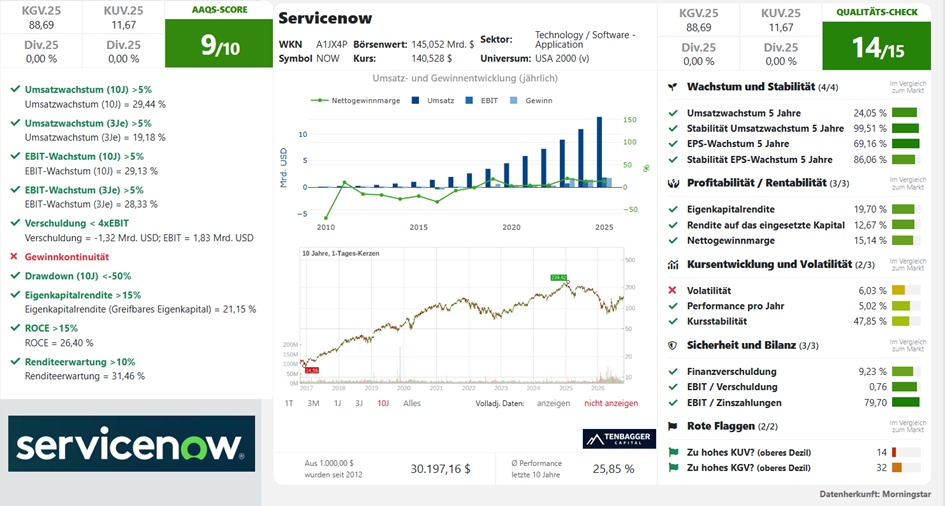
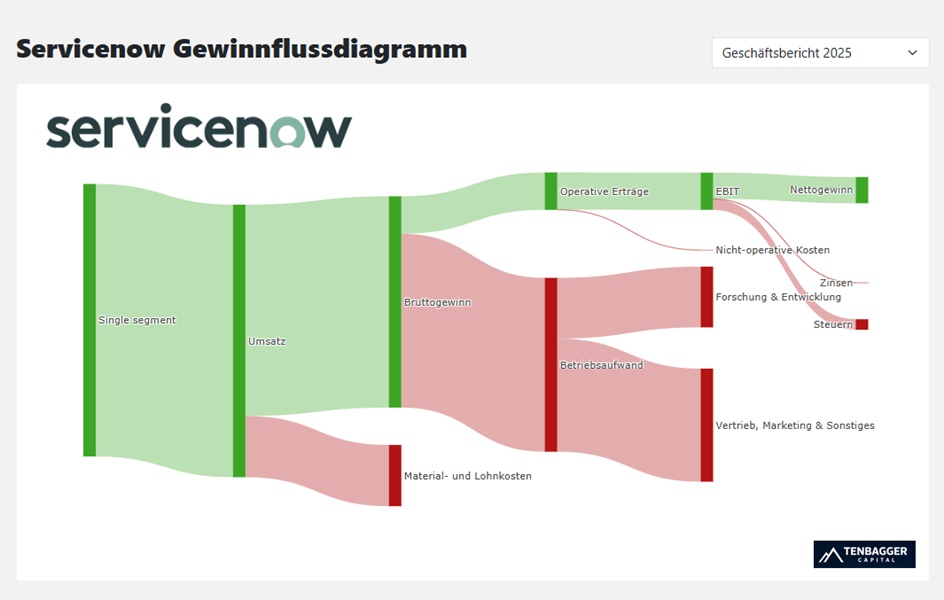
Brief Overview
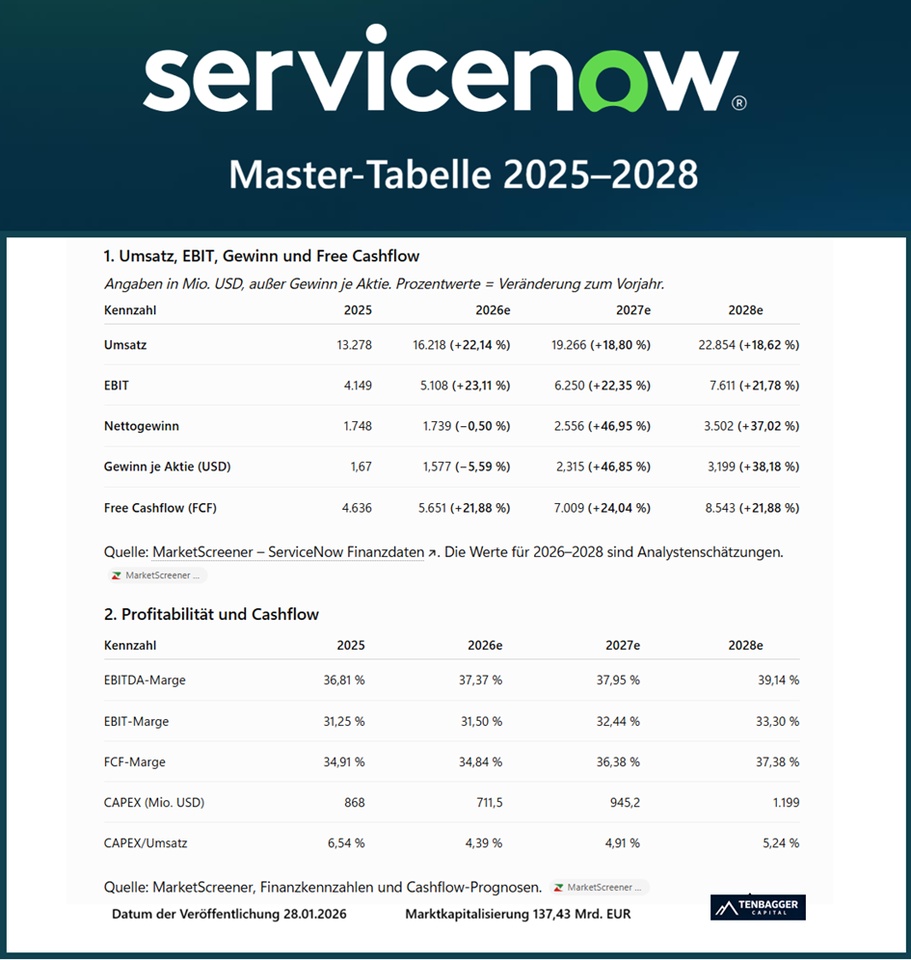
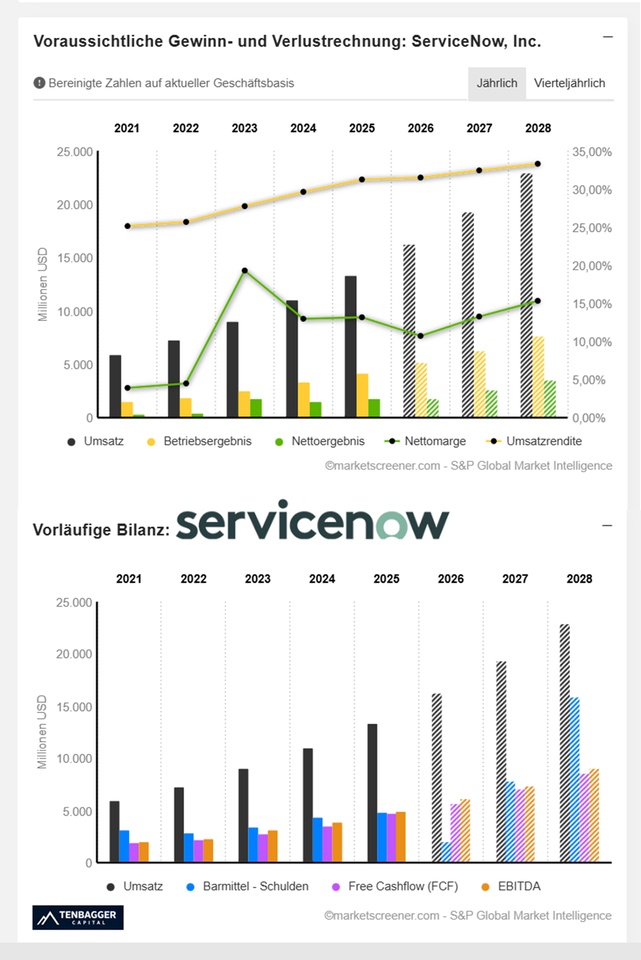
- Strong growth: Revenue is expected to rise from $13.3 billion in 2025 to approximately $22.9 billion in 2028.
- Operational Scaling: According to the forecast, the EBIT margin is expected to improve from 31.25% to 33.30%.
- Strong Cash Flow: Free cash flow (FCF) is expected to reach $8.5 billion in 2028—a high level of cash flow generation for a software company.
- Notable Trends: For 2026, MarketScreener forecasts nearly stagnant net income and a decline in earnings per share, even though revenue and EBIT are rising significantly. Strong earnings growth is expected to resume starting in 2027.
Important: The table reflects the forecast figures reported on MarketScreener. Especially for net income and EPS, it’s worth comparing these figures with the upcoming quarterly results and updated consensus estimates.
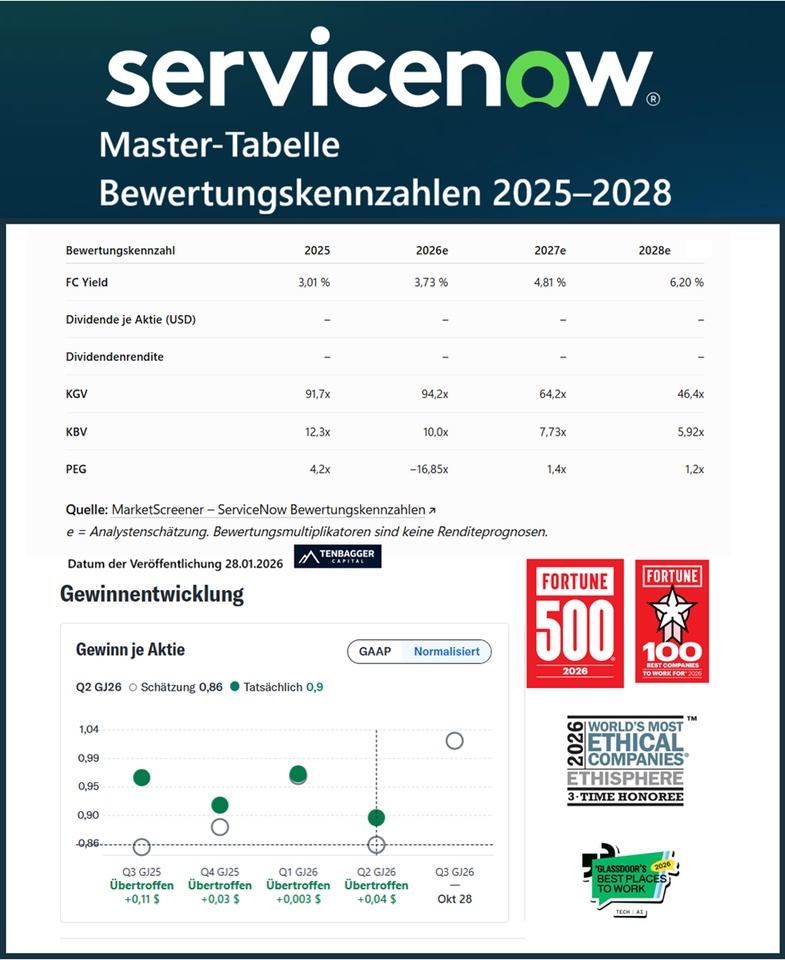
Brief Analysis for Portfolio 2036
- FC Yield rises: from 3.01% to 6.20%. This indicates an increase in free cash flow generation relative to the company’s value.
- P/E ratio drops significantly starting in 2027: despite expected earnings growth, ServiceNow remains expensively valued with a P/E ratio of 46.4 for 2028.
- P/B ratio falls: The price-to-book ratio falls from 12.3 to 5.92. However, a lower price-to-book ratio does not automatically mean a favorable valuation for a software company.
- View the PEG ratio with caution: The negative value for 2026 is not very meaningful. The values for 2027 and 2028 are 1.4 and 1.2, respectively.
My conclusion: ServiceNow combines strong expected growth with a high valuation. For a long-term “Portfolio 2036” approach, the key factor is whether the company can continue to boost its growth through AI products and automation while simultaneously increasing free cash flow. The declining valuation multiples assume that the earnings forecasts will actually be met.
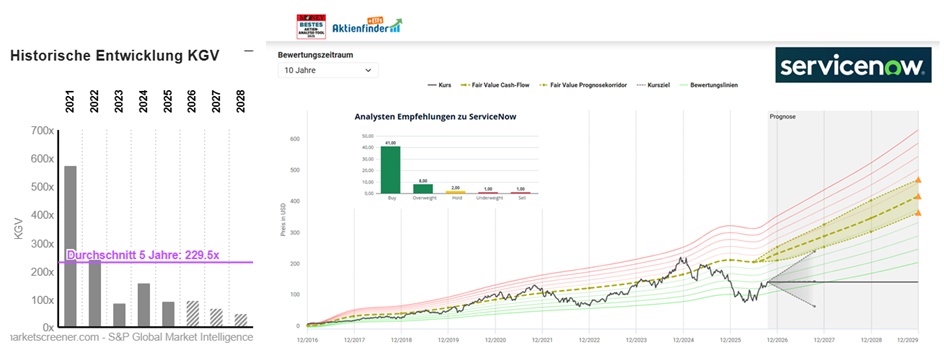
The most stable metric for ServiceNow stock is operating cash flow, which is used below for the valuation. The P/CF ratio (price-to-cash-flow ratio) stands at 29.24 , which is 12.55 points below the historical average of 41.80 over the past 10 years. From this perspective, ServiceNow stock appears to be to be undervalued .
The fair value of ServiceNow stock is calculated using the 10-year valuation period selected above. In this case, the average P/CF ratio is 41.80.
Multiplying this by the operating cash flow per share of $5.13 over the last 4 quarters yields a fair value of $214.41. The current price of $150.01 is 30.0% below this fair value, which represents a undervaluation of the stock.
(Source: AKTIENFINDER)
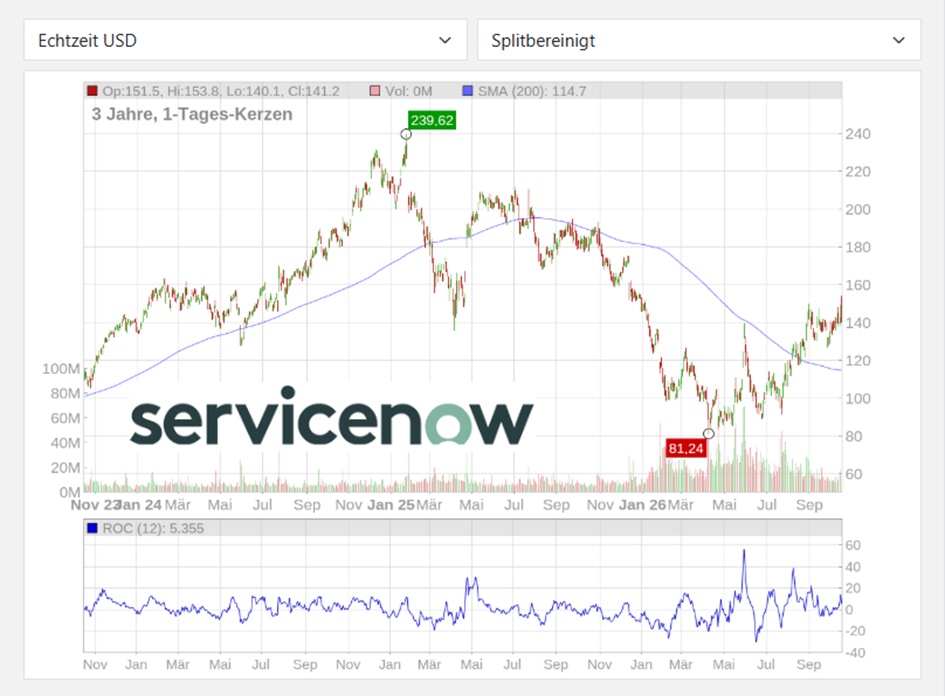
Oct. 16, 2026, 6:53:45 PM •
Lang & Schwarz (EUR)
125.55 EUR


