2D·

21 Years of Dividend Growth, and No One Has Noticed: The Secret Cash Cow for Our Portfolio!

Hey there, fellow investors! 🚀


Last night, I once again had an in-depth discussion with my trusty AI companion about our stocks, and together we did a bit of market research.

(It’s a new version of Mr. Prompt—more on the Prompt update, including the automatic market screener, coming in early September.)


We were specifically looking for a few very special stocks to add a crisis-proof, rock-solid cash generator to our portfolio.


As we pored over the key metrics and looked beyond the big tech hype, we stumbled upon a British stock that nearly made our eyes pop out of our heads.


The crazy thing is:


This absolute dividend gem is still flying completely under the radar here in the forum—and, in fact, among almost all retail investors!


I think for our dividend collectors like @Dividendenopi
@PoorDad or @Keineui this is a great stock.

But @Multibagger I promise you, there’s a great stock coming your way later this week that fits your investment style :)


Only 5 analysts have even rated this stock so far.

Grab a coffee and sit back. Here’s our comprehensive 15-point overview of one of the most exciting and consistent cash generators—one that no income portfolio should be without. Curtain up for Chesnara!đŸ”„


$CSN (-3,58%)

attachment


1. What does the company do?


Chesnara plc is a highly profitable acquirer and manager of life insurance and pension portfolios.

The business model is ingeniously simple: The company purchases so-called “closed books” (insurance portfolios that no longer accept new customers) from other insurers and manages them extremely cost-effectively until maturity. This enables Chesnara to generate highly predictable and steady cash flows.


2. Geographic Presence & Brand Portfolio


Chesnara operates primarily in three core markets:

the United Kingdom, the Netherlands, and Sweden. The company has recently expanded its footprint significantly: In January 2026, it completed the acquisition of HSBC Life (UK) for £260 million (approx. €304 million).

In addition, the acquisition of the Luxembourg-based Scottish Widows Europe SA for €110 million was announced in February 2026, marking the company’s entry into the Luxembourg market.


3. Key Figures, Data & Facts (as of August 2026)


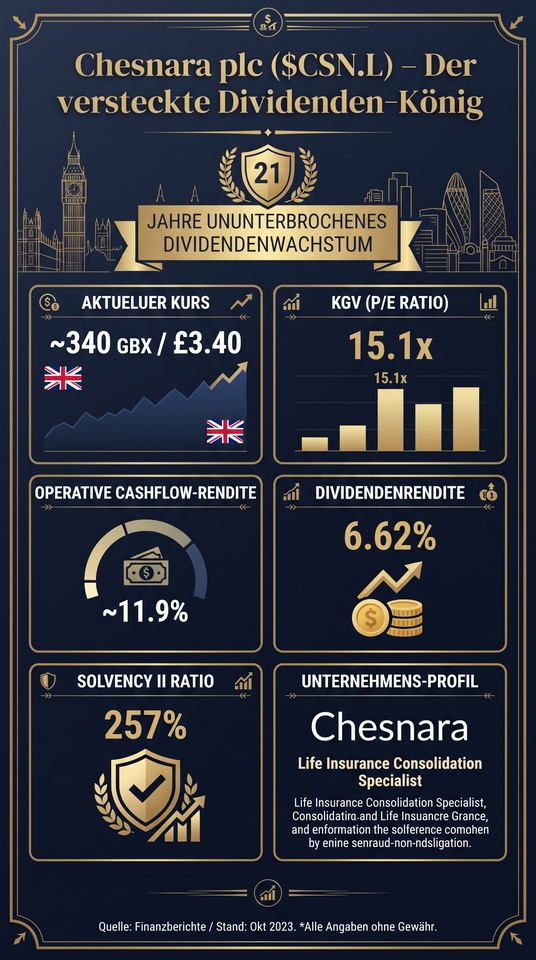
  • Current share price: 340.00 GBX (pence) or ÂŁ3.40 (approx. 3.98 €).
  • Market capitalization: ÂŁ787 million (approx. €921 million) – A true mid-cap.
  • P/E Ratio (Trailing): 15.15x.
  • Dividend yield: 6.62%.
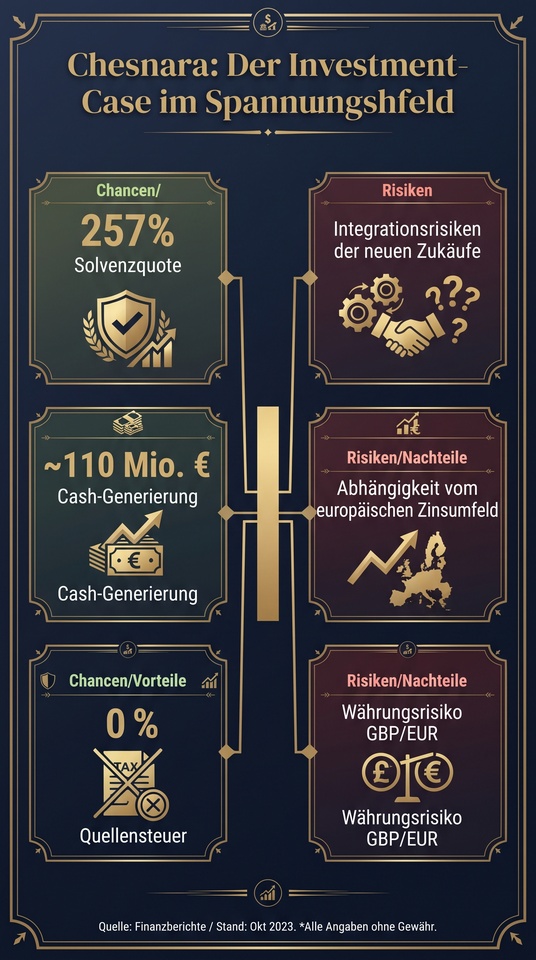
  • Tax Highlight: In the United Kingdom, dividends are subject to 0% withholding tax! This means that the gross dividend is paid out to us in full (aside from the domestic flat-rate withholding tax) without any annoying foreign withholding taxes.
  • Solvency II Ratio: 257%—a staggering figure that far exceeds the target range of 140% to 160%.
  • Assets under Administration (AuA): ÂŁ15 billion (approx. €17.5 billion). On a pro forma basis following the latest acquisitions, this figure is even on track to reach ÂŁ20 billion (approx. €23.4 billion).


4. Check against our established formulas


  • Core Quality Formula: For an insurance consolidator, the classic industry margin doesn’t apply perfectly. Nevertheless, adjusted operating profit (AOP) recently rose by a whopping 42% to ÂŁ56 million (approx. €65.5 million).


  • Cash Flow Quality Formula (The Cash Engine): Insurers measure their “free cash flow” as “Operating Capital Generation” (OCG). Chesnara generated ÂŁ94 million (approx. €110 million) here. When viewed in relation to the market capitalization of ÂŁ787 million (approx. €921 million), this results in an sensational OCG yield of 11.9%! This blows our >8% threshold out of the water.


  • Dividend Filter: At 6.62%, the yield is well above our 3.5% minimum. The absolute highlight: Chesnara has increased its dividend in 2025 for the 21st consecutive time ! The payout is absolutely secure, backed by ÂŁ94 million (approx. €110 million) in OCG and ÂŁ58 million (approx. €68 million) in operating cash flows. No pseudo-payout funded by debt!

attachment


5. Chart Analysis of Recent Months


  • Price trend: The stock has posted an extremely strong performance over the past 12 months, rising by over +22%.
  • Moving averages: The stock is currently trading about +10.45% above the key 200-day moving average.
  • Momentum: Chesnara is currently significantly outperforming the broad UK FTSE All-Share Index. The trend remains intact, and the stock is being steadily accumulated.


6. Special Entry Zones (“Bargain Hunter’s List”)


  • Bargain Zone (Absolute Bargain): ÂŁ2.80 – ÂŁ3.00 (approx. €3.28 – €3.51). This is where the stock was trading prior to the announcement of the major acquisitions.


  • Fair-Value Entry: ÂŁ3.25 – ÂŁ3.40 (approx. €3.80 – €3.98). Current level, ideal for building a long-term dividend position.


  • Sell/Take partial profits: From ÂŁ3.80 – ÂŁ4.00 (approx. €4.45 – €4.68).


7. Risk Deep Dive 1: Acquisition & Integration Risks


With the acquisition of HSBC Life (UK), Chesnara has pulled off the biggest deal in the company’s history. This brings in £5 billion (approx. 5.85 billion €) in new assets and 450,000 new policies.

The risk here lies in IT and administrative migration. When such mega-integrations hit a snag, they eat into margins and management capacity in the short term.


8. Risk Deep Dive 2: The Interest Rate and Capital Markets Environment


As a manager of £15 billion (approx. €17.5 billion) in assets, Chesnara is dependent on global equity and bond markets. Significant volatility in the financial markets or extreme changes in interest rates can cause fluctuations in the “own funds” (equity capital under Solvency II).

For us as euro investors, currency risk (GBP to EUR) is also a factor here.


9. Future Outlook & Growth Drivers


The company operates in a high-growth market.

Many major insurers (such as $HSBA (-1,99%) or $LLOY (-2,91%) ) want to offload their old, unprofitable legacy portfolios. Chesnara $CSN (-3,58%) stands ready with deep pockets.

Thanks to the successful placement of a £150 million (approx. €175 million) RT1 bond last year, management has tremendous financial firepower to acquire additional lucrative portfolios at favorable prices.
attachment

10. Competition & Alternative Candidates


  • Phoenix Group ($PHNX): The British market leader in this segment. Phoenix is significantly larger but also has higher debt.


  • M&G plc ($MNG): Also a strong British dividend stock in the financial sector. By comparison, however, Chesnara is the more agile, specialized player with the more solid balance sheet coverage.


11. Margin & Profitability Analysis


Chesnara’s solvency ratio (Solvency II) rose last year from 203% to a staggering 257% . Eligible capital (“Own Funds”) rose by 34% to £859 million (approx. €1.00 billion).

The company is literally awash in excess capital, which provides massive security for future dividends and M&A activities.


12. Analyst Opinions & Fair Value


  • Consensus: The majority of analysts recommend buying Chesnara.
  • Price Target: The average analyst price target is 362.80 GBX (ÂŁ3.63 / approx. €4.25).
  • Upside: Based on the current price, this corresponds to a purely theoretical price potential of just under +6.7%— plus the hefty dividend yield!


13. Upcoming Catalysts


The most important milestone in the near future is the so-called “Part VII Transfer” of the newly acquired HSBC Life (UK) portfolios, which is expected in 2027. If this goes smoothly, massive administrative synergies will be realized. In addition, the official completion of the Scottish Widows Europe acquisition is scheduled for late 2026.


14. SEO & Market Sentiment


As a British mid-cap, Chesnara flies completely under the radar among retail investors. There is hardly any media hype or retail focus on the stock.

It is precisely this information asymmetry that works in our favor as patient investors: While the masses chase after expensive tech stocks, Chesnara is quietly acquiring highly profitable insurance portfolios.


15. Long-Term Viability & My Personal Conclusion


Dear Community, if you’re looking for a fundamentally extremely strong, crisis-resistant anchor for your portfolio, Chesnara $CSN (-3,58%) .


The company delivers a OCG yield of just under 12%, an unshakable solvency ratio of 257% and boasts 21 years of uninterrupted dividend growth .


All of this is sweetened by 0% withholding tax , in my opinion, currently makes Chesnara one of the best and most fairly valued cash generators.

A real gem for reducing volatility in your portfolio and keeping the cash flow steadily flowing!


Greetings from Denmark


Raketentoni


@Keineui

@Aktienhauptmeister

@Multibagger

@Tenbagger2024

@Get_Rich_or_Die_Tryin

@Stocktective

@Simpson

@WarrenamBuffet

@SAUgut777

@TradingHase

@PikaPika0105

@Derspekulant1

@NichtRelevant

@Klein-Anleger

@Dividendenopi

and, of course, everyone else :)

30
11 ComentĂĄrios

imagem de perfil
The Tireless Cash Toll Booth
Chesnara ($CSN) operates not as a dynamic growth insurer, but as a disciplined specialist in closed life insurance and pension portfolios (run-off). Like a private toll booth, the company collects steady fees from existing legacy contracts, radically optimizes administrative costs through outsourcing partners, and converts shrinking policy portfolios into high-yield cash flow.

đŸ› ïž DNA Check
Unassailable financial fortress: The Solvency II Coverage Ratio stands at an excellent 257% (well above its own target range of 140–160%).

Pure Cash Flow Machine: With an Operating Capital Generation (OCG) of ÂŁ94 million, CSN posts a phenomenal OCG yield of ~11.9%.

A True Dividend Aristocrat: Dividends have been raised for 21 consecutive years, currently backed by solid operating cash flows (cash remittances) of £58 million—completely free of artificial debt-financed special distributions.

0% withholding tax advantage: Being headquartered in the UK means German investors receive gross dividends as net (minus domestic flat-rate withholding tax), without any annoying foreign withholding tax deductions.

🚀 Growth Leverage & Catalysts

Massive M&A pipeline: The successful integration of HSBC Life UK (+£5 billion in assets under administration) and the announced acquisition of Scottish Widows Europe (€110 million) are driving assets under administration toward the £20 billion mark.

Synergies from Part VII Transfer: Administrative consolidations of portfolios scheduled for 2026/2027 will generate significant cost synergies and free up tied-up equity.

Regulatory Tailwind: Major banks are continuously divesting capital-heavy life insurance divisions to relieve capital pressure—Chesnara stands ready as the preferred buyer with deep pockets.

⚠ Valuation & Risks
Integrity of the M&A Migration: Large portfolio acquisitions carry IT and settlement risks. Delays in the transfer will eat into administrative capacity in the short term.

The Curse of Organic Attrition: Since closed-end policies naturally expire, management must make disciplined, accretive acquisitions to prevent the earnings base from shrinking in the long term.

Financing Costs: While the ÂŁ150 million RT1 hybrid bond provides M&A firepower, it requires high operating income to cover the interest burden.

⚔ Cross-Check: Raketentoni vs. Jack’s Exorcist Perspective

1. The Dividend & The Promise of Infinite Security
Raketentoni: Hails the 21 years of uninterrupted dividends and the 6.6% yield as an “impenetrable fortress,” where investors can completely eliminate volatility from their portfolios.

Our View: We highly value the stable cash flow, but we reject the illusion of a “bond” that has no impact on earnings. Chesnara is an equity security with run-off dynamics. The dividend is only as secure as management’s ability to offset natural inventory attrition through lucrative portfolio acquisitions.

2. The ÂŁ150 million RT1 bond & M&A firepower
Raketentoni: Views the placement of the RT1 bond primarily as “well-filled coffers” for aggressive M&A expansion.

Our view: We factor in the cost of capital with cold, hard logic. Hybrid capital (RT1) in the insurance sector is expensive. Every M&A deal must yield an operating return significantly above the bond coupon burden. We don’t celebrate acquisitions across the board at closing, but only once the Part VII transfer is complete and the synergies are realized in the OCG.

3. Valuation & Entry Discipline
Raketentoni: Sees the current price at ~ÂŁ3.40 as the ideal fair-value entry point for long-term dividend growth.

Our view: We fully agree on the focus on cash. With a solvency ratio of 257%, the company is awash in equity. However, we strictly accumulate shares in tranches and take advantage of market-driven dips below £3.20 to expand our position, aiming to capture a cash flow yield (OCG) beyond 12–13%.

Jack’s Conclusion:
“Chesnara is a highly specialized quality utility play for pure cash flow strategists. Anyone looking for a stock to double in price is in the wrong place here—but anyone seeking a ~7% dividend yield backed by genuine cash remittances, along with an M&A option, is buying into an extremely solid foundation. Unspectacular, no-frills, highly profitable.”

Reaper Rating: ✅ ACCUMULATE (entry/additional positions on pullbacks)
Reaper Score: 7.8/10
‱
10
‱
imagem de perfil
Sounds like an interesting stock. The dividend yield and its UK location are already quite attractive.

However, much like @Keineui, I don’t quite understand why the major insurers don’t keep their old portfolios or spin them off into a separate subsidiary instead of selling them off. I understand that they want to focus on their core business, but it should actually be possible for the major insurers to copy the business model of $CSN. Especially since the buyer would presumably have to provide similar equity and collateral as the original insurer.

On the other hand, even regular insurers are making pretty good profits. So it’s certainly possible that they could boost their earnings even further through a focused and specialized approach with lean administrative structures and no sales commissions.
‱
2
‱
imagem de perfil
@NichtRelevant That’s exactly the approach—just like everywhere else in the industry. When you get big, you’re like a huge, heavy tanker. When you’re small, you can streamline your production and switch gears more effectively and quickly. That’s how it is here, too. Efficiency and flexibility are crucial. But it’s been working for decades—and, by the way, it’s also the case in Germany.
‱
1
‱
imagem de perfil
@Raketentoni I'll keep this company in mind. It seems very reliable.
‱
1
‱
imagem de perfil
@NichtRelevant Yep, that's right. I was surprised myself that the stock is so "unknown," but all my research has shown the same picture, with the same opportunities and risks.
I'm still waiting for the next earnings report coming out next week before I invest.
‱
1
‱
imagem de perfil
It's actually surprising that there wasn't anything about this on the forum before your post—that hardly ever happens. You really dug something up there. 🙂
‱
1
‱
imagem de perfil
@NichtRelevant Well, if we're being honest, a lot of people are actually looking for tech, AI, and so on right now. But people like me, who are also looking for cash flow, end up searching in completely different areas—and without my new prompt, I probably wouldn't have discovered them either.
‱
1
‱
imagem de perfil
@Raketentoni Absolutely. I'm actually more interested in generating a solid, sustainable cash flow. I leave tech and AI investments to younger investors—or I track them through ETFs and the broader market.
‱‱
imagem de perfil
Sounds like a great title. Thanks for the introduction. But I don't get the business model. So I'm out. Why are they making so much money off insurance policies that nobody else wants anymore? Just better processes? Isn't that the kind of thing AI is going to sweep away, even more so than software? Or am I wrong about that?
‱
1
‱
imagem de perfil
Hey @Keineui! 🚀

First off, huge respect: Never investing in anything you don’t understand 100% is the most important rule of the stock market (Warren Buffett calls this the “Circle of Competence”).
Unfortunately, this is where most retail investors fall short!

Your questions are absolutely valid and hit the nail on the head. Let me briefly shed some light on why this model is so brilliant and why AI isn’t a threat here—but rather the ultimate margin booster:

1. Why are the big players selling off their “old” insurance portfolios?

The major players (such as HSBC or Lloyds) aren’t selling these portfolios because they’re bad contracts, but because they tie up dead capital.

Under the strict European Solvency II regulations, insurers must set aside an extremely large amount of equity capital as collateral for each contract.
However, a “closed book” (run-off) no longer brings the major insurer any new customers or growth. So, to free up billions in tied-up capital and use it to pursue new business, they sell these legacy portfolios to specialists like Chesnara.

2. Where does Chesnara’s big money come from?

That’s the magic of the run-off model. Chesnara has enormous advantages over a typical insurer:

* Zero sales costs:
No expensive advertising campaigns, no broker commissions, no marketing. They simply purchase the fixed, predictable cash flow from ongoing premiums in one lump sum.

* Extreme economies of scale:
They take the outdated, expensive IT systems from five different legacy insurers and consolidate all the data onto a single, highly efficient administrative platform.
This drastically reduces the cost per policy, while revenue remains constant.

3. Why doesn’t AI just sweep this away?

Because Chesnara’s business isn’t a pure software startup model—it’s a strictly regulated capital and risk business.
While AI can automate processes, it doesn’t hold a British banking and insurance license.
AI cannot deposit hundreds of millions in real equity capital (solvency capital) with the financial regulator to absorb mortality and market risks onto its own balance sheet.

On the contrary:
AI is the absolute jackpot for Chesnara!

The better software and AI become, the cheaper and faster Chesnara can process the dusty contracts and outdated IT structures of the major insurers it has acquired.

So AI simply continues to lower its own administrative costs and pushes profit margins even higher.

Hope that untangles things a bit! 😉

Best regards from Denmark

RaketenToni
‱
3
‱
imagem de perfil
I'm already looking forward to my type.😂😎
‱
1
‱
Participar na conversa