Last week, on the Saturday episode of “Alles auf Aktien” [1], there was a segment on the study “Do Stocks Outperform Treasury Bills?” [2], which sounded quite interesting and whose contents I subsequently read more closely.
Essentially, the study shows that only a small fraction of companies is responsible for the majority of returns.
It thus serves as a a reminder that for the “average investor,” investing in a well-diversified ETF is likely the best choice.
Here is a brief summary of the results.
Hendrik Bessembinder of the W.P. Carey School of Business at Arizona State University investigated which stocks truly drive the market over the long term.
According to his findings, since 1926 only 4% of all stocks have generated the total net return of the U.S. stock market [2].
The remaining 96% of the stocks collectively yielded a return no greater than that of safe one-month U.S. Treasury bills—or even less [2]. The average monthly return here was 0.37% (which corresponds to an annual return of about 4.53% when compound interest is taken into account).
What’s even more interesting is this:
The top 50 companies accounted for 39.29% of the total value created by the U.S. stock market, and...
...the top 90 stocks (just 0.36% of all companies) generated more than 50% of total market profits [2].
After all, the aforementioned 4% still represents just under 1,092 out of over 25,000 companies. At first glance, it doesn’t seem all that unrealistic to find them.
The only problem is:
You usually only recognize the best stocks in hindsight
- Apple, Microsoft, and Amazon were still small, unknown companies 30 years ago.
- Many investors back then would have bet on “safe” large companies, but some of them (e.g., Kodak or Nokia) are no longer among the top performers today.
- We won’t know today’s 4% winners until the future.
Even professionals often fail at this
- Active fund managers try to do exactly that: find the best stocks and avoid the bad ones.
- But most fund managers don’t consistently beat the market.
Timing is often extremely difficult
- Many of the best stocks looked like losers at one point or another.
- For example, Amazon stock $AMZN (+0,18%) by nearly -90% after the dot-com crash; even by mid-2021, Amazon was down nearly -50%—would you have held onto them?
More than half of all stocks have actually generated negative returns over their entire lifetime [2].
This means: The average stock return we’re all familiar with isn’t generated by the “broad” market, but only by these 4% of stocks.
Further findings from the study:
Value creation in the stock market is extremely unevenly distributed.
- ExxonMobil $XOM (-0,01%) alone generated the most shareholder value—$1 trillion—and accounted for 2.88% of the total market return from 1926 to 2016 [2].
- Apple $AAPL (+0,06%) ($745.7 billion), Microsoft $MSFT (-0,43%) ($629.8 billion), General Electric $GE (-0,32%) ($608.1 billion), and IBM $IBM (+0,03%) ($520.2 billion) are among the top five companies, which together account for over 10% of total market value creation [2].
Now, the question for us as investors is:
Do I really believe that I can identify these 4% of winning stocks early enough ?
... and can I, at the same time, at least steer clear of the biggest losers among the remaining 96%?
... or would I rather stick with John Bogle , the founder of Vanguard, who famously said:
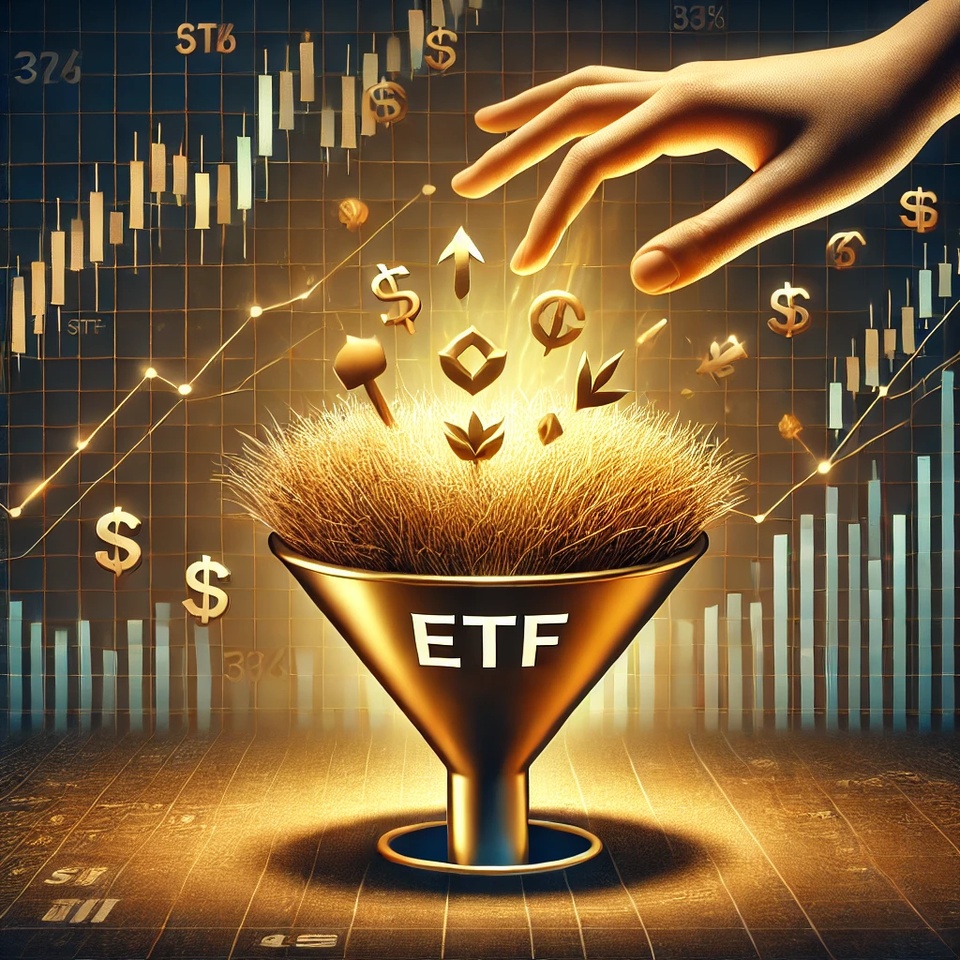
🧠 “Don’t try to find the needle in the haystack. Just buy the whole haystack.”
The haystack is, in this sense, an ETF:
- ETFs are a self-optimizing system in which well-performing sectors and companies are overweighted, while underperforming companies gradually lose importance.
- You don’t have to find that 4% yourself—the ETF does it for you.
Conclusion
Yes, theoretically it’s possible to identify that 4% yourself, time your entry correctly, and hold on to it, as well as steer clear of the biggest losers among the 96% over the long term.
The question is: Do you want to bet your portfolio on that, or would you rather ensure that you automatically benefit from the 4%?
💡For most investors, a simple ETF investment as a “core” holding is therefore probably the best choice.
Thank you for reading 🤝
__________
P.S. The study was published in 2017 and last updated in 2018.
As for a more up-to-date analysis specifically covering recent years, the study does not provide separate results for shorter time periods. However, it does mention that this effect has been even more pronounced in recent decades, particularly since the 1980s. To obtain a detailed, up-to-date analysis, one would need to review more recent research.
__________
Source:
[1] https://open.spotify.com/episode/7ik1W0e9zq7TBYacPW0eVl?si=Sw2Mu0XSSH2SQFp5cHtpLQ
[2]
Published 01/2017, revised 06/2018
https://papers.ssrn.com/sol3/papers.cfm?abstract_id=2900447&utm_source=chatgpt.com