
Alphabet $GOOGL (-3,06%) exceeded earnings estimates by 214 percent. The stock price then rose by 0.65 percent.
Coeur Mining $CDE (-8,07%) missed expectations by 54 percent during the same period. The stock rose 11 percent.
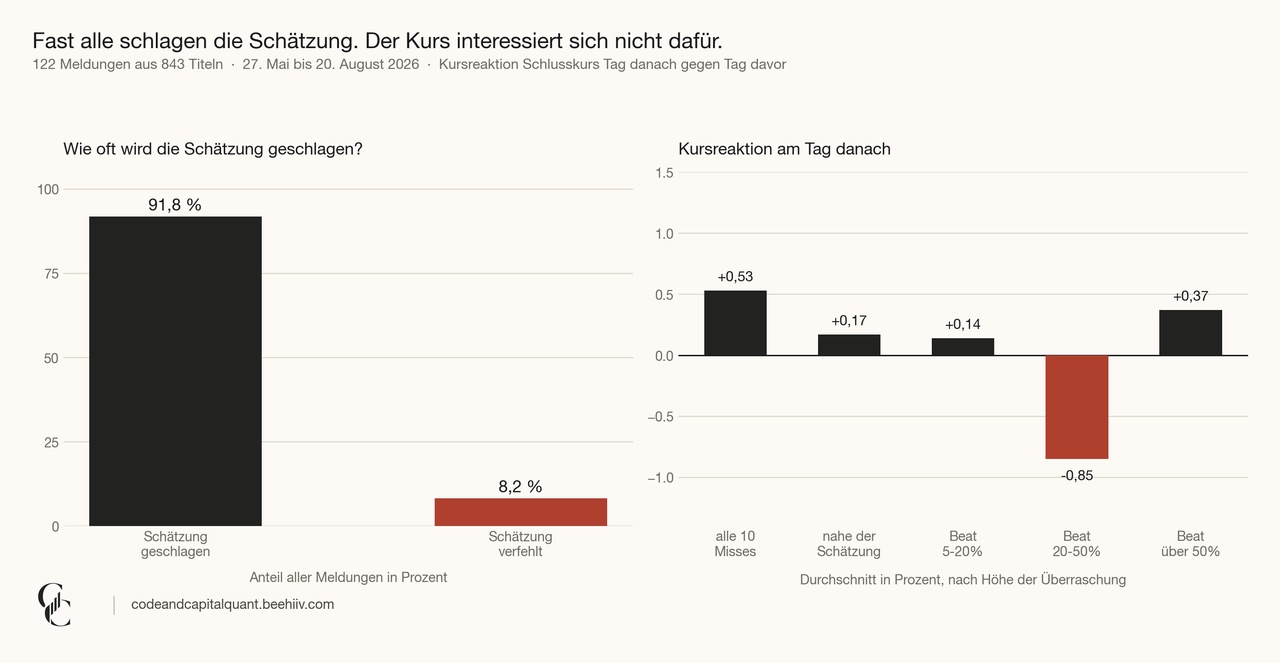
Since the end of May, I’ve had every quarterly earnings report from my stock universe automatically recorded, along with the stock price reaction the following day. A total of 122 reports were collected between May 27 and August 20. This isn’t a simulation; the data was collected as events unfolded.
The common assumption goes like this: A company beats estimates—that’s good news—so the stock price rises. None of these three steps holds true.
1️⃣ Almost all beat estimates
112 out of 122 were above expectations. That’s 91.8 percent. Ten missed.
The rate says nothing about the companies. It says something about the estimates. Analysts lower their forecasts in the weeks leading up to the earnings release because the companies prepare them accordingly. What’s left is a bar that practically everyone clears. Anyone who reads “exceeded expectations” has learned about as much as they would from the news that a train departed on time.
2️⃣ The stock price falls anyway
Of the 112 companies that beat estimates, the stock price fell in 65 cases—that’s 58 percent.
On average, the reaction after a “beat” was a decline of 0.03 percent, and after a “miss,” an increase of 0.53 percent. The median shows the same pattern: -0.47 versus -0.28. Both figures are close to zero, so I wouldn’t base a trading rule on them. With only ten misses, the second figure is insignificant anyway. But the trend is consistent in both calculations.
3️⃣ Even a big surprise doesn’t help
It might seem obvious that two percent above the estimate isn’t enough and that a real outlier is needed. The correlation between the magnitude of the surprise and the price reaction is minus 0.042. That’s just noise. Alphabet $GOOGL (-3,06%) 214 percent above estimates, stock price up 0.65. Warner Bros. Discovery $WBD 154 percent above estimates, stock up 1.44. Centene $CNC (+2%) 133 percent above estimate, price down 1.59. Intel $INTC (-8,67%) 95 percent above estimates, down 7.89.
There’s movement, but it’s coming from elsewhere
NetApp rose $NTAP (-1,59%) up 22.4 percent, Teradyne $TER (-11,83%) up 14.4 percent, and Seagate $STX (-12,36%) up 11.4 percent. On the downside, Reddit $RDDT (-2,91%) was down 21.0 percent, Ciena $CIEN (-10,87%) down 8.9 percent, Broadcom $AVGO (-3,58%) down 7.9 percent, and Apple $AAPL (+1,43%) down 7.4.
These are double-digit daily movements. Reddit $RDDT (-2,91%) beat estimates by 30 percent and lost a fifth of its value. Broadcom $AVGO (-3,58%) was 1.7 percent above estimates and lost nearly 8 percent. The number in the headline doesn’t explain any of these movements. It’s about the outlook, margins, and a statement in the earnings call.
What it isn’t
Three months constitute an earnings season, not a cycle. In a period of falling earnings, the 92 percent rate would likely look different. I measure only the day after the announcement, not the two weeks that follow. My universe consists of large-cap stocks from fourteen indices; with small-cap stocks, things can play out differently. I’ll keep collecting data; in a year, I’ll have four quarters.
For me, this means: Anyone who buys after a report because expectations were exceeded is reacting to information that everyone has and that almost always comes to pass. The reverse scenario is more interesting—when a stock price reacts strongly even though the numbers were unremarkable. That means there’s something else in the report.
❓ Do any of you deliberately trade around earnings reports? And does anyone have an explanation for why misses, on average, fare better than beats?
👇 Leave your thoughts in the comments!
➡️ I do analyses like this regularly; in between, I post the monthly Wikifolio update.
🗞️ Newsletter: codeandcapitalquant.beehiiv.com
📈 Wikifolio: https://www.wikifolio.com/de/de/w/wf0gquant6
Not investment advice; based on my own research. Past performance is not indicative of future results.


