
If you look at the share price performance of MercadoLibre it almost looks as if the business model is falling apart.
How MercadoLibre uses Latin America's weaknesses to its advantage
MercadoLibre operates the largest online marketplace in South America. However, the company is now much more than that.
In recent years, the company has developed into a digital ecosystem that combines retail, logistics, advertising and financial services. It is precisely this integration that makes the platform so strong and creates a competitive advantage that new competitors find difficult to attack.
The marketplace remains the foundation. MercadoLibre acts primarily as an intermediary between buyers and sellers. The core of the business is therefore not trading in its own goods.
The model is partly reminiscent of western platforms such as Amazon or eBaybut is much more tailored to the specifics of Latin America.
Numerous services have been created around this platform that bind retailers more closely to the system. Sellers receive tools for product searches, inventory management, price optimization and marketing.
The company's own logistics network is particularly important. In Latin America, shipping has long been a central weakness of online retail. MercadoLibre has therefore invested heavily in warehouses, sorting centers and delivery structures.
The result is significantly faster and more reliable shipping. This significantly improves the user experience for shoppers and reduces effort and complexity for retailers. At the same time, MercadoLibre controls a larger part of the value chain.
How the individual business areas reinforce each other
Another growth driver is the advertising business. Retailers can place advertisements directly on the platform to make their products more visible. This is a profitable business because MercadoLibre has enormous amounts of user data and can analyze purchase intentions very precisely.
As the marketplace grows, so does the value of this advertising space. The model is similar to that of Amazon Advertising and has become an important source of revenue.
In my view, however, the real goldmine is likely to be the payment business. Millions of people in South America have no access to traditional banks. MercadoLibre has closed this gap with Mercado Pago.
The platform offers digital payment processing, wallets, loans and other financial services. Mercado Pago was originally created as a supplement to the marketplace, but the business is now growing far beyond that.
MercadoLibre is no longer just an e-commerce group, but also one of the most important players in digital payments in Latin America. This opens up enormous opportunities. Payment services generate high economies of scale, strong customer loyalty and often attractive margins. In addition, valuable data on consumer behavior and creditworthiness is generated, which in turn can be used for credit offers.
The various business areas complement each other and increase customer loyalty.
The marketplace brings users to the platform. Logistics improves the shopping experience. Advertising monetizes the merchant base. Payment services increase loyalty and expand the ecosystem beyond actual retail. Each additional service makes the overall system stronger.
Political risks as a plus point?
On the bear side, on the other hand, the political risks are repeatedly pointed out. Latin America is economically and politically volatile. Inflation, currency fluctuations and regulatory risks cannot be dismissed out of hand.
However, this also has advantages, as it has kept Western competition at bay - and for long enough. In the meantime, MercadoLibre is likely to find it difficult to catch up in the core markets of Brazil, Mexico and Argentina.
The business figures prove that MercadoLibre is thriving despite the difficult conditions.
In the last five financial years, turnover has increased from USD 7.07 billion to USD 28.89 billion. At the same time, profitability has improved significantly, with earnings climbing from USD 1.67 to USD 39.40 per share during this period.
At times, this led to a veritable hype surrounding the share. At its peak, the P/E ratio was over 20 and the P/E ratio was outside the measurable range.
However, the euphoria is currently very limited. The share price has plummeted from over USD 2,600 to below USD 1,600.
This is not entirely without reason, as expectations have been missed several times recently.
Expectations missed several times
However, anyone who has followed the events live will probably be asking themselves a completely different question. It is important to know that MercadoLibre announced higher investments some time ago and clearly communicated that this would have a negative impact on profits in the short term.
It was therefore foreseeable that earnings would not increase as dynamically for the time being.
The problem is that the forecasters did not react to this and the consensus estimates were therefore too high.
Very few investors are aware of all this. First and foremost, they see the negative headlines, falling share prices and the fact that expectations were not met.
However, if you ignore the arbitrary consensus estimates and look at the actual business figures, a completely different picture emerges.
In the last quarter, expectations were missed, but what does that change the fact that sales rose by 49% to USD 8.85 billion?
The number of active customers increased from 67 to 84 million. The number of items sold climbed from 492 to 722 million. The transaction volume in the payment business increased from USD 58.3 billion to USD 87.2 billion.
All divisions and regions contributed to this growth. Business in Brazil grew by 55% in US dollars, Mexico by 62% and Argentina by 23%.
The Commerce division grew by 47% and Fintech by 51%.
Gross profit for the year improved from USD 2.77 billion to USD 3.86 billion. Operating cash flow more than doubled from USD 1.03 billion to USD 2.08 billion.
This data shows how the underlying business is developing.
Bears, on the other hand, will criticize the fact that net income fell from USD 494 million to USD 417 million. It is up to each investor to decide which factors carry more weight - as always on the Börse.
At the moment, the majority are coming to a negative conclusion, which is why the share price is falling
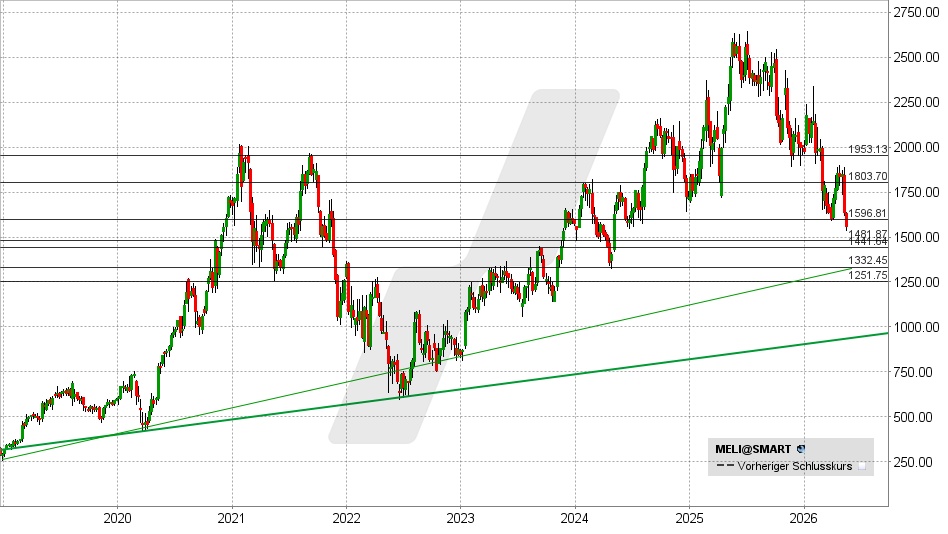
MercadoLibre share: chart from 12.05.2026, price: USD 1,557 - symbol: MELI | Source: TWS
With the share price falling below the support level of USD 1,600, a Verkaufssignal with possible price targets at USD 1,440 - 1,480 or USD 1,333 was triggered.
A return above USD 1,600 in the near future would ease the situation again. In this scenario, a recovery to the USD 1,750 - 1,866 range would be conceivable
Source
