

Nvidia is the world's most valuable chip company, and its AI data centers are laying the foundation for the AI boom, but sentiment on the stock market has shifted. On November 5, 2026, the stock plummeted 9.26% to $181.60 on the Nasdaq, after the Democrats won both chambers of Congress in the U.S. midterm elections and investors began to fear stricter regulations on the construction of AI data centers. The SOX semiconductor index lost about 12% that day, while the Nasdaq 100 fell more than 6%. Since its record closing price of $239.24 on October 6, 2026, the stock has thus lost about 24%. Operationally, however, things are going brilliantly: In the second quarter of fiscal year 2027, revenue rose 106% to $96.2 billion, the data center business grew 117% to $89.0 billion, and the gross margin stood at 75.0%. For the third quarter, Nvidia expects $108 billion in revenue; the results will be released on November 17, 2026, after the U.S. market closes. Analysts have an average price target of around $327; according to Aktienfinder, the adjusted P/E ratio of 26.8 is significantly below the 10-year average of 35.7. From a technical analysis perspective, the sell-off below $191.72 has caused the stock to falter: A quick reversal above $200 could trigger follow-on buying up to $234; otherwise, the next support zone lies between $152 and $167.72.
Key Points
- Price drop: −9.26% to $181.60 on November 5, 2026, about 24% below the record closing price of $239.24
- Triggers: Democratic victory in the midterms, concerns over regulation and construction freezes for data centers
- Q2 FY 2027: Revenue $96.2 billion (+106%), Data Center $89.0 billion (+117%), gross margin 75.0%
- Q3 Outlook: $108 billion in revenue (±2%), gross margin around 74%, earnings to be reported on November 17, 2026
- Valuation: P/E ratio of approximately 23 based on the last twelve months; dividend of $0.25 per quarter since May
- Analysts: Average price target around $327, range up to $515
- Chart levels: Resistance at $191.72, reversal above $200 with a target of $234, support range from $152 to $167.72
What are the current key metrics for Nvidia stock?
Following the plunge on November 5, 2026, Nvidia stock is trading at $181.60 (−9.26%), which is about 25% below its all-time high of $243.37.
With a market capitalization of approximately $4.4 trillion, Nvidia nevertheless remains one of the world’s most valuable companies. The P/E ratio based on the last twelve months is around 23, and the dividend yield—following the increase to $0.25 per quarter—is approximately 0.55%.
- Price (NASDAQ: NVDA): $181.60 (−9.26%) (Nov. 5, 2026, close)
- Previous day’s closing price: $200.13 (November 4, 2026)
- 52-week high = all-time high: $243.37 (record closing price $239.24) (October 6, 2026)
- 52-week low: $164.27 (March 30, 2026)
- Market capitalization: approx. 4.4 trillion USD (November 5, 2026)
- Revenue for Q2 FY 2027: $96.2 billion (+106%) (August 26, 2026)
- Data Center Q2: $89.0 billion (+117%), 92.5% of revenue (August 26, 2026)
- Edge Computing Q2: $7.2 billion (+27%) (August 26, 2026)
- Q2 Gross Margin (GAAP): 75.0% (previous year: 72.4%) (August 26, 2026)
- Q2 Operating Income (GAAP): $63.7 billion (+124%) (August 26, 2026)
- Net Income Q2 (GAAP): $59.7 billion, $2.46 per share (August 26, 2026)
- Operating Cash Flow / Free Cash Flow for Q2: $24.1 / $21.4 billion (August 26, 2026)
- Revenue for fiscal year 2026: $215.9 billion (+65%) (February 25, 2026)
- Revenue Forecast for Q3 FY 2027: $108.0 billion (±2%), gross margin approx. 74% (August 26, 2026)
- P/E ratio (last 12 months): approx. 23 (Aktienfinder 23.7; FMP 22.8) (November 5, 2026)
- Adjusted P/E ratio (Aktienfinder): 26.8 (10-year average 35.7) (November 6, 2026)
- Quarterly dividend: $0.25 (since May 2026; previously $0.01), yield approx. 0.55% (October 1, 2026)
- Average analyst price target: approx. $327 (+80%) (November 5, 2026)
- Next earnings report (Q3 FY 2027): November 17, 2026, after U.S. market close (Nvidia IR)
- WKN / ISIN / Ticker: 918422 / US67066G1040 / NVDA
What news is currently driving Nvidia’s stock?
Nvidia stock is currently being driven primarily by the outcome of the U.S. midterm elections: The Democrats have won control of the Senate and the House of Representatives, and investors now fear a slowdown in the construction of AI data centers.
In Texas, the most important location for new data centers, Governor Greg Abbott had already halted new grid connections in late summer, and Governor-elect Gina Hinojosa called for a moratorium during the campaign. On November 5, 2026, Nvidia lost 9.26%, and the SOX chip index fell by about 12%. The sell-off also spread to Europe: My analysis of Infineon Aktie —there, the exact same data center fantasy is hanging by a thread.
- November 5, 2026 – AI Sell-off After the Midterms: Nvidia closes 9.26% lower at $181.60, the SOX falls by about 12%, and the Nasdaq 100 by over 6%. The trigger is the Democrats’ election victory and concerns about stricter regulations for data centers. (Very bearish)
- November 2, 2026 – Stock Falls Below $200: For the first time since late July, the stock closes below the $200 mark ($202.06 on Nov. 2, $200.13 on Nov. 4). According to media reports, Melius Research lowers its price target from $420 to $315 but maintains its “Buy” rating. (Bearish)
- Oct. 28, 2026 – Date for Q3 earnings: Nvidia will report its third-quarter results for fiscal year 2027 on November 17, 2026, after the U.S. market closes; the conference call will begin at 2:00 p.m. Pacific Time. (Neutral)
- October 9, 2026 – UBS confirms “Buy”: Price target: $300. Taiwanese export data is seen as only a weak indicator of Nvidia’s revenue. (Bullish)
- October 6, 2026 – All-time high: The stock hits a new record high of $243.37 and closes at $239.24, its highest level ever. (Bullish)
- August 26, 2026 – Q2 Results: Revenue Doubles: Revenue of $96.2 billion (+106%), Data Center segment at $89.0 billion (+117%), gross margin of 75.0%, Q3 outlook of $108 billion. The following day, JPMorgan ($320), RBC ($330), Goldman Sachs ($300), and Bernstein ($400), among others, raise their price targets. (Very bullish)
- May 20, 2026 – Dividend increased twenty-fivefold: Along with its Q1 results, Nvidia increases its quarterly dividend from $0.01 to $0.25 and authorizes an additional $80 billion for share buybacks. New segment structure: Data Center and Edge Computing. (Bullish)
What does Nvidia’s management say about the Q2 results?
CEO Jensen Huang sees AI at a turning point: “AI has reached its inflection point. It’s doing useful work,” he said during the Q2 earnings call on August 26, 2026, adding: “Now, compute is revenue.”
The expansion of AI infrastructure is in full swing, and the Vera Rubin platform is in full production. CFO Colette Kress reports that capacity is fully utilized in every cloud that Nvidia supplies and expects revenue growth of around 70% for fiscal year 2028, limited only by supply.
What went well: Revenue more than doubled to $96.2 billion. The hyperscale business with major cloud providers grew to $49 billion (+13% from the previous quarter), while the business with AI clouds, industry, enterprises, and governments (ACIE) grew to $40 billion (+25% from the previous quarter, +138% year-over-year). The networking business posted record revenue, the gross margin held steady at 75.0%, and Nvidia returned a record $26 billion to shareholders ( $20 billion in share buybacks, $6 billion in dividends).
The catch: Margins have peaked. According to Kress, rising memory prices will push the gross margin down to 71–72% in the fourth quarter; in fiscal year 2028, it is expected to be 72–73%. Accounts receivable rose to a 60-day payment term because major customers are being granted longer payment periods, and inventory rose to $32 billion. Added to this is customer financing: Nvidia has invested nearly $50 billion in AI labs and is backing just under two gigawatts of computing power for another lab with credit guarantees—analysts refer to this as circular financing, but management disagrees. China is contributing almost no revenue and is no longer included in the outlook at all.
Outlook: For the third quarter, Nvidia expects $108.0 billion in revenue (±2%) with a gross margin of around 74%. The new Vera Rubin platform is expected to already account for around 20% of data center revenue. According to Kress, supply will remain the bottleneck—not demand—at least through the end of fiscal year 2028.
What does Nvidia do—and how does the company make its money?
Nvidia develops the graphics processors, networking technology, and software used to train and run AI models worldwide, generating over 90% of its revenue from data centers.
The Santa Clara, California-based company has been led by Jensen Huang since its founding in 1993. Nvidia has its chips manufactured by contract manufacturers such as TSMC; its actual business model is the complete AI ecosystem consisting of chips, servers, networking, and the CUDA software platform. Since the 2027 fiscal year, Nvidia has reported results in only two segments.
Data Center: The core segment, with $89.0 billion in revenue in the second quarter (+117%), accounting for 92.5% of the company’s total revenue. This includes the Blackwell and Vera Rubin AI systems, the Vera CPU, and networking technology (Spectrum-X, NVLink). Within this segment, Nvidia distinguishes between two customer groups: Hyperscale—the major cloud providers such as Microsoft, Amazon, Google, and Oracle (USD 49 billion)—and ACIE, which includes AI clouds, industry, enterprises, and governments (USD 40 billion).
Edge Computing: Everything that powers AI outside the data center—graphics cards for gaming PCs and game consoles, workstations, cellular base stations (AI-RAN), robotics, and cars. The segment generated $7.2 billion in revenue in the second quarter (+27%). This is where the future of physical AI lies: According to Nvidia, Amazon will rely on its platform for warehouse robots in the future.
How Nvidia Makes Money: Nvidia primarily sells complete data center systems with extremely high margins—for every dollar in revenue, it retains about 75 cents in gross profit and 62 cents in net profit. Its competitive moat is the CUDA software, on which nearly all AI development is based. My analysis of Palantir Aktie —that’s where it’s decided whether the billions spent on Nvidia’s chips will pay off in the end.
Fundamental Analysis: Is the Nvidia Stock Undervalued After the Crash?
Fundamentally, following the crash, Nvidia stock is valued more cheaply than it has been in nearly a decade—the market isn’t doubting the numbers, but rather how long the AI expansion will continue at this pace.
The P/E ratio based on the last twelve months is around 23 (Aktienfinder: 23.7, FMP: 22.8), while the adjusted P/E ratio, according to Aktienfinder, stands at 26.8—well below the 10-year average of 35.7. Based on earnings estimates for fiscal year 2028 (through January 2028), the adjusted P/E ratio drops to around 12, according to Aktienfinder.
Fair Value: Based on adjusted earnings and historical valuation levels, Aktienfinder calculates a fair value of approximately $332 for early 2027. The current price of $181.60 is thus significantly below that level. However, this calculation stands or falls with the earnings estimates—and those depend entirely on the investment budgets of AI customers.
Margins: With a gross margin of 75.0% and an operating margin of just over 66% in the second quarter, Nvidia is in a league of its own. However, the peak has been reached: Due to rising memory prices, management expects a gross margin of 71 to 72% in the fourth quarter and 72 to 73% in fiscal year 2028. Price increases are expected to counteract this trend starting in the first quarter of 2028.
Cash Flow and Balance Sheet: According to its 10-Q, Nvidia generated operating cash flow of $24.1 billion and free cash flow of $21.4 billion in the second quarter, following $48.6 billion in free cash flow in the first quarter. There is a clear reason for the decline: Accounts receivable rose by $22.3 billion because major customers are being granted longer payment terms. The balance sheet remains solid nonetheless: Nvidia still has approximately $99 billion in outstanding buyback volume as of the end of the quarter.
Dividends and Share Buybacks: Starting in May 2026, Nvidia will pay $0.25 per quarter instead of $0.01, for a total of $1.00 per year. At the current stock price, this represents a yield of only about 0.55%—the actual distribution comes via share buybacks, which most recently totaled $20 billion per quarter.
Valuation Comparison: Measured against its own history, Nvidia is cheaper than it has been in years, and even more so when measured against its growth: Revenue is expected to rise by about 70% in fiscal year 2028. Just how differently the market prices growth can be seen in a comparison with Europe’s software heavyweight—my analysis SAP Aktie shows just how ruthlessly the stock market there prices in every percentage point of cloud growth.
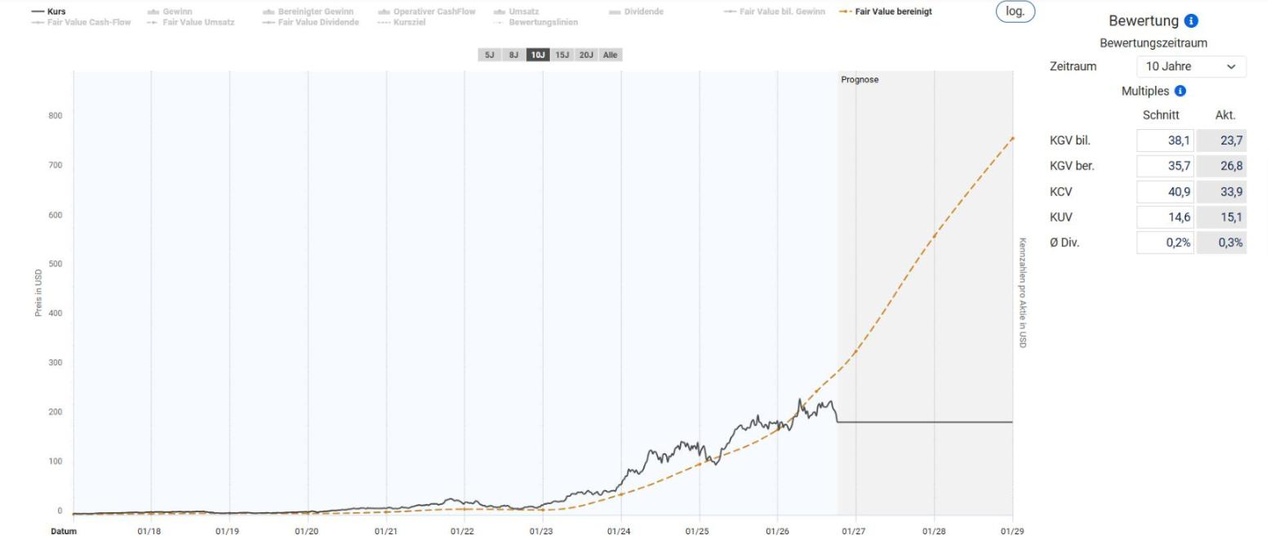
Fair Value Valuation of Nvidia Stock (NVDA) 2026 (as of Nov. 6, 2026) – Source: Aktienfinder / Christian Lill
Nvidia Stock Price Targets and Forecast for 2026
Analysts see an average price target of around $327 for Nvidia stock, representing about 80% upside potential; however, from a technical perspective, the sell-off below $191.72 has shaken the stock’s footing.
Almost all price targets date from before the midterms; some firms, such as Melius Research, have already lowered theirs. The next key decision on the stock’s direction will come with the Q3 earnings report on November 17, 2026.
Key price levels:
- 52-week high and all-time high: $243.37 (October 6, 2026)
- Current price: $181.60 (Nasdaq close on November 5, 2026, −9.26%)
- First resistance level: $191.72 (red zone, previous support level, breached on November 5, 2026)
- Reversal level: $200 (a quick retake of this level would be the first positive signal)
- Second resistance: $234.56 (red resistance zone just below the all-time high, target of the reversal scenario)
- First support: $167.72 (yellow zone, upper limit of the support range)
- Critical support level: $152.12 (yellow zone, lower boundary of the support range from $152 to $167.72)
Analyst price targets:
- Average price target: approx. $327 (consensus of 62 analysts, as of November 5, 2026)
- Bernstein Research: Outperform, $400 (September 21, 2026)
- RBC: Outperform, $330 (August 27, 2026)
- JPMorgan: Overweight, $320 (August 27, 2026)
- DZ Bank: Buy, fair value $320 (August 27, 2026)
- Melius Research: Buy, $315 (lowered from $420, early November 2026)
- UBS: Buy, $300 (October 9, 2026)
- Goldman Sachs: Buy, $300 (August 27, 2026)
- Jefferies: Buy, $300 (August 27, 2026)
Chart Analysis:
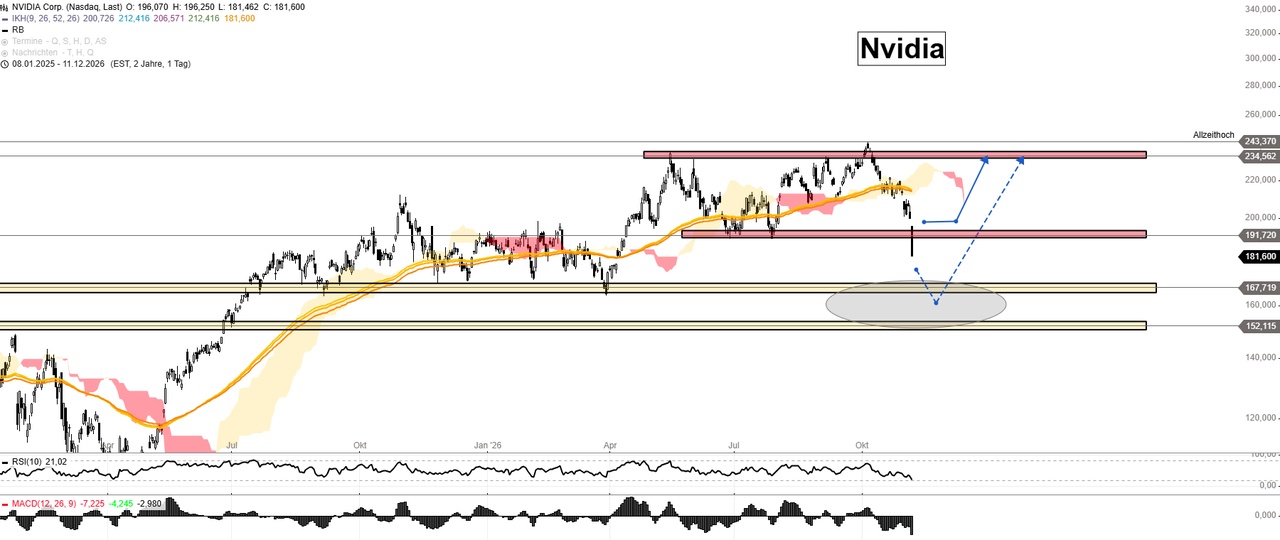
Nvidia Stock (NVDA) Chart Analysis and Price Targets for 2026 (as of November 6, 2026) – Source: Stock3 / Christian Lill
Nvidia on the daily chart: A massive sell-off below $191.72 is causing the stock to falter. On November 5, 2026, the AI sell-off following the U.S. midterms sent the stock tumbling 9.26% to $181.60, breaking directly through the red zone at $191.72, which had served as support on multiple occasions since early summer. This support level has thus turned into resistance. The price is also trading below the Ichimoku cloud, and the MACD is clearly negative.
At the same time, the stock is extremely oversold with an RSI(10) of 21.02—such an extreme condition can trigger a rapid rebound at any time. Therefore, I believe the most likely scenario is a quick reversal above $200, which could well be rewarded with further buying momentum up to $234. There, at $234.56, lies the red resistance zone just below the all-time high of $243.37. A possible catalyst for this move is the Q3 earnings report on November 17, 2026.
If there is no quick reversal above $200, the next key support zone is between $152 and $167.72. I expect buying interest to return here at the latest—and from there, a recovery back toward $234 would be possible again.
Conclusion: Nvidia Stock—Panic Ahead of Earnings or Opportunity After the AI Earthquake?
Following the plunge to $181.60, Nvidia stock is fundamentally as cheap as it has been in a long time—but in the short term, the direction will be determined by politics in Washington and the earnings report on November 17, 2026.
From an operational standpoint, there’s no reason to panic: Revenue has doubled, the data center business is growing at triple-digit rates, and management sees supply—not demand—as the bottleneck through fiscal year 2028.
Nevertheless, the risks are real. The gross margin has peaked, receivables are rising, Nvidia is helping to finance some of its customers, and a Democratic-controlled Congress could slow down the construction of new data centers. With a P/E ratio of around 23 based on the last twelve months and an average price target of around $327, the market is already pricing in a great deal of skepticism. From a technical analysis perspective, the sell-off below $191.72 has caused the stock to falter. However, with an RSI of 21, it is extremely oversold: If a quick reversal above $200 occurs, follow-on buying could push the price up to $234. If this rebound fails to materialize, the next key support zone lies between $152 and $167.72—I expect buying interest to return there at the latest.
Anyone who wants to see how brutally the market can punish a growth story when sentiment shifts—and how quickly it can turn around—should read my analysis on SpaceX Aktie : It shows in real time exactly what happens when fantasy meets reality.
✅ Opportunities
- Q2 revenue +106% to $96.2 billion, Data Center +117%
- Q3 Outlook: $108 billion; approximately 70% growth expected in FY 2028
- Gross margin 75%, net margin over 60%
- P/E ratio around 23; adjusted P/E ratio of 26.8 instead of the 10-year average of 35.7
- Average price target around $327; fair value according to Aktienfinder around $332
- RSI 21: extremely oversold; reversal above $200 with a target of $234 possible
⚠️ Risks
- Democratic-controlled Congress: potential regulation and construction freezes for data centers
- Gross margin to drop to 71–72% by Q4 due to expensive storage
- Receivables are rising; Q2 free cash flow only $21.4 billion
- Customer financing: nearly $50 billion invested in AI labs
- China is effectively no longer a market for AI chips
- Sell-off below $191.72; without a reversal, the $152 to $167.72 range looms
Sources
- Nvidia Investor Relations: Q2 FY 2027 Press Release (August 26, 2026)
- Nvidia Investor Relations: Q3 Earnings Release Scheduled for November 17, 2026 (October 28, 2026)
- SEC: Nvidia Form 10-Q (cash flow, accounts receivable, inventory)
- Nvidia Investor Relations: Dividend History
- Nasdaq closing price for Nvidia on November 5, 2026: $181.60 (−9.26%), previous day’s close $200.13, intraday high $196.25, intraday low $181.46; 52-week range: $164.27 (March 30, 2026) to $243.37 (October 6, 2026). Reconciliation of Financial Modeling Prep (quotes and intraday prices) and Alpha Vantage NVDA (intraday and weekly prices)
- Nvidia Q2 FY 2027 earnings call with Jensen Huang and Colette Kress (August 26, 2026), summaries from MarketBeat and transcript
- Reuters, CNBC, Yahoo Finance: Sell-off in chip stocks following the U.S. midterms (November 5, 2026)
- dpa-AFX: Analysis Flash from UBS (October 9, 2026), Bernstein (September 21, 2026), JPMorgan, RBC, Goldman Sachs, Jefferies, and DZ Bank (August 27, 2026)
- Melius Research: Price target of $315 (media reports, early November 2026); analyst consensus of approximately $327 based on 62 estimates (Yahoo Finance, November 5, 2026)
- Texas Public Radio / HPPR: Moratorium on new data centers in Texas (August 2026); Gina Hinojosa’s election campaign
- DatacenterDynamics: New segment structure for Data Center and Edge Computing (May 2026)
- Stock3: Nvidia daily chart (Nasdaq, USD), as of November 6, 2026
- Aktienfinder: Fair value calculation and valuation metrics for Nvidia, as of November 6, 2026
This is not investment advice—all information is provided solely for financial education purposes.
What are your current thoughts on $NVDA (+3,8%)?