
1G·

The Defense Industry—Crisis-Proof?

attachment

The aerospace and defense sector now accounts for about 8% of my investment capital. Although some companies in the industry are already in the $HMWO (-0,51%) , $TDIV (-0,04%) or the $VHYL (-0,4%) portfolio, they were nevertheless added as individual stocks due to their long-term trends and future prospects.

These are $LMT (+0,98%) , $NOC (+1,28%) , $AVEX and $AVAV (+1,51%)


The defense sector is booming for the first time since 1990 due to global conflicts and looming crises—order books are full, jobs are being created, and new plants are being built. Countries are arming themselves with drones, among other things, as well as other equipment and systems, ever since they’ve seen what these are now capable of. Defense capabilities against drones, cyberattacks, and hybrid warfare also play a massive role and require nations to arm themselves against these threats.
attachment

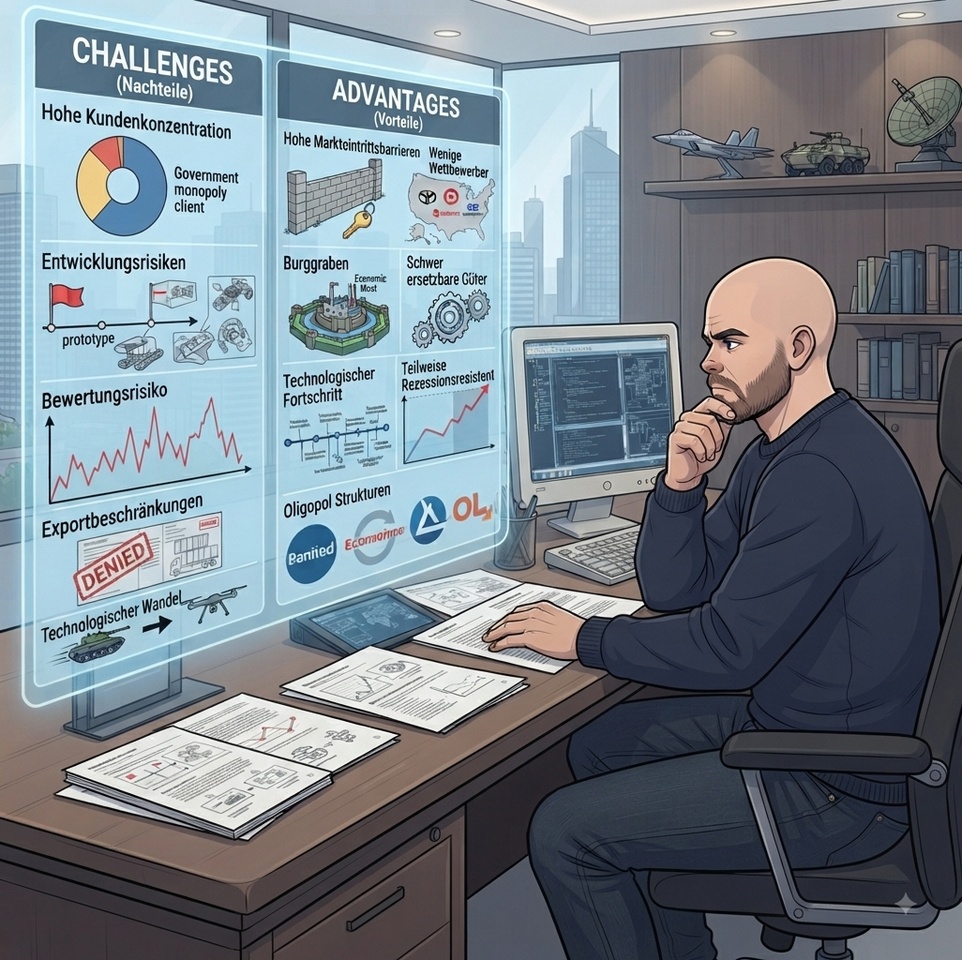
In addition to the current boom, however, this industry is also interesting for another reason: it is quite recession-proof due to its customer base. Furthermore, there are high barriers to market entry, few competitors, and the customers are almost exclusively governments—which also have maintenance and upgrade contracts in place for decades to come—and, last but not least, a certain level of trust among users in the systems’ performance.


Even though one might sometimes get the impression that NATO is falling apart, many systems and pieces of equipment are still compatible with one another—or are intended to become so in the future—which greatly expands the list of potential customers.

Disadvantages of the industry? A high concentration of customers, development risks, export restrictions, political interference—sometimes sensible, sometimes less so—and if a company falls behind technologically, it could very quickly lose ground.


While $LMT (+0,98%) and $NOC (+1,28%) have been established in the industry for years and are growing through scaling, diversification, and expertise, $AVEX and $AVAV (+1,51%) represent, in my view, the future of military development and thus represent a growth bet on nations’ drive to deploy autonomous systems in crisis zones.

attachment

My conclusion is this: Anyone who actively chooses to include defense industry stocks in their portfolio accepts an ethical dilemma, but benefits from tremendous predictability, structural tailwinds, as well as technological change and the associated government spending.


Final Thoughts:

If world peace were to break out tomorrow—then, by the way, I would be more than happy and more than willing to pay the price for it in the form of losses!


*contains AI-generated images*

6
2 Commenti

immagine del profilo
Another drawback of the industry is evident in the Ukrainian Armed Forces’ procurement process:

In a war fought at the highest technological level, the ability to procure equipment quickly and flexibly is crucial throughout. Huge defense contractors simply cannot offer that.

Ukrainian unit and formation commanders order equipment, UAVs, weapons, and accessories through a government website where many small businesses offer their products. This decentralized procurement process provides the armed forces with what they need: Immediately available equipment that can be tested, adapted, discarded, and replaced.

An army’s tactical level is not concerned with long-term contracts, maintenance schedules, or spare parts production lead times—all of which defense contractors try to sell to a government seeking to become a customer in order to earn predictable, long-term profits.

When we talk about major defense projects such as main battle tanks, cruise missiles, frigates, submarines, and fighter jets, the major defense contractors remain in a league of their own. However, it’s important to keep in mind that the following is also evident in Ukraine:

- A €35 million tank can easily be destroyed by a €1,500 drone

- The operational value of a fighter jet is drastically reduced in a war between two evenly matched parties due to a lack of air superiority

- Frigates and submarines can be trapped in ports, as setting sail is too dangerous due to underwater UAVs

- Cruise missiles costing millions are being replaced by inexpensive long-range UAVs, which enable better aerial reconnaissance and more selective target engagement

Defense contractors will not stop making money, especially since countries like Germany continue to rely heavily on conventional warfare, but there are also reasons why what defense contractors offer may not be attractive to an army.
7
immagine del profilo
@hendrik_lmr Thank you for your in-depth analysis and explanation, which is absolutely spot on.
I think that many combat missions will also undergo fundamental changes in the future.

We’re already seeing the first steps in this direction with the CCAs program for the F-35. Something similar is also conceivable for tanks. To my knowledge, this is called MUM-T and is also based on the loyal wingman principle.

And even though drones now pose the greatest threat to infantry, we will always need “boots on the ground” and will continue to seek solutions there to minimize the danger as much as possible.
1
Partecipa alla conversazione